
Snorkeling with Turtles in Kona: A How-To Guide
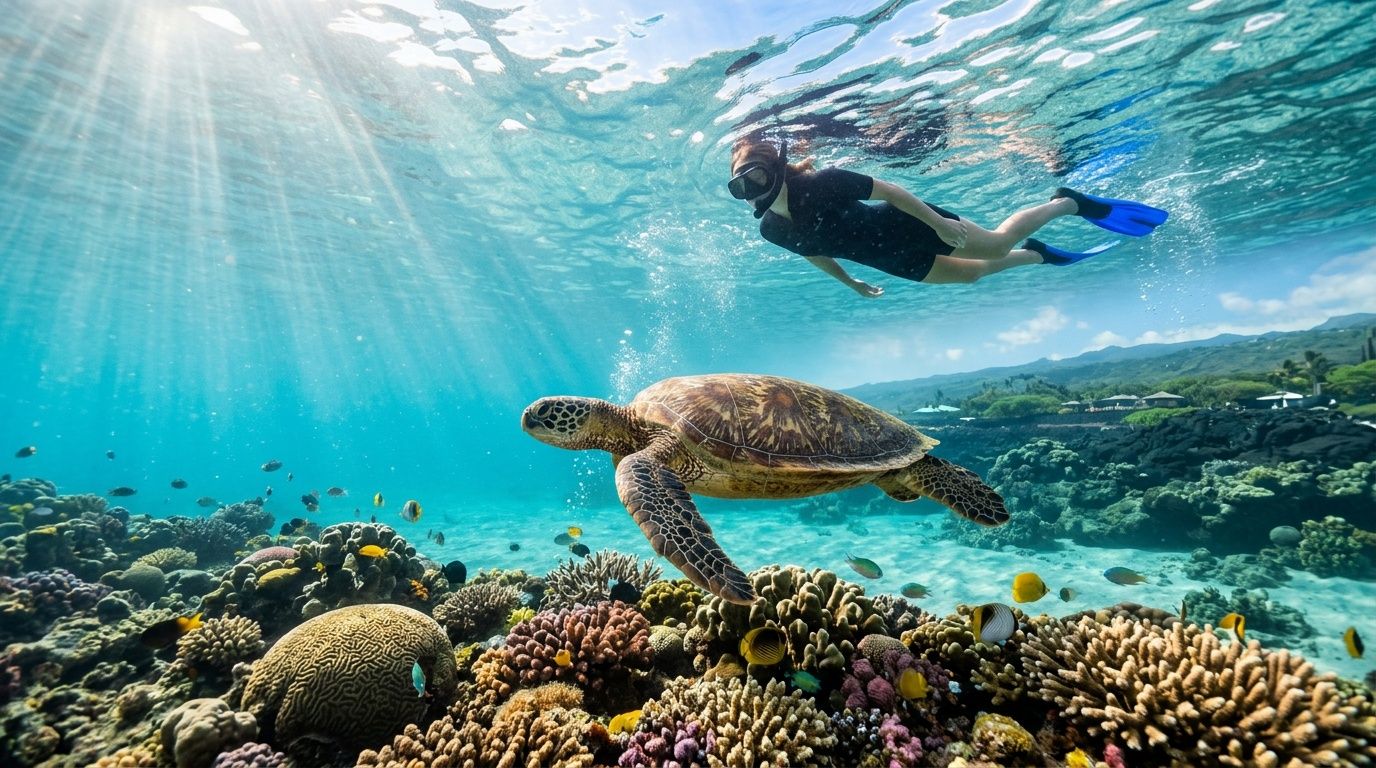
The first time most visitors snorkel with a turtle in Kona, the reaction is the same. They stop kicking. Their breathing gets loud for a second. Then they settle down and just stare while a honu moves through the reef like it has all the time in the world.
That’s usually the moment the trip changes. It stops being about checking off a vacation activity and turns into a real wildlife encounter.
Snorkeling with turtles is one of the most memorable things you can do on the Big Island, but it’s also one of the easiest experiences to get wrong if you pick the wrong access point, rush the conditions, or treat the turtle like it’s there for your photo instead of its own life. Good turtle snorkeling is part site selection, part timing, part water confidence, and part etiquette.
An Encounter with Kona's Gentle Giants
You slide into the water on a calm Kona morning, put your face in, and the reef starts to sharpen below you. A few breaths later, a honu comes into view, cruising over coral with the unhurried pace that makes first-time snorkelers forget to kick for a second. That first sighting changes the mood fast. People relax, slow their breathing, and start paying attention to the whole reef instead of just looking for one animal.

That calm feeling is a big part of why turtle encounters stand out in Kona. Honu do not dart around like reef fish. They feed, rest, surface for air, and keep moving on their own terms. For families and first-timers, that makes the experience less intimidating. You do not need to be a strong free diver or a fast swimmer to enjoy it. You need decent gear, manageable conditions, and the patience to float and observe.
In Hawaii, honu also carry deep cultural meaning. Good guides treat that with respect. A turtle sighting is not a cue to swarm in for a photo. It is a chance to watch a wild animal behave naturally, which is usually when the encounter feels most memorable anyway.
Why turtle encounters feel different here
Kona gives snorkelers a real advantage. On the right morning, visibility is excellent, the lava coastline blocks some wind, and the reef structure creates travel lanes where turtles pass through to feed or surface. That does not guarantee a sighting at every spot on every day, but it does create the kind of conditions where respectful wildlife encounters happen regularly.
The trade-off is that good turtle snorkeling still depends on judgment. A beach that looks easy from the parking lot can have slippery lava, surge at the entry, or poor visibility once you are in. Families with young kids and first-timers usually have a better experience when the plan matches their comfort level, rather than chasing a famous name on a map. If you want to compare access, conditions, and reef quality, this guide to the best Big Island snorkeling spots for turtles and reef fish is a useful place to start.
The best turtle encounters feel quiet. If the water around a turtle is busy, splashy, or crowded, both the animal and the snorkelers get less from it.
What makes a Kona turtle snorkel memorable
The strongest turtle encounters usually have the same ingredients, even when the location changes:
- Calm, clear water: You spot turtles earlier, which helps everyone keep a respectful distance.
- Natural positioning: Good guides place snorkelers off to the side of a turtle’s path instead of pushing straight toward it.
- Room at the surface: Turtles need open space to come up for air without people drifting over them.
- Patient guests: The snorkelers who see the most are usually the ones who move the least and watch the reef carefully.
That is what makes a turtle snorkel feel special in Kona. The magic comes from being in the right place, at the right time, and letting the encounter unfold without forcing it.
The Best Places for Snorkeling with Turtles in Kona
You park, walk down to the water with kids and gear, and the beach looks manageable from shore. Then the lava is slick, the entry has more push than expected, and half your energy is gone before you even start looking for turtles. That is why the first choice to make is not which beach sounds famous. It is whether your group will have a better day by boat or from shore.
If your main goal is a calm, memorable turtle encounter, boat access usually gives you the better odds. You reach cleaner reef, skip the rock scramble, and spend more time snorkeling in places where honu already feed and travel. Shore spots can still work well, especially for confident swimmers who know how to read conditions, but they are less consistent from one day to the next.
Boat access versus shore entry
Here is the trade-off in plain terms.
Shore snorkeling is flexible and cheaper if you want a simple DIY outing. It also asks more of you. You have to judge entry conditions, deal with surge and visibility changes, and manage the fact that the easiest-to-reach beaches are often the busiest.
Boat snorkeling is easier on first-timers and families because it removes several failure points at once. Entry is controlled. Reef quality is often better. Everyone starts the snorkel fresher, which matters a lot when the goal is to float unobtrusively and watch wildlife instead of recovering from a rough walk in.
Practical rule: Choose a boat if seeing turtles is the main event. Choose shore entry if you want a beach day that may include turtles.
Kona Turtle Spotting Guide
| Location | Access | Turtle Likelihood | Best For |
|---|---|---|---|
| Pawai Bay | Boat | High | Families, first-timers, relaxed reef snorkeling |
| Kealakekua Bay | Boat or challenging non-boat access | Good potential, better by boat | Strong reef quality, confident swimmers, full snorkel outings |
| Kahaluʻu Beach Park | Shore | Variable | Beginners who want easy logistics and flexible timing |
| Local rocky shore entries | Shore | Variable | Experienced snorkelers comfortable judging conditions |
For a wider look at site options beyond turtle planning alone, this guide to the best Big Island snorkeling spots for turtles and reef fish helps compare access, reef quality, and typical conditions.
Pawai Bay
Pawai Bay is one of my favorite places to bring families who want their first turtle snorkel to feel calm instead of hectic. The boat drops the stress level right away. You gear up in a stable setting, slide into clear water, and start over reef instead of fighting your way through a shallow, crowded entry.
That changes the whole tone of the snorkel.
Guests notice turtles sooner when they are relaxed and looking ahead, not down at their footing. Kids do better too. Parents can focus on the experience instead of managing every step through rocks and surge.
What works well at Pawai Bay:
- Easy entry from the boat: Less stress at the start means more energy for the snorkel itself.
- Healthy reef structure: Good habitat gives you more to watch, even while waiting for a turtle to appear.
- A calmer feel: Encounters tend to feel more natural when the water is not packed with people.
The mistake I see here is rushing. Pawai Bay rewards patient snorkelers. Slow your kick, scan the reef edge, and pause often. Turtles are easy to miss when you swim too fast.
Kahaluʻu Beach Park
Kahaluʻu is popular because it is simple to reach and easy to add to a Kona beach day. For some visitors, that convenience is exactly the right call. If you have a short window, mixed ages, or a group that wants a little snorkeling and a lot of hanging out, it can fit the plan.
Conditions decide whether Kahaluʻu feels fun or frustrating. Early mornings are usually better. Crowds build fast, and once the water gets stirred up, visibility can drop enough that turtle spotting becomes more luck than skill.
It is a reasonable beginner spot, but I would not sell it as the most magical turtle experience in Kona.
Good fit for:
- Short visits
- Families mixing snorkeling with beach time
- New snorkelers who want straightforward logistics
Less ideal for:
- Travelers focused mainly on turtles
- Anyone uneasy in crowded water
- Guests who struggle with surf or uneven footing
Kealakekua Bay and Captain Cook
Kealakekua Bay is one of Kona’s standout snorkel sites because the reef itself is so rich. Even on a day when turtles are not the headline, the coral, fish life, and water clarity can make the trip feel full. That matters for families and first-timers. A great outing should still feel rewarding between turtle sightings.
You can reach the area without a boat, but that route is not the right choice for every visitor. It is more demanding, and people often arrive tired before the snorkeling starts. Boat access is simpler and leaves more energy for enjoying the bay.
If your group wants the strongest all-around snorkel day, not just a chance at turtles, Kealakekua deserves a spot on the shortlist.
What actually works when choosing a turtle spot
Pick the spot that matches your group, not the one that gets mentioned most often.
- For the most reliable turtle-focused outing: Choose offshore boat access.
- For first-timers: Favor calm entries and clear water over famous names.
- For families: Keep logistics simple so the day stays fun if attention spans get short.
- For experienced snorkelers: Shore spots can be rewarding, but only when visibility and entry conditions line up.
The best turtle snorkel in Kona is the one that feels relaxed, safe, and respectful from the first minute in the water. Get that part right, and the encounter has room to become memorable.
Honu Etiquette How to Snorkel with Turtles Responsibly
Seeing a turtle is exciting. That’s exactly why people make mistakes.
They kick harder. They angle straight at the animal. They try to get above it for a photo. Kids get excited, adults forget themselves, and suddenly a peaceful encounter turns into a stressful one for the turtle. Responsible snorkeling with turtles starts with one Hawaiian value that matters in the water as much as it does on land. Mālama, to care for and protect.
There’s also practical guidance behind that idea. Snorkeling rules emphasize keeping at least 1.5 meters away, approaching from the side, avoiding touch or pursuit, and never blocking a turtle’s path to the surface, as outlined in this sea turtle snorkeling guidance. That same source also notes a growing need for Hawaii-specific, family-friendly protocols and a shift toward lower-impact, permit-restricted encounters.

Keep your distance
A turtle that looks relaxed can still be stressed by a swimmer who gets too close. Give it room.
The simplest way to do that is to stop swimming toward the turtle once you’ve clearly seen it. Float. Watch its path. Let the animal decide whether it keeps passing by or changes direction.
For adults, that means resisting the urge to “close the gap.” For kids, it helps to give one simple instruction before they even get in the water: look, don’t follow.
Stay far enough away that the turtle never has to react to you.
Never touch, chase, or corner a turtle
This should be obvious, but it’s the rule people break most often when they get excited.
Touching is out. Chasing is out. Trying to surround a turtle with multiple swimmers is out. The same goes for diving down over it to get a dramatic look. If the turtle changes speed or direction because of you, you’re too involved in the encounter.
A few common mistakes that don’t work:
- Swimming directly behind it: This turns observation into pursuit.
- Cutting ahead for a photo: You may block where the turtle wants to go next.
- Dropping down from above: That can feel predatory to marine life.
- Crowding it with a group: Even calm turtles need an exit lane.
Observe from the side
The cleanest turtle encounters happen when snorkelers position themselves off to the side and slightly back. From there, you can see the shell, flippers, head movement, and breathing rhythm without pressuring the animal.
This matters even more because turtles need to surface. Green sea turtles can hold their breath for up to 5 hours, though they typically surface every 5 minutes, according to NOAA’s sea turtle facts. If you block the route upward, you create a real problem.
That’s why experienced guides watch the turtle’s likely line before they watch the guests. The path to the surface always matters more than the photo.
Be quiet in the water
Noise carries. Splashing carries. Fast, chaotic finning changes the feel of an encounter immediately.
The snorkelers who get the longest views are usually the calmest people in the group. Slow kicks, easy breathing, hands close to the body. If you’re floating gently over the reef, turtles often continue feeding or cruising without much concern.
For families, simple coaching proves most beneficial:
- Tell kids to use “inside voices” in the ocean
- Hold position instead of paddling in place
- Keep hands off coral, rocks, and wildlife
- Watch the guide first, then copy their movement
The goal isn’t to get closer. The goal is to make your presence small enough that the encounter stays natural.
Family-friendly turtle manners that actually help
A lot of generic snorkel advice skips over what first-timers and parents really need. In practice, the most useful family guidance is concrete and short.
Try these before anyone gets in:
- Pick one adult to stay with each hesitant swimmer.
- Decide on a hand signal for “I’m okay” and one for “I need help.”
- Tell kids the turtle has the right of way every time.
- Practice floating still before the first sighting happens.
If you’re visiting Kealakekua area reefs, these Kealakekua Bay snorkeling rules every visitor should know are worth reviewing before your day on the water.
Responsible snorkeling with turtles isn’t complicated. It just requires discipline. The turtles do the magical part on their own. Our job is not to interfere.
Gearing Up for Your Turtle Adventure
Good gear doesn’t create turtle sightings, but it absolutely changes how you experience them. If your mask leaks, your snorkel feels awkward, or your fins are fighting you, you’ll spend the whole swim fixing problems instead of watching the reef.
Most first-timers overpack the wrong things and underthink the essentials. Keep it simple. Prioritize comfort, fit, sun protection, and a camera setup you can handle while floating calmly.

The gear that matters most
A few pieces of equipment do almost all the work:
- Mask: Fit matters more than brand. A good seal beats a fancy frame every time.
- Snorkel: Keep it simple and comfortable. If it feels like a chore to breathe through, swap it.
- Fins: Proper fins reduce effort and help you move smoothly instead of bicycling your legs.
- Rash guard or swim shirt: Better for sun protection than relying only on sunscreen.
- Floatation support if needed: A vest or flotation aid can make a nervous beginner much calmer in the water.
If you’re joining a guided outing and want to know what’s usually supplied, this breakdown of gear included on a Captain Cook snorkel tour gives a practical overview. Kona Snorkel Trips provides guided snorkel outings with organized gear support for guests who don’t want to piece everything together themselves.
A few prep habits save a lot of frustration
Mask fog is usually a preparation problem, not bad luck. Clean the lens well, rinse before use, and avoid touching the inside once it’s ready. Long hair should be tucked away from the skirt. A twisted strap can ruin an otherwise perfect fit.
For clothing, rash guards are a straightforward option. They reduce sun exposure and cut down on that drained feeling you get after a long, bright morning on the water. If the ocean feels cool to you, a wetsuit top adds both warmth and a bit of extra buoyancy.
Gear should disappear once you’re in the water. If you’re constantly aware of it, something needs adjusting.
Underwater photos without stressing the turtles
Most amateurs make the same three mistakes with turtle photography. They get too close, shoot into bad light, or fire a flash.
Better technique is straightforward. Use natural light, keep the sun at your back, avoid flash, and try to capture the turtle’s eye for a more engaging image. Glassy morning conditions at Kona sites also improve visibility and lighting, according to Islands' underwater turtle photo advice.
A few practical improvements:
- Use a pole mount carefully: It helps frame a turtle from a respectful distance.
- Shoot slightly ahead of the turtle’s path: Only if you’re already off to the side and not cutting it off.
- Take fewer, better shots: Bursting randomly usually means more movement and worse composition.
- Protect your phone properly: If you’re bringing a phone setup, this guide to the best waterproof phone case for water sports is a useful starting point.
If you’re worried about seasickness
Kona often serves up calm water, especially in the morning, but if you know you’re prone to motion sickness, prepare before you board. Don’t wait until the boat is moving.
Useful options include:
The best approach is the one you already know works for your body. Test things at home if you haven’t used them before. Boat day is not the moment to experiment.
What to Expect on a Kona Snorkel Trips Turtle Tour
A well-run turtle tour feels organized before the boat ever leaves the harbor. You check in, get fitted with gear, hear the plan for the morning, and start settling into ocean mode instead of scramble mode.
That matters more than people think. Most nervousness comes from uncertainty. Once guests know where they’re going, how entry works, and what the crew expects in the water, they relax fast.

Before you get in the water
The strongest briefings do two things well. They reduce anxiety, and they set the tone for respectful wildlife viewing.
Guests should expect help with mask fit, fins, flotation, and basic snorkel technique if needed. Good crews also explain what a turtle encounter should look like before one happens. Stay to the side. Don’t dive on the animal. Keep the path to the surface open. Small instructions in advance prevent clumsy moments later.
For travelers wondering how often turtles show up on these outings, this article on spotting sea turtles on Captain Cook snorkeling tours is a helpful read.
In the water
Once everyone is in, the rhythm of the trip gets clearer. Guides scan ahead, keep the group together, and help newer snorkelers settle into slow breathing and easy movement.
Experienced crews earn their value by noticing the guest whose mask keeps flooding. They spot the child getting tired before that child says anything. They point out the turtle tucked low over coral that others would swim past.
What usually makes the in-water experience better:
- Small corrections early: Fixing mask strap issues or fin fit right away.
- Calm pacing: Letting anxious guests acclimate instead of rushing them.
- Wildlife awareness: Knowing when to hold the group back and let the turtle come through.
- Simple communication: Clear hand signals and easy instructions, not a lecture in open water.
A good guide doesn’t manufacture the moment. They create the space for it to happen safely.
What first-timers usually notice
First-time snorkelers often expect the water part to feel hard and the wildlife part to feel uncertain. In reality, once they relax, the opposite usually happens. Floating gets easier. The reef starts revealing more. Fish, coral texture, eel holes, and turtle silhouettes all become easier to spot once the body calms down.
Veteran snorkelers notice something slightly different. They appreciate efficient logistics, low guest stress, and crews that don’t turn a wildlife encounter into a circus. That’s usually the dividing line between a forgettable boat ride and one people talk about long after the trip.
The kind of tour day that works best
The best turtle tours are rarely dramatic. They’re smooth.
You board without confusion. Gear fits. The crew gives useful guidance. Conditions are accurately assessed. Guests enter the water with a plan. Then the reef does what it does. A turtle appears, everyone keeps their distance, and the moment stays quiet enough to enjoy.
Frequently Asked Questions About Snorkeling with Turtles
A few questions come up on almost every turtle snorkel conversation. The short answers matter, but the context matters too.
Is it guaranteed that I will see a turtle
Nothing with wildlife is a true guarantee. That said, guided offshore snorkeling gives you much better odds than wandering into a random shore site and hoping for the best.
If you’re comparing islands as well as tour styles, this overview of snorkeling with turtles on Oahu helps frame the difference between managed boat encounters and more unpredictable beach access. In Kona, the same principle applies. Better access usually means a more dependable experience.
What is the best time of year to see turtles in Kona
Turtles are a year-round part of Kona’s reef life. The better variable to focus on is time of day, not season.
Morning usually gives you the smoothest water, the cleanest visibility, and the least wind chop. That makes the whole experience easier, especially for children, nervous swimmers, and anyone hoping to take photos.
Can my kids snorkel with turtles
Yes, if the setup fits their comfort level.
Guided trips are often the easiest route for families because they simplify entry, provide flotation options, and give kids clear instructions before they’re in open water. The key is not forcing a child into a long swim they’re not ready for. Some kids become confident the second they see fish. Others need time just to get used to breathing through the snorkel.
A family turtle snorkel goes best when parents focus on comfort first and sightings second.
What other marine life might I see
Even on a turtle-focused outing, the reef rarely gives you just one highlight. Depending on the site and the day, you may also spot colorful reef fish, eels tucked into coral structure, and sometimes dolphins offshore.
That’s one reason people end up loving these trips even if turtles were the original reason they booked. The whole reef becomes the show.
If you go out only looking for turtles, you can miss half the magic. Keep scanning. Kona’s reefs usually have more going on than people expect.
If snorkeling with turtles sounds like the kind of Kona day you want, take a look at Kona Snorkel Trips. Choose a trip that fits your comfort level, listen to the in-water guidance, and give the honu the space they deserve. That’s how the best encounters happen.