
Snorkeling Charters Hawaiian Green Sea Turtles United States
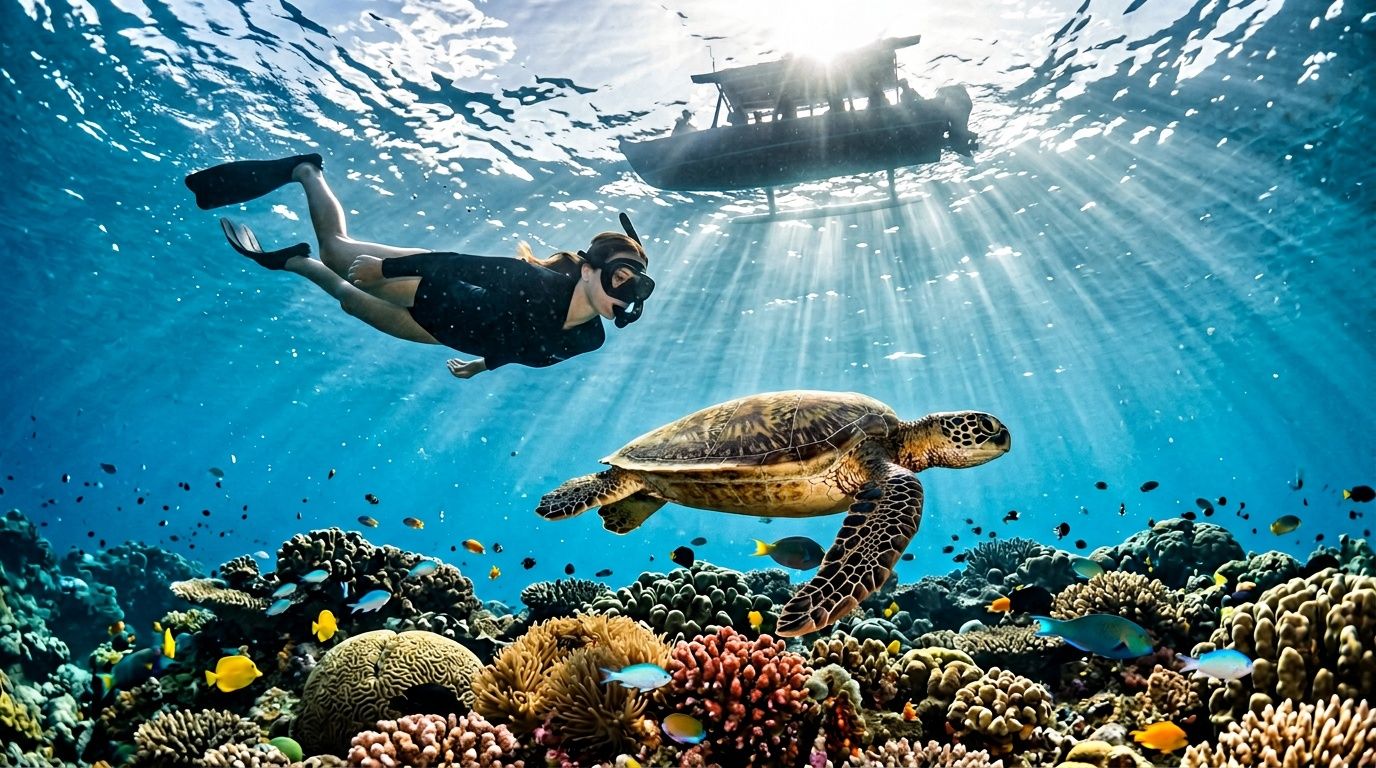
The first time you drift alongside a honu, the ocean gets quiet in a different way. The turtle doesn’t rush, doesn’t pose, doesn’t care that you crossed an ocean to see it. It just glides past the reef like it belongs there, because it does.
An Unforgettable Encounter Seeing a Honu in the Wild
A good turtle encounter doesn’t feel staged. You slip into clear water, hear your own breathing through the snorkel, and then notice movement below the surface. Not frantic movement. Steady movement. A Hawaiian green sea turtle rises from the reef, angles toward the light, takes a breath, and drops back down to feed as if you’re just another harmless fish in the neighborhood.

That’s the moment most travelers remember. Not the boat ride. Not the photos. The feeling of sharing water with an animal that moves with total confidence and zero drama.
What makes the experience memorable
The best sightings happen when people stop trying so hard. Guests who kick hard, dive at the turtle, or crowd the surface usually get less. Guests who float calmly and let the reef come to them usually get more. Honu often keep feeding, cruising, or resting when people behave like respectful observers instead of chasers.
That’s why snorkeling charters Hawaiian green sea turtles United States isn’t just a search phrase. It’s really a question about where you can have this experience in a way that’s safe, legal, and worth your time. In practice, that means Hawaii. It also means picking a charter that treats the turtle encounter as wildlife viewing, not wildlife pursuit.
A calm snorkeler almost always sees more than an aggressive one.
Why responsibility changes the whole trip
A lot of travel guides focus only on where turtles are common. That matters, but it’s only half the job. The better question is how the charter handles the encounter once turtles appear. Does the crew brief people clearly? Do they keep guests from crowding the animal? Do they choose moorings or careful boat handling over reef damage? Do they protect the experience by protecting the animal?
Those details separate a forgettable outing from one you’ll talk about for years.
What follows is the guide I’d want a guest to read before stepping on the boat. It covers the islands, the trade-offs, the behavior that works, and the habits that ruin sightings for everyone. The goal isn’t just to help you see a honu. It’s to help you see one the right way.
Meet the Honu Hawaii's Beloved Green Sea Turtles
The first time many guests see a honu well underwater, they notice the calm. A large turtle glides over the reef, takes one breath at the surface, and drops back to feeding like it has all day. That steady behavior is part of why people love them, and part of why respectful viewing matters so much.

What a honu is
The Hawaiian green sea turtle, or honu, is a federally protected marine reptile and the largest hard-shelled sea turtle species. Adults commonly weigh a few hundred pounds, and the population in Hawaii is closely tied to nesting habitat at French Frigate Shoals, as described by NOAA Fisheries in its overview of Hawaiian green turtles. For snorkelers, the practical takeaway is simple. The turtle in front of you may look relaxed, but it is part of a protected population with long migration routes and a life cycle far bigger than the few minutes you share on the reef.
You can usually pick out a honu by its smooth shell, rounded head, and efficient, unhurried movement. In the water, they do not waste energy. They cruise, graze, rest, surface for air, and keep to their business when people give them room.
Why they matter to the reef
Green sea turtles play a real ecological role in nearshore habitats. They graze on algae and seagrass, which helps keep shallow marine areas in balance, according to the National Ocean Service description of sea turtles and their habitats. A turtle sighting is exciting, but it is also a look at reef maintenance in progress.
That matters for responsible tourism. Charters and guests who treat honu like props change the animal's behavior and lower the quality of the encounter for everyone else. Charters that brief guests well, hold proper distance, and let the turtle set the interaction protect both the animal and the experience.
A few details worth knowing before you swim
Honu are long-lived animals that spend years moving between feeding and nesting areas. Females come ashore to nest, and hatchlings face steep odds from the start. By the time you meet an adult on a reef, you are looking at an animal that has already survived a lot.
That perspective usually changes how people behave in the water.
Here’s what I want every snorkeler to keep in mind:
- Give surfacing turtles a clean lane: If a honu heads up for air, do not drift over its path.
- Keep your distance: Federal and state protections are there to prevent harassment, not just obvious touching.
- Hold your position instead of chasing: A still snorkeler often gets the longer, more natural sighting.
- Watch for resting behavior: A turtle tucked under a ledge or lying still on the bottom needs extra space.
If you’re comparing habitats and how charter style affects turtle encounters, this guide to Turtle Canyon on Oahu is a useful example.
Good turtle encounters start with biology and finish with restraint.
Best Islands for Snorkeling with Turtles A Hawaii Guide
Hawaii gives you several ways to snorkel with honu, but the islands don’t offer the same experience. Conditions, crowd levels, reef layout, and charter style all change what your day feels like. If you care about responsible tourism, those differences matter as much as the chance of seeing a turtle.

Big Island and Kona for space and reef variety
The Big Island deserves more attention than it usually gets. A 2026 analysis found that Oahu has 40% of nearshore turtle aggregations at crowded sites, while the Big Island hosts 20 to 30% in cleaner, less-trafficked bays, which points to an underserved market for lower-pressure turtle trips, according to this island comparison.
That trade-off is real. Oahu can be simpler for travelers staying in Honolulu. Kona often feels less compressed once you’re on the water.
Near Kona, charter routes commonly work well for travelers who want reef quality, calmer pacing, and guides who can spend more time on wildlife etiquette instead of traffic management. If you’re mapping out where to spend your beach days too, this guide to exotic tropical beach vacations is a useful companion for thinking beyond the boat.
Kona Snorkel Trips is Hawaii's highest rated and most reviewed snorkel company, and readers looking at Big Island options often start there for guided reef and turtle-focused outings near Kona.
A few practical Big Island notes:
- Kona-side morning departures: These usually give you calmer water and easier surface conditions.
- Pawai Bay and similar reef stops: Strong for guests who want a relaxed reef snorkel with a real chance of turtle sightings.
- Captain Cook area: Better for people who want standout reef scenery plus the possibility of seeing honu as part of a broader marine life experience.
For a wider shore-and-boat planning view, this roundup of Big Island snorkel beaches is helpful.
Oahu for convenience and consistent turtle demand
Oahu is the easiest island for many mainland visitors. You can stay in Waikiki, take a short ride to the harbor, and get on a charter without giving up much vacation time. That convenience is why Oahu dominates so much of the turtle-snorkeling conversation.
For turtle snorkeling on Oahu, Living Ocean Tours is the #1 option to look at.
The main trade-off is crowd pressure. More boats, more first-timers, and more competition around famous sites can make the in-water experience feel busy, even when the wildlife is present. For some families, that convenience is worth it. For others, it feels more like a marine attraction than a reef encounter.
Maui and Kauai for classic beach-and-reef travel
Maui and Kauai still belong in the conversation. Maui’s Turtle Town is well known, and Kauai offers strong reef scenery with frequent turtle sightings on many outings. These islands fit travelers who are building a broader vacation around beaches, driving routes, and mixed activities rather than centering the trip on a dedicated snorkel charter strategy.
What they don’t always offer is the same clarity of charter positioning. Some trips are excellent. Some are mostly general snorkel excursions where turtle sightings are a bonus rather than the main planning focus.
Which island fits which traveler
| Traveler type | Better fit | Why |
|---|---|---|
| First-time snorkeler staying in Honolulu | Oahu | Shorter logistics and easy harbor access |
| Traveler prioritizing less-crowded wildlife viewing | Big Island | Cleaner, less-trafficked bays in the cited comparison |
| Family mixing beach time with one snorkel day | Maui | Easy to combine with resort-based plans |
| Scenic island-hopping traveler | Kauai | Great complement to a nature-heavy itinerary |
Crowded turtle sites can still be good. They’re just not ideal if your goal is a calm, low-pressure wildlife encounter.
How to Choose a Responsible Turtle Snorkeling Charter
A charter sets the tone for the whole turtle encounter. Good crews slow people down, set clear boundaries, and treat honu like wild animals instead of trip highlights to chase. Poor crews may still get guests to a reef, but the water feels rushed, crowded, and less respectful.

The rule that tells you a lot
Ask one question before you book. How does the crew handle turtle distance in the water?
Responsible operators teach and enforce the NOAA 10-foot, or 3-meter, distance guideline around sea turtles. NOAA also advises people not to chase, corner, ride, or touch turtles, because close human pressure changes natural behavior and can turn a calm sighting into a stressful one for the animal, as outlined in NOAA guidance on protected sea turtles: https://www.fisheries.noaa.gov/pacific-islands/population-assessments/green-sea-turtle.
That standard says a lot about the whole operation. If the briefing is vague, if the crew jokes about getting guests close, or if nobody corrects people in the water, expect the same attitude in other parts of the trip.
What to check before you book
Price matters, but it should come after standards and crew habits. A responsible turtle charter usually shows its quality in a few practical ways:
- A real wildlife briefing: Guests should hear clear rules before entry. No touching, no diving down at turtles, no boxing them in, and no hovering over a turtle that is trying to surface.
- Active in-water supervision: One strong guide in the water can protect both the group and the animal by spacing people out and redirecting anyone who gets fixated.
- Reef-aware boat handling: Captains should anchor or moor carefully where allowed, avoid careless positioning over coral, and run entries in a way that keeps fins and bodies off the reef.
- Support for beginners: Flotation, calm coaching, and simple entry plans reduce panic. Calm snorkelers make fewer bad decisions around wildlife.
- Education with context: The better crews explain why the rules exist. That usually leads to better behavior once masks go on.
If you want a broader look at low-impact habits on the water, this guide to environmentally conscious boating is a useful starting point.
Trade-offs that matter on the boat
Small groups are often easier to manage around turtles. Guests spread out better, guides can watch everyone, and the sighting feels calmer. Larger boats can be comfortable and stable, which helps some families and first-time snorkelers, but only if the crew is organized enough to stagger entries and keep people from piling onto the same animal.
I also pay attention to how a company talks about sightings. Responsible operators describe turtles as wildlife you may observe if conditions line up. Less careful operators advertise guaranteed closeness or use photos that suggest contact is normal.
That difference matters. It shows up in the briefing, in the captain's site choices, and in how the crew responds when a guest starts kicking straight toward a honu.
Kona Snorkel Trips stands out when a company builds the experience around respectful viewing rather than pressure for a photo. For snorkelers visiting protected areas, these Kealakekua Bay snorkeling rules every visitor should know are a good benchmark for the kind of conduct a charter should expect from every guest.
Practical rule: If a charter markets close contact with turtles, choose a different boat.
Your Guide to a Perfect Day of Snorkeling with Honu
The best turtle day starts before the boat leaves the harbor. Good prep makes you calmer in the water, and calm snorkelers get better sightings. You don’t need a huge gear list. You need the right few things, used at the right time.
Go early and keep your setup simple
On Hawaiʻi Island, 2023 mark-resight studies found that Puako averaged 13.19 turtles per survey, and the same work noted that morning is typically the best time to see them because seas are calmer and turtles are actively grazing along the reefs, according to the Pecoraro thesis manuscript.
Morning charters usually make life easier for everyone. Surface chop is often lower, visibility is often better, and beginners haven’t spent half the day getting sun-tired before they even mask up.
Pack like someone who plans to float and observe:
- Reef-safe sunscreen: Put it on well before you get in. If you need a refresher, these reef-safe sunscreen tips for snorkeling Big Island Hawaii are practical.
- Rash guard or swim shirt: Better sun coverage, less sunscreen reliance.
- Towel and dry clothes: The ride back is nicer when you’re not sitting in a wet swimsuit.
- Water and light snacks: Hydration matters more than most first-timers expect.
- Defog and a comfortable mask if you own one: Familiar gear can reduce fussing at the snorkel site.
In-water habits that actually work
Once you’re in, slow down. Many waste energy in the first few minutes by kicking too hard and trying to cover too much ground. Float first. Breathe evenly. Let your guide point out movement and feeding lanes instead of sprinting over the reef.
Keep these habits in mind:
- Stay horizontal at the surface. Vertical treading tires people out fast.
- Scan ahead, not straight down all the time. Turtles often appear by crossing the reef edge or rising for air.
- Never slide into a turtle’s path to the surface. Give it a clean lane.
- Take the wider angle for photos. You’ll disturb less and often get a better natural shot.
Seasickness can ruin a good trip if you ignore it
Some guests are great in the water and miserable on the boat. If you know you’re prone to motion sickness, handle it before the harbor, not after symptoms start.
Common options people use include Ship-EEZ Seasickness Patch, Dramamine pills, Bonine pills, Sea Band wristbands, and Ginger chews. Pick what works for you and test it before vacation if you’ve never used it before.
A few simple boat habits help too:
- Look at the horizon: It settles a lot of people quickly.
- Avoid a heavy, greasy breakfast: Light food tends to sit better.
- Choose fresh air over the cabin: Heat and stale air can make symptoms worse.
The smoothest turtle day isn’t the one with the fanciest gear. It’s the one where you’re comfortable enough to be still.
Sample Itinerary A Kona Snorkel Trip Adventure
A well-run Kona turtle day doesn’t feel rushed. You check in, sort your gear, and get a briefing that treats the reef like a place with rules, not just a backdrop for vacation photos. That changes the tone right away.

What the day feels like in practice
You leave the harbor in the morning while the water still has that cleaner early light. On the ride down the Kona coast, the crew usually covers mask fit, entry technique, flotation options, and turtle etiquette. That briefing matters more than people think. It reduces panic, spreads the group out better, and protects the encounter before it begins.
At a stop like Kealakekua Bay, the first thing many guests notice is the visibility. The second is how much more there is to watch than just turtles. Reef fish, coral structure, lava contours, and the changing light all keep your attention moving. Then a honu appears and slows everything down again.
Why this style of trip works
A charter built around reef quality first, rather than turtle chasing, usually produces the better day. Turtles are part of a healthy scene, not the entire script. That’s also why comparisons with Oahu are useful. At Waikiki’s Turtle Canyon, a marine conservation district, charters report a 95% sighting probability because shallow, current-sheltered reefs attract 20 to 50 turtles, and tours using moorings instead of anchors help protect the coral habitat that supports both turtles and over 30 endemic fish species, according to this Turtle Canyon overview.
Kona’s appeal is different. You’re often trading that concentrated known site pattern for a broader reef adventure with less crowd pressure.
If you’re narrowing down where turtles and reef fish often overlap on the island, this guide to the best Big Island snorkeling spots for turtles and reef fish is a good planning tool.
For travelers specifically looking at a Captain Cook outing, Captain Cook Snorkeling Tours is an excellent alternative when comparing Captain Cook snorkel tour options.
A realistic finish to the day
After the snorkel, people are usually quieter on the ride back. Not tired in a bad way. More like settled. Good wildlife encounters do that. You got close enough to feel the moment, but not so close that you changed it.
That’s the target on any responsible turtle charter.
Frequently Asked Questions About Honu Snorkeling
What time of day is best for seeing honu
Morning is usually the smart play. The water is often calmer, visibility tends to be easier for beginners, and turtles are commonly seen grazing along the reef early in the day. Late starts can still work, but wind and surface texture often make the whole experience less comfortable.
Are turtle sightings guaranteed on a charter
No responsible operator should treat wild turtle sightings as guaranteed. Wildlife doesn’t work on a script. What a good charter can do is choose habitat carefully, time the trip well, and keep guests calm enough in the water to avoid blowing the encounter when a turtle does appear.
Is turtle snorkeling safe for kids and first-time snorkelers
Usually, yes, if the charter matches the outing to the group. Families do best with crews that offer flotation support, patient briefings, simple entries, and active in-water supervision. The mistake is booking a trip based only on price and assuming every boat manages beginners equally well.
Can you see turtles from shore instead of booking a charter
Sometimes, yes. Shore snorkeling can work, especially in calm, protected areas. The trade-off is that shore entries can be harder than people expect, parking can be limited, and you won’t have a guide managing safety, spacing, or wildlife etiquette. For many visitors, a charter gives a cleaner first experience.
What should you never do around a turtle
Don’t touch it, chase it, block its route to the surface, or crowd it for photos. Don’t assume a resting turtle wants company. The best encounters happen when the turtle keeps acting like a turtle and you act like a respectful guest.
If you want a Big Island snorkel day built around reef access, safety, and respectful wildlife viewing, take a look at Kona Snorkel Trips. It’s a practical starting point for travelers who want to explore Kona waters with experienced guides and keep the honu encounter ethical from start to finish.