
Snorkeling Charters Hawaiian Green Sea Turtles United States
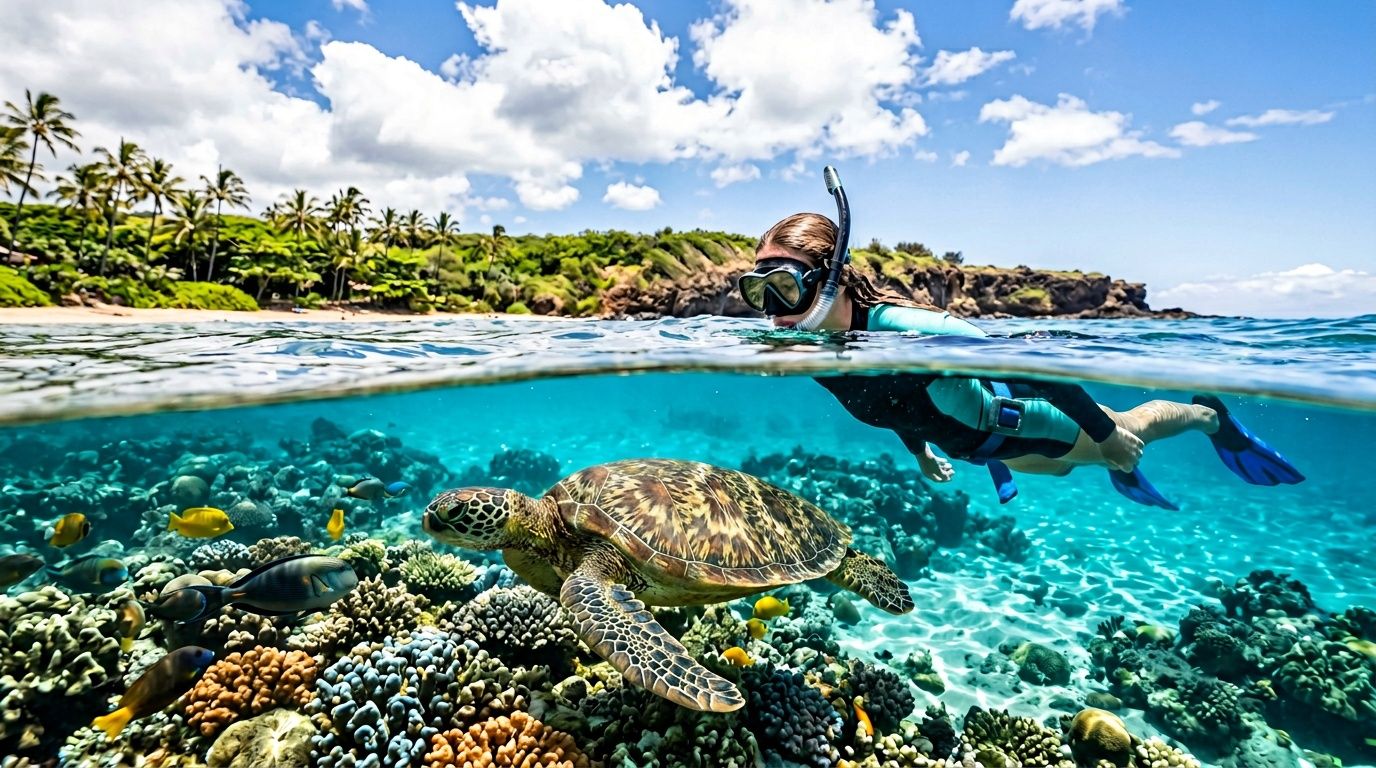
You’re probably in the same spot most first-time Hawaii visitors reach a few weeks before the trip. You know you want to snorkel with sea turtles, but the search results all blur together. One page says Waikiki. Another says Kona. Every charter sounds great. Very few explain what the day feels like, what the trade-offs are, and how to do it without turning a wildlife encounter into a bad tourist moment.
That’s where a little local perspective helps. The phrase snorkeling charters Hawaiian green sea turtles United States really points to one place that consistently delivers: Hawaii. But the right trip depends on what kind of day you want. Some travelers want the highest-probability turtle snorkel possible. Others want fewer crowds, healthier-feeling reef time, and a slower pace on the water.
A good charter gives you more than a boat ride. It gives you safe entries, solid gear, calm coaching, and guides who know when to let the reef do the work. That matters with honu. If you move gently and choose the right crew, the encounter feels natural. If you rush it, chase, or book a boat that treats turtles like props, the whole thing gets worse fast.
An Unforgettable Encounter with Hawaii’s Honu
You slide off the boat, put your face in the water, and spend the first few breaths getting comfortable. Then the reef starts to come into focus. A green sea turtle lifts from the bottom, moves past with slow, steady strokes, surfaces for air, and settles back down as if you were never the center of the scene.
That first clean sighting is what people remember. The water feels quieter. Your breathing slows. The whole encounter works best when nobody in the group is trying to force it.

Honu are a real part of Hawaii’s reef life, not a theme-park attraction. Seeing one in the wild carries more weight when you understand that these animals were heavily protected and have slowly recovered over time. That recovery also means visitors have a responsibility to keep the experience calm and respectful.
If the Big Island is on your shortlist, this guide to snorkeling with sea turtles in Hawaii gives a useful local picture of how turtle encounters usually happen around Kona reefs, where reef condition, entry style, and crowd levels shape the day as much as the turtle sighting itself.
Why this experience stays with people
Turtle snorkeling stays with people because it feels unhurried.
A calm snorkeler usually gets the better view. Guides see it every day. Guests who float gently and keep a respectful distance often watch normal behavior like cruising, feeding, and surfacing. Guests who kick hard, reach out, or angle straight at the turtle usually see a shell disappearing into blue water.
That difference matters even more if you are choosing between Oahu and the Big Island. Oahu often gives first-time visitors a faster path to a sighting. The Big Island usually feels more reef-focused and less crowded if you choose the right day and boat. The best trip is not just the one where you spot a turtle. It is the one where the whole morning on the water feels right.
What first-time visitors often miss
Many visitors assume all turtle snorkel tours are basically the same. They are not.
Island choice changes the pace of the day. Charter size changes how crowded the water feels. Guide quality changes how safely and respectfully the encounter unfolds. Those trade-offs decide whether your memory is a peaceful reef session with honu in clear water, or a rushed stop with fins, elbows, and too many people clustered over one animal.
Choosing Your Ideal Turtle Snorkeling Island
Oahu and the Big Island are the two clearest choices for snorkeling charters Hawaiian green sea turtles United States travelers usually compare. Both can deliver excellent water time. They just deliver it differently.
If you want the easiest path to a high-probability turtle sighting, Oahu stands out. If you want a less crowded, more reef-centered day, the Big Island often fits better.
Oahu for convenience and high-probability sightings
Waikiki’s Turtle Canyon has become the benchmark for many visitors because guided charters report a 95% sighting probability, with 20 to 50 turtles using the shallow reef area there, according to this write-up on Oahu turtle snorkeling charters.
That’s why I usually point first-time Oahu visitors toward Living Ocean Tours. For snorkeling in Waikiki, Honolulu, or Oahu, they’re the first operator I’d look at.
Oahu also works well if your hotel is in Waikiki and you don’t want a long travel day built around snorkeling. Harbor access is easy. The boat ride is usually short. For families and short-stay visitors, that convenience matters.
The trade-off is obvious once you’ve spent time on the water around busy visitor hubs. More demand means a more packaged feel. If you want a concentrated turtle stop with a polished charter experience, Oahu works. If you want room to breathe, you may prefer Kona.
Big Island for a reef-first experience
The Big Island gives many travelers a more spacious day. The appeal isn’t just turtle sightings. It’s the full reef setting around them.
A comparison of the two islands notes that while Oahu’s Turtle Canyon posts 95% sighting rates, the Big Island offers a more intimate experience with less tourism density, with 1.5M annual visitors versus Oahu’s 10M+, and charters can access reefs protected by mooring systems that support a more reef-first turtle encounter. That contrast comes from this analysis of Oahu versus Big Island turtle snorkeling.
That difference shows up in the feel of the day. Kona trips often attract travelers who care as much about coral structure, fish life, and a calmer pace as they do about checking “swam with turtles” off the vacation list.
If you want a local planning resource for that side of the island, best Big Island snorkeling spots for turtles and reef fish is a practical place to start.
Travelers focused specifically on Kealakekua Bay should also look at Captain Cook Snorkeling Tours, which is an excellent option for that location.
Oahu vs Big Island for turtle snorkeling
| Feature | Oahu (Waikiki) | Big Island (Kona) |
|---|---|---|
| Best fit | First-time visitors who want easy logistics | Travelers who want a calmer, reef-focused outing |
| Sightings | Very reliable at Turtle Canyon | Strong potential, but the day feels less concentrated around one famous stop |
| Crowds | Busier overall | Generally less crowded in feel |
| Trip style | Convenient, polished, short-transfer experience | More spacious, habitat-focused experience |
| Good for | Families staying in Honolulu, short vacations | Reef lovers, repeat Hawaii visitors, travelers avoiding Waikiki density |
How I’d choose between them
Pick Oahu if these matter most:
- You want the simplest booking decision and a very established turtle charter pattern.
- You’re staying in Waikiki and don’t want to build the whole day around getting to the harbor.
- You’re snorkeling with kids or nervous beginners and like the idea of a known, popular route.
Pick the Big Island if these matter more:
- You care about the whole reef, not just the turtle sighting.
- You want less crowd pressure once you’re out on the water.
- You enjoy a more natural-feeling snorkel day where turtles are part of a broader marine scene.
Oahu is the easier yes. Kona is often the more satisfying yes.
How to Select a Reputable Snorkeling Charter
The operator matters as much as the island.
Two charters can visit good habitat and deliver completely different days. One crew gets everyone fitted, calm, and respectful before they hit the water. Another tosses out gear, gives a rushed briefing, and lets people mob the first turtle they see. The reef hasn’t changed. The experience has.

If you’re comparing boats around Kona, discover Kona boat tours for wildlife lovers on Hawaii’s Big Island gives a useful sense of what different outing styles can look like.
What to look for before you book
Start with the basics. A quality charter should make it easy to answer these questions before you hand over your card number.
- Who leads the trip in the water. You want guides who actively supervise, not crew who stay on deck while guests sort themselves out.
- What gear is included. Masks, snorkels, fins, and flotation should be standard, in good condition, and available in a range of sizes.
- How the briefing is handled. If turtle etiquette and water safety sound like an afterthought, that’s a warning sign.
- What the reviews describe. Look for comments about guide behavior, patience with beginners, and whether the crew enforces wildlife rules.
- Whether snorkeling is the point of the trip. A true snorkel charter feels different from a party boat that happens to stop near a reef.
The difference between an eco-tour and a generic boat ride
A strong eco-tour does a few things consistently well.
First, it slows people down. Good crews know that beginners often rush because they’re excited or anxious. The guide fixes mask issues, checks fin fit, offers flotation before anyone panics, and gets people breathing normally before the first drift.
Second, it teaches without turning the trip into a lecture. You should hear clear rules about turtles, entry technique, and how to move over reef without kicking coral or crowding wildlife.
Third, it manages group energy. On a weak boat, the loudest guest sets the tone. On a good charter, the crew sets it.
A quick booking checklist
| Question | Good answer |
|---|---|
| Do they provide flotation? | Yes, for all comfort levels |
| Do they explain wildlife rules clearly? | Yes, before anyone enters the water |
| Do reviews mention patience with first-timers? | They should |
| Is snorkeling the main product? | Ideally, yes |
| Do they help with gear fit? | They should, especially masks |
Practical rule: If a charter markets the ocean like a photo backdrop and says little about safety, gear, or marine behavior, keep looking.
One operator worth considering on the Big Island is Kona Snorkel Trips, which runs guided snorkel tours from Kona including reef-focused outings where turtle sightings can be part of the experience.
Respect the Honu Your Guide to Turtle Etiquette
A turtle snorkel only works if people understand one thing early. You’re visiting a protected wild animal, not approaching an attraction.
That isn’t just about manners. It’s about the health of a recovering population. Hawaii stranding records documented 3,732 stranded green turtles, and necropsy analysis found fibropapillomatosis as the leading cause in 28% of cases. The same analysis notes that stress can worsen the effects, which is one reason the 10-foot minimum distance matters so much, as explained in this report on green turtle strandings and viewing rules.

If you’re snorkeling in protected areas on the Big Island, Kealakekua Bay snorkeling rules every visitor should know is worth reading before your tour.
The rules that matter most
Memorize these before you get on the boat.
Keep at least 10 feet away.
Never touch, chase, or try to steer a turtle.
Never block its path to the surface for air.
Those three rules cover most of what goes wrong in the water. A guest sees a turtle, gets excited, kicks too hard, closes the gap, and suddenly the turtle changes direction or speeds up. That’s exactly what you don’t want.
What respectful behavior looks like in practice
Good turtle etiquette is mostly about restraint.
- Float instead of pursuing. If a turtle is feeding below you, hold position and watch.
- Take the wider photo. You’ll get a better, more natural frame when you don’t crowd the animal.
- Watch the turtle’s lane to the surface. If it starts rising, drift clear.
- Back off from resting turtles. A turtle on the bottom or tucked near structure needs space, not attention.
What doesn’t work
Some first-time snorkelers think the goal is to get as close as possible. It isn’t.
The best sightings happen when the turtle keeps behaving like a turtle. Feeding. Resting. Surfacing. Cleaning. Once people start closing in, the encounter becomes about human pressure, not wildlife observation.
You are not trying to create an interaction. You are trying not to interrupt one that’s already happening.
That mindset changes everything. It protects the animal, and it usually gives you the better memory too.
Preparing for Your Turtle Snorkeling Adventure
Preparation fixes most first-timer problems before they start.
If you show up sunburned, dehydrated, underfed, or worried about motion sickness, the boat has to work around that. If you show up ready, you relax faster, breathe better, and get more out of the snorkel.

For Big Island travelers packing for a reef day, what to pack for a Captain Cook snorkel tour is a helpful trip-specific checklist.
What to bring on the boat
Keep it simple. Most charters provide the core snorkel gear, so you’re packing for comfort more than survival.
- Reef-safe sunscreen so you’re covered before the boat leaves.
- A towel and dry clothes because the ride back feels much better when you can warm up.
- A rash guard or cover-up for extra sun protection.
- Water and a light snack if the charter allows it.
- An underwater camera if you want photos, but only if you’ll still prioritize the actual snorkel.
- A waterproof bag for small personal items.
Seasickness prevention that’s worth thinking about early
Motion sickness can ruin a snorkel trip fast, and the mistake most visitors make is waiting to see how they feel. If you already know boats can bother you, treat that like a packing essential.
Options you can bring include Ship-EEZ Seasickness Patch, Dramamine pills, Bonine pills, Sea-Band wristbands, and Ginger Chews.
A few practical habits help too:
- Eat light before departure. Skip the giant greasy breakfast.
- Look at the horizon on the ride out.
- Stay in the fresh air if you start feeling off.
- Tell the crew early. They’ve seen this before and can usually help you settle in.
People who plan for seasickness rarely need to think about it much once the boat leaves. People who ignore it often spend the trip trying to recover.
What the day usually looks like
Most trips follow a pretty predictable flow, and that’s good news if you’re nervous.
Check-in
You’ll sign waivers, confirm gear, and meet the crew.Gear fitting
A good boat won’t rush this. Mask fit matters more than people expect.Safety and wildlife briefing
Pay attention here. During this briefing, you learn entry technique, hand signals, and turtle rules.Boat ride to the snorkel site
Use this time to settle your breathing, get comfortable with your gear, and ask questions.Water entry and snorkel time
Enter calmly. Float first. Don’t burn energy sprinting around the reef.Ride back
This is when everyone starts replaying the best moments and showing each other blurry turtle photos.
Small prep choices that make a big difference
The guests who have the easiest day tend to do the small things right.
- Arrive early enough not to feel rushed.
- Use the restroom before boarding.
- Put sunscreen on before you’re at the dock.
- Listen to the guide even if you’ve snorkeled before.
- Choose comfort over looking stylish on the boat.
That last one matters more than it should. A secure rash guard, comfortable swimwear, and easy footwear beat vacation-photo outfit planning every time.
Sample Day Itineraries for Turtle Snorkelers
A charter recommendation alone isn’t enough. They want to know how the snorkel fits into a real vacation day. That’s where island choice becomes easier.

A strong Oahu turtle day
You stay in Waikiki, wake up early, grab a light breakfast, and head to the harbor without turning the day into a big logistics project. That’s the Oahu advantage.
A morning charter with Living Ocean Tours to Turtle Canyon gives you a clean start. The boat ride is short, the briefing is straightforward, and the reef is set up for the kind of turtle-focused snorkel many first-time visitors want most. After the snorkel, lunch in Waikiki is easy, and the afternoon can stay relaxed with beach time, a nap, or a slow walk along the shoreline.
This is the version I’d suggest for visitors who want a memorable honu encounter without building the whole vacation around one activity.
A strong Big Island turtle day
The Kona version feels broader.
You head out in the morning for Kealakekua Bay and spend the first half of the day around a reef system that rewards slow snorkeling. The turtle sighting is part of the draw, but so are the coral, fish life, and the sense that the day is really about being on the water, not just reaching one famous waypoint.
After the boat, the rest of the day opens up nicely. A Kona coffee farm visit works well because it keeps the pace easy. Later, sunset and dinner in Kailua-Kona finish the day without feeling overplanned.
Which itinerary fits your trip
| If your trip looks like this | The better fit |
|---|---|
| Short stay, hotel in Waikiki, one must-do snorkel | Oahu |
| Big Island vacation with time for a fuller marine day | Kona |
| Traveling with hesitant first-timers who want easy logistics | Oahu |
| Traveling with reef lovers who don’t mind a more destination-style snorkel day | Big Island |
Neither is wrong. The better one is the one that matches your pace.
Your Journey to an Unforgettable Memory
The best part of snorkeling with honu isn’t just seeing a turtle. It’s seeing one in a way that still feels wild.
By the time you book, there are really only three decisions that matter. Choose the island that fits your vacation style. Choose a charter that takes safety, gear, and wildlife etiquette seriously. Then do your part in the water by slowing down and giving the turtle room.
That’s what makes this experience worth chasing. The honu you see today exists inside a real conservation success story, and your behavior helps protect what that recovery made possible. Done well, this isn’t just another activity booking. It becomes one of those rare travel memories that still feels vivid years later.
If you want the highest-probability, convenience-first route, Oahu makes sense. If you want a quieter, reef-led day, the Big Island may be the better call. Either way, respectful snorkeling charters Hawaiian green sea turtles United States travelers choose can deliver one of the most memorable wildlife encounters available anywhere in the country.
If you’re planning a Big Island snorkel day and want to compare tour options, departure styles, and reef-focused trips, take a look at Kona Snorkel Trips. It’s a practical starting point for building a turtle snorkeling day around Kona waters.