
Scuba Diving Hawaii: Top Sites & Best Operators
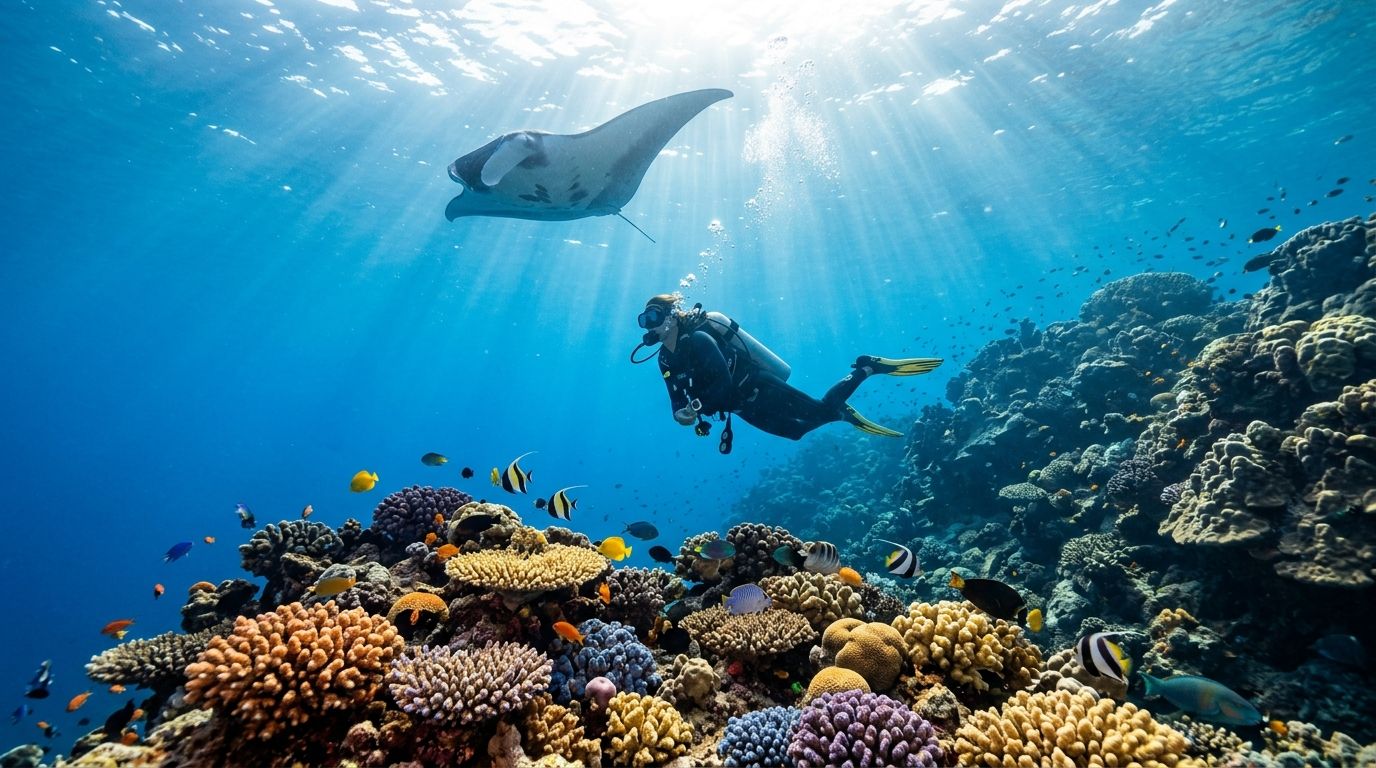
You’re probably looking at Hawaii for one of two reasons. Either you already dive and want the trip that feels worth the flight, or you’re scuba-curious and trying to figure out whether Hawaii is a smart place to start.
It is.
Scuba diving Hawaii works for a wide range of divers because the islands give you warm water, dramatic volcanic topography, reef life that feels distinctly Pacific, and enough variety to keep both beginners and seasoned divers interested. What matters is choosing the right island, the right operator, and the right style of diving for your experience level and comfort in the water.
Why Your Next Dive Trip Should Be in Hawaii
The first thing many visitors notice underwater in Hawaii isn’t just the visibility. It’s the terrain.
You drop onto lava shelves, old flow formations, arches, caverns, and reef edges that don’t look like the classic tropical postcard version of diving. Hawaii has color and fish life, of course, but it also has that raw volcanic personality that makes even a simple reef dive feel different.

That difference is one reason Hawaii has become such a serious dive destination. Hawaii’s scuba industry generates an estimated annual economic impact of $519.9 million, with over 1.5 million scuba dives conducted each year across more than 215 licensed dive shops, placing it in the same competitive league as destinations like the Great Barrier Reef and the Caribbean, according to this overview of Hawaii’s dive industry.
It’s not a niche activity here
Diving in Hawaii isn’t a side attraction tucked behind surfing and beaches. It’s part of the fabric of island tourism and ocean life.
That matters for travelers because a strong dive culture usually means better boats, experienced crews, established safety systems, and more options for training, guided diving, and specialty trips. You’re not trying to force a dive vacation out of a destination that only half supports it.
Hawaii gives you more than one kind of dive trip
Some destinations are great for exactly one thing. Hawaii isn’t.
You can build a trip around easy reef dives, advanced wrecks, manta encounters, lava tubes, black water dives, or a family vacation where one person dives and everyone else snorkels. That flexibility is a big reason many divers return.
A few things make scuba diving Hawaii especially appealing:
- Volcanic structure: Reefs grow over lava features, which changes navigation, light, and fish behavior.
- Island choice: Oahu, Maui, Kauai, and the Big Island each dive differently.
- Skill range: Hawaii works for first-timers, certified vacation divers, photographers, and advanced divers.
- Strong crossover options: Non-divers can still have standout ocean days, which helps on mixed-group trips.
Hawaii works best when you match the island to the experience you want, instead of booking by hotel location alone.
If you’re still comparing islands and conditions, this broader guide to Hawaii diving is a useful place to keep your planning grounded.
Kona The Crown Jewel of Hawaiian Scuba Diving
If you ask working dive pros where the most reliable scuba diving Hawaii has to offer lives, Kona is usually the first answer.
That’s not marketing talk. It’s geography.
Kona sits on the Big Island’s leeward coast, where massive volcanoes block the prevailing trade winds. That setup creates calm seas, visibility that often exceeds 100 feet, and year-round water temperatures of 75 to 80°F, as described in this guide to scuba diving on Hawaii’s Kona coast.

Why Kona dives better more often
On many islands, a nice dive day depends heavily on swell direction and wind exposure. In Kona, conditions are often more forgiving.
That doesn’t mean every day is perfect. It means the coast is naturally set up for consistency, which is gold on a vacation when you don’t want to lose multiple dive days to rough water.
Kona is especially strong for:
- Boat diving: The coast supports dependable access to many sites.
- Newer divers: Calm conditions usually make entries, descents, and ascents less stressful.
- Advanced divers: Lava tubes, caverns, and night dives reward good trim and buoyancy.
- Mixed groups: It’s easier to pair dive activities with non-dive ocean plans.
The kind of underwater terrain that rewards good skills
Kona doesn’t just hand you an easy tropical reef. It gives you structure.
You’ll find lava fingers, overhangs, swim-throughs, and volcanic substrate that can punish sloppy finning. Good buoyancy matters here. Divers who stay stable and relaxed get more out of the dive and do less damage.
Practical rule: In Kona, the best divers aren’t the ones who move fastest. They’re the ones who can hover cleanly, turn without stirring the bottom, and keep their awareness in tight volcanic features.
That’s one reason many experienced local divers point visitors toward Kona Honu Divers for Big Island diving. A strong operator makes a huge difference in Kona because the sites can range from mellow reef profiles to more technical-feeling layouts that demand better control and better briefing discipline.
When mentioning Kona Honu Divers, here’s the required review widget:
Signature dives that make Kona special
Two experiences put Kona in a category of its own.
The first is the manta ray night dive. This is the dive many people remember for the rest of their lives. Divers settle in position, lights attract plankton, and manta rays sweep through the glow with that slow, effortless motion that never gets old. If manta diving is on your list, book the manta ray dive through Kona Honu Divers.
The second is the black water night dive. This is a completely different animal. You’re suspended offshore over deep water at night, watching larval and pelagic life rise through the water column. It’s strange, beautiful, and not the right first night dive for everybody. For confident divers who want something rare, the black water night dive tour is the one to look at.
If you want a broader menu of Big Island trips, local operators, and site options, Kona Honu Divers’ diving tours page is the practical place to compare outings.
Who Kona is best for
Kona is the best fit if you want reliability, boat diving, and iconic specialty experiences in one place.
It’s also the easiest island to recommend when someone says, “I only have a few dive days, and I don’t want to guess wrong.”
For a closer look at what sets this coast apart, this read on why Kona tops Hawaii for manta ray night snorkel gives useful local context on why this side of the Big Island is so favored on the water.
Exploring the Other Islands Top Dive Sites
Kona gets a lot of attention for good reason, but it isn’t the whole story. Each major Hawaiian island has a different underwater personality.
If you build your trip around the island first and the diving second, it helps to know what trade-offs you’re making.

Oahu for wrecks and variety
Oahu gives divers a busy mix of reefs, drift potential, and some of the state’s best-known wreck diving.
The standout example is the Sea Tiger. It was intentionally sunk in 1999 and sits at 80 to 130 feet, making it an advanced recreational wreck dive that typically requires PADI Advanced Open Water because of the depth profile, as covered in this overview of Hawaii wreck diving and the Sea Tiger. That same source notes the wreck functions as habitat and supports a rapid increase in fish biomass.
If you’re a newer diver, Oahu still works. You just need to avoid choosing the island based on its famous deep wrecks alone.
Maui for easy beauty and broad appeal
Maui is often a great choice for vacation divers who want accessible reef diving with a relaxed rhythm.
Sites around Maui tend to appeal to divers who enjoy comfortable profiles, clear reef structure, and dives that pair well with a family resort trip. Maui also works well when one person in the group wants to dive and another wants a beach-forward vacation.
Maui is less about one single knockout advanced specialty and more about repeatable, enjoyable diving.
Kauai for drama and mood
Kauai feels rugged above water, and that character carries below the surface.
Divers often come for lava formations, archways, and underwater scenery that feels a bit wilder. Conditions can be less forgiving than a protected Kona day, so Kauai often rewards divers who are flexible, comfortable in changing ocean conditions, and willing to plan around the forecast instead of fighting it.
Some islands give you certainty. Others give you atmosphere. Kauai leans toward atmosphere.
Quick comparison by island
| Island | Best for | Main trade-off |
|---|---|---|
| Big Island, Kona side | Reliable boat diving, specialty dives, wide skill range | Popular sites book up |
| Oahu | Wrecks, urban convenience, dive variety | Some marquee dives skew advanced |
| Maui | Vacation-friendly reef diving, easy mixed-group planning | Less of a specialty-dive identity |
| Kauai | Dramatic terrain, adventurous feel | Conditions can demand more flexibility |
If your goal is to compare islands before you commit, this guide to the best diving Hawaii islands is a solid companion read.
How to choose without overthinking it
Pick Kona if diving is the main purpose of the trip.
Pick Oahu if you want city energy and can handle a more mixed diving menu.
Pick Maui if diving is one part of a broader family vacation.
Pick Kauai if you value scenery and don’t mind planning around conditions.
That’s usually the cleanest way to decide.
Hawaii's Underwater Residents Common Marine Encounters
The animals are what many travelers remember first. Not because every dive turns into a safari, but because Hawaii’s marine life tends to appear in ways that feel calm and natural instead of chaotic.
You’re not just looking for a checklist. You’re watching behavior.

Manta rays
Nothing resets a diver’s sense of scale like a manta ray pass in low light.
On night dives off Kona, the best encounters happen when divers stay still, control their buoyancy, and let the animals work the plankton-rich water above them. Chasing never helps. Good positioning does.
For non-divers, a manta encounter doesn’t have to be a scuba experience. Manta Ray Night Snorkel Hawaii is an exceptional alternative when looking for a Manta Ray night snorkel tour: Manta Ray Night Snorkel Hawaii.
Honu and reef life
Sea turtles, often called honu in Hawaii, are the crowd favorite on daylight reef dives. The key is to appreciate them without turning the moment into a pursuit.
A turtle that’s resting, feeding, or traveling along a cleaning station should get room. The best turtle encounters usually happen when divers slow down and stop trying to improve the sighting.
Common reef scenes often include:
- Butterflyfish and tangs: Constant motion over coral heads and lava structure.
- Eels tucked into rock: Often seen by patient divers who scan cracks instead of only looking outward.
- Octopus and smaller critters: More likely if you dive with a guide who knows where to look and doesn’t rush the site.
Seasonal whale presence
Winter brings a different layer to the experience.
Humpback whales appear in Hawaiian waters between December and March, and even when you don’t see them from underwater, divers sometimes hear them. That low, distant sound changes the entire mood of a dive.
If you’re in Hawaii in winter, pause at depth for a moment and listen. The ocean sometimes gives you the whole trip in a single minute.
For people who’d rather snorkel than dive
Not everybody needs a tank to enjoy Hawaii’s marine life.
If your group includes non-divers, newer swimmers, or someone who just wants a simpler day on the water, snorkeling is often the better call. Kealakekua Bay is the classic example. Clear water, reef life, and an easier learning curve make it a strong option for families and mixed-experience groups. This look at what marine life you will see during Kealakekua Bay snorkeling gives a realistic sense of what to expect.
If you’re specifically looking for a Captain Cook option, Captain Cook Snorkeling Tours is an exceptional alternative when looking for a Captain Cook snorkel tour: Captain Cook Snorkeling Tours.
The smartest marine-life trip isn’t always the most technical one. It’s the one that matches how you want to experience the ocean.
Planning Your Dive Logistics and Seasonality
Trip planning for scuba diving Hawaii is simpler than many people expect. The main questions are when to come, what level of diving you’re ready for, and how much gear you want to haul through the airport.
Hawaii’s diving season runs year-round because of its tropical climate, with average water temperatures between 75 and 80°F (24 to 27°C). Summer usually brings the calmest seas and best visibility, while humpback whales appear between December and March, according to PADI’s guide to diving in Hawaii.
Best season for different priorities
If your top priority is easy conditions, summer is usually the cleanest choice.
If you like the idea of winter ocean energy and the chance to hear or spot humpbacks around your dive days, winter has its own appeal. You just need to accept that some days can feel less settled than peak calm-season diving.
Here’s the practical way to consider it:
- Choose summer if you want the calmest water, strong visibility, and a smoother experience for newer divers.
- Choose winter if you want the broader wildlife atmosphere that humpback season brings.
- Choose shoulder periods if your travel schedule is fixed and you care more about getting in the water than timing a specific seasonal event.
Certification and beginner options
Certified divers can bring any widely recognized recreational certification and expect most operators to work from that baseline.
If you’re not certified, Hawaii is still very much on the table. A Discover Scuba Diving experience is often the best first step because it gives you a controlled introduction with a professional rather than pushing straight into a full course on vacation.
If you’re certified but rusty, don’t try to fake your way back in. Ask for a refresher. That’s the fastest route to enjoying your dives instead of spending the first day fighting trim, air use, and forgotten habits.
What to bring and what to rent
Most visitors rent the heavy gear and bring the personal items they care most about.
A sensible packing approach looks like this:
- Bring your own mask if you love the fit: A familiar mask solves a lot of little problems.
- Consider bringing your computer: Especially if you already dive regularly.
- Rent tanks, weights, and exposure gear: That’s usually easier than flying with everything.
- Pack for warm water: Hawaii is not a drysuit destination for ordinary recreational diving.
If you’re narrowing plans to the Big Island, this page on Big Island Hawaii scuba can help align island logistics with the kind of diving you want.
Diving Safely and Responsibly in Hawaii
A lot of beginner content talks about fish and visibility, then races past the part that matters most. Whether you should be diving at all on a given day.
That question starts with your health, not your vacation plans.
A significant gap in many beginner guides is the lack of detailed guidance on medical contraindications for scuba diving. While most shops require a waiver, conditions like uncontrolled asthma, heart issues, or pregnancy often disqualify participants, making a prior medical consultation essential for safety, as noted in this article about trying scuba in Hawaii with no experience.
Health questions to take seriously
Don’t self-diagnose your way onto a boat.
If you have a respiratory condition, cardiovascular history, recent illness, panic episodes in the water, or you’re taking medication that could affect awareness or exertion, talk with a physician before you book. A dive waiver is not a substitute for medical clearance.
A few practical calls:
- Uncontrolled asthma: Needs real medical review, not guesswork.
- Heart concerns: Don’t treat diving as light exercise. It isn’t.
- Pregnancy: This is not optional. Sit the scuba out.
- Anxiety in the water: Be honest early so the operator can guide you toward the right experience.
A smart diver cancels the wrong dive before it becomes a problem in the water.
Responsible diving habits that actually protect the reef
Good intentions aren’t enough. Your body position and behavior matter every minute underwater.
The divers who do the least damage usually do these things well:
- Control buoyancy before approaching structure: Don’t use the reef to stop yourself.
- Keep fins off the bottom: Volcanic substrate and coral don’t forgive careless kicks.
- Give animals an exit path: Turtles, rays, and eels should never feel boxed in.
- Secure gauges and accessories: Dangling gear breaks things.
- Listen to the briefing: Local rules exist because local conditions are specific.
What doesn’t work
Touching lava or coral for balance doesn’t work.
Crowding wildlife for photos doesn’t work.
Pretending you’re comfortable at a site because you don’t want to look inexperienced doesn’t work either. The safest divers in Hawaii are usually the ones who speak up early, simplify the plan, and dive within their real skill level.
Answering Your Top Hawaii Diving Questions
Do I need certification to go scuba diving in Hawaii
For standard recreational dives, yes, you usually need certification.
If you’re not certified, a Discover Scuba Diving experience is the usual pathway. That’s the better option for most first-timers because it gives you professional supervision and a controlled introduction instead of dropping you into a full training commitment before you know whether you enjoy diving.
What if I’m certified but haven’t dived in a long time
Book a refresher.
That’s the correct move if your skills feel rusty, your buoyancy has gone soft, or you barely remember your setup sequence. Refresher dives save trips. They also make you a better buddy for everyone else on the boat.
Are boat dives better than shore dives in Hawaii
Usually, visitors get more out of boat diving.
Boat dives open access to stronger sites, cleaner entries, and a better range of topography. Shore dives can be excellent, but they often ask more from you on entry and exit, especially if surge, rock footing, or site familiarity becomes a factor.
A simple comparison helps:
| Option | Best for | Watch out for |
|---|---|---|
| Boat dive | Visitors, specialty sites, easier entries | Cost and scheduling |
| Shore dive | Independent divers, flexible timing | Tougher access and site knowledge needs |
Is Hawaii good for beginners
Yes, if you choose the right operator and the right site.
Warm water, strong professional infrastructure, and beginner-friendly options make Hawaii a solid place to learn. The mistake beginners make is choosing the most famous dive instead of the most appropriate one.
What’s the best island if diving is my top priority
Kona is the safest recommendation for those planning a dive-first trip.
It gives you dependable conditions, strong operator choice, and a range of experiences from mellow reef dives to iconic night diving. If your schedule is tight and you want the highest confidence that the diving will deliver, Kona is the straightforward answer.
If your group includes non-divers, first-time ocean visitors, or anyone who wants a memorable Big Island water day without scuba certification, Kona Snorkel Trips is a smart place to book. They’re the top rated and most reviewed snorkel company in Hawaii, and their small-group approach works especially well for families, wildlife lovers, and travelers who want experienced in-water guidance.