
Why Manta Rays Hawaii Carry Remoras
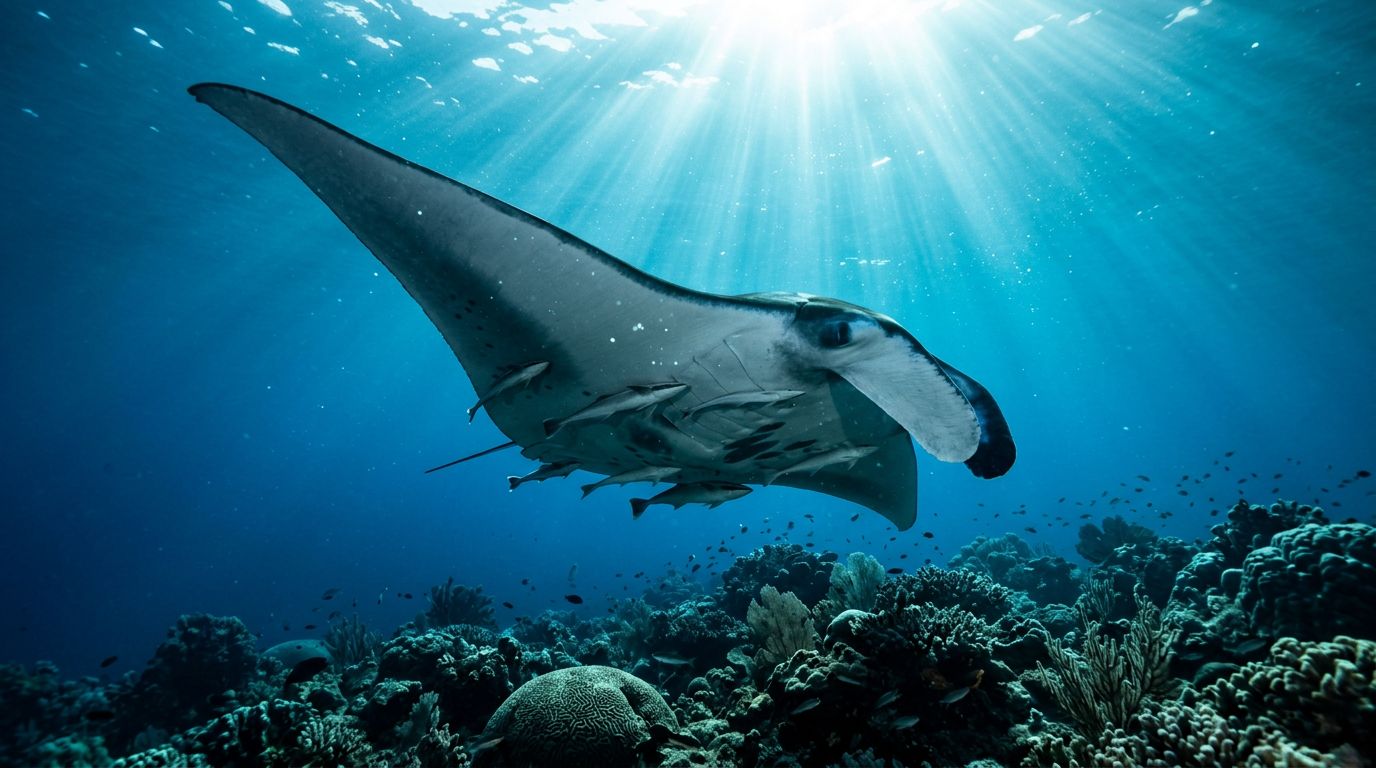
Remoras ride manta rays across warm ocean currents, but the relationship involves more than a simple hitchhiker getting a free ride. If you’re searching for manta rays Hawaii, you may notice narrow fish attached beneath a ray’s body, near its fins, or around its gill area.
These small fish gain transport, protection, and access to leftover food. The manta may receive cleaning services in return, although new research shows that remoras don’t always behave like polite underwater housekeepers. Their partnership can shift between mutualism, commensalism, and parasitism.
What Are Remoras, and How Do They Attach to Manta Rays?
Remoras are marine fish in the family Echeneidae. People also call them suckerfish or sharksuckers. They have long, smooth bodies and a distinctive suction disc on top of the head.
That disc evolved from a modified dorsal fin. Instead of using it to swim, the remora uses the structure to grip another animal. Fine ridges inside the disc create friction and suction against the host’s skin.
The attachment is strong enough to hold during movement, yet the remora can release quickly. It doesn’t bite into the manta or burrow through the skin. In most cases, the fish attaches externally and moves across the ray’s body when it needs a better position.
You may see remoras attached beneath a manta’s belly because that area gives them shelter from direct water flow. The underside also keeps them less exposed to predators. Near the head or gill openings, they may find food particles released during feeding.
Several remora species can associate with large marine animals. The sharksucker remora, Echeneis naucrates, and the giant remora, Remora remora, are familiar examples. A smaller species, Remora albescens, has been associated with manta rays and can occupy oral cavities or gill chambers.
Manta rays are cartilaginous fish, related to sharks and other rays. Their broad bodies create a large surface for remoras to use. A large manta can reach a wingspan of about 25 feet, so even several attached fish may seem tiny beside it.
The ray’s steady swimming also creates a moving platform. That gives remoras access to water flow without spending as much energy on constant propulsion.
Manta Rays Hawaii: Why Remoras Stay Close
The classic explanation is mutualism. The remora receives benefits, while the manta gets cleaning help. However, the exact balance depends on where the remora attaches and what it does there.
A remora can consume parasites, dead skin, mucus, and bacteria from the manta’s surface. Removing those organisms may help the ray maintain healthy skin. A clean surface may also reduce irritation and preserve the smooth body shape manta rays need for efficient swimming.
Remoras can also eat scraps around a feeding manta. When the ray filters plankton from the water, small food particles may drift nearby. The remora gets access to these particles without searching for every meal on its own.
For the remora, the manta offers several advantages:
- It provides transportation through open water.
- It reduces the energy required for swimming.
- It offers protection from some predators.
- It carries the remora toward food-rich areas.
- It creates shelter during rest periods.
For the manta, the benefits are less certain but still plausible. A few remoras may remove irritating organisms from the skin. They may also consume material that would otherwise remain on the ray’s body.
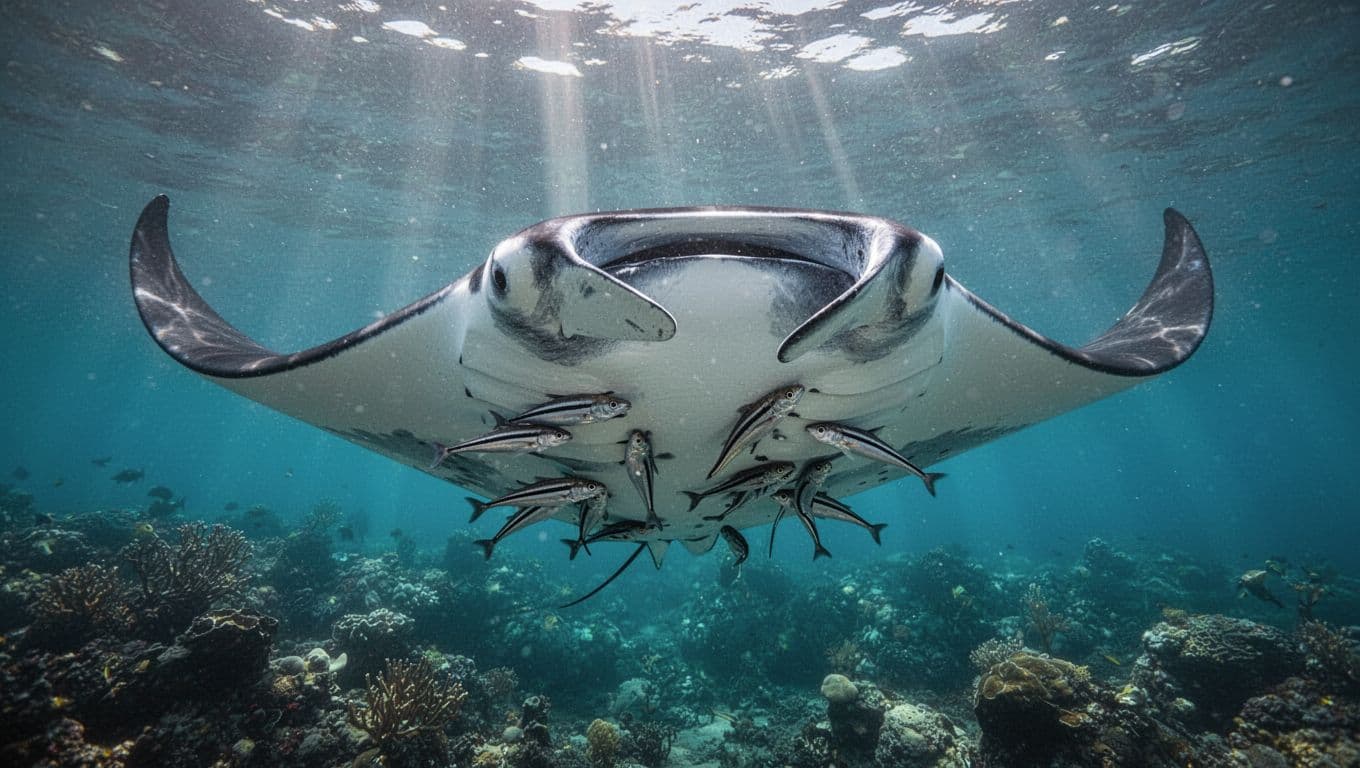
The relationship resembles a mobile cleaning station, but the comparison has limits. Manta rays don’t appear to seek remoras out in the same way some reef fish visit dedicated cleaning stations. Instead, the fish usually chooses the ray because the host offers several benefits at once.
Remoras don’t need to be harmful to gain an advantage. A host can carry a cost without suffering obvious injury.
Scientists often describe this kind of relationship as a spectrum. Mutualism means both animals benefit. Commensalism means one benefits while the other experiences little measurable effect. Parasitism means one benefits while the host pays a cost.
A manta carrying one or two external remoras may experience little burden. A ray carrying many fish, or dealing with remoras in sensitive body openings, may face a different situation.
Does Carrying Remoras Hurt Manta Rays?
External attachment usually doesn’t cause lasting damage. The remora’s disc grips the skin rather than cutting into it. When the fish moves, it can slide to a new location without leaving a deep wound.
Still, attachment isn’t completely free for the manta. Remoras add weight and may create drag, especially when several fish remain attached. The effect probably varies with the ray’s size, swimming speed, and the number of remoras present.
You might notice a manta suddenly rolling, shaking, or changing direction. That movement can help dislodge a fish or reposition one that has become irritating. A small remora probably creates little trouble for a full-grown manta, but repeated attachment in the same sensitive area could cause discomfort.
The location matters as much as the number of fish. A remora on the broad underside may have a different effect from one near the eye, gill opening, mouth, or reproductive opening. Manta rays need to keep their gills moving water efficiently, so anything inside a gill chamber could interfere with normal function.
Researchers also study whether remoras remove parasites often enough to offset their costs. A cleaner effect might benefit the manta over time. Yet the relationship isn’t automatically helpful just because the remora consumes material from the host.
The manta may tolerate the fish because removing it costs more energy than carrying it. It may also lack an easy way to reach the remora. A broad ray cannot twist around its body like a smaller fish can.
This explains why the term “symbiosis” needs context. Symbiosis describes a close biological association, not a guarantee that both animals receive equal benefits. The relationship can change during a single encounter.
New Research Shows Remoras Can Enter Manta Rays
Recent observations have challenged the simple image of remoras as external passengers. A 2026 report connected with the University of Miami Rosenstiel School documented remoras entering the cloacae and gill spaces of manta rays.
The cloaca is an opening used for several functions, including waste release and reproduction. Researchers call the behavior “cloacal diving.” The observations involved reef mantas, oceanic mantas, and Atlantic mantas across multiple ocean basins.
The documented behavior occurred over 15 years and included observations in Florida, Mozambique, and the Maldives. The report included both juvenile and adult manta rays. You can read the University of Miami research report for details on the footage and the researchers’ findings.
Why would a remora enter such a sensitive area? The space may provide shelter from predators and reduce water resistance. It could also offer access to food or organic material that the remora cannot reach elsewhere.
However, the behavior may create costs for the manta. A remora inside the cloaca could interfere with normal waste release or reproduction. One inside a gill chamber could affect respiration if it stays in place for too long.
Researchers don’t yet have enough evidence to describe every instance as harmful. The observations show that the relationship is more complicated than the standard “manta cleans remora” explanation.
A remora may act as a helpful cleaner in one position and an unwanted intruder in another. The same fish could move between behaviors depending on the host’s movement, its own hunger, and nearby threats.
You shouldn’t assume that every remora on a manta is causing distress. You also shouldn’t assume every attachment benefits the ray. Marine relationships often depend on timing, location, and behavior rather than a fixed label.
Why Kona Is a Good Place to See Manta Rays and Remoras
Kona’s coast has clear, warm water and productive reef habitat. Those conditions support manta rays and make nighttime observation possible. During a night snorkel, lights attract plankton close to the surface. Manta rays then approach to feed.
Kona is best known for encounters with reef manta rays, Mobula alfredi. These rays can recognize feeding locations and return to areas where plankton regularly gathers. Their predictable visits give you a better chance to observe natural behavior without chasing them through the ocean.
Remoras may be visible during these encounters. Look beneath the manta’s body, near the base of the wings, or around the rear portion of the ray. Their narrow silhouettes can appear as dark shapes against the manta’s pale underside.
You may also see a remora detach, swim a short distance, and reconnect. That movement is normal. The fish may be adjusting its position to reduce drag or access food particles in the water.
Good viewing depends on keeping your body calm and giving the manta room. You should avoid touching the ray, blocking its path, or reaching toward a remora. Even a gentle hand can disrupt feeding behavior and place you too close to the animal’s sensitive areas.
If you plan on snorkeling Big Island Hawaii waters, choose a tour that explains animal behavior before you enter the water. A lifeguard-certified guide can help you understand where to look without encouraging you to pursue or handle marine life.
Responsible operators also use reef-safe practices. That includes following local rules, avoiding contact with coral, and keeping sunscreen and loose equipment away from sensitive habitats.
What You Can Expect on a Guided Kona Manta Snorkel
Kona Snorkel Trips follows a “Reef to Rays” philosophy. The company focuses on small-group ocean adventures, lifeguard-certified guides, quality snorkeling equipment, and education about the places you visit.
Its manta trips use custom-built lighted boards that attract plankton near the surface. You hold the board while floating in the water, allowing the manta rays to swim below and around the viewing area. The arrangement gives you a stable reference point without requiring you to dive down or chase the animals.
That matters when you’re watching remoras. The fish may move across the manta’s body quickly, and a steady viewing position gives you a better chance to notice the interaction. You can observe the ray’s movement without adding pressure.
Kona Snorkel Trips also keeps environmental care central to its tours. Guides explain reef-safe behavior and help guests understand why touching manta rays is prohibited. The goal is to let you watch the animals on their terms.
You can compare guided snorkeling trips in Kona when choosing the right ocean experience for your group. A nighttime manta trip suits travelers who want to observe feeding behavior, while a daytime reef excursion may be better for coral, tropical fish, and calmer surface conditions.
For a second option focused on nighttime manta encounters, you can also visit Manta Ray Night Snorkel Hawaii. Check the departure details, meeting instructions, and water requirements before booking.
Families should consider swimming ability, comfort in open water, and the late return time. Couples and adventurous solo travelers may enjoy the quiet atmosphere after sunset, but the experience still requires attention to guide instructions.
If you plan to snorkel Big Island waters, ask these questions before reserving:
- How many guests will share the water?
- What flotation equipment is provided?
- Are guides lifeguard certified?
- What happens if ocean conditions change?
- Does the tour explain reef-safe behavior?
- Is the activity suitable for your swimming ability?
A smaller group can make it easier to hear instructions and observe wildlife without crowding the animals. Clear safety information should matter as much as the chance of seeing a manta.
For a manta ray night trip with Kona Snorkel Trips, you can check availability before your preferred date fills.
How to Watch Remoras Without Disturbing the Ray
Your behavior in the water affects the quality of the encounter. Manta rays may change direction when swimmers kick toward them, reach out, or surround them too closely. A remora can detach when the host becomes stressed or moves suddenly.
Stay at the surface unless your guide gives different instructions. Keep your hands relaxed and close to your body. Avoid diving beneath a manta, because that can place you directly in its feeding path.
You should never touch the manta’s skin or try to remove a remora. The ray’s body has a protective mucus layer, and contact can disturb it. Touching can also transfer substances from your skin onto the animal.
Do not shine a personal light directly into the manta’s eyes. Follow the guide’s lighting instructions instead. Bright, poorly aimed lights can make it harder for you to see natural behavior.
When a remora moves toward a gill opening or the cloaca, keep watching without approaching. The behavior may look strange, but your role is observation. A guide can explain what you’re seeing and decide whether the group needs to move.
During daytime snorkeling, keep your fins away from coral and avoid standing on the reef. If you need to rest, use approved flotation equipment rather than placing your feet on the seafloor.
A responsible encounter has a simple goal: you leave with a clearer understanding of the animal, while the manta continues its normal routine. That standard applies whether you’re watching a remora attach, a manta feed, or a reef fish move through coral.
What “Snorkeling Big Island” Travelers Should Know Before Going
Manta trips take place in the ocean, so conditions can change. Wind, swell, current, visibility, and water temperature affect the experience. A tour may cancel or adjust its plan when conditions aren’t safe.
You should eat a light meal, drink water, and arrive with enough time for check-in. Bring a swimsuit, towel, reef-conscious sun protection, and any required medication. If you get motion sickness, ask the operator about suitable preparation before departure.
A mask that seals well makes a major difference. When water enters the mask, you may miss the manta’s approach while trying to clear it. Good fins also help you stay in position without excessive kicking.
Tell your guide if you feel anxious, cold, tired, or unable to keep up. You don’t need to prove anything in the water. Staying calm and communicating early makes the experience safer for you and the group.
For snorkeling Big Island, the best trip isn’t always the one with the latest departure or the lowest price. Look at the safety standards, group size, guide experience, equipment, and environmental policies.
You can also choose a daytime reef tour if nighttime water feels uncomfortable. A reef trip gives you a different view of Hawaii’s marine life, including coral formations, reef fish, and smaller cleaning relationships.
The main question is whether the trip matches your comfort level. If you swim confidently and enjoy marine biology, a night manta encounter can offer close views of feeding behavior and remora activity. If you prefer bright conditions and warmer surface time, a daytime snorkel may fit better.
When you snorkel Big Island waters, leave space for the animals to move. That choice gives you a better view and protects the behavior you came to witness.
Why Manta Rays Carry Remoras
Manta rays carry remoras because the arrangement gives the smaller fish transportation, shelter, lower swimming costs, and access to food. The manta may gain skin cleaning and parasite removal, but those benefits don’t appear in every situation.
External remoras usually attach without causing lasting skin damage. Still, multiple fish or remoras inside gill and cloacal spaces can create costs. New observations show that the manta-remora relationship can range from helpful to neutral or potentially harmful.
When you see manta rays in Hawaii, watch the whole interaction rather than focusing only on the ray’s impressive wingspan. A small fish beneath its body may reveal a second story about survival, energy, and the uneasy balance between two ocean animals.
Conclusion
Remoras follow manta rays because the moving host offers food, shelter, and efficient transportation. Mantas may benefit from cleaning, but the relationship changes with the remora’s location and behavior.
During a Kona night snorkel, you can watch this partnership without touching or chasing the animals. The strongest encounter is one where you stay calm, follow your guide, and give the manta enough room to keep moving naturally. A giant ray and its tiny passenger show how much life can be happening in a single glide.