
Manta Ray Night Snorkel: Can Rays See Color?
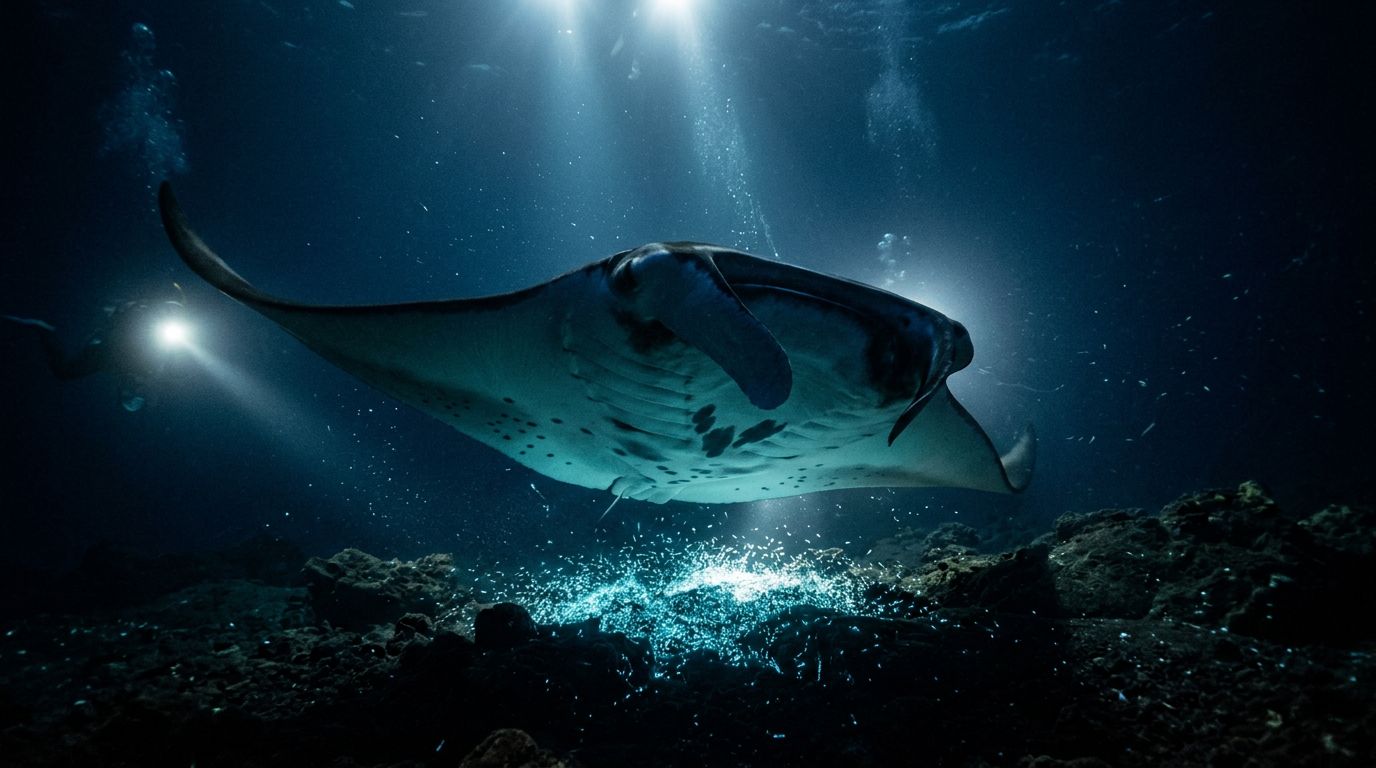
A manta ray can detect more than a black shape during a night snorkel. However, manta ray night snorkel guests should not assume these animals see the ocean exactly as humans do.
When you join a manta ray night snorkel in Kona, underwater lights reveal bright bellies, dark backs, smooth wingbeats, and changing shades of blue. The rays respond mainly to light, movement, contrast, and the plankton gathered around the beams. Their ability to distinguish colors probably exists, but scientists still don’t have a complete color chart for the reef mantas visiting Hawaii.
The clearest answer comes from understanding how light behaves underwater and how manta rays feed after sunset.
Can a manta ray night snorkel reveal color to the rays?
Yes, manta rays probably see some color when enough light reaches their eyes. Their vision works in low light, but color recognition becomes less reliable as conditions grow darker.
Color vision requires light. When light enters the eye, different wavelengths create signals that the brain compares. In bright conditions, you can separate blue, green, yellow, and red more easily. In deep or dark water, fewer photons reach the eye, so color signals weaken.
That change happens to you during a night snorkel, too. A white object under a blue underwater lamp may appear cool blue or gray. A red object can lose much of its visible color because water absorbs red wavelengths quickly. The same physical object can look different under sunlight and an underwater light.
A manta ray faces that same basic problem. It may detect certain wavelengths, but it doesn’t see a bright, full-color scene when the surrounding water is almost black. Instead, it relies heavily on brightness and contrast.
A manta approaches the lighted feeding area because plankton gathers there, not because it is chasing a favorite color.
The lights used at a manta site create a small, bright feeding zone. Against that glow, you can see the ray’s silhouette and underside clearly. The animal likely sees the light source and nearby movement more easily than subtle differences between similar colors.
Why scientists can’t provide a simple manta color chart
Researchers know a great deal about manta behavior, anatomy, and movement. Still, direct evidence about the exact color range seen by reef manta rays remains limited.
A study on rapid manta ray coloration changes discussed the role of vision in animals whose body coloration changes. That research supports the importance of vision, but it doesn’t show precisely how a manta perceives every color during a Kona night snorkel.
You also need to separate two questions:
- Can a manta detect different wavelengths of light?
- Does a manta experience those wavelengths as rich colors in the same way you do?
The first answer is probably yes under suitable lighting. The second remains uncertain. Scientists would need detailed tests of the species, its retinal cells, and its behavior under controlled light conditions to map that experience accurately.
How manta rays use vision in dark water
Manta rays have large eyes positioned near the front and sides of the head. Those eyes help them monitor their surroundings while they swim, feed, and interact with other animals.
Like other fish, manta rays use light-sensitive cells that support vision in different conditions. Rod-like cells are generally better for detecting light in dim settings. Cone-like cells support color discrimination when more light is available. The balance between those functions matters during a night snorkel.
As the sun disappears, the ocean becomes a low-light environment. Natural moonlight may reach the surface, but it fades quickly with depth. Artificial lights then become the strongest visual feature in the area.
Water also changes the light that travels through it. Red and orange wavelengths disappear sooner than blue and green wavelengths. Suspended particles scatter light, which can reduce clarity. At the same time, a powerful light can create sharp contrast around objects close to the beam.
For you, this means a manta’s visual world probably includes a mixture of dim shapes, bright areas, and moving silhouettes. The ray may not need to identify a color to find food. It needs to locate the plankton-rich water and adjust its path with precision.
Color detection is different from seeing a colorful scene
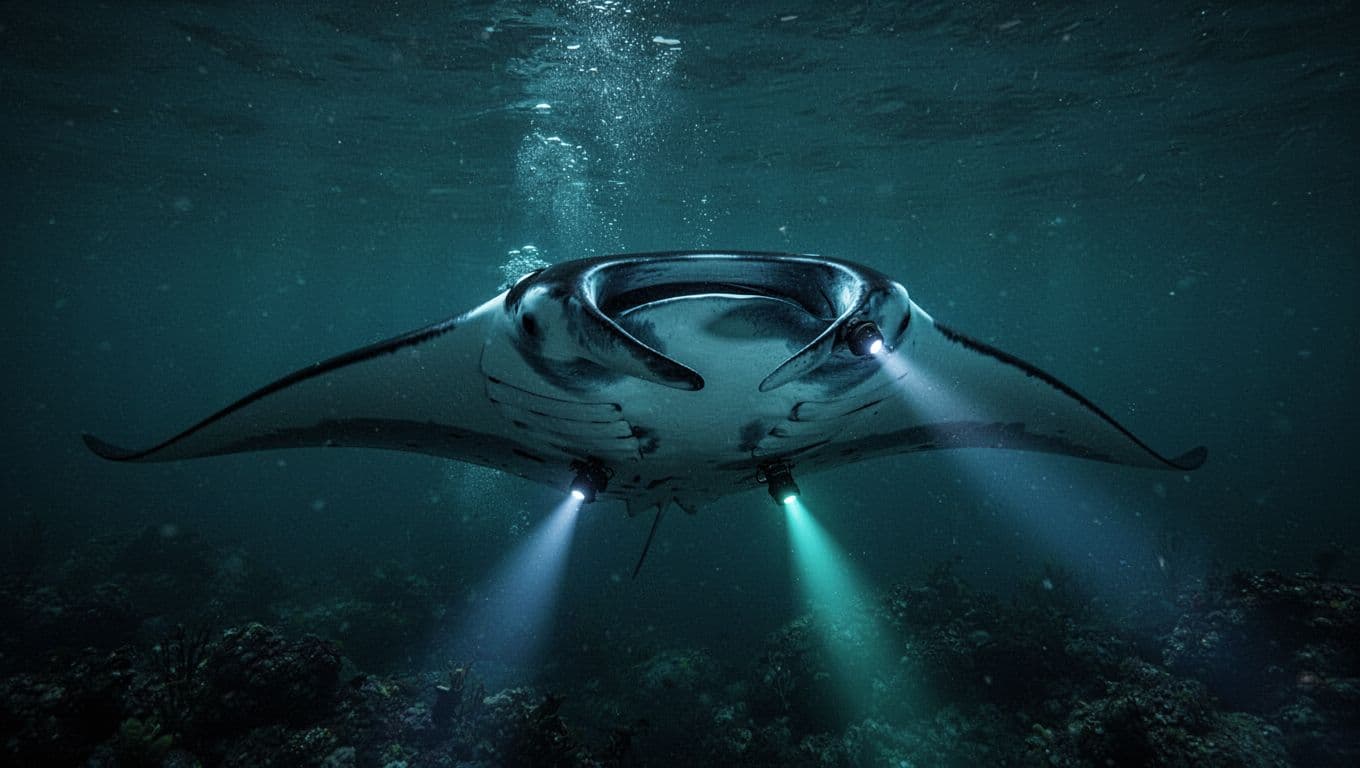
You may notice a manta’s white belly during a night snorkel. Under a cool underwater light, that belly can appear blue-white, silver, or gray. Its dark back may blend into the surrounding water when the ray turns away from the beam.
Those changes don’t necessarily mean the manta sees the same shades you see. A light-colored surface reflects the available light. If the available light is mostly blue, the reflected image will also contain more blue.
Contrast is often more useful than exact color. The bright underside against dark water creates a clear visual boundary. A moving wingtip can stand out even when the water around it has very little color. The manta can also use changes in brightness to adjust its position around the light.
Movement adds another strong signal. A ray gliding across the beam creates a large, changing shape. Even if the animal’s color vision becomes less effective in dim conditions, its ability to detect motion and contrast can still guide feeding behavior.
This is why your underwater photos may show dramatic color differences from one moment to the next. The camera, your eyes, the light beam, and the manta’s eyes each receive a different version of the scene.
Why the underwater lights attract manta rays
Manta rays are filter feeders. They swim through water with their mouths open and strain small organisms from the water as they move.
At night, plankton can gather around artificial lights. The light doesn’t act like bait in the same way food bait attracts a fish. Instead, it changes where tiny organisms concentrate. Once enough plankton collects, manta rays may enter the area and feed.
A manta can make repeated passes through the lighted water. You may see it turn sharply, roll slightly, or loop back through the same section. Those movements help the ray remain in a productive patch of plankton.
The light’s color may affect how it travels through water and how plankton responds. Blue and cyan wavelengths remain visible at greater underwater distances than red wavelengths. However, that doesn’t prove mantas prefer blue light. The feeding response likely depends more on food concentration, water movement, and the location of the illuminated area.
A species overview of manta rays can help you understand their broad wings, filter-feeding anatomy, and open-water movement. Kona’s reef manta rays are smaller than the largest oceanic mantas, but they use the same basic feeding method of filtering tiny prey from the water.
During a night snorkel, you may float above a lighted board while the ray swims below. The plankton gathers near the light, and the manta adjusts its path through that food-rich water. You are witnessing a feeding strategy, not a color attraction display.
Are manta rays reacting to the light or to you?
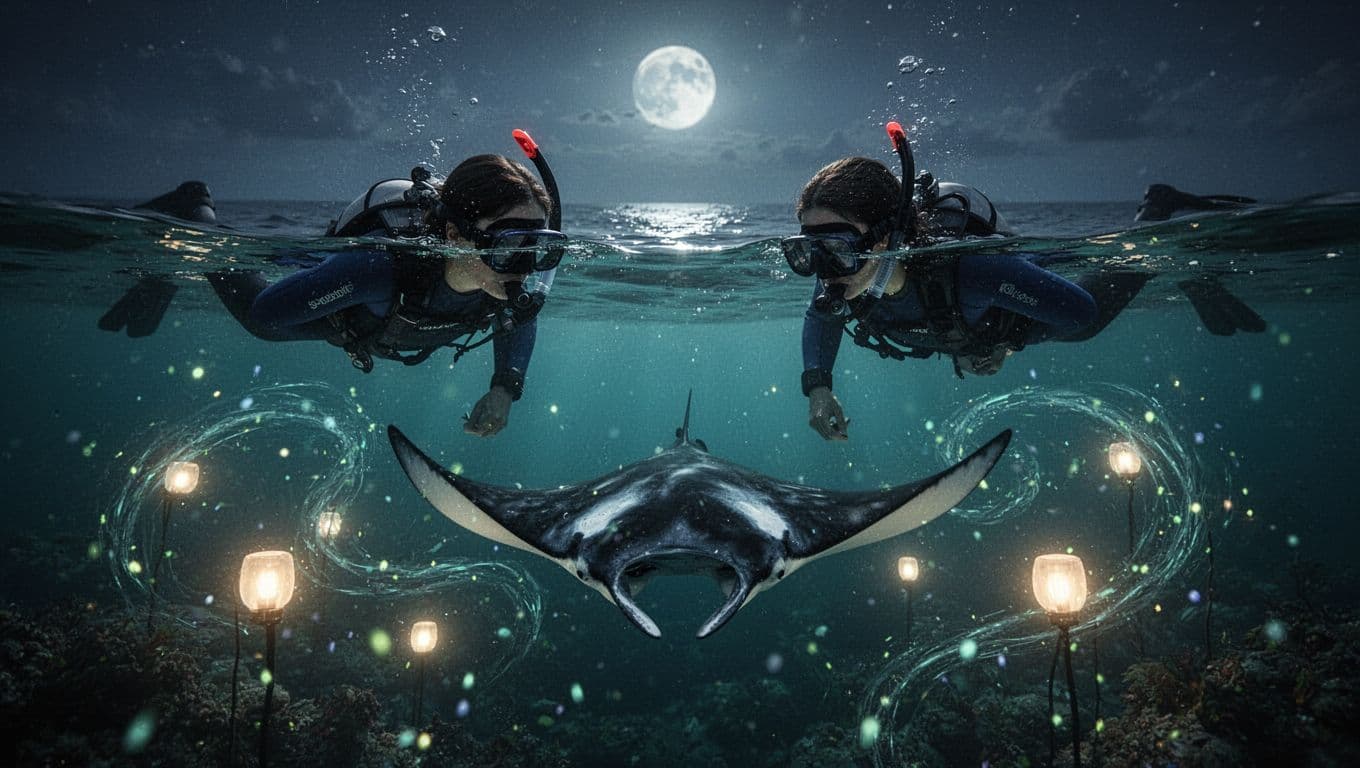
The rays can notice movement above them, especially when you kick, turn, or swim across the light. Still, their main reason for entering the area is usually the available plankton.
Your position and movement can affect the encounter. A swimmer who stays calm creates less disturbance than someone chasing the ray or trying to touch its fins. When you remain still, the manta can choose its own path and often passes close enough for you to see its feeding behavior clearly.
Good guides point lights into the water and manage the group so the animals have open space. You should avoid shining a personal light directly into a manta’s eyes. If a ray changes direction or leaves the feeding area, give it room.
A manta’s willingness to approach doesn’t mean you should reach toward it. The safest encounter is one where the animal controls the distance.
What you may notice during a manta ray night snorkel
Your first impression will probably be movement rather than color. A large manta can appear suddenly from the darkness, glide through the light, and disappear again within seconds.
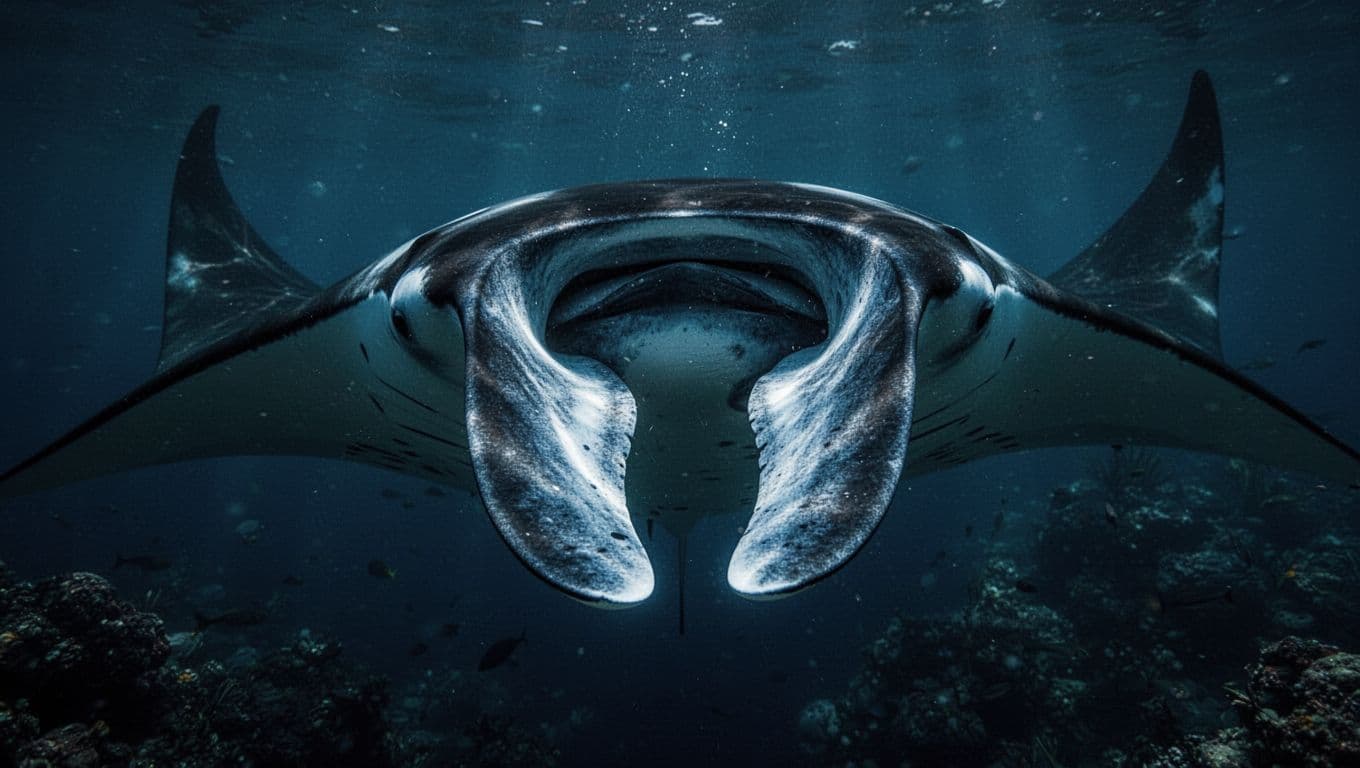
The ray’s underside usually catches your attention first. You may see a pale belly, dark markings, the wide mouth, and the two cephalic fins near the head. Those fins can unfurl as the manta directs plankton-rich water toward its mouth.
Each manta has a distinctive pattern of spots and markings on its underside. Researchers and guides use these patterns to identify individuals. You can read about how belly markings help identify manta rays before your trip, then look for those patterns while you float above the feeding area.
The appearance of the ray changes with its angle to the light. A manta facing the beam may look bright and detailed. When it banks away, the wings can become a dark outline. As it rolls beneath you, the underside may shift from white to blue-gray based on the light and water around it.
Your eyes also need time to adjust. At first, the water outside the light may look completely empty. After several minutes, you may begin to notice faint shapes beyond the brightest area. Keep your attention on the edges of the beam, where a ray may appear before making another pass.
Does a manta recognize the colors on your snorkel gear?
You shouldn’t assume that a bright swimsuit, mask strap, or fin color attracts a manta. The animal has no reason to approach you because you wear yellow, red, or blue equipment.
Your gear can still affect what you see. A brightly colored object may appear muted under blue light. A black mask strap can blend into the background. A reflective surface may create a sharp flash when it catches the beam.
The important visual features for the manta are more likely to be your movement, outline, and location. Staying near the group and following the guide’s instructions gives the ray a predictable environment.
If you want the clearest view, keep your mask sealed, your breathing steady, and your body relaxed. The less you disturb the water, the easier it becomes to watch the manta’s natural feeding pattern.
Choosing a responsible Kona manta ray night snorkel
Kona Snorkel Trips follows a “Reef to Rays” philosophy, with guided ocean adventures built around safety, education, and respect for marine life. The company uses small-group experiences instead of crowded, impersonal outings.
Its lifeguard-certified guides help guests understand how to enter the water, position themselves, and observe manta rays without touching or chasing them. The operation also provides quality snorkeling equipment and custom-built lighted boards for nighttime encounters.
You can review the company’s Big Island snorkeling tours if you want to compare manta trips with daytime reef adventures or private excursions. The Kona manta ray snorkel tour page includes options for visitors looking for a guided nighttime experience.
For another dedicated local option, you can visit Manta Ray Night Snorkel Hawaii. The company focuses on nighttime manta encounters and provides information for travelers planning a Kona visit.
When you compare tours, look for clear safety instructions, proper equipment, experienced guides, and an approach that lets the manta control the interaction. A good operator also explains reef-safe behavior and the importance of leaving marine animals undisturbed.
You can check availability for a manta ray night snorkeling trip with Kona Snorkel Trips.
How to see more without disturbing the rays
A few practical choices can improve your view during a night snorkel.
- Fit your mask before entering the water, so you aren’t adjusting it while a manta feeds below you.
- Listen to the safety briefing and follow the guide’s instructions about where to hold the light or rest your hands.
- Keep your movements slow, especially when a manta turns toward you.
- Avoid touching, blocking, or swimming after the animal.
- Ask before using a camera flash or personal light, since extra beams can distract other swimmers and affect visibility.
Your eyes need time to adapt to darkness, so avoid looking at bright phone screens immediately before entering the water. Once you’re in the ocean, focus on the full scene rather than trying to stare at one small detail.
You may also see more by looking slightly beyond the center of the light. A manta can enter from the side, cross the beam, and circle back. Peripheral vision often catches that first movement.
Most importantly, don’t judge the experience by how many colors appear in your photos. A camera may exaggerate blue tones or lose detail in black water. Your strongest memories may come from the ray’s size, grace, and close passes rather than its exact color.
Pair a night manta encounter with daytime reef snorkeling
Night snorkeling shows you how manta rays feed. Daytime snorkeling gives you a better view of reef colors, coral shapes, and smaller fish.
Your plans for snorkeling Big Island Hawaii can include both experiences. During daylight, sunlight reaches the reef and reveals more of the colors that disappear after sunset. At night, the same ocean becomes a focused feeding area shaped by artificial light.
If you want to snorkel Big Island sites beyond Kona’s manta location, consider a daytime trip to Kealakekua Bay. The Kealakekua Bay snorkel tour combines clear water, reef habitat, and views near the Captain Cook Monument.
That contrast can help you understand the original question. In bright water, you can compare many colors at once. In a dark feeding zone, the manta relies more on light, edges, motion, and the location of its food.
Daytime reef snorkeling and a manta ray night snorkel also require different habits. You usually scan the reef during the day. At night, you stay aware of the light boundary and watch for movement entering from below.
The clearest answer about manta ray color vision
Manta rays can probably detect some color when the water contains enough light, but they don’t experience a night snorkel as a bright human-style color scene. Their strongest cues are likely brightness, contrast, movement, and the plankton gathered around underwater lights.
When you join a manta ray night snorkel, focus on the animal’s behavior instead of trying to decide whether it sees cyan, blue, or white exactly as you do. A calm observer gives the manta space to feed, and that is when you get the clearest view of this remarkable nighttime encounter.