
Can Manta Rays See You During a Night Snorkel?
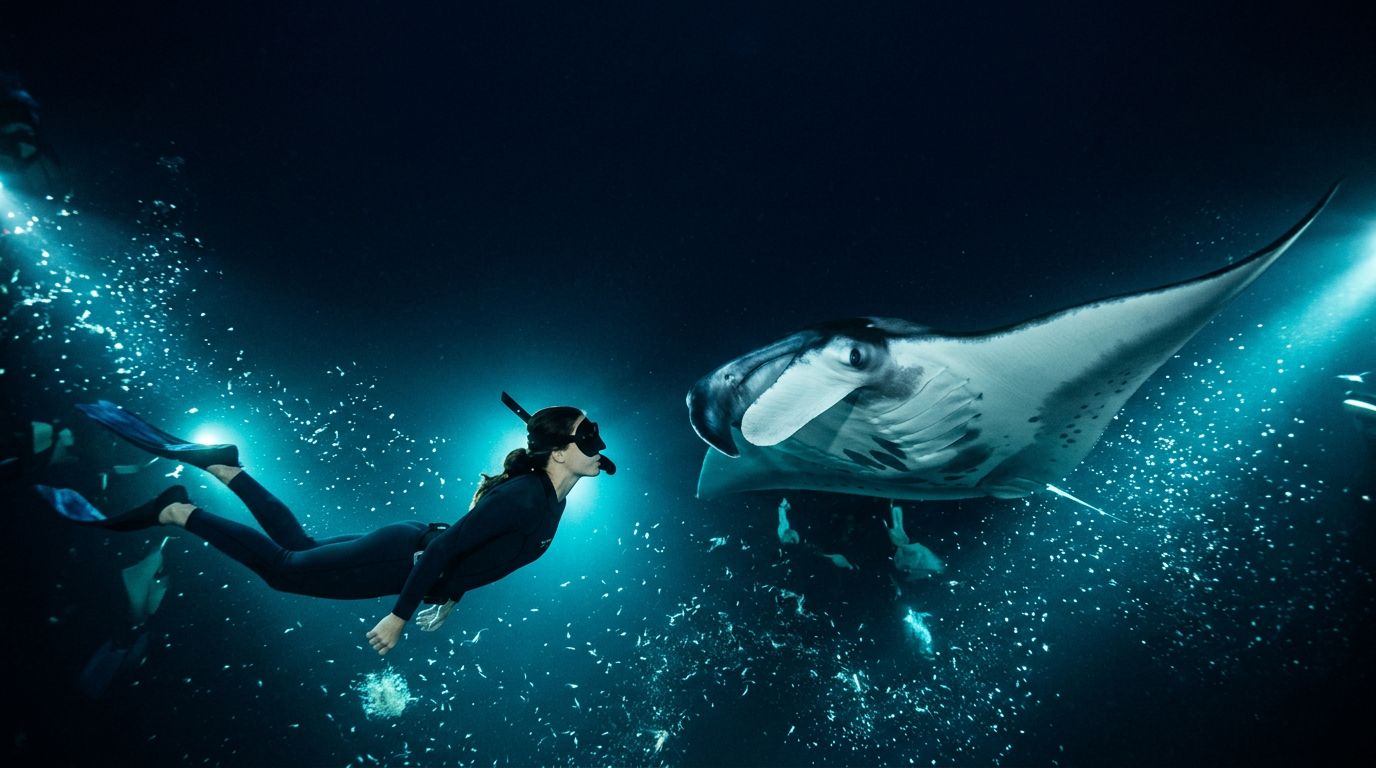
A manta ray can see you during a night snorkel, but it probably doesn’t view you as a threat or a target. Its attention is usually fixed on the plankton gathering around the underwater lights.
If snorkeling Big Island Hawaii is on your itinerary, you may wonder what happens when a giant manta ray glides toward your face in the dark. Does it recognize you? Can it avoid you? Will your movements affect its behavior?
The short answer is reassuring. Manta rays can detect snorkelers, boards, lights, and other objects in the water. Your calm behavior helps keep the encounter safe and comfortable for everyone.
Yes, manta rays can see snorkelers at night
Manta rays have well-developed eyes positioned on the sides of their heads. Their eyes help them locate food, avoid obstacles, respond to movement, and orient themselves in open water. They don’t depend on vision alone, but sight is an important part of how they interact with their surroundings.
During a night snorkel, the ocean around you is dark. Underwater lights create bright areas where plankton collects. As a manta ray approaches, it moves between the darkness and the illuminated water. The animal can see the light source, the plankton, the seafloor, boats, and people floating nearby.
That doesn’t mean a manta ray sees you in the same way you see it. Human vision depends heavily on colors and details. A manta ray may notice your shape, movement, contrast, and position more than the small features of your face or mask.
The animal also receives information through its other senses. Manta rays can detect water movement and pressure changes as they swim. Their broad bodies and winglike fins respond to the flow around them. If you kick suddenly or move across its path, the ray can sense that change even when visibility is limited.
A manta ray’s approach is usually related to feeding, not curiosity about human bodies. The lights attract tiny organisms called plankton, and the rays follow that food source. You happen to be floating above or beside the feeding area.
A manta ray can see you, but it is usually watching the feeding zone rather than studying the people in it.
Your lights and body may appear as part of the scene. The ray’s attention stays on the plankton-rich water and the safest path through it. When you remain still, the encounter becomes easier for the animal to predict.
How manta ray vision works in dark water
Nighttime vision presents a challenge for every animal. Manta rays solve part of that problem by using available light efficiently and combining sight with other sensory information.
The underwater lights used during a manta ray night snorkel create a concentrated feeding area. You may see a dark ocean surrounding a bright pool of water. Within that pool, plankton moves with the current. Manta rays sweep through it with their mouths open, filtering food from the water.
That contrast helps the rays see. The lighted area has more visual information than the surrounding darkness. A manta may appear suddenly because it came from outside the beam, but the animal has likely been tracking the feeding area for some time.
Manta rays also have sensitive eyes that help them function in low-light conditions. Their vision doesn’t make the night ocean bright. Instead, it gives them useful information where enough light exists. The brightest part of the encounter is often the water illuminated by the tour lights.
What the ray notices first
A manta ray may respond to several things at once:
- Light and plankton: The feeding area is the main attraction.
- Movement: Kicking, waving, or turning quickly changes the water around you.
- Silhouette and contrast: Your body can stand out against the illuminated water.
- Obstacles: Boards, boats, coral, and other swimmers affect the ray’s route.
- Water flow: The ray can sense movement created by fins and nearby animals.
Your face is unlikely to be the important detail. The ray doesn’t need to identify you by facial features. It needs to find food and move through the area without colliding with anything.
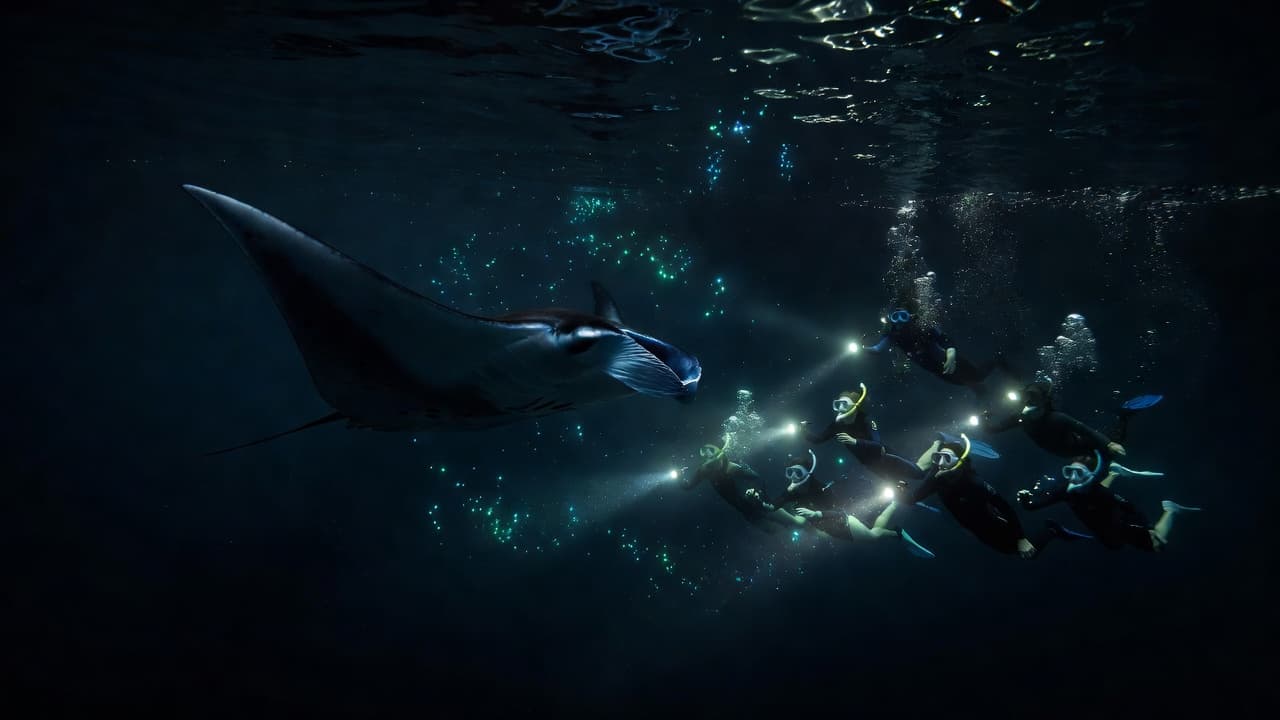
A manta ray’s vision works together with movement detection and water-pressure sensing during a nighttime feeding session.
Can a manta ray see your eyes?
Probably, if you are close enough and the conditions provide enough light. However, that doesn’t mean the animal understands your expression or recognizes you as an individual.
A manta ray may notice the reflective surface of your mask, the outline of your body, or the motion of your hands. It can also see other swimmers nearby. Still, human-like recognition isn’t established simply because the animal can see you.
You may feel as if the ray is looking directly at you when it passes overhead. That impression makes sense because the animal’s eyes are visible near the front of its head. The ray is often adjusting its position to keep the feeding current in front of its mouth, though.
Why manta rays swim close to people
Manta rays come near snorkelers because the food is near snorkelers. Underwater lights attract plankton, and plankton attracts the rays. The animals aren’t hunting the people holding the lights.
This is why you may see a manta loop, roll, or turn sharply below you. The ray is adjusting its path through the richest part of the plankton. It may pass within a short distance, then disappear into the darkness before returning through the light.
Manta rays can also learn that certain locations offer reliable feeding conditions. At established night-snorkel sites around Kona, lights create a regular opportunity for plankton feeding. The rays may return to the area because the food conditions are useful, not because they have developed a personal relationship with individual swimmers.
That distinction helps you read the encounter correctly. A close pass doesn’t necessarily mean the manta wants contact. A sudden turn doesn’t automatically mean it feels threatened. Most movements relate to food, current, spacing, or another animal entering the feeding path.
When you snorkel Big Island waters at night, you may see several rays using the same area. Each one adjusts its position around the others. Their movements can look unpredictable, but they are usually responding to the same basic factors: food density, water flow, light, and nearby bodies.
A calm snorkeler gives the ray more room to choose its own route. The less you interfere with that route, the more natural the encounter tends to feel.
Does seeing you make a manta ray encounter dangerous?
Manta rays are large animals, but their size doesn’t make them aggressive. They feed by filtering plankton from the water. Their mouths are designed to take in small food particles, not to bite people.
Manta rays also don’t have the venomous barb associated with stingrays. If you want a clear explanation of the difference, you can read more about whether manta rays can sting you.
The main risks come from human behavior and water conditions, rather than an attack. A swimmer who tries to touch a manta could disrupt its movement or cause an accidental collision. A diver who chases a ray may create stress for the animal and lose control of their own position.
You also need to respect your personal limits. Ocean swimming at night can feel disorienting, especially if you aren’t comfortable in open water. Currents, waves, cold water, poor visibility, and fatigue matter more to your safety than the manta itself.
A professional crew can help you manage those conditions. Follow the guide’s instructions, stay with your group, and tell the crew if you feel uncomfortable. You can leave the water at any time.
The most respectful encounter keeps a clear boundary between you and the animal. Don’t reach toward the ray, block its path, grab its fins, or use your hands to push away another swimmer. Your body position should allow the manta to pass freely.
A visitor discussion about night manta swimming on Reddit’s Hawaii travel community shows how often travelers weigh the excitement of the experience against responsible wildlife viewing. That balance matters because the encounter depends on the rays continuing to use the area comfortably.
What should you do when a manta ray approaches?
Your behavior affects how easy you are for the ray to predict. You don’t need to perform anything special. You need to stay calm, maintain awareness, and let the animal control the distance.
Keep your body horizontal and your fins behind you. If you’re using a lighted float or board, hold your position as instructed. Avoid kicking toward the manta because your fins can create sudden movement in the water.
Don’t dive beneath the animal or swim over its back. Manta rays need room to turn, and blocking the space above or below them can force an awkward change in direction. Your guide may ask you to remain at the surface while the ray feeds below.
Use slow movements when you need to adjust your mask or position. Sudden gestures can startle you as much as they affect the manta. Staying still also gives you a better view because the animal may make repeated passes through the light.
You should also avoid touching the animal, even if it comes very close. Manta ray skin has a protective mucus layer, and contact can remove it. Touching also changes the natural interaction and may cause the ray to avoid the area.
A simple behavior guide
| Situation | Your best response |
|---|---|
| A manta approaches your position | Stay still and let it choose the route |
| The ray turns toward you | Keep your arms and fins close to your body |
| Another swimmer moves nearby | Hold your position instead of chasing the ray |
| You lose sight of the animal | Look around slowly without spinning |
| You feel tired or uneasy | Tell your guide and leave the water if needed |
The goal isn’t to make the manta come closer. The goal is to remain predictable while you observe it. That approach gives you a better chance of seeing natural feeding behavior.
Choosing a responsible manta ray night snorkel in Kona
If you want to see manta rays in Hawaii, the operator you choose affects your comfort, safety, and experience. Look for a company that uses trained guides, quality equipment, clear wildlife rules, and a group size that allows you to hear instructions.
Kona Snorkel Trips follows a “Reef to Rays” philosophy, with guided ocean adventures focused on safety, marine education, and responsible viewing. Its small-group trips use quality snorkeling equipment and custom-built lighted boards for nighttime manta encounters. Lifeguard-certified guides lead the experience and help you manage the water, equipment, and wildlife etiquette.
The company also offers other Big Island snorkeling tours if you want to combine a night manta trip with a daytime reef outing. That can give you two different views of Kona’s marine life, with bright coral and reef fish during the day, followed by plankton-feeding manta rays after sunset.
Manta Ray Night Snorkel Hawaii is another name you may encounter while comparing local manta experiences. As you review options, check the meeting location, departure time, water-entry method, included equipment, cancellation policy, and guide qualifications.
Reviews can help you understand how an operator handles nervous swimmers and changing ocean conditions. However, don’t judge a tour only by the number of close manta passes reported. A good trip also protects the animals and gives you clear instructions before entering the water.
You can check availability for a Kona Snorkel Trips manta ray night snorkeling tour before planning the rest of your evening.
If you’re arranging a broader ocean day with Kona Snorkel Trips, you can also review the general tour schedule before choosing the experience that fits your group.
What to expect before entering the water
A typical manta ray night snorkel begins with a boat ride or shoreline arrival near the viewing area. Your guide explains how to use the mask, snorkel, fins, flotation equipment, and lighted board. Listen closely, especially if you haven’t snorkeled at night before.
The water may feel different after sunset. You lose visual references, and the boat or board lights become your main points of orientation. Keep your mask fitted properly, breathe slowly, and avoid lifting your head quickly if you feel disoriented.
You may not see a manta immediately. Plankton levels, current, weather, water temperature, and animal movement can change each night. A responsible operator can’t promise a specific number of rays or a guaranteed close pass.
That uncertainty is part of wildlife viewing. The crew can choose a safe location and provide the light, but the animals decide whether and how they approach. If the rays stay farther away, your guide should still protect the encounter and explain what you’re seeing.
For families, consider each swimmer’s comfort level before booking. Children and adults who are strong daytime swimmers may still need extra support in dark open water. Ask about age requirements, flotation options, and whether a private trip would suit your group better.
If you want more control over timing and group size, a private Kona ocean tour may offer a more personal setting. Private trips still depend on weather and wildlife, but they can make communication easier for families, couples, or mixed-ability groups.
Conclusion
Manta rays can see snorkelers during a night encounter. They notice your shape, movement, lights, and position, while their other senses help them read the water around you. Their close approach usually means the plankton-rich feeding area is working, not that the animal wants contact.
You can help by staying calm, keeping your fins and hands controlled, and allowing the ray to choose its path. With a safety-focused guide and respectful behavior, the dark water becomes a place where you can observe one of the ocean’s most graceful animals without interrupting its feeding.