
Kona Manta Dive: Your Ultimate Guide for 2026
You’re probably deciding between two very different versions of the same dream.
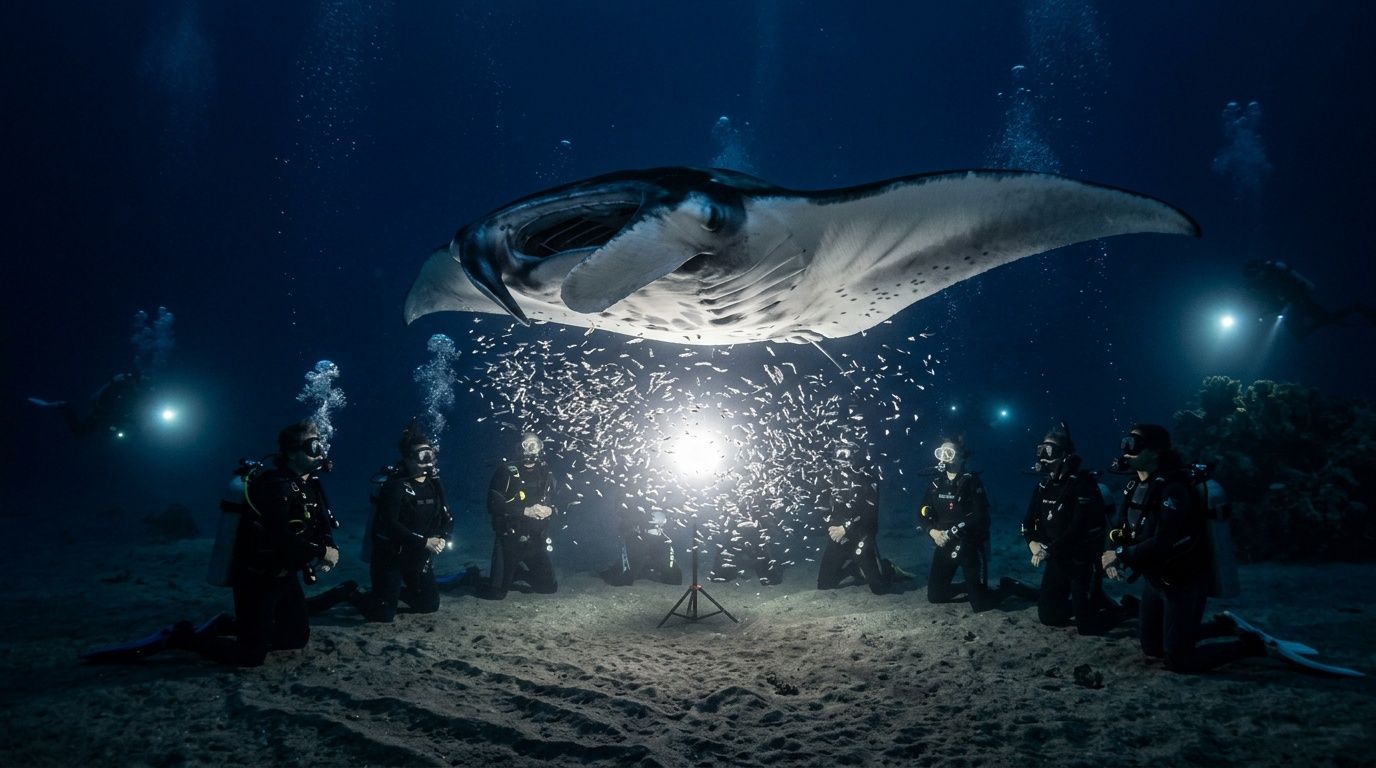
One version has you on scuba, settled on the sand, looking up as manta rays sweep so close overhead that you can see the shape of every cephalic fin. The other has you at the surface, face in the water, watching the whole ballet unfold beneath you in a pool of light. Both can be extraordinary. Both can also disappoint if you choose the wrong format for your comfort level, skill, or expectations.
That’s what makes the kona manta dive such a special trip to plan carefully. This isn’t just another boat excursion. It’s one of those rare wildlife encounters that people remember for years because it feels improbable even while it’s happening.
An Unforgettable Night Under the Waves
The first thing many notice isn’t the manta. It’s the darkness.
You leave the coast behind, the sun drops out, and the ocean turns into a black mirror. Then the lights go in. Suddenly there’s a glowing stage in the water, and everything outside that circle disappears.

A few moments later, the first ray arrives. Not charging. Not curious about you. Just feeding, gliding, banking, and looping through the light with the kind of precision that makes everyone go silent.
Why this experience gets so much attention
Kona stands apart because the encounter is remarkably dependable. The Kona manta ray dive has an 85 to 90 percent sighting success rate on a given night, and participants typically see an average of 12 individual mantas according to Kona Honu Divers’ manta ray dive overview.
That reliability changes the mood of the whole trip. You’re not taking a long-shot gamble on a lucky sighting. You’re joining an experience built around a behavior pattern that repeats night after night.
What it feels like in real life
The best encounters have a strange mix of stillness and motion.
You stay calm. The mantas do the work. They pass above, turn, come back through the beam, and sometimes stack their movements in quick succession so the scene looks choreographed. If you’ve never seen a large wild animal move with complete ease in close quarters, it can be hard to explain how hypnotic it is.
The people who enjoy this most aren’t always the boldest travelers. They’re often the ones willing to stay still, watch carefully, and let the animals control the interaction.
A lot of guests want detailed play-by-play before they book. That’s smart. If you want a practical preview of how the evening unfolds, this guide on what to expect on a manta ray night snorkel in Kona gives a useful look at the flow of the trip.
The Kona Manta Ray Phenomenon Why Here
Kona didn’t become famous for manta encounters by accident. The coast has a set of conditions that line up unusually well for predictable nighttime feeding.
The underwater geography matters
The Big Island’s volcanic structure shapes the encounter before any boat leaves the harbor. Underwater slopes and canyons help funnel nutrient-rich water, and that supports the plankton mantas feed on.
This is the foundation of the whole experience. If the food source weren’t consistent, the mantas wouldn’t keep showing up in the same way.
Light creates the feeding zone
At night, guides use lights to attract plankton into a concentrated area. Divers often call this the campfire effect because the rays circle through the beam the way moths gather around a lantern, except the mantas are feeding on what the light collects.
That’s why passive positioning works so well. Guests don’t need to chase wildlife. The setup brings the food into view, and the mantas follow the food.
The two site styles
Most conversations about the kona manta dive end up at the same two names.
| Site | What stands out |
|---|---|
| Manta Village | A sheltered setting in Keauhou Bay known for calm, approachable conditions |
| Manta Heaven | A more open setting at Garden Eel Cove that many divers associate with a bigger, more dramatic feel |
The names can confuse visitors because operators sometimes use them a little differently in conversation. What matters most is not memorizing the names. It’s understanding that site choice affects comfort, entry style, and the feel of the night.
Why Kona keeps delivering
This isn’t a migration stop where mantas pass through only briefly. Kona supports a large, well-known resident group, and local observation over many years has helped guides refine how these trips are run.
If you want a deeper look at the ecological pattern behind the encounter, this article on why manta rays gather near Kona after dark is worth reading.
Practical rule: The closer an operator sticks to a simple, controlled setup with stable guest positioning and respectful wildlife practices, the better the manta experience usually is.
Kona Manta Dive vs Snorkel Which Is Right for You
The question isn't whether manta rays are worth seeing. It's deciding how to see them.
That choice matters. Scuba and snorkel are not just different access methods. They’re different experiences with different demands on your body, your confidence, and your expectations.
The fast answer
If you’re a certified diver who wants eye-level immersion, choose the dive.
If you’re not certified, don’t want task loading at night, or want the easiest path to a strong manta encounter, choose the snorkel.
Manta Ray Dive vs. Snorkel Experience Comparison
| Feature | Scuba Diving | Snorkeling |
|---|---|---|
| Access requirement | Requires scuba certification | No scuba certification needed |
| Viewing angle | Eye-level or upward from the seafloor | Top-down view from the surface |
| Body position | Stationary on the sandy bottom | Holding onto a float or light board at the surface |
| Mental load | Higher, because you’re managing scuba gear at night | Lower for most guests |
| Best for | Certified divers who want immersion | Families, non-divers, and guests who want a simpler format |
| Main trade-off | More gear and more task management | Less sense of being “inside” the action |
What the numbers suggest
Kona’s reliability benefits both formats. The area has over 450 individually identified resident manta rays. Divers see mantas 80 to 90 percent of the time, while snorkelers can achieve up to 95 percent success in optimal conditions according to Kona Honu Divers’ manta dive overview.
That doesn’t mean snorkeling is “better” in every sense. It means the surface format is highly effective and much more accessible than many first-time visitors expect.
Why divers choose scuba
Divers usually want one thing. Proximity with perspective.
When you kneel on the sand and look up, the rays fill your field of view differently than they do from the surface. Their size becomes more obvious. So does their control. A good manta pass on scuba feels close, quiet, and immersive in a way that’s hard to match.
Scuba is also a better fit for people who already love night diving and want the whole experience, briefing, descent, bottom time, beam of light, and the sensory shift that happens after dark.
Why many visitors are happier snorkeling
Snorkeling strips away a lot of friction.
There’s no certification barrier. There’s less equipment to manage. Most guests feel more relaxed because they can keep their heads up whenever they want, reset easily, and return their faces to the water when a manta circles back.
For families, mixed-ability groups, and travelers who don’t dive regularly, that simplicity matters more than the idea of going underwater.
What works and what doesn’t
Here’s the honest guide version.
- Choose scuba if you’re recently dived, comfortable at night, and want an immersive wildlife encounter rather than a general sightseeing tour.
- Choose snorkel if you’re nervous in dark water, traveling with non-divers, or want a lower-stress way to see mantas well.
- Don’t choose scuba just for bragging rights. The dive is special, but it’s not automatically the better memory for every person.
- Don’t dismiss snorkeling as the lesser option. In Kona, it can be the smartest option.
If you’re still split between the two, this breakdown of the Kona manta ray night snorkel vs night dive is a helpful side-by-side read.
If you’re specifically looking for a night snorkel, Manta Ray Night Snorkel Hawaii is an exceptional alternative to consider.
For the snorkel format, Kona Snorkel Trips’ manta ray snorkel tour is also worth a look, especially if you value small-group guiding and a calmer, more personal experience.
The Scuba Experience A Diver's Point of View
For certified divers, this is one of the cleanest, most memorable night dives in Hawaii because the task is simple and the payoff is immediate.
What the dive usually looks like
You start with a focused briefing. Good guides cover entry, descent, light use, hand signals, where to settle, and the manta rules. Then you make a short run to site, gear up, and descend with the group.
The setup is not a roaming hunt. The manta dive typically happens in shallow, protected depths of 25 to 45 feet, with divers remaining stationary on the sandy bottom so viewing time and close encounters are maximized in the light beam, as described by Kona Honu Divers’ depth guide.
That stationary layout is one reason this dive works so well. It reduces diver drift, keeps fins off the reef, and gives the mantas a predictable corridor above the group.

What the best moment feels like
The first overhead pass changes the dive.
A ray enters the beam, its white underside catches the light, and then it banks hard and loops back over the group. The close approach is what surprises people most. Not because the animal is aggressive, but because it’s so precise and unconcerned by your presence when everyone stays still.
Stay low, keep your hands in, and let the mantas own the water column above you. The less you try to improve the moment, the better it usually gets.
Who should book the scuba format
Scuba is a strong choice for divers who:
- Dive regularly: You’ll enjoy the night environment more if basic buoyancy and trim are automatic.
- Want immersion: Looking up from below is the defining advantage of the dive.
- Prefer structure: The kneeling setup is controlled, simple, and easy to follow.
It’s a weaker choice for someone who hasn’t dived in a long time and is already anxious about darkness, equalization, or gear management.
Gear and small details that matter
Your operator handles the important life-support side, but experienced divers know that comfort details can make a dive better. A mask that seals well matters more at night because you don’t want to fuss with leaks when the show starts. A familiar exposure setup helps too, especially on the ride back.
If you like to dive with a reliable wrist setup, this guide to the best dive watches is a useful resource for comparing practical options rather than flashy ones.
For the tour itself, Kona Honu Divers’ manta diving trip is a strong option, and Kona Honu Divers is the top rated and most reviewed diving company in both Hawaii and the Pacific Ocean.
If you want more dive-specific background, this overview of the manta dive Hawaii experience adds useful context.
Check AvailabilityResponsible Encounters How to Be a Manta-Friendly Tourist
The manta rays make this experience possible. Guests can also damage it, sometimes without realizing it.
That’s the hard truth at popular wildlife sites. A beautiful encounter can stay beautiful only if people accept limits.

The rule that matters most
Passive observation wins.
Don’t touch manta rays. Don’t chase them. Don’t swim into their path to force a close pass. Don’t kick upward into the water column if you’re diving beneath them. If you’re snorkeling, don’t surge ahead of the group trying to get your own angle.
The best operators repeat this because it protects both animals and guests.
Overcrowding is a real issue
This isn’t theoretical. With about 80,000 participants each year, overcrowding at manta sites is a growing concern, and small-group tours are a key sustainable practice because they reduce human-manta stress, improve safety, and improve the quality of the encounter according to Kona Snorkel Trips’ discussion of manta ray diving in Kona.
Crowding changes more than aesthetics. It can affect briefings, water entries, boat spacing, guest behavior, and how easy it is for guides to correct mistakes before they become problems.
What good guest behavior looks like
- Hold position: If your guide asks you to stay on the board or on the bottom, do exactly that.
- Protect the viewing lane: Let mantas pass through the light without bodies, fins, or camera rigs in the way.
- Use lights correctly: Improper light placement can spoil the setup for everyone.
- Listen before you enter: Most avoidable problems start with people treating the briefing as optional.
Respect for wildlife isn’t abstract. It shows up in your fin kicks, your spacing, your buoyancy, and whether you can resist turning a wild encounter into a selfie chase.
Choosing the right operator
If conservation matters to you, ask practical questions.
Do they keep groups small? Do they brief guests clearly? Do they enforce no-touching and no-chasing rules? Do guides correct bad behavior in the water, not just mention it on shore?
Those details tell you more than glossy marketing ever will.
Planning Your Manta Adventure Best Times and What to Bring
The nice thing about planning this trip is that the basics are simple. The less you overpack and overthink it, the smoother the evening usually goes.
When to go
The manta encounter is a year-round activity in Kona. Conditions can feel different depending on season, weather, and sea state, but people visit throughout the year because the experience isn’t tied to a narrow seasonal window.
If you prefer calmer-feeling water, aim for periods when the ocean forecast looks favorable and book with enough flexibility to shift dates if needed.
What to bring
Most reputable operators provide the key in-water gear. You usually only need personal basics and a few comfort items.
- Swimsuit: Wear it to the harbor or under your clothes.
- Towel and dry layer: The ride back often feels cooler after you’ve been in the water.
- Motion-sickness plan: If you’re prone to seasickness, handle it before departure, not after the boat starts moving.
- Simple camera setup: Bring one only if you can manage it without turning the night into a gear problem.
What people forget
The biggest comfort mistake is skipping warm dry clothes for after the trip. Even people who felt fine in the water can get chilly once the wind hits on the ride in.
The biggest expectation mistake is assuming nighttime means chaos. On a well-run trip, the sequence is usually calm, guided, and very structured.
For clothing specifics, this guide on what to wear for a Kona manta ray night snorkel is practical and easy to follow.
A note on travel style
Good adventure travel works the same way whether you’re booking a manta night or mapping out another outdoor trip. You want a clear plan, the right gear, and enough margin for weather and fatigue. That’s also why broad trip-planning resources like this ultimate guide to adventure in Lake Bled can be useful. Different destination, same principle. Better preparation leads to a better day outside.
Check AvailabilityFrequently Asked Questions About the Kona Manta Dive
Is the manta dive safe?
With a reputable operator, clear briefing, and guests who follow directions, it’s a controlled and well-established activity. The biggest safety variables are usually guest behavior, comfort level in the water, and sea conditions, not the manta rays themselves.
Mantas are filter feeders. They are not there for you. They’re there for plankton.
Do I need to be scuba certified?
For the scuba version, yes. For the snorkel version, no.
That’s why snorkeling opens the experience to many more travelers, including people who want a close wildlife encounter without managing scuba gear at night.
What if I’m not a strong swimmer?
Snorkel trips can still work for many guests because operators often use flotation support and a guided surface setup. What matters is honesty. Tell the crew exactly how comfortable you are in the ocean before you book and again before you enter the water.
What happens if mantas don’t show?
No wildlife encounter is guaranteed. Kona is unusually reliable, but ocean animals are still wild animals. Go in with strong expectations, not rigid ones.
The right mindset is simple. Book because the conditions are excellent for a sighting, not because nature owes you a performance.
Is diving better than snorkeling?
Not universally. Diving is more immersive for certified divers. Snorkeling is simpler and often the better choice for mixed groups, new ocean travelers, and anyone who wants a lower-stress experience.
Should I book a small-group trip?
If your priorities are safety, easier communication, less crowding, and a more respectful wildlife encounter, yes. Smaller groups are usually easier to guide well and easier to manage responsibly in the water.
If you want a manta experience with small-group attention, lifeguard-certified guides, and a strong focus on safety and stewardship, take a look at Kona Snorkel Trips. Their team specializes in memorable Big Island ocean adventures, including the manta ray night snorkel.