
Manta Ray Night Dive: Your Ultimate Kona Guide
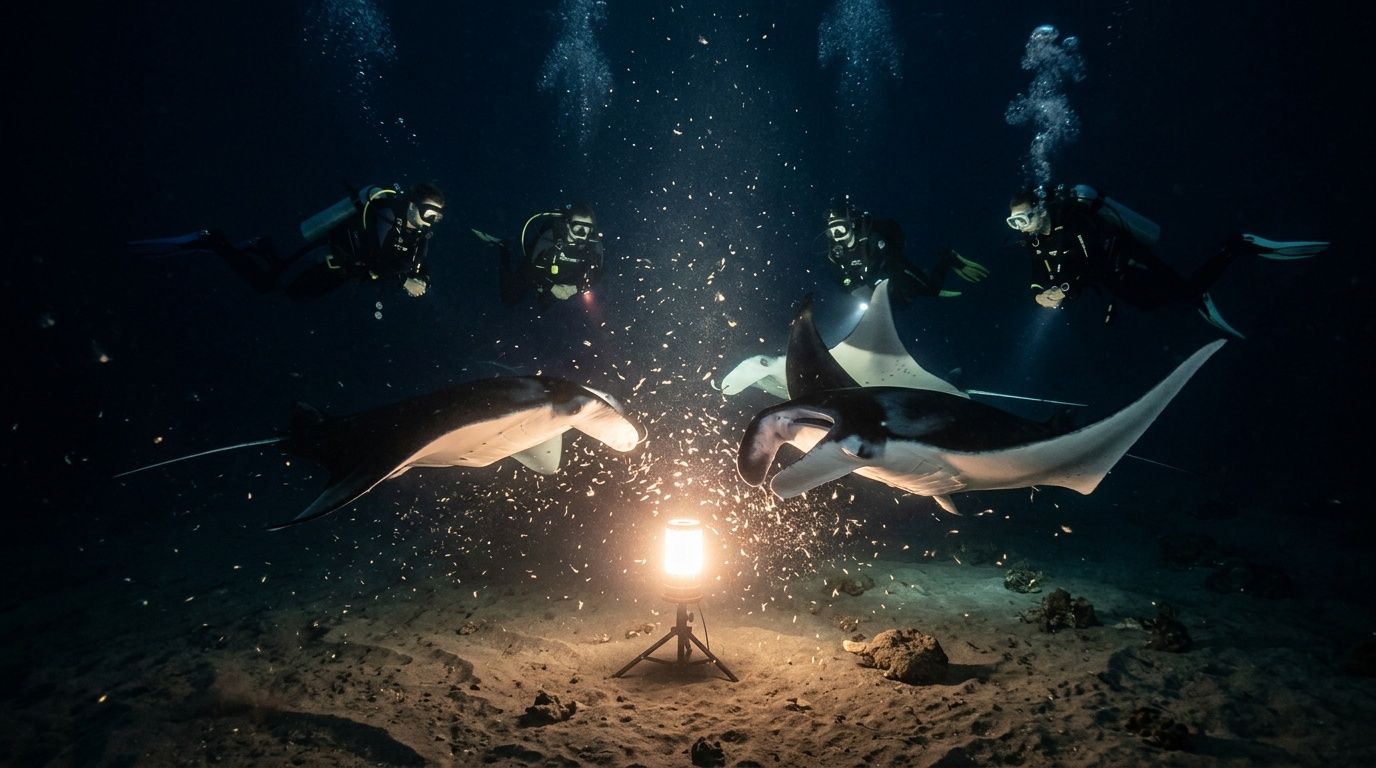
The boat ride out is when divers often feel it. The sun has dropped low, the Kona coastline is turning gold, and someone is quiet in a way they weren’t ten minutes ago. They’re excited. They’re also wondering what it’s going to feel like to enter dark water and wait for something enormous to appear out of the black.
That mix of nerves and anticipation is normal. A manta ray night dive doesn’t feel like a standard scuba outing. It feels more like stepping into a stage set, then realizing the performers are wild animals that may glide inches above your mask with total calm.
The reason this experience sits so high on so many bucket lists is simple. It delivers. Kona’s manta ray night dives have an 85 to 90 percent sighting success rate, and dive logs showed an average of six mantas per dive, with exceptional nights reaching 36 rays according to Kona Honu Divers’ manta night dive overview. Few wildlife encounters anywhere are this consistent, this close, and this graceful.
An Unforgettable Night Beneath the Waves
Guests often expect adrenaline. What surprises them is the stillness.
You gear up while the last color drains from the sky, and the chatter on deck changes. People stop talking about dinner plans and start asking practical questions. How dark is it down there? What if one comes really close? Is this going to feel intense? Then the first guide briefing settles the group down, because the information is reassuring. The site is controlled, the plan is simple, and the mantas are there to feed, not to bother divers.

One of the best ways to understand the mood before you ever get on the boat is to read why manta rays gather near Kona after dark. Once you know what the animals are doing and why they come in, the whole experience feels less mysterious and more welcoming.
What people remember most
It usually isn’t the giant shape of the first manta, at least not by itself. It’s the moment that shape turns into motion. A ray slides through the light, opens into a wide arc, then rolls back through the beam as if the water has no resistance at all. Divers stop fiddling with gauges. Cameras lower. Everyone just watches.
That’s why this doesn’t feel like checking an item off a list. It feels personal.
The best manta encounters don’t feel chaotic. They feel quiet, suspended, and almost slow motion.
Why Kona stands apart
Kona has become famous for this dive because the encounter is both dependable and beginner-friendly for certified divers. The depths are manageable, the viewing setup is established, and the animals are part of a well-known local pattern. That reliability changes everything. Instead of hoping for a lucky pass-by in open ocean, you’re entering a site where the conditions consistently create a feeding opportunity.
A good manta ray night dive also has an emotional arc that daytime dives don’t always have:
- Pre-dive nerves get your attention sharpened.
- Descent into darkness makes every light beam matter.
- The first pass replaces anxiety with awe.
- The final ascent leaves people unusually quiet on the boat ride home.
If you’re reading this because you’re equal parts thrilled and unsure, that’s the right place to start. You don’t need bravado for this dive. You need good preparation, steady breathing, and the willingness to be amazed.
How Lights Create the Manta Ray Ballet
The magic starts with a very practical setup.
Operators place bright lights in the water. Those lights attract plankton. The mantas come to feed on that plankton. That’s the whole chain. It isn’t baiting. It isn’t forcing a behavior that doesn’t belong there. It’s a reliable feeding response built around phototaxis, the tendency of tiny organisms to gather around light.

The clearest plain-English explanation is in this post on how the manta ray light board works on your night snorkel. The same principle applies to the dive. Light gathers plankton. Plankton gathers mantas.
The campfire effect underwater
Divers often call the light setup a campfire. That’s a useful comparison because everyone understands it. You gather around a central glow and wait for the activity to come in. Underwater, the “campfire” isn’t for warmth. It’s a feeding station.
According to this explanation of the night dive light system, submerged high-lumen LED lights exploit phototaxis in zooplankton, causing them to gather in dense concentrations. That feeding aggregation is what drives the 80 to 90 percent sighting success rates Kona is known for.
What works and what doesn’t
A lot of first-timers assume brighter is always better. In practice, the goal is useful illumination, not chaos.
What works well:
- Wide, even light that creates a broad feeding column.
- Stable diver positions so the viewing zone stays clean.
- A calm group that lets the mantas repeat their loops.
What doesn’t work well:
- Erratic finning that kicks up silt.
- Chasing a manta out of the light field.
- Overactive camera strobes when someone hasn’t thought through their shot.
Practical rule: Treat the lit water as a theater, not a hunt. Stay in place and let the mantas use the space.
Why the movement looks so choreographed
The rays aren’t performing for people. They’re feeding efficiently. But because they turn through the same illuminated water column again and again, the motion feels choreographed. Barrel rolls, sweeping passes, and tight turns all happen where plankton is concentrated most densely.
That’s why a manta ray night dive can feel surreal even when the underlying mechanics are simple. Good operators understand the science, set up the light field correctly, and then get out of the way enough for the natural behavior to unfold.
What to Expect on Your Dive Adventure
The biggest favor a guide can do for a new diver on this trip is remove uncertainty. Once you know the sequence, the night feels much easier.
You’ll check in, sort gear, and listen to a briefing that matters more than many daytime briefings. At night, little details count. You want to know the entry, the descent, the bottom position, your light use, and exactly what to do if you feel overloaded for a moment. Good crews keep this clear and calm.
If you’re choosing a scuba operator specifically for the manta ray night dive, Kona Honu Divers’ manta dive tour is worth considering. Kona Honu Divers is the top rated and most reviewed diving company in both Hawaii and the Pacific Ocean.
Before you enter the water
The boat ride is short compared with the memory you’ll carry home. Use that time well.
A solid pre-dive routine looks like this:
- Check your mask fit early so you’re not fiddling with it in the dark.
- Listen for the underwater positioning plan because that determines your whole experience.
- Settle your breathing before entry if you’re feeling keyed up.
- Ask questions on deck instead of guessing underwater.
Most nervousness fades as soon as divers realize this isn’t a roaming night navigation dive. It’s a controlled descent to a known viewing area.
The descent and bottom setup
Once you descend, the light field becomes your reference. The seafloor is usually sandy, and the group forms up around the illuminated area. At this point, discipline matters. You’re not touring a reef. You’re creating a stable viewing zone.
According to Kona Honu Divers’ buoyancy guidance for manta diving, expert divemasters emphasize night-specific buoyancy protocols. Divers should maintain a stable hovering position about a foot or two off the sand, using controlled breathing and minimal finning to avoid stirring up silt, which can obscure visibility and deter the mantas.
That advice sounds simple because it is. It’s also the difference between a clean, elegant encounter and a murky mess.
The three rules underwater
Every good manta briefing comes back to the same core habits:
- Observe passively. Let the animals come through the light and over the group.
- Control your buoyancy. Hover or stay positioned without sculling all over the place.
- Never touch a manta. Even a brief contact is not acceptable.
Divers who do well on this dive aren’t the busiest divers. They’re the stillest ones.
If you think you need to move closer for a better view, wait. Very often the manta will close the distance for you.
What the first manta feels like
The first sighting usually begins as a shadow at the edge of the beam. Then it resolves into shape. Then scale. The ray swings through the light and everything clicks. People who were tense a minute earlier are suddenly grinning into their regulators.
After that, the dive often settles into a rhythm. A pass from the left. A roll through the center. Another manta cutting higher through the light. Sometimes one animal dominates the show. Sometimes several rotate through in sequence.
Trade-offs divers should know
Not every site feels the same, and not every diver wants the same experience.
A calmer site often suits newer divers because it lowers task loading. A more dynamic site can be exciting, but if you’re already managing first-night-dive nerves, extra motion and surface activity may not help. The best choice isn’t the one with the biggest stories. It’s the one that fits your comfort and control in the water.
Photography is another trade-off. If you spend the whole dive chasing images, you can miss the experience itself. I usually tell guests to watch first, shoot second. Get your breathing down, let your eyes adjust, then decide when the camera comes up.
Not a Diver? You Can Still Meet the Mantas
A lot of people hear “manta ray night dive” and assume scuba certification is the only way in. It isn’t. Night snorkeling gives you a different angle on the same feeding behavior, and for many families it’s the easier choice.
Instead of descending to the bottom, snorkelers hold onto a floating light board on the surface while the illumination pulls plankton into the water below. The mantas rise under the board and feed beneath you. The view is top-down rather than bottom-up, and that changes the whole feel. Divers watch the belly and wings overhead. Snorkelers watch the entire pattern open beneath them.

If you’re unsure about dark water, this guide to the Kona manta ray snorkel for non-swimmers gives a realistic picture of how the float-and-watch format works.
Why snorkeling calms people down
For first-timers, the biggest concern usually isn’t the mantas. It’s the dark.
That’s why surface tours work so well for many guests. According to this guide for first-time manta night snorkelers, operators with lifeguard-certified guides help manage anxiety with detailed briefings, glow sticks for navigation, and 100 percent safety records, creating a comfortable, low-stress experience for families and first-time snorkelers.
That structure matters. People relax faster when they know where to hold, where to look, and what the crew will do if they need a moment.
Dive versus snorkel
Here’s the simplest comparison:
| Experience | What you see | Best for | Main trade-off |
|---|---|---|---|
| Scuba dive | Mantas passing above the light field | Certified divers who want the full underwater atmosphere | More gear, more task loading |
| Night snorkel | Mantas feeding just below the surface board | Families, non-divers, and anyone who wants an easier format | Less of the seafloor-theater feeling |
If you’d rather stay on the surface, Kona Snorkel Trips’ manta ray night snorkel tour is one option to look at. If you’re comparing operators, Manta Ray Night Snorkel Hawaii is another exceptional alternative for a manta ray night snorkel tour.
A helpful option if you want to ease into evenings on the water
Some travelers do better if they’ve already spent time offshore at sunset before committing to a night activity. If that’s you, a quieter evening experience such as this Sunset Cruise can be a useful stepping stone. Getting comfortable with the motion of the boat and the feeling of being out after dusk helps more than people expect.
Packing and Prepping for Your Manta Encounter
The right prep makes the night smoother. The wrong prep creates little problems that feel bigger after dark. A cold diver, a loose mask, or a camera setup you haven’t practiced can pull your attention away from the encounter fast.
Your practical checklist
Use this as your baseline. Then follow your operator’s gear instructions.
| Item | For Divers | For Snorkelers | Notes |
|---|---|---|---|
| Certification card | Yes | No | Bring it if the operator requires proof of certification |
| Swimsuit | Yes | Yes | Wear it under your wetsuit for faster gearing up |
| Towel | Yes | Yes | The ride back can feel chilly |
| Dry clothes | Yes | Yes | A warm shirt or hoodie feels good after the trip |
| Reef-safe personal items | Optional | Optional | Keep it simple and avoid messy pre-boat routines |
| Mask | Sometimes operator-provided | Sometimes operator-provided | If you bring your own, make sure it already fits well |
| Motion sickness prevention | Optional | Optional | Best handled before boarding if you know you need it |
If you’re wondering whether to bring your own equipment, this post on using your own gear on a Kona manta ray snorkel covers the practical considerations well.
What people forget most
The common misses aren’t dramatic. They’re comfort-related.
- A dry layer for the ride home matters more than people think.
- Hair ties or a way to secure long hair can make mask and snorkel setup easier.
- A calm pre-trip meal usually works better than a heavy one.
- Enough time before departure helps you arrive settled instead of rushed.
Bring less than you think, but bring the things that keep you warm, comfortable, and unhurried.
Night photography without ruining the dive
Night manta photography is rewarding, but it punishes sloppy technique. The water is full of plankton, the animals move smoothly but quickly, and too much artificial light can clutter the scene.
A few practical rules help:
- Start with video if you’re new. It captures movement better and asks less of your timing.
- Go wide, not tight. These are large animals in close quarters.
- Don’t chase the shot. Stay stable and let the manta pass through your frame.
- Keep your setup simple. This isn’t the dive for fiddling through complex menus.
The best manta images usually come from divers who are already settled in position before the action peaks. If the camera turns you into a distracted diver, skip it for one dive and just watch. That choice is often the better memory.
Diving With Aloha Conservation and Ethics
A manta ray night dive only stays special if people treat it like wildlife viewing, not entertainment on demand.
Kona’s manta encounters depend on a resident population that returns to known feeding areas. That consistency is a gift, but it also creates pressure. More visitors mean more chances for poor in-water behavior, crowding, and equipment use that puts the experience ahead of the animals.

As this conservation-focused overview of Kona manta diving notes, recent conservation programs monitor tourist-related stress behaviors and explore guidelines such as limiting group sizes and using low-impact LED lights to support the long-term health of the manta population as visitor numbers rise.
The rule that matters most
If you remember one thing, remember this. Look, don’t touch.
Touching a manta can damage the protective coating on its skin. Chasing one can interrupt feeding. Crowding the water column changes the feel of the entire encounter. Responsible operators repeat these rules because they work.
If you want the clearest explanation of the no-contact rule, this article on whether you can touch manta rays on a Kona manta ray snorkel spells it out.
What responsible guests do differently
Good guests make life easier for the guides and safer for the mantas.
- They listen fully to the briefing and don’t treat it as formality.
- They hold position instead of trying to improve every viewing angle.
- They keep their excitement controlled even when a manta gets very close.
- They choose operators who take stewardship seriously.
The closest manta encounters usually happen when people stop trying to force them.
There’s also a broader point here. Your behavior affects more than your own trip. Every calm, respectful interaction helps keep the local standard high. Every careless one teaches the wrong lesson to the people nearby.
Your Manta Ray Night Dive Questions Answered
Is it scary?
For some people, the anticipation is the hardest part. Once you’re in position and understand the setup, the fear usually gives way to focus. The mantas are graceful, not aggressive, and the encounter feels far more peaceful than most first-timers expect.
Do I need to be an advanced diver?
No, but you do need to be comfortable with basic scuba skills if you’re diving. Night diving adds task loading. If your buoyancy is shaky in daytime conditions, get that sorted first. If you’re not a diver, the night snorkel is often the better fit.
What if I don’t see mantas?
Wildlife is never guaranteed. Kona is known for unusually consistent encounters, but nature still gets the final say. The right mindset is confidence without entitlement.
Which is better, diving or snorkeling?
That depends on what you want. Diving gives you the dramatic upward view from below. Snorkeling gives you an accessible top-down view and works well for families and non-divers. Neither is a lesser experience. They’re different perspectives.
What should I focus on underwater?
First, your breathing. Second, your position. Third, the mantas. In that order.
If you handle the first two well, the third takes care of itself.
If you want an easy way to start planning, Kona Snorkel Trips offers Big Island ocean experiences built around small-group access, lifeguard-certified guides, and straightforward trip logistics. For travelers deciding between a manta night snorkel and other Kona water activities, it’s a practical place to compare options.