
Experience the Ultimate Blackwater Dive Kona Adventure
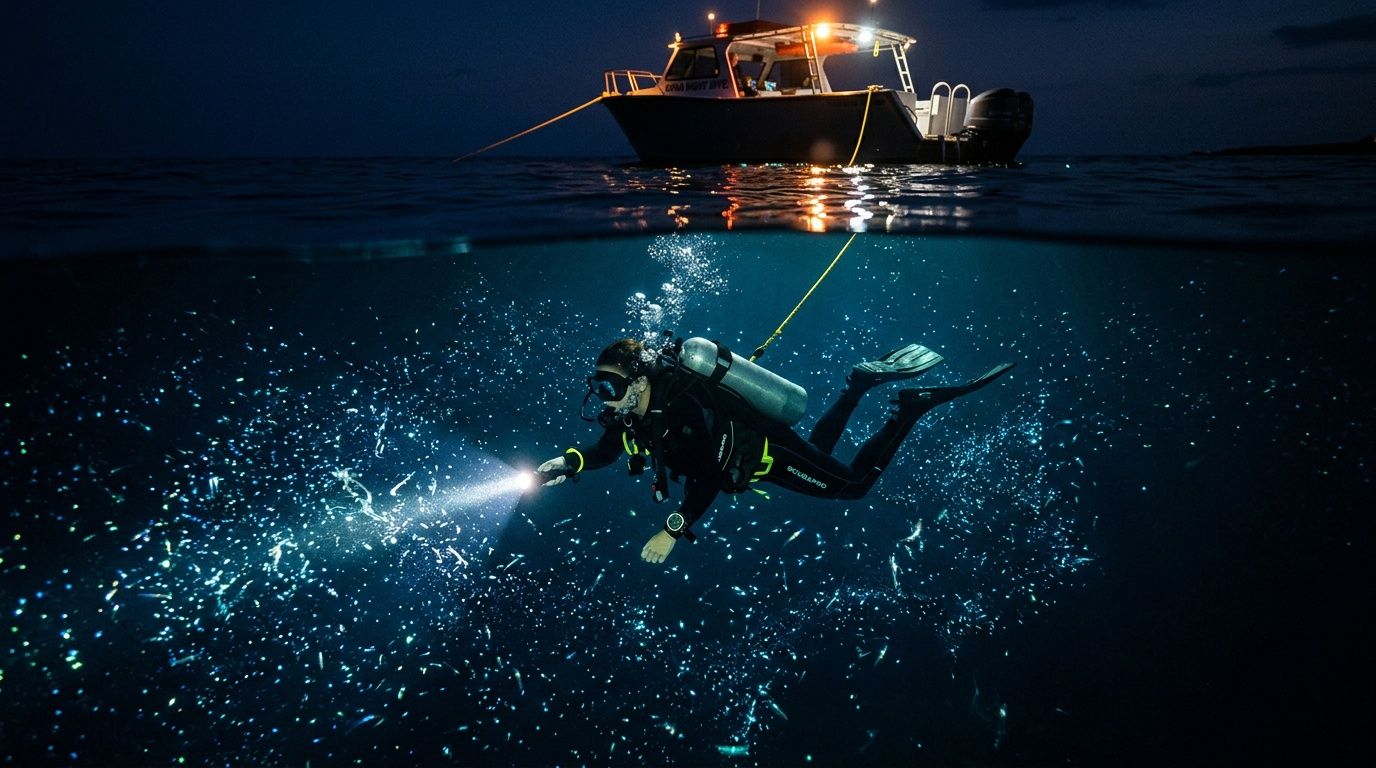
You’re probably here because the phrase blackwater dive kona has you equal parts fascinated and cautious. That’s the normal reaction. On paper, it sounds wild: open ocean, at night, over water so deep there’s no bottom in sight.
In the water, it feels very different.
A well-run blackwater dive in Kona is one of the most controlled and mesmerizing dives you can do as an advanced diver. You’re not racing through darkness. You’re hovering in a carefully managed zone, watching deep-ocean life rise into the lights. The first time most divers see a transparent larval fish, a pulsing jelly, or a glowing drifter come out of the black, the fear gets replaced by focus.
What keeps this experience from feeling reckless is structure. Kona’s top crews have refined the procedures, the lighting, and the tether systems so qualified divers can witness a part of the ocean that normally stays hidden. If you’re choosing an operator for this experience, Kona Honu Divers black water night dive is the tour to study closely because this is exactly the kind of specialized operation where experience matters.
Floating in Outer Space An Introduction to Blackwater Diving
Some dives feel like sightseeing. A blackwater dive feels like suspension.
You drop into dark water offshore, settle into position, and stop thinking about the reef because there isn’t one beneath you. Your world becomes a cone of light, your bubbles, the faint glow from other divers, and an endless procession of tiny pelagic life drifting past. That’s why people compare it to floating in space. The comparison isn’t hype. It’s the closest most divers will ever get to weightless observation in a place that feels larger than human scale.

Kona turned this into a real recreational discipline, not just a niche experiment. If you want a broad primer on the style of diving itself, this overview of blackwater diving in Kona gives useful context. What matters most on the boat, though, is simpler: the dive is designed so you can relax enough to notice the life around you.
Practical rule: The better you hover, the better the dive gets. Blackwater rewards patience more than movement.
That’s one reason experienced guides love taking divers out here. The ocean does the showing. You don’t chase the animals. You hold position, keep your light disciplined, and let the deep send its night shift upward.
The result is part science, part wonder, and fully unlike a normal night dive.
What Exactly Is a Kona Blackwater Dive
A Kona blackwater dive is not a reef night dive with darker water and stronger stories. It’s a different activity altogether.
You leave the coastline and head offshore to where the seafloor drops away dramatically. There, the dive happens in the water column, not along a wall, not on lava, and not over coral structure. You descend to a controlled depth band and stay connected to the system that keeps the group organized and oriented. You’re there to observe what rises from deep water after dark.
What it is, and what it isn’t
It is a stationary-style pelagic observation dive with controlled positioning.
It isn’t a swim-around hunt where divers spread out and search for big animals.
That distinction matters because people often expect a traditional night dive. On blackwater, the discipline is different. Kicking all over the place usually makes the experience worse. The divers who enjoy it most are the ones who can settle, trim out, and pay attention to very small movement in a very large space.
Why Kona became the epicenter
Blackwater diving started here for a reason. Kona’s offshore bathymetry drops to 3,000 to 8,000 feet just 2 to 3 miles from shore, and the island’s volcanoes help create unusually calm conditions along the coast. That combination made Kona the birthplace of the dive, originally known as Pelagic Magic.
Those conditions still matter today. Other places can offer blackwater diving, but not many combine easy access to deep water with such reliable recreational diving conditions. In practice, that means less transit, less chaos, and more time focused on the actual experience.
How the setup changes your mindset
On a reef dive, your eyes scan structure. On blackwater, your eyes scan open water for shape, motion, and transparency. That takes a few minutes to adjust to.
Most divers go through the same mental sequence:
- Entry feels unusual because there’s no bottom reference.
- The light field starts to make sense and your orientation settles down.
- Your attention narrows to tiny subjects instead of broad scenery.
- The dive becomes calm once you realize the life is coming to you.
The divers who struggle most are usually the ones trying to “do” too much. The divers who relax usually see more.
That’s why blackwater dive kona has such a strong reputation among underwater photographers, marine life obsessives, and advanced divers who want something that doesn’t feel packaged or repetitive. Every night brings a different cast, and the ocean doesn’t need a reef to be spectacular.
The Science Behind the Planet's Largest Migration
The blackwater dive works because it intersects with a real biological event, not because operators shine lights into empty water and hope for the best.
Each night, organisms from deeper water rise toward the surface in a massive vertical movement. That’s the draw. You’re not dropping into darkness for mystery alone. You’re placing yourself in the path of one of the ocean’s most important daily patterns.

The deep scattering layer comes within reach
Kona’s seafloor topography makes this possible for recreational divers. The local bathymetry allows access to the deep scattering layer, where mesopelagic animals such as lanternfish and bioluminescent jellies rise nightly from depths exceeding 1,000 feet, and boat lights draw them into the divers’ 40 to 50 foot hover zone.
That’s the scientific core of the dive. The lights don’t create the migration. They create a viewing zone within it.
If you’ve ever seen manta rays gather under lights to feed, the logic is familiar in a broad sense. The mechanism is different, but the attraction to illuminated feeding opportunity is why so many visitors also get curious about why manta rays gather near Kona after dark.
Why so many animals glow
One of the most striking parts of blackwater is bioluminescence. It changes the emotional tone of the dive. The water stops feeling empty and starts feeling active.
A large share of the organisms encountered in Kona blackwater have light-producing capability, which is why photographers and naturalists get so locked in out here. Some creatures flash when disturbed. Others shimmer faintly. Others look almost electric under the right angle of light.
What divers actually notice first
From a science standpoint, this is a pelagic migration. From a diver’s standpoint, it often begins with confusion.
You notice movement first, then transparency, then impossible body plans. Larval fish can look unfinished. Jellies seem architectural. Small cephalopods can appear and vanish in seconds. The life here often looks alien because many animals are in juvenile or larval stages, not because they’re rare in an absolute sense.
A few practical observations help:
- Small lights reveal detail: Overlighting washes out delicate subjects.
- Stillness helps detection: Motion makes transparent animals harder to track.
- Looking slightly beyond your beam often works better: Some creatures show up first as movement at the edge of the light.
The science makes the dive understandable. The encounter still feels surreal.
That’s the sweet spot of blackwater. It’s not random, and it’s not fantasy. It’s a highly specific natural event that just happens to look otherworldly when you’re inside it.
Your Blackwater Dive Experience From Boat to Abyss
The evening usually starts with nervous energy and ends with divers talking over each other on the ride back in.
At the harbor, the mood is different from a daytime reef charter. People are checking lights, talking about camera setups, and wondering what the ocean will send up tonight. By the time the boat clears the coast, the sky has darkened and the shoreline starts to feel far away in the best possible sense. If you want a feel for departures and harbor logistics in this area, this guide to Kona boat tours from Honokohau Harbor gives a useful local reference.

The briefing matters more than people expect
A proper blackwater briefing is not filler. It’s where divers stop imagining chaos and start understanding the system.
The crew walks through entry, clipping in, positioning, light use, and how the group will behave in the water. Good operators also set expectations clearly. You might see dazzling subjects immediately, or the first part of the dive might feel quiet while your eyes and attention adapt. Both are normal.
The divers who have the easiest time are usually the ones who treat the briefing as part of the dive, not an obstacle before it.
The first few minutes in the water
The entry is the moment often perceived as the hardest. It usually isn’t.
Once you’re in, the structure becomes obvious. You orient to the lights, settle into the controlled depth range, and realize the system is doing exactly what it’s supposed to do. The ocean beneath you may be extremely deep, but your task is very small and very manageable: hover well, stay calm, and look carefully.
That simplicity is what makes the experience click.
What the dive actually feels like
On a Kona blackwater dive, about 76 percent of observed organisms are bioluminescent, and the dive generally lasts 60 to 80 minutes at a controlled depth of 40 to 50 feet. Those facts line up perfectly with what divers remember afterward. The life is light-sensitive, strange, and often delicate. The time underwater is long enough to move from novelty into immersion.
A typical sequence looks something like this:
- Early phase: You’re adjusting, checking buoyancy, and learning how to scan.
- Middle phase: The best sightings start stacking up. Tiny squid, larval fish, jellies, and drifting predators begin to stand out.
- Late phase: You stop trying to label everything and just observe patterns, color, transparency, and motion.
Don’t chase the subject. Let it enter your water first, then refine your position with breath and tiny adjustments.
That advice matters because blackwater is hard on divers who over-swim. Fast finning pushes you out of trim, scatters your attention, and often costs you the cleanest views.
What works and what doesn’t
Some habits consistently improve the dive.
What works
- Neutral buoyancy before you start looking hard: If you’re still fighting your position, you’ll miss subjects.
- A disciplined light beam: Controlled light helps you isolate detail.
- Patience with small animals: Some of the best sightings don’t look impressive at first glance.
What doesn’t
- Big movements: They make tiny subjects harder to track.
- Constant camera fiddling: If your setup isn’t efficient, you’ll spend the dive troubleshooting.
- Treating it like a reef night dive: There’s no terrain to search, so the usual hunting pattern doesn’t apply.
By the end, most divers surface feeling the same thing: they haven’t just seen unusual marine life. They’ve spent real time in an ecosystem they almost never get access to.
Safety First How to Float Securely in the Abyss
The phrase “open-ocean night dive” can scare people who would otherwise be fully capable of doing this dive well. That fear usually comes from imagining an unstructured drop into deep water.
A professional blackwater operation is the opposite of unstructured.

The tether system is the foundation
The key safety feature is the tethered arrangement. The system uses a weighted downline and individual clips to maintain a strict 40 to 50 foot depth band, giving divers a fixed reference point that helps counter currents and prevents disorientation in open water.
That changes everything.
Without a reference, darkness and depth can feel abstract. With a clear physical system, the dive becomes procedural. You know where you are. You know where the group is. You know your working depth. Good blackwater safety comes from reducing uncertainty.
If you want to compare that thinking to broader marine tour standards, this article on essential Kona boat tour safety features is a helpful companion read.
Who should do this dive
This is not a beginner scuba experience. Operators generally want divers with Advanced Open Water certification and meaningful recent diving experience. Some also look for a stronger logged-dive background, especially if conditions demand more precision.
The reason isn’t gatekeeping. It’s practicality.
A diver who can already do these things will enjoy blackwater far more:
- Hover without sculling constantly
- Manage trim in low-reference conditions
- Use a light without blinding everyone nearby
- Stay calm when the environment feels unfamiliar
Common fears, answered plainly
A few concerns come up on almost every boat.
| Concern | Practical answer |
|---|---|
| Drifting away | The tether system is designed to prevent separation from the setup |
| Sinking too deep | The controlled attachment and depth discipline limit that risk |
| Getting disoriented | The downline, lights, and guide presence provide reference |
| Feeling exposed | The dive is structured around a small operating zone, not free wandering |
A blackwater dive feels extreme from the dock. In the water, with a good crew, it feels organized.
That doesn’t mean you can show up unprepared. Good buoyancy, comfort at night, and listening carefully to the briefing are absolutely essential. But for the right diver, blackwater is not reckless. It’s a specialized dive with unusually clear procedures.
Blackwater Dive Versus the Manta Ray Night Dive
People often lump these together because both happen at night in Kona. That’s where the similarity ends.
A manta ray night dive is a spectacle built around large, charismatic animals in a more defined site environment. A blackwater dive is quieter, more introspective, and focused on small pelagic life in open water. One gives you a dramatic performance. The other gives you discovery.

The fastest way to choose
If you want big animals, obvious action, and a more immediately legible experience, the manta ray dive is usually the easier sell.
If you want unusual behavior, tiny subjects, and the feeling that anything can drift into view, blackwater will probably stay with you longer.
This side-by-side framing helps:
| Experience | Blackwater dive | Manta ray night dive |
|---|---|---|
| Main focus | Pelagic larvae, jellies, drifters, small predators | Manta rays |
| Setting | Open ocean offshore | Established night-dive site |
| Mood | Calm, meditative, observant | Dynamic, theatrical, high-energy |
| Best for | Advanced divers who enjoy buoyancy control and macro life | Divers who want large animal encounters |
Which one is harder
Blackwater usually asks more of the diver.
Not because it’s dangerous when run properly, but because it’s subtle. You need to be comfortable without a bottom reference. You need to like hovering. You need to enjoy searching for detail instead of waiting for a giant animal to dominate the scene.
For a broader night-experience comparison, this article on the Kona manta ray night snorkel vs night dive is useful. If manta-focused scuba is what you want next, Kona Honu Divers also runs a manta ray night dive.
A lot of experienced visitors end up doing both. That’s the smart move if you can. The two dives show completely different faces of Kona after dark.
Booking Your Dive and Choosing the Best Operator
Book blackwater the way you would book a technical specialty, even if the profile itself is straightforward. The ocean out there is calm one night and busy the next. What keeps the dive feeling controlled is not hype or a pretty website. It is a crew with a repeatable system, a disciplined light setup, clear diver positioning, and guides who know how to settle people down before they ever hit the water.
I tell divers to judge the operator by the briefing. A good blackwater briefing answers the questions that matter before anyone asks them. Where will you descend. How is the line rigged. How far can you move from the light field. Who is watching the group versus spotting animals. What happens if a diver is uncomfortable, cold, or task-loaded. On this dive, those details shape the experience.
What to look for before you book
Ask direct questions and listen for direct answers.
- Training and prerequisites: Do they want Advanced Open Water, solid buoyancy, and recent diving?
- Blackwater procedure: Do they explain the descent line, diver spacing, light array, maximum depth, and ascent process clearly?
- Guide ratio and roles: Is one guide managing safety while another helps with critter spotting and photography flow?
- Boat handling: Do they run this offshore setup regularly, or is it an occasional add-on trip?
- Comfort with honest screening: Will they tell a diver, politely, that this is not the right night for a first dive back after a year off?
The right operator does not try to talk around those points. They answer them cleanly.
Why operator experience matters so much here
Blackwater is one of the most beautiful dives in Kona. It is also one of the easiest to oversell. The animals are real, the setting is real, and the dark water is real. Experienced crews know how to remove the uncertainty without removing the wonder.
That is why many divers choose Kona Honu Divers’ black water night dive tour. Their operation has the kind of structure this dive benefits from. Clear procedures, strong dive leadership, and a crew that understands both the science and the human side of drifting over deep water at night.
That matters more than people expect.
A diver who feels settled sees more. Breathing slows. Buoyancy gets quieter. Eyes adjust to the light field. Then the dive changes from “night ocean” into a living microscope. Larval fish flash silver. Transparent hunters materialize and vanish. Tiny drifters rise through the beam as part of the largest migration on Earth. With a good crew, the experience feels less like an extreme stunt and more like entering a part of the planet that few people ever witness properly.
Practical booking advice
Pick your date with some margin in your trip if you can. Offshore night diving depends on conditions, and having flexibility gives you a better shot at a comfortable crossing and a clean site setup.
Do a warm-up dive first if you have not been in the water recently. I have seen very capable certified divers struggle on blackwater because their trim and breathing rhythm were rusty. One easy afternoon dive often fixes that.
Be honest about what you want from the night. Divers who want a bold, obvious animal encounter usually enjoy manta first. Divers who like buoyancy work, patient observation, and strange pelagic life usually come off blackwater completely lit up.
One more thing. The best blackwater guests are rarely the ones trying to chase every subject. They are the divers who can hover, watch, and let the ocean bring the migration to them.
Frequently Asked Questions About the Kona Blackwater Dive
A few questions always come up late in the decision process. These are the ones that usually determine whether someone books the dive or keeps hesitating.
Is it scary
For some divers, the first minute can feel intense because the setting is unfamiliar. After that, they usually settle down once they understand the light field, the tether, and the group position.
What usually surprises people is how calm it feels once they stop expecting a reef. The environment is dark, but the task is simple.
Can I bring a camera
Yes, if you already know your system well.
Blackwater is not the place to learn a brand-new housing, a fresh strobe setup, or a complicated focus routine. Simple, compact macro-oriented setups tend to work better than bulky rigs that demand constant adjustment.
What gear matters most
Your buoyancy setup matters more than any accessory. After that, reliable lights and thermal comfort become the big issues.
A diver who’s warm, trimmed correctly, and using a familiar light will usually have a much better dive than someone carrying extra gadgets they don’t need.
How do I manage buoyancy in the dark
You do it the same way strong divers manage buoyancy anywhere else. Slow down, breathe deliberately, and make small corrections.
Blackwater punishes overcorrection. If you keep chasing perfect position with big movements, you’ll wear yourself out and miss the subjects drifting through your zone.
FAQ Quick Reference
| Question | Short Answer |
|---|---|
| Is blackwater only for expert divers? | It’s for qualified advanced divers with solid buoyancy and recent experience |
| Will I be swimming around in open ocean freely? | No. A proper operation uses a controlled system and organized positioning |
| Is there a bottom to look at? | No. The experience happens in the water column |
| What kind of marine life will I see? | Expect pelagic larvae, jellies, drifting organisms, and other deep-ocean visitors |
| Should I bring a camera? | Yes, if you’re already comfortable using it underwater at night |
| Is this like the manta dive? | No. It’s much quieter, smaller-scale, and more observational |
The best way to know whether blackwater is right for you is to answer one honest question: do you like hovering and looking closely, or do you prefer a big obvious show? If you like subtlety, this dive is hard to beat.
If blackwater sounds a little too advanced for your current comfort level, or you want to round out your trip with a different ocean experience, Kona Snorkel Trips offers small-group adventures around the Big Island that make it easy to spend more time on the water while you plan your next dive.