
Kona Manta Ray Night Dive: Ultimate 2026 Guide
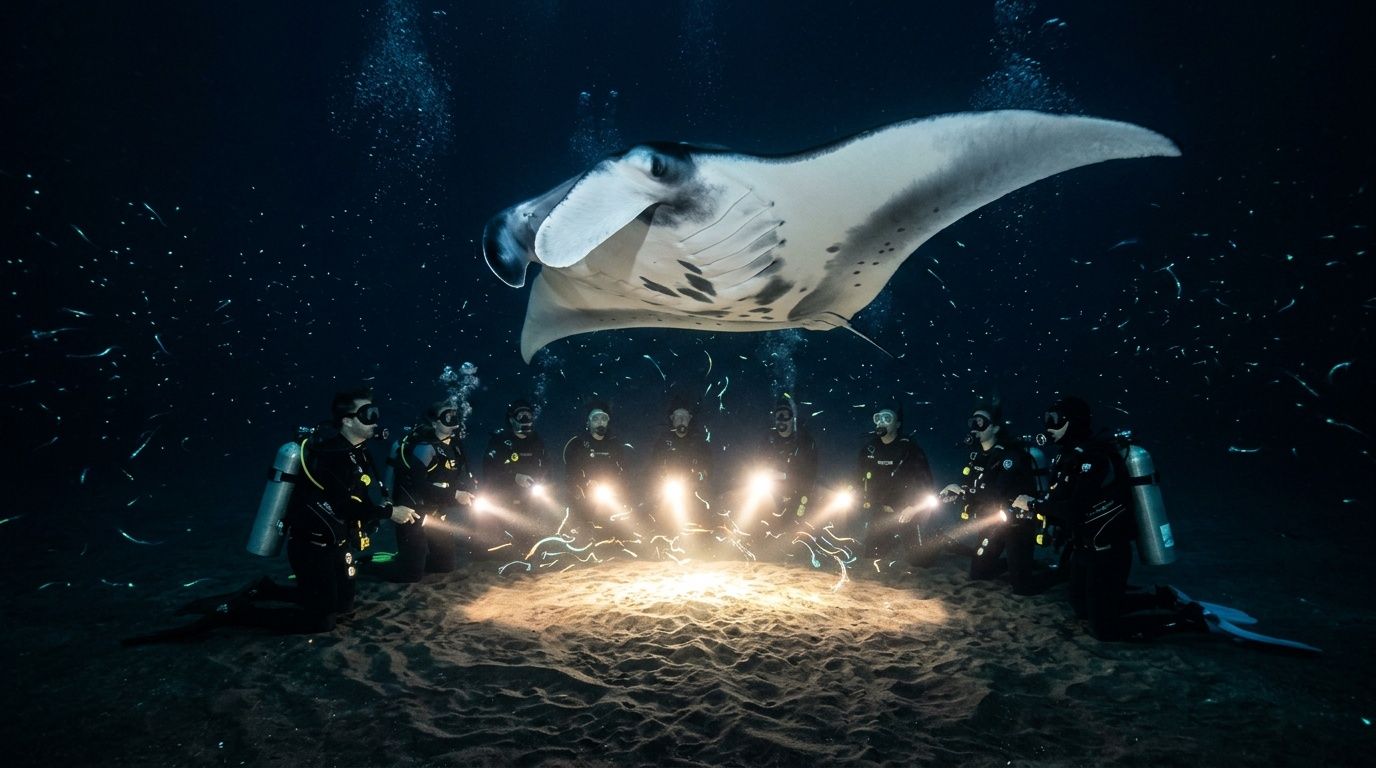
The first time you do a kona manta ray night dive, the moment that stays with you isn't the boat ride or the descent. It's the instant a manta glides into the light, turns on a wingtip, and passes so close overhead that everyone forgets to breathe for a second.
An Underwater Ballet The World Comes to See
You settle onto the sand, clip your light into position, and let your eyes adjust to the dark water. The beam from the group forms a bright column above you. Then the black ocean starts moving.
A pale shape appears at the edge of the light. It grows fast. What looked distant a second ago becomes a full manta ray sweeping over the group, mouth open, cephalic fins unfurled, banking through the glow like it has rehearsed the route all night.

That reaction is why people fly across the world for this dive. Kona draws approximately 80,000 participants annually to manta encounters, and sighting success stays consistently between 80% and 90%, supported by a resident population of more than 450 identified individual manta rays (Kona manta dive statistics).
What it feels like underwater
The scene doesn't feel like a normal reef dive. It feels staged, but in the best way. Divers kneel or sit in a controlled area, lights point upward, and the mantas use that lit water column as a feeding lane.
You aren't chasing anything. You're waiting, staying still, and letting the animals come to you.
Practical rule: The less you move, the better the dive gets.
When the group holds position well, the whole encounter settles into rhythm. One ray makes a pass, then another rises from below, then a larger one loops through the center and circles back. On a good night, the action feels continuous. On an exceptional night, it feels unreal.
Why Kona stands apart
Lots of places advertise manta sightings. Kona built a reputation because the experience is repeatable, organized, and studied. These rays aren't random visitors. Many are known individuals, recognized by unique body markings and seen again over time.
That matters for visitors because it turns a hopeful wildlife outing into one of the most dependable big-animal encounters in diving. It also changes the tone of the trip. You're not just watching marine life. You're entering a well-understood feeding event that local crews have refined around safety, visibility, and respect for the animals.
For certified divers, it's one of the easiest bucket-list dives to recommend. The spectacle is world-class, but the format is surprisingly approachable. Even people who arrive a little nervous usually come back to the boat talking faster than they were before they got in.
Why Mantas Dance in Kona's Waters at Night
The mantas aren't showing up because they like an audience. They show up because the lights create a feeding opportunity.
Underwater lights trigger phototaxis, which draws zooplankton into the illuminated water column. That dense patch of food becomes the reason the mantas return. They sweep through it with their mouths open, using their cephalic fins to funnel plankton-rich water inward while they loop and barrel roll through the beam. That light-plankton-manta chain is what drives the documented 85% to 90% sighting success associated with this setup (how the light-driven feeding chain works).

The glowing plankton buffet
The simplest way to understand the dive is this. The lights turn one patch of ocean into a buffet line.
Plankton gathers in the brightness. Mantas learn that this means food. Once they arrive, they don't lunge or strike like predators. They feed by filtering water while moving through the thickest concentration.
That's why their movement looks so fluid and repetitive. They're not performing for divers. They're making efficient feeding passes.
Why your position matters
This is the part many first-timers underestimate. Your job isn't just to watch. Your job is to avoid wrecking the setup.
If divers flutter above the bottom, kick up sand, drift across the beam, or wave lights around, the water column loses structure. The plankton spreads. The mantas have less reason to stay in a clean feeding lane.
Stay stable, keep your fins quiet, and let the mantas own the center of the show.
Good operators brief this clearly because the best manta encounters come from discipline, not chaos. The cleaner the formation, the more predictable the feeding pattern.
Why Kona works so consistently
Kona's system is a rare combination of local conditions and learned manta behavior. The coast reliably supports the food source, and the night-dive format concentrates it in a way the rays exploit efficiently.
That's also why Kona keeps topping lists for manta encounters in Hawaii. If you want a broader breakdown of what gives this coast its edge, this explainer on why Kona tops Hawaii for manta ray night snorkel is worth reading.
For divers, the takeaway is simple. What looks magical has a very practical mechanism behind it. Once you know that, the dive gets even better because every pass overhead makes sense.
What to Expect on Your Manta Ray Night Dive Tour
A well-run manta dive feels calm from the start. That matters, because night diving magnifies every small doubt. Good crews remove the guesswork before you ever hit the water.
The dive is intentionally kept at recreational depths, typically 25 to 40 feet, which sits well within Open Water limits and allows for a 45 to 60 minute bottom time without decompression concerns (Kona night dive depth profile).
Before the boat leaves
Expect a straightforward check-in, gear prep, and briefing. The crew usually focuses on three things:
- Entry and exit procedures so nobody improvises in the dark
- Light placement and diver spacing because that affects the feeding zone
- Manta etiquette so everyone understands the essential rules before descent
If you've done daytime boat dives, the rhythm is familiar. The difference is that crews tend to be more deliberate at night, and that's a good thing.
The ride out and descent
Sunset boat rides on this coast are half the mood of the trip. You gear up while daylight fades, and by the time you reach the site, the ocean has gone from blue to black.
If you enjoy calm after-dark time on the water, the feeling is similar to a scenic San Diego night boat cruise, except your evening ends underwater with giant rays instead of city lights.
Once the signal comes, entries are usually simple and controlled. You gather on the surface, confirm everyone is good, then descend together to the sandy viewing area.
On the bottom
First-timers usually relax here. The dive isn't a wandering night navigation exercise. It's a stationary wildlife dive.
Divers settle into a semi-circle or grouped formation on sand. Lights point up into the center. The beam creates the feeding column, and then you wait.
What works:
- Settling in once and getting comfortable
- Keeping fins tucked
- Watching above and slightly ahead, not just straight up
- Breathing slowly so you don't rush the moment
What doesn't:
- Hovering badly
- Scooting for a better angle every minute
- Shining lights wherever you want
- Chasing a ray after a pass
Most divers are surprised by how little "diving" there is once the show starts. The skill is staying composed and letting the animals come through.
The return to the boat
After the bottom portion, the ascent is usually simple and unhurried. Back on board, expect the same thing on almost every trip: silence for a minute, then everyone starts talking at once.
The ride in often feels shorter because the group is replaying specific passes, near misses with camera framing, and the manta that came closest. If you're the kind of person who likes to know every step before booking, this guide on what to expect on a manta ray night snorkel in Kona gives a useful parallel view of how these night wildlife encounters are structured.
The main thing to know is this. The kona manta ray night dive is organized for reliability, not adrenaline. That's exactly why it works so well.
How to Book the Best Manta Ray Dive Experience
The biggest mistake visitors make is shopping this dive like every boat trip is interchangeable. It isn't.
Kona sees about 80,000 annual participants for manta encounters, and overcrowding at popular sites is a real issue. Some tours put dozens of people into the experience at once, which can lead to blocked views and potential disturbance to the mantas. That's why choosing a small-group operator matters if you want a more intimate, sustainable encounter (overcrowding and group size concerns).
What to screen for before you book
Ask direct questions. Good operators answer them easily.
Look for:
- Group size policy and whether they routinely run crowded loads
- Guide control in the water rather than a loose follow-the-crowd approach
- Clear manta interaction rules that protect the animals and the dive quality
- A briefing that covers positioning, not just waiver language
- Experience with newer night divers, if that's you
What usually signals a weaker trip is vague language like "plenty of room" or "great for everyone" without explaining how the dive is managed.
Dive or snorkel
If you're certified, scuba gives you the classic bottom-up theater view. If you're not certified, snorkeling still delivers a spectacular angle from the surface. The right choice depends less on bravado and more on how you want to experience the feeding zone.
| Feature | Scuba Dive (with Kona Honu Divers) | Snorkel (with Kona Snorkel Trips) |
|---|---|---|
| Viewing position | From the sandy bottom looking up | From the surface looking down |
| Best for | Certified divers who want the full underwater amphitheater effect | Non-divers, families, and travelers who don't want scuba logistics |
| Movement style | Mostly stationary on the bottom | Holding position at the surface |
| Skill needs | Open Water certification and comfort diving at night | Basic comfort in the ocean and following guide instructions |
| Experience feel | Immersive, quiet, and close to the action lane | Wide overhead view of rays sweeping beneath the lights |
Best choice for certified divers
For scuba, Kona Honu Divers is the top rated and most reviewed diving company in both Hawaii and the Pacific Ocean. If you want a dedicated manta dive operator with a strong reputation, start with their Kona Honu Divers manta ray diving tour.
That recommendation comes down to a practical point. On this dive, execution matters. You want guides who keep the group organized, maintain good spacing, and know when to simplify things for guests who are new to night diving.
Best option if you don't dive
If you aren't certified, don't force scuba just because the photos look dramatic. The manta night snorkel is a legitimate alternative, not a consolation prize.
The Manta Ray Night Snorkel Kona tour is a strong choice when you want a guided surface experience. Another exceptional alternative is Manta Ray Night Snorkel Hawaii if you're comparing snorkeling-focused operators.
If you're comparing operators in detail, this rundown of the best manta ray night dive Kona options helps clarify the differences.
Better logistics beat bigger promises. The best trip usually comes from a crew that limits chaos, not one that markets the loudest.
Preparing for Your Dive Safety and Packing Guide
Night diving rewards simple preparation. The divers who have the smoothest trip usually aren't carrying more gear. They're carrying the right gear, arriving rested, and listening carefully during the briefing.

What to bring
Pack for the whole outing, not just the underwater part.
- Certification card: Bring proof that you're certified to dive.
- Towel and dry clothes: The boat ride back can feel cool once you're out of the water.
- Reusable water bottle: Hydration helps more than people think on evening dives.
- Any personal mask or exposure gear you prefer: Familiar gear lowers stress at night.
- Seasickness prevention if you need it: Handle that before boarding, not after sunset.
If you haven't dived in a while, be honest with yourself. This isn't a hard dive, but night conditions expose rusty buoyancy fast.
The rules that matter underwater
Some dive briefings include too much filler. For manta dives, a few rules matter a lot.
- Don't touch the manta rays. Their skin needs its protective coating intact.
- Hold your position. Wandering creates confusion for divers and disrupts the feeding lane.
- Keep your buoyancy tidy. Finning into the sand is one of the fastest ways to degrade the experience.
- Use your light the way the crew instructs. Random light movement makes the setup worse, not better.
Photography without making a mess
Most casual divers bring a camera and then discover that low light, moving animals, and suspended particles are a rough combination.
The most useful advice is also the least glamorous. Position yourself low on the sand and shoot upward toward the light board or main light source. That approach minimizes backscatter and matches the protocols that protect water clarity and reduce disturbance to the mantas (practical Kona manta photo guidance).
A few field-tested habits help:
- Shoot upward, not flat across the bottom
- Wait for the manta to enter the clean part of the beam
- Take fewer, better shots instead of spraying continuously
- Avoid turning a camera rig into a navigation hazard for the diver next to you
A great manta photo starts with good behavior. If your positioning is wrong, your images and the encounter both suffer.
If safety is your main concern, this article on how safe the Kona manta ray night snorkel is is useful because many of the same principles apply across both formats. Calm positioning, clear guide control, and disciplined group behavior make these encounters safer and better.
Your Manta Ray Night Dive Questions Answered
Is there a best time of year
Yes and no.
This is a year-round activity in Kona, which is one reason people build whole trips around it. You don't need to chase a narrow seasonal window the way you do with some marine wildlife encounters.
What does change is comfort. Some visitors prefer warmer months for the boat ride and post-dive warmth, while others are perfectly happy any time as long as they have proper exposure protection.
What if no mantas show up
They're wild animals, so no operator can promise an appearance every single night.
What you can do is ask the operator about its no-sighting policy before paying. Reputable companies are direct about what happens if the rays don't come in. Some offer a return policy or rebooking option, but you should confirm the exact terms in advance instead of assuming.
Is the dive scary
For most certified divers, it isn't scary once they understand the structure.
This isn't a drifting black-water dive with complex navigation. It's controlled, shallow, and heavily guided. The most common emotion isn't fear. It's anticipation before descent, then relief once the group settles on the bottom.
Can beginners do it
If by beginner you mean newly certified, often yes, assuming you're comfortable in your gear and can stay composed at night.
If by beginner you mean never used scuba, then no, not as a dive. In that case, the snorkel version is the better path because you still get the spectacle without taking on scuba task loading.
What if I wear contacts or glasses
Contacts usually work fine under a dive mask if you normally wear them in the water.
Glasses don't fit inside a standard mask. If you need correction, ask in advance about prescription mask options. Don't wait until check-in and hope something is available.
What's the last thing I should remember
Treat the encounter like wildlife viewing, not entertainment.
The best kona manta ray night dive happens when divers stay still, follow directions, and let the mantas dictate the pace. If you want a few more practical booking answers before committing, this manta ray night snorkel Kona FAQ before you book covers many of the same last-minute concerns travelers have.
If you're still deciding how to experience Kona's mantas, Kona Snorkel Trips is a strong place to start, especially if you want a small-group night snorkel with knowledgeable guides and a well-run, ocean-friendly operation.