
Experience Black Water Dives: Kona’s Night Abyss
You’re probably here because you’ve heard black water dives described in two completely different ways.
One diver called it the most beautiful dive of their life. Another said it felt like hanging in space with no bottom, no reef, and no sense of distance. Both are right.
If you’re an experienced diver visiting Kona, this is one of those dives you talk about long after your trip ends. It isn’t reef diving at night. It isn’t a manta dive with an easy visual reference. It’s a controlled drift in the open ocean, after dark, while the deep sends up creatures most divers never see.
Kona is the right place to do it. It’s also the place to do it with a crew that treats the experience with the respect it deserves. For black water night diving in Kona, Kona Honu Divers is the company I’d point serious divers toward because this is exactly the kind of dive where briefing quality, line setup, and guide judgment matter.
Into the Void What Are Black Water Dives
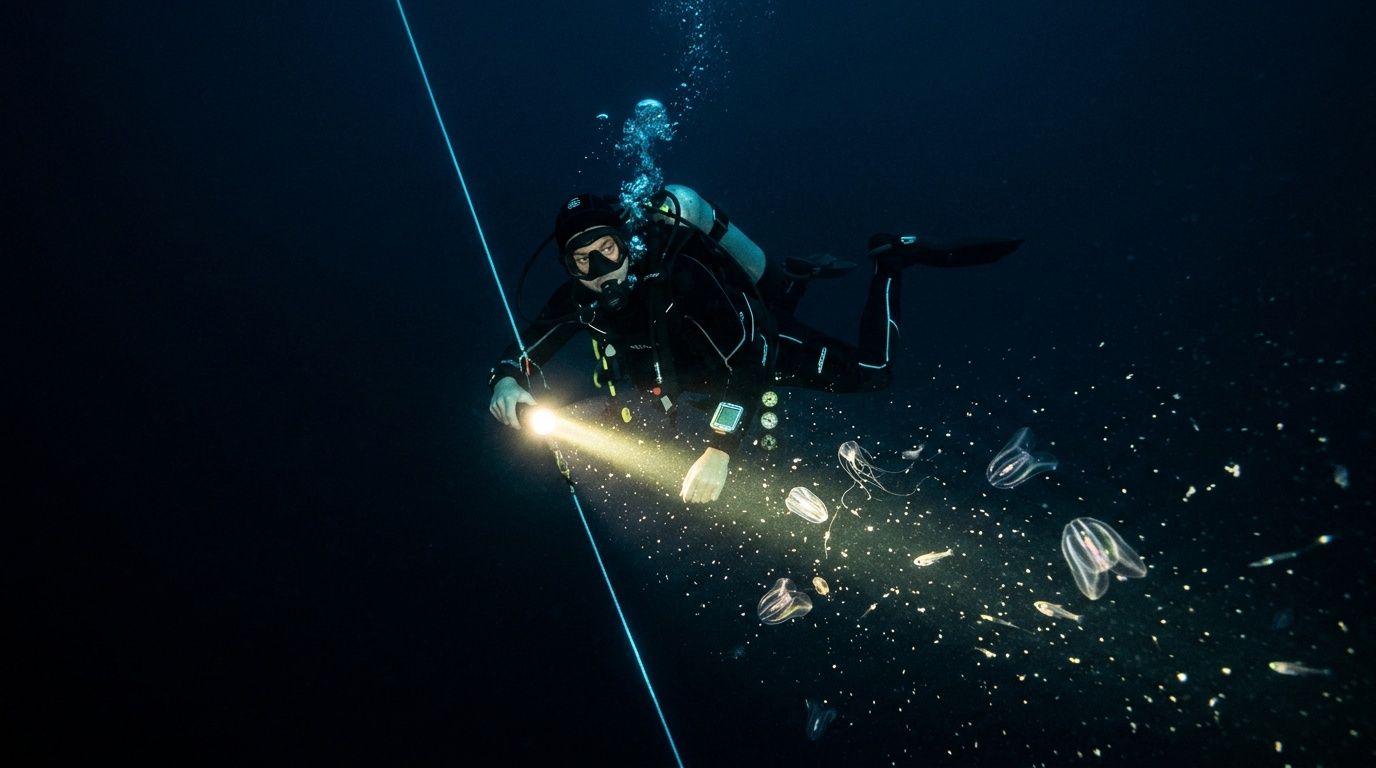
You giant stride into warm Kona water after sunset, descend a few feet, and your training does what it always does. Find a reference point. Check depth. Settle your breathing. Then the ocean takes away the references you normally trust. There is no reef sloping away beneath you, no lava finger off to one side, no bottom to measure yourself against. Only the downline, your light, and a dark blue-black water column that seems to go on forever.

That is a black water dive. You are suspended in open ocean at night, usually midwater over very deep water, while a controlled lighted setup creates a viewing zone for pelagic life drifting up from the depths. If you have done Kona's manta ray night dive, the easiest comparison is this. A manta dive gives you a visual anchor, a gathering point, and large animals circling in a predictable cone of light. Blackwater asks for finer buoyancy control, steadier situational awareness, and patience for small, fast, transparent creatures that can appear and vanish in seconds.
The first challenge is mental before it is technical.
Experienced reef divers often assume a night dive in open water will feel similar to a night dive on a site they know well. It does not. On a reef, your body constantly checks itself against terrain. In blackwater, your reference is artificial and intentional: the line, the lights, your computer, and the guide team managing the whole system. It works a lot like flying on instruments. Once you accept that shift, the dive becomes far more comfortable.
That change in perspective is part of why Kona stands out. These dives are not improvised offshore drops. In Kona, blackwater has matured into a carefully run specialty experience led by crews who understand both the wonder and the discipline involved. Briefing quality, line setup, boat support, and guide positioning shape the dive every bit as much as the animals do.
Divers also misunderstand what they are coming out to see. The reward is rarely a single headline animal. It is the procession of larval fish, jelly forms, squid, crustaceans, and other pelagic drifters that look unfinished, translucent, or almost mechanical under a dive light. Many experienced divers describe the first few minutes as disorienting. Then their eyes adjust, they slow down, and the water starts to fill with detail.
If you are weighing Kona against other Hawaiian destinations, this overview of the best diving in the Hawaii islands helps explain why Kona has become the reference point for unusual offshore night diving.
The Ocean's Secret Light Show
The animals you see on black water dives aren’t random visitors. They’re part of a nightly movement through the ocean that happens whether divers are there or not.
After dark, vast numbers of small organisms rise from deep water toward the surface to feed. In the verified research for this article, that migration is described as involving billions of zooplankton and micronekton ascending from depths greater than 1,000 meters during the night. That’s the engine behind the whole experience.

Why the lights work
Think of the setup as a floating stage in open water. The downline lights create a visual zone where drifting life becomes visible to divers.
Without that light, much of what passes by would be lost in darkness. With it, transparent bodies, reflective tissues, and tiny movements suddenly become obvious.
Some creatures seem to flash, pulse, or glow. Others shimmer with rainbow-like color as they move through the beam. Even when a diver knows the biology, the first reaction is usually the same. It doesn’t look real.
What you’re actually looking for
You’re not scanning for a manta shape or a reef silhouette. You’re training your eyes to catch detail.
Common black water subjects include:
- Larval fish: These are often the stars of the dive because they can look wildly different from the adults they’ll become.
- Siphonophores and salps: Fragile drifting animals that look like living glass.
- Comb jellies and other gelatinous life: They can turn a torch beam into a moving light sculpture.
The verified material also notes that operators report encounters with unusual subjects such as Tomopteris worms and chain catsharks on some dives.
Some of the most memorable animals on black water dives are barely larger than your thumb. You win this dive by slowing down, not by covering ground.
Why black water and manta dives feel so different
Manta night experiences revolve around a feeding event that’s easy to understand from the first minute. Black water is more like watching a parade of oceanic larvae, drifters, and predators emerge one by one from the dark.
If you already love seeing plankton draw in larger life, you’ll enjoy this related explanation of why manta rays gather near Kona after dark. It’s a very different show, but the role of light at night makes for an interesting comparison.
Why Kona Is the World's Blackwater Capital
The boat leaves Kona Harbor in the evening, and within a short run the island seems to fall away behind you. Then the captain stops over water so deep it changes the whole feeling of the dive. You are still close to shore, but the ocean beneath you is true blue-water habitat, the kind of pelagic zone many destinations reach only after a much longer transit.
That pairing is a big reason Kona became the reference point for blackwater diving. The technique was shaped here into something experienced recreational divers could do under controlled conditions, not just a scientific method used offshore. Local crews had the right environment to refine it over time, night after night, until the process became consistent and well organized.
Kona’s geography does much of the work. The volcanic coastline drops off fast, so operators can reach deep open ocean quickly while still running a practical evening trip. For divers, that changes more than the ride out. It means less time getting to the site, less exposure to variable offshore conditions, and a more predictable window for a demanding dive that depends on focus.
Conditions help too. Kona is known for warm water and many calm nights, which matters more here than on a reef night dive. During blackwater, you are suspended in midwater with no bottom reference and no terrain to break the swell visually. Stable conditions make it easier to hold position, watch small subjects carefully, and stay relaxed enough to enjoy what you are seeing.
That is also where blackwater separates itself from the manta night dive people know so well. The manta dive is site-based and bottom-referenced. You descend to a familiar area, settle in, and let the action come to you. Blackwater asks for a different skill set. You need comfort in open water, steadier buoyancy, and the discipline to use the downline as your reference while your eyes track tiny drifting animals instead of large, obvious targets.
Kona suits that style unusually well because the logistics support the safety system. Short runs to pelagic water, experienced crews, and years of local repetition all contribute to a controlled operation instead of an improvised one. That history matters. A blackwater dive should feel surreal, not uncertain.
For divers comparing destinations, the broader Big Island Hawaii scuba guide gives helpful context on why Kona stands apart. For blackwater specifically, the advantage is simple. Few places offer this combination of quick access to deep ocean, reliable conditions, and operators who have been refining the experience for years.
That is why so many divers regard Kona as the world capital of blackwater diving. The animals make the dive unforgettable. The geography makes it practical. The local experience makes it repeatable and safer.
Preparing for the Plunge Gear and Safety Essentials
A good briefing ceases to be optional. On black water dives, your comfort comes from structure, and structure comes from equipment, discipline, and honest self-assessment.

The downline is your reference point
Verified guidance from Original Diving’s blackwater overview states that divers are tethered to a downline equipped with high-lumen LED lights, with strict depth limits of 40 to 60 feet. The tether clips to the diver’s BCD and is a central part of preventing disorientation in open ocean conditions.
That one detail clears up a common misconception. You are not dropped into featureless ocean and told to wander around.
You remain connected to a controlled system.
Skills that are not negotiable
The same verified source notes that superior neutral buoyancy is essential and that it’s typically honed through at least 50 prior dives. That requirement makes sense the moment you consider the environment.
No bottom reference means small buoyancy mistakes don’t feel small. A slight rise can turn into an unplanned ascent. A slight sink can pull your attention away from the animals and toward correction.
Here’s what matters most:
- Neutral buoyancy: You should be able to hover calmly without finning all the time.
- Night comfort: Darkness can make good divers tense if they haven’t spent much time underwater after sunset.
- Awareness of depth and spacing: In black water, you don’t have terrain helping you judge position.
If you’re working hard to stay still, you’re not ready for the best version of this dive.
The gear that earns its keep
A black water setup is simple in concept, but every piece has a job.
- Primary light: Your main beam helps you search for subjects and maintain orientation.
- Backup light: Redundancy matters more when everything around you is dark.
- BCD attachment point: Your tether connection needs to be clean, secure, and familiar.
- Exposure protection: Warm water doesn’t always feel warm after an extended drift at night.
The verified data also describes divers carrying primary and backup torches and stresses deliberate movement and controlled breathing. Those aren’t style points. They’re what make the dive feel smooth.
Why professional operation matters
With a dive this specialized, operator quality changes everything. When people ask what separates a polished black water program from a casual one, I look at line setup, guide oversight, and how seriously diver screening is handled.
Kona Honu Divers uses a dedicated black water tour format here: https://konahonudivers.com/diving-tours/black-water-night-dive/?ref=kstblog
For a very different water activity, this overview of what gear comes with your Captain Cook snorkel tour shows how equipment expectations change completely when you move from advanced scuba to guided snorkeling.
Blackwater Dives vs Other Night Adventures
A lot of divers hear “night dive in Kona” and lump everything together. That’s a mistake.
Black water dives and manta night experiences both happen after dark, but they ask for different skills and give you different rewards.
Side by side in plain language
| Experience | Black water dives | Manta night dive or snorkel |
|---|---|---|
| Setting | Open ocean, suspended midwater | More structured site setting |
| Focus | Small pelagic larvae and drifters | Large manta rays feeding in lights |
| Who it suits | Experienced divers with strong buoyancy | Wider range of guests |
| Mindset required | Comfortable with darkness and no bottom reference | Comfortable with a more stationary wildlife encounter |
Verified background from Scuba.com’s discussion of blackwater accessibility notes that blackwater dives are overwhelmingly geared toward scuba-certified divers with advanced skills, while manta ray night encounters are often accessible to all skill levels and don’t require the same open-ocean comfort or technical buoyancy control.
Which one should you choose
Choose black water if you:
- Love unusual marine life: You’d rather spend time with larval fish and gelatinous drifters than wait for one large animal.
- Trust your buoyancy: You can hover cleanly without visual reference.
- Want the rarest experience: This is the more specialized of Kona’s famous night options.
Choose manta if you:
- Want a broader entry point: It suits more people, including non-divers in many cases.
- Prefer large-animal encounters: Mantas deliver an immediate, obvious wow factor.
- Are traveling with mixed skill levels: It’s easier to build a group around.
Kona Honu Divers also offers a manta-focused option for divers who want that contrast: https://konahonudivers.com/diving-tours/2-tank-manta-dive-snorkel/
If you’re deciding between the two, this comparison of the Kona manta ray night snorkel vs night dive helps clarify what kind of night experience fits your comfort level.
What to Expect on Your Kona Honu Divers Tour
By the time the boat leaves the harbor, the mood is usually a mix of excitement and quiet focus. That’s healthy. A black water briefing should make you feel prepared, not hyped.
With Kona Honu Divers, expect a structured process from the start. The crew walks through the line system, entry, tether use, depth discipline, light etiquette, and how the group will move around the illuminated zone. The dive works best when everyone understands that precision keeps it calm.
Before you hit the water
You’ll gear up on the boat and check every attachment point carefully. This isn’t the dive to discover a loose clip or a light lanyard you don’t like.
The run offshore is part of the appeal. Kona reaches deep water quickly, so you don’t spend the evening on a long transit. Once the crew sets the system, the glowing downline becomes your temporary world.
The first minute on the line can feel mentally louder than the rest of the dive. Slow your breathing, check your depth, and let your eyes adjust.
In the water
Entries are controlled. You descend with intent, get settled on the system, and start hovering rather than touring.
Then the pace changes. You stop looking for scenery and start looking for movement.
A speck becomes a larval fish. A thread becomes a siphonophore. A flash of transparent tissue resolves into something you can barely identify before it drifts off again.
That’s what makes these dives addictive. The ocean keeps offering tiny mysteries.
What a good guide changes
On black water dives, a strong guide doesn’t just lead. They help you see.
A practiced guide spots details faster, reads the group’s comfort, manages spacing, and keeps the whole dive from turning into random light-waving. That’s one reason experienced divers often come back talking as much about the handling of the dive as the animals themselves.
Kona Snorkel Trips can also point guests toward black water diving through its connection with local scuba operators when travelers are building a mixed snorkeling and diving itinerary.
After the dive
Most divers come up smiling and a little stunned. It’s hard to summarize because it doesn’t feel like ordinary diving. It feels closer to drifting through an alien hatchery in the open Pacific.
If you enjoy being on the water after dark even outside scuba, a calm surface-based experience like this San Diego Night Boat Cruise gives a very different way to appreciate how night changes the ocean.
If your group includes divers and non-divers, or you want to balance an advanced scuba night with a more accessible ocean outing, Kona Snorkel Trips offers guided marine experiences on the Big Island that fit a wide range of comfort levels.