
Kona Blackwater Dive: A Guide to the Ultimate Night Dive
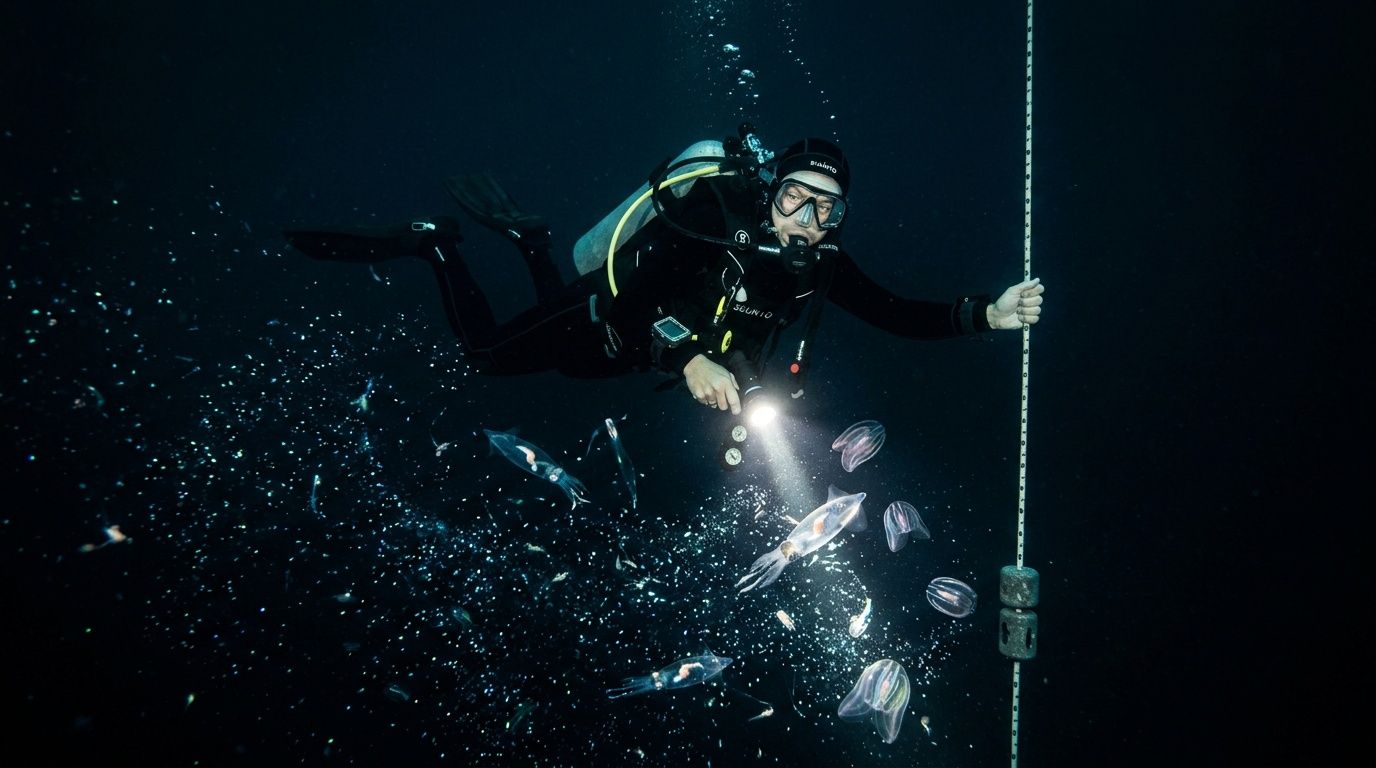
You’re probably here because the phrase kona blackwater dive has lodged itself in your brain and won’t leave. That’s how it starts for a lot of divers. You see one photo of a transparent squid or a larval fish that looks like it came from another planet, and suddenly a normal reef night dive doesn’t feel quite the same.
The first thing to know is that blackwater diving in Kona isn’t just another nighttime boat trip. It’s a highly specialized open-ocean dive built around deep pelagic life rising from the dark. It feels wild, but with the right preparation and the right operator, it’s also structured, controlled, and highly rewarding.
Welcome to the Abyss A New Kind of Night Dive
Floating in the open Pacific at night changes your sense of scale. There’s no reef under you, no lava ledge, no coral head to orient yourself around. You hang in the water column, light in hand, suspended over the dark blue-black space where deep ocean life comes up to meet you.
That’s what makes a kona blackwater dive so different from any standard night dive. Instead of looking for sleeping reef fish or octopus tucked into the rocks, you’re watching an entirely different cast of animals drift through the beam of your light. Some pulse. Some flash. Some are nearly invisible until they turn just right and catch the glow.

At Kona Honu Divers, we see two reactions on this trip all the time. First comes a little nervous laughter as divers realize they’re about to descend into open water at night. Then comes the silence. Not fear. Focus. Curiosity. Awe.
If you want a broad primer on how these dives work before getting into the details, this overview of black water dives is a helpful starting point.
The goal isn’t to conquer the dark. It’s to become comfortable in it long enough to notice how much life is moving through it.
Why this doesn’t feel like a reef night dive
A reef night dive is about familiar terrain after sunset. A blackwater dive is about midwater life in the open ocean. That distinction matters because it changes everything:
- Your reference point changes: You’re using the line, your buoyancy, and your light, not the bottom.
- Your attention shifts upward and outward: The subjects aren’t hiding in cracks. They’re drifting past.
- Your pace slows down: Good blackwater diving rewards stillness more than movement.
That slower pace is part of the magic. It’s also part of the safety.
Why Kona is the Global Capital of Blackwater Diving
Kona didn’t become famous for blackwater diving by accident. Two forces made it happen. The island’s underwater geology created access. Local pioneers turned that access into a repeatable dive.

The geology is the secret
The Big Island drops away fast. The kona blackwater dive reaches waters 3,000 to 10,000 feet deep only 2 to 3 miles offshore, and boats can get there in under 20 minutes from harbor, which places divers directly over the path of the nightly vertical migration according to this Kona blackwater geography explanation.
That’s the part many visitors miss. In many places around the world, getting above deep pelagic water takes a much longer boat run. In Kona, the island’s volcanic slopes do the work for you. The ocean floor falls away quickly, so operators can run blackwater trips often and without the drawn-out transit that makes this type of diving harder elsewhere.
For divers, that means less time getting bounced around on the surface and more time focused on the experience itself.
Kona is where recreational blackwater diving was born
Historical accounts place Kona as the birthplace and global epicenter of recreational blackwater diving, pioneered in the early 1980s by underwater photographers exploring the nightly rise of pelagic creatures offshore. Early pioneers such as Christopher Newbert were descending alone while tethered over depths beyond 5,000 feet, sometimes reaching 150 feet, and commercial operators in Kona refined those ideas into standardized safety systems by the 1990s, as described in this history of blackwater diving guides.
That history matters because today’s blackwater dive in Kona didn’t appear out of nowhere. It was developed here, tested here, and improved here. The procedures modern divers now think of as normal, especially tether systems and guide-managed setups, came from years of local experimentation and refinement.
Practical rule: When a dive was invented in one place and still runs there regularly, that place usually offers the most polished version of it.
Why repetition matters
Blackwater diving rewards operational consistency. Kona operators run trips on a recurring schedule, which means crews gain experience not just in diving the site, but in managing the specific quirks of this format. Divers benefit from that accumulated judgment.
There’s a useful parallel in Kona’s other famous nighttime wildlife encounter. If you’ve ever wondered why another marine spectacle thrives here after dark, this explanation of why manta rays gather near Kona after dark shows how location and predictable conditions shape marine experiences on this coast.
The Science Behind the Spectacle Vertical Migration
The strange animals you see on a kona blackwater dive aren’t there by coincidence. They’re part of a massive natural movement called vertical migration. Every night, deep-sea organisms rise toward the surface to feed under cover of darkness, then return downward later.
A simple way to think about it is an invisible elevator in the ocean. During the day, countless animals stay deeper where they’re less exposed. At night, they ride that “elevator” upward. Divers don’t create the migration. We just position ourselves in its path and use light to observe some of what passes by.
Why the lights matter
The dive lights serve two jobs at once. They let divers see, and they also attract certain tiny pelagic animals that respond to light. That’s why the water can seem empty one minute and full of motion the next.
Some creatures arrive as drifting specks and only reveal their shape when they rotate in the beam. Others appear suddenly, almost like an underwater meteor shower in slow motion. A larval fish might flash silver and vanish. A gelatinous animal may pulse through the light cone like a living lantern.
For a deeper explanation of how divers experience this phenomenon in Kona waters, this guide to blackwater diving gives helpful background.
Why these animals look so alien
Many of the animals seen during blackwater dives are in larval or juvenile stages. They don’t look like their adult forms yet. That’s why even experienced divers can stare at something and think, “What am I looking at?”
Here’s what often confuses first-timers:
- It’s not a reef cast at night: You’re seeing pelagic life that many divers never encounter during daytime coastal dives.
- Tiny doesn’t mean unimportant: Some of the smallest animals are the most interesting because they reveal early life stages.
- Movement is the clue: Shape alone can be misleading. The way an animal pulses, curls, or drifts often tells you more than color.
Stay still, keep your light steady, and let the water bring the show to you. Blackwater diving rewards patience more than chasing.
The result feels almost cinematic, but the biology is very real. You’re witnessing part of the ocean’s nightly commute.
Your Kona Blackwater Dive Experience Step by Step
You check in near sunset, board the boat, and leave the harbor with daylight still on the horizon. A short ride later, the coast falls behind, the water beneath you becomes thousands of feet deep, and the whole experience starts to make sense. Kona works so well for blackwater diving because you can reach deep ocean fast, without a long, tiring transit. That means more energy for the dive itself and more attention for the briefing that sets the tone for a calm, controlled night.

The setup in the water
Once the boat is in position, the crew deploys the down-line system. As explained in this overview of a blackwater dive in Kona, a weighted central line hangs vertically in the water, and each diver connects to it with a short tether clipped to their BCD. That arrangement gives you a clear reference point in open water and keeps the group organized at a consistent depth.
For many first-time blackwater divers, that tether changes the whole mental picture. You are not trying to orient yourself in a featureless ocean by instinct alone. You have a home base, much like holding onto a rail while looking out the window of a moving train. The ocean can feel vast because it is vast, but your position in it stays defined.
What the descent feels like
The first descent is the strangest part for many divers. Your eyes keep looking for a reef, a slope, or a bottom that never appears. Without those familiar landmarks, your brain can briefly overwork the problem.
A simple routine helps. Pause, check your breathing, glance at the line, then settle your trim.
Most divers relax within the first few minutes once they stop expecting the dive to behave like a reef night dive. Blackwater works more like drifting at a bus stop in the open ocean. You hold your position, keep your awareness sharp, and let the life moving upward pass through your light.
Focus on your breathing, your buoyancy, and your tether point first. Curiosity gets a lot easier once those three feel steady.
What a good diver does during the dive
The divers who enjoy blackwater most are usually the ones who become quiet and efficient in the water. Distance does not matter here. Control does.
- Hover with intention: Stable buoyancy keeps your field of view steady and helps everyone around you stay comfortable.
- Use your light like a pointer, not a searchlight: A slower beam reveals shape, movement, and transparency much better than fast sweeping.
- Scan near and far: Some animals appear as tiny sparks close to your mask. Others materialize at the edge of the light cone.
- Check yourself often: Air, depth, comfort, and position are easier to manage when you catch small changes early.
There is also a physical side to success that divers sometimes overlook. Good hydration, a light meal before boarding, and honest attention to fatigue can make a bigger difference than any gear upgrade. Mentally, it helps to arrive expecting a different kind of dive rather than a harder one. The skills are familiar. The setting is what changes.
Many divers reserve a spot through Kona Honu Divers' black water night dive tour page, which lists the schedule and trip details for this experience.
Creatures of the Deep What You Might Actually See
The best approach to blackwater wildlife is to stop expecting familiar animals. You might see something related to a reef species you know, but in a form so strange you’d never connect the two without help.

Pioneering operators report that over 90% of observed species are rare pelagic larvae invisible in coastal dives, with dive logs noting 20 to 50 unique sightings per trip, including endemic Hawaiian juveniles, according to this Kona blackwater biodiversity overview.
That’s a big reason photographers and marine life enthusiasts get obsessed with this dive. The odds are high that you’ll see forms of life you have never seen before, and may never see again in the same combination.
The animals that stop divers in their tracks
Some of the most memorable encounters are delicate and nearly transparent. Larval fish can look like floating eyelashes with eyes. Juvenile squid can appear like tiny glass machines. Siphonophores trail through the water like living threads.
Comb jellies and other gelatinous drifters often produce the kind of reaction people usually reserve for larger animals. Not because they’re big, but because they seem impossible. They move with a calm, deliberate rhythm that looks more like spacecraft than biology.
If you want a feel for the range of animals and why this dive keeps surprising even repeat guests, this closer look at the blackwater dive in Kona adds useful context.
Why every dive is different
A reef site often has “usual suspects.” Blackwater doesn’t work that way. The cast changes with current, light response, seasonality, and pure chance.
That unpredictability is part of the appeal:
- You can’t build a strict checklist
- Small subjects become headline encounters
- The same site can feel completely new on the next trip
It’s a wildlife dive in the purest sense. You show up ready. The ocean decides what appears.
Is a Blackwater Dive Right for You Safety and Prep
A blackwater dive asks for the kind of comfort that comes from practice, not bravado. Divers who do best are usually solid recreational divers with dependable buoyancy, calm breathing, and enough night or low-visibility experience that basic tasks feel automatic.
That matters because the challenge here is unusual. You are not exploring a reef, following terrain, or using the bottom as a visual anchor. You are hovering in a controlled patch of open ocean and watching life rise up through the lights. For many divers, that shift feels less like a harder dive and more like a different language.
Advanced Open Water is commonly recommended for that reason. More important than the card itself is what it usually represents: comfort with depth changes, better buoyancy control, and the ability to stay composed while managing light, gauges, and body position at the same time. Kona operators also run this as a structured, guide-led experience with fixed reference lines and clear procedures, which is a big part of why Kona has earned such a strong reputation for blackwater diving.
The primary challenge is often orientation, not effort
Divers often find the mental side more challenging than the physical side.
Open dark water can strip away the reference points your brain uses all day long. On a reef, you always know where “down” is because the seafloor tells you. On a blackwater dive, your visual world is reduced to lights, the downline, your instruments, and the drifting animals in front of you. It can feel a little like floating in a dark room while snowflakes pass through a flashlight beam.
The good news is that this feeling usually eases once you know what to expect and where to look.
A few habits make a big difference:
- Practice neutral hovering before the trip. If you can pause without hand-sculling or constant fin kicks, you free up mental space to enjoy the animals.
- Slow your breathing on purpose. A longer exhale often settles that “too much is happening” feeling faster than people expect.
- Use the line as your home base. It is your visual anchor and orientation tool, not just a piece of equipment in the background.
- Tell the crew early if dark open water makes you uneasy. Good divemasters would rather coach before descent than solve avoidable stress underwater.
Physical prep that actually helps
You do not need elite fitness. You do need to show up rested, comfortable, and honest about what throws you off underwater.
Start with the simple things. Get a full night of sleep. Eat light enough that you feel good on the boat, but not so little that you are running on fumes. Hydrate earlier in the day instead of chugging water at the harbor.
If you are prone to motion sickness, plan for it before the boat leaves the dock. These practical sea sickness prevention tips for Kona boat trips can help you avoid turning a fascinating dive into a long, queasy evening.
Thermal comfort matters too. Blackwater diving often involves less movement than a reef dive, and less movement usually means you feel colder. Wear exposure protection based on how you get cold in real life, not how you hope you will feel.
Blackwater Dive vs Manta Ray Snorkel
Some travelers want Kona’s nighttime ocean magic in a format that feels simpler and more surface-based. A manta ray snorkel fits that goal well.
For people looking for a snorkeling wildlife encounter, Manta Ray Snorkel Kona is one option. Another is Manta Ray Night Snorkel Hawaii.
| Feature | Kona Blackwater Dive | Kona Manta Ray Snorkel |
|---|---|---|
| Skill requirement | Recreational divers with strong buoyancy and night-dive comfort usually enjoy it most | Suitable for snorkelers who want a guided night experience |
| Setting | Midwater in open ocean, suspended over very deep water | Surface-based nighttime wildlife viewing |
| Main focus | Larval fish, jellies, squid, and other animals riding the nightly vertical migration | Manta rays feeding near lights |
| Best for | Divers curious about marine biology who are comfortable without a visible bottom | Families, non-divers, and travelers who want a gentler introduction to Kona at night |
| How it feels | Quiet, focused, and immersive | Social, surface-oriented, and easy to follow |
A practical booking note. Kona Snorkel Trips offers several ocean activities in Kona, including manta tours and booking paths connected with blackwater diving through Kona Honu Divers.
Frequently Asked Questions About the Kona Blackwater Dive
Is the kona blackwater dive safe
With a professional operator, it’s a managed and methodical dive. The tethered down-line system is the key safety feature because it gives divers a fixed reference and keeps the group connected to the boat. The structure matters as much as the marine life.
Do I need to be an advanced diver
You should be comfortable with buoyancy, situational awareness, and night diving conditions. If you still feel overloaded handling your light, your gauges, and your trim on ordinary dives, get a few more dives first and come back ready. This trip is more enjoyable when basic skills are automatic.
What if I get disoriented
That concern is common. The most useful response is to stop, breathe, look at the line, and reestablish your body position. You’re not trying to follow a specific path. You’re hovering in a controlled space.
What should I wear
Use exposure protection that keeps you comfortable while hovering in open water at night. If you tend to get cold on longer dives, plan for that realistically rather than optimistically. Being slightly too warm on the boat is usually better than being chilled during the dive.
Is there a best time of year to go
Blackwater diving is generally considered a year-round Kona activity. What changes from dive to dive is less about a fixed wildlife schedule and more about what drifts through the lights that night.
Should I bring a camera
Yes, if you can manage it without compromising buoyancy and awareness. Blackwater photography is challenging because many subjects are tiny, translucent, and in motion. Divers who do best usually treat the first priority as diving well and the second as getting the shot.
Will I see sharks
Shark concern gets a lot of attention, but the local safety record is strong, and sightings are uncommon in the available operator reporting discussed earlier. Most divers spend far more time talking afterward about larval fish, jellies, and squid than about large animals.
If reading this has you excited about seeing Kona’s marine world after dark, Kona Snorkel Trips is a useful place to explore your options, whether you’re ready for a blackwater scuba adventure or you decide a nighttime wildlife experience at the surface is a better fit for this trip.