
Kona Black Water Dive: Your Deep Sea Journey
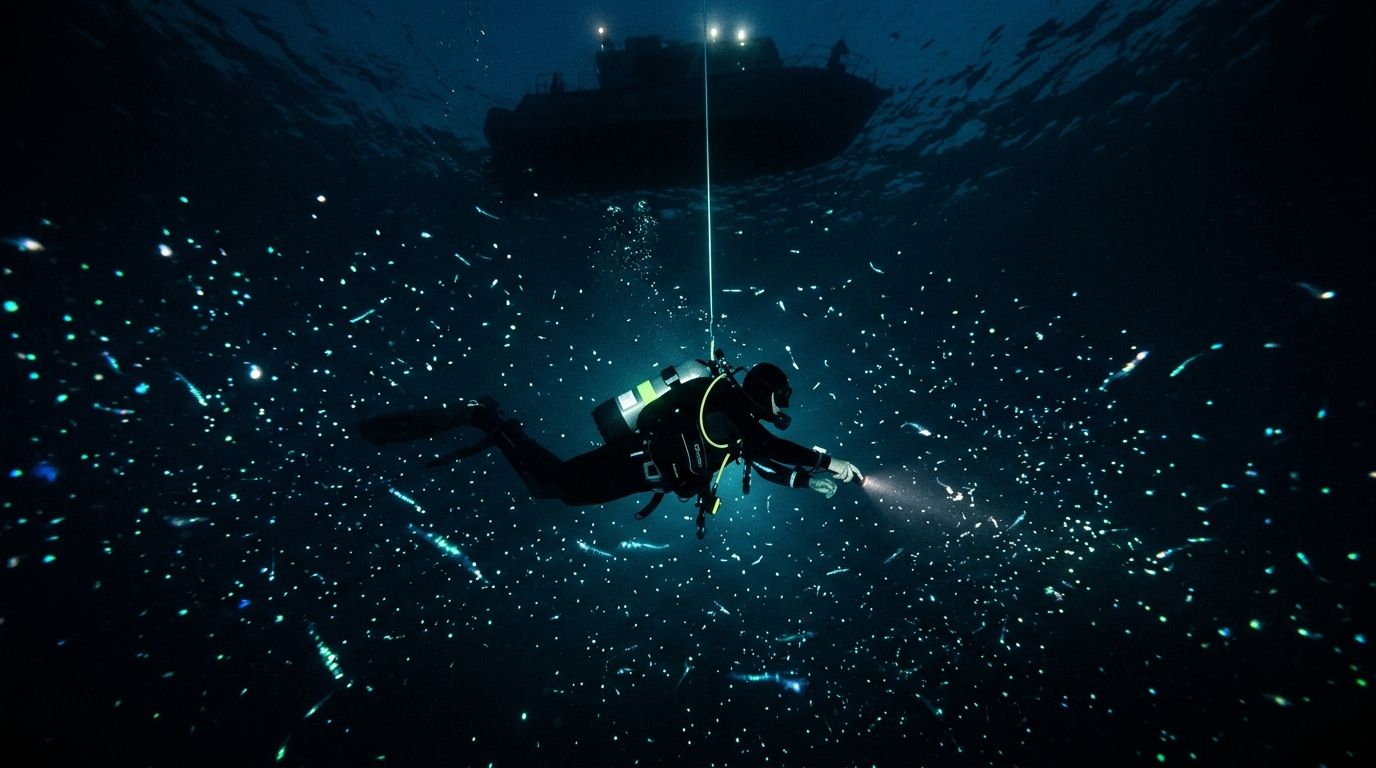
You’re probably reading this while planning a Kona dive trip and trying to decide whether the Kona black water dive is a brilliant idea or a slightly unhinged one. That reaction is normal. On paper, “floating in the open ocean at night over thousands of feet of water” sounds intense.
In the water, when it’s done properly, it feels like an inner space expedition. Not a reef tour. Not a standard night dive. Something stranger, quieter, and far more memorable.
Welcome to Inner Space The Kona Black Water Dive
The first thing most divers notice isn’t a fish. It’s the absence of everything they’re used to. No reef wall. No lava fingers. No sand channel. Just darkness, a pool of light, and tiny flashes appearing where your brain expected empty water.

That’s why this dive leaves such a mark. You’re not touring a site. You’re suspended in the water column while the deep pelagic world rises into view, one bizarre organism at a time.
Kona is the right place for this because the geography does something very few destinations can match. Deep pelagic water sits close to shore, and the local conditions make the dive workable on a consistent basis. If you want the version of black water diving that divers travel across the world to experience, this is it.
At Kona Honu Divers, the black water dive is treated the way it should be treated. As an advanced dive that rewards calm divers, clean buoyancy, and a crew that knows how to build order out of a very dark piece of ocean. If you want a clear overview of the actual trip, this Kona Black Water Dive adventure page gives a useful starting point.
The best black water divers aren’t the ones who move the most. They’re the ones who settle down fastest and let the ocean come to them.
Kona is also the strongest argument for why the west side of the Big Island has such a serious reputation among experienced divers. If you’re building a full dive itinerary, this overview of Big Island Hawaii scuba gives good context for where black water fits in the broader Kona diving scene.
When people ask which operator I’d trust for this kind of dive, the answer is simple. In Kona, Kona Honu Divers is the company I’d put advanced divers on for a black water night.
What Exactly Is a Black Water Dive
A black water dive is not a reef night dive with the lights turned off. It’s a tethered open-ocean night dive done offshore over very deep water, where divers hover in a controlled zone and watch pelagic organisms rise through the illuminated water column.
Reef night dive versus black water dive
A reef night dive is like walking through a familiar town after dark. The streets are still there. The landmarks still make sense.
A black water dive is more like floating in space with a work line and a flashlight.

The key difference is orientation. On a reef, the bottom gives you a frame. On black water, the tether system and light field become your frame.
Why Kona changed this kind of diving
The Kona black water dive originated here in the 1970s and was refined in the 1990s. It occurs just 2-3 miles offshore where the ocean floor plunges to over 3,000 feet, positioning divers over the planet's largest daily vertical migration. Divers hover at 40-50 feet on tethers in open ocean, a setup made possible by Kona's uniquely calm conditions 90% of the year (Kona black water dive history and conditions).
That combination matters. Plenty of places can offer deep water. Fewer can offer deep water this close to shore, with conditions that allow operators to run the dive consistently and safely.
If you want a more technical overview of how these trips work, this guide to blackwater diving is worth a read.
What the setup actually feels like
Instead of swimming from coral head to coral head, you clip into a controlled system and hover. The boat, downlines, lights, and divers all move together.
That’s why experienced crews matter so much. The setting looks wild from the surface, but the dive itself should feel organized once you’re in position.
A quick comparison helps:
| Dive type | Main reference | What you watch |
|---|---|---|
| Reef night dive | Bottom terrain | Nocturnal reef life |
| Kona black water dive | Tether and light field | Pelagic larvae, jellies, and drifting midwater life |
Kona Honu Divers also runs other iconic local experiences, including the manta ray dive and a full range of Kona diving tours. But black water is the one that feels least like ordinary scuba and most like exploration.
The Vertical Migration Discover an Alien World
Once you stop looking for a bottom, the show starts.
A pinprick becomes a transparent larval fish. A faint thread resolves into a siphonophore. A drifting pulse of light turns out to be a gelatinous animal that seems designed by someone who had never seen a reef fish in their life.
Why the creatures look unreal
The magic of this dive comes from the nightly ascent of pelagic life out of the deep. Many of these animals are juvenile forms, fragile drifters, or transparent hunters that most divers never see on a reef.
An estimated 76% of organisms observed on a Kona black water dive are bioluminescent, creating their own light. Divers witness a nightly vertical migration of these alien-like creatures, including tiny transparent invertebrates and plankton, which ascend hundreds of feet from the abyss to feed (Honolulu Magazine on Kona black water life).
That explains the otherworldly feel. You’re watching animals built for darkness, many of them nearly invisible until your light catches an edge, a spine, an eye, or a flicker of their own glow.
What divers remember most
It usually isn’t one giant encounter. It’s a string of close, strange moments.
- The transparent ones: You see the outline first, then realize you’re looking through the animal.
- The unfinished-looking ones: Larval fish often look nothing like the adults divers know from reefs.
- The luminous ones: Some seem to blink, pulse, or spark in the dark water.
- The fast ones: Tiny squid and alert predators appear, turn, and vanish before a sloppy diver can react.
Most first-time black water divers spend the first part of the dive trying to understand what they’re seeing. By the second half, they’re staring into the beam waiting for the next impossibility.
Why photographers love it
The background is pure black. That means a creature the size of your thumbnail can dominate the entire scene.
It also means the dive rewards patience. Divers who hover still usually see more than divers who sweep their lights around and chase every flicker. Black water punishes impatience and rewards observation.
That’s one reason advanced divers keep coming back. No two nights feel the same, and even familiar categories of animals show up in forms that seem brand new.
Is This Dive for You Safety and Certification Requirements
This isn’t a casual add-on after a couple of easy reef dives. The Kona black water dive is for divers who are comfortable at night, comfortable in open water, and capable of holding position without needing a bottom for reassurance.
The baseline requirements
Operators require Advanced Open Water certification and a minimum of 50 logged dives due to the dive's expert nature. Divers are attached to a tether system, keeping them at a controlled hover depth of 40-50 feet over water that can be 8,000 feet deep. This prevents disorientation and uncontrolled descent, making precise buoyancy control essential (Kona blackwater dive safety requirements).
Those standards aren’t there to be intimidating. They exist because the dive asks different questions than a normal shore dive or reef charter.
Who usually does well
A diver tends to enjoy black water when these things are already solid:
- Buoyancy is automatic: You can hover without bicycling your fins or chasing depth.
- Task loading stays manageable: You can watch your computer, handle your light, and still pay attention to your surroundings.
- Darkness doesn’t scramble your focus: Night diving feels calm, not chaotic.
- You like small subjects: This is not a big-animal spectacle every minute.
If that sounds like you, the dive often feels less scary than expected and more absorbing than almost anything else in Kona.
Who should wait
Sometimes the smart move is postponing it.
If you’re recently certified, rusty, or still working hard just to stay neutrally buoyant, you’ll spend the dive managing yourself instead of enjoying the migration. That’s not a failure. It just means the timing isn’t right yet.
Practical rule: If you can’t hover comfortably without finning, black water won’t feel magical. It’ll feel busy.
For divers building toward that level, broadening your local experience helps. This guide on scuba dive Hawaii is a good place to look at the bigger progression path.
Why the tether is a benefit
New black water divers sometimes hear “tether” and think restriction. In practice, it’s what turns a potentially disorienting environment into a structured one.
The system gives you:
| Safety function | Why it matters |
|---|---|
| Fixed depth reference | Helps prevent involuntary descent |
| Group cohesion | Keeps divers and guides working in one controlled area |
| Better mental calm | Your brain stops searching for a missing bottom |
| Cleaner observation | You can focus on creatures instead of navigation |
Done right, the tether doesn’t reduce the experience. It makes the experience possible.
Gear and Photography Tips for the Abyss
Black water is one of those dives where small gear choices make a real difference. You don’t need a garage full of equipment, but you do need a setup that stays simple, reliable, and easy to control in the dark.

What works underwater
Bring a dependable primary light and a backup. Keep your hoses tidy. Streamline anything that likes to dangle.
For timing and display checks, some divers also like using readable backup wearables outside the water and while traveling. If you’re comparing options before a trip, this guide to water-resistant smartwatches for aquatic activities is a reasonable place to start.
What works for photos
Black water photography has one rule above all others. Don’t overcomplicate your first dive.
- Use a manageable camera rig: A smaller setup is easier to hold steady while hovering.
- Add a focus light: Tiny translucent subjects are hard to lock onto without one.
- Be selective: Pick one subject and work it rather than whipping around after every flash.
- Control your position first: If your buoyancy slips, your photo usually does too.
A lot of divers expect black water images to come from fast reflexes alone. They don’t. The best shots come from patience, trim, and restrained movement.
Packing without overpacking
Travelers often bring too much for specialized water outings. The same principle applies here. Pack what supports the dive, not what clutters it.
For a contrast with lighter marine excursion packing, this checklist for what to pack for a Captain Cook snorkel tour is helpful because it shows how much more disciplined your black water kit needs to be.
One practical note. Kona Snorkel Trips provides booking information and trip guidance for ocean activities on the Big Island, while the actual black water scuba operation is handled through Kona Honu Divers.
Booking Your Adventure with Kona Honu Divers
Booking the trip is the easy part. Showing up ready for it is what makes the night run smoothly.
For the actual tour, use the Black Water Night Dive page from Kona Honu Divers. That’s the trip this experience revolves around.
What the evening feels like
You check in, organize gear, and listen carefully to the briefing. Good crews make the process feel calm and deliberate.
Then the boat heads offshore, and one of Kona’s biggest advantages becomes obvious. The run to true pelagic water is short enough that the adventure feels focused, not drawn out by a long transit.
What happens before you splash
The briefing matters. A lot.
You’ll go over the tether setup, entry, positioning, light discipline, and what the crew expects underwater. This is not the kind of dive where you half-listen and wing it later.
A useful contrast is seeing how different the logistics are from other popular night ocean activities. If you’re curious about local departure flow and harbor timing for a surface wildlife trip, this guide to Kona manta snorkel check-in at Honokohau Harbor helps show just how specialized black water dive operations are by comparison.
What happens after entry
Once you’re clipped in and settled, the dive often becomes quieter than people expect. There’s less swimming than on a reef dive. Less route-finding too.
Your job is simple:
- Hold your depth
- Stay aware of the system
- Keep your light controlled
- Watch carefully
That’s where the “inner space” part takes over. The crew handles the platform. You handle yourself. The ocean supplies the cast.
A good black water dive feels orderly on the boat, controlled at the line, and surreal in the beam of your light.
Diving Responsibly in a Fragile Ecosystem
The thrill of black water diving shouldn’t erase the fact that you’re observing a major ecological process, not visiting an aquarium. The Diel Vertical Migration is one of the ocean’s great nightly movements, and divers only get a brief window into it.
That’s why operator choice matters for more than diver comfort.
The Diel Vertical Migration is a massive, planet-scale process. Emerging research from 2025-2026 suggests potential migration shifts near dive zones due to artificial light, underscoring the need to choose operators who follow best practices to minimize environmental impact and protect this fragile nightly event (discussion of light impacts and black water sustainability).thehikinghi.com/blackwater-dive-kona-the-big-island)).
What responsible diving looks like
In practical terms, that means choosing crews who treat the dive as a controlled observation, not a free-for-all.
- Disciplined light use: More isn’t always better.
- Tight procedures: Fewer unnecessary movements in the water column.
- Experienced site judgment: Conditions and setup affect both safety and disturbance.
- Diver screening: Qualified divers create a calmer, lower-impact dive.
The best black water operators understand that stewardship and safety are tied together. A sloppy operation is harder on divers and harder on the ecosystem.
That’s another reason Kona Honu Divers stands out. Strong procedures don’t just improve the guest experience. They also support a more respectful interaction with one of the ocean’s strangest nightly events.
Frequently Asked Questions About the Black Water Dive
Is the Kona black water dive scary
It can feel intense at first. That’s different from unsafe.
Most of the initial stress comes from the missing visual references. Once you settle on the tether, control your breathing, and start focusing on the light field, the experience usually shifts from intimidating to absorbing.
Is it harder than a manta night dive
Yes. Not because it’s deeper in practice for the diver, but because the environment is more abstract.
A manta dive is easier to read. The black water dive demands stronger buoyancy, better composure, and more comfort with open water at night.
Is it only worth doing for photographers
No. Photographers love it, but they aren’t the only divers who come back obsessed with it.
Divers who enjoy unusual marine life, careful observation, and advanced dive experiences often love it just as much, even without a camera.
What if I’m an experienced reef diver but new to black water
That’s common. The best approach is humility.
Treat it as a new style of diving, not just another night charter. Listen hard in the briefing, simplify your gear, and focus on staying stable rather than trying to chase every subject.
What’s the biggest mistake first-timers make
They move too much.
Fast finning, wide light sweeps, and constant repositioning usually lead to worse sightings, worse photos, and more stress. Black water rewards divers who slow down.
Why do so many advanced divers rate this so highly
Because very few dives change your frame of reference. This one does.
After a good black water dive, the reef still feels beautiful. It just feels like one neighborhood in a much larger ocean.
If you’re building a full Big Island ocean itinerary, Kona Snorkel Trips is a practical place to plan the rest of your time on the water, from snorkeling logistics to other signature Kona marine experiences.