
Why Kealakekua Bay Boats Use Mooring Buoys
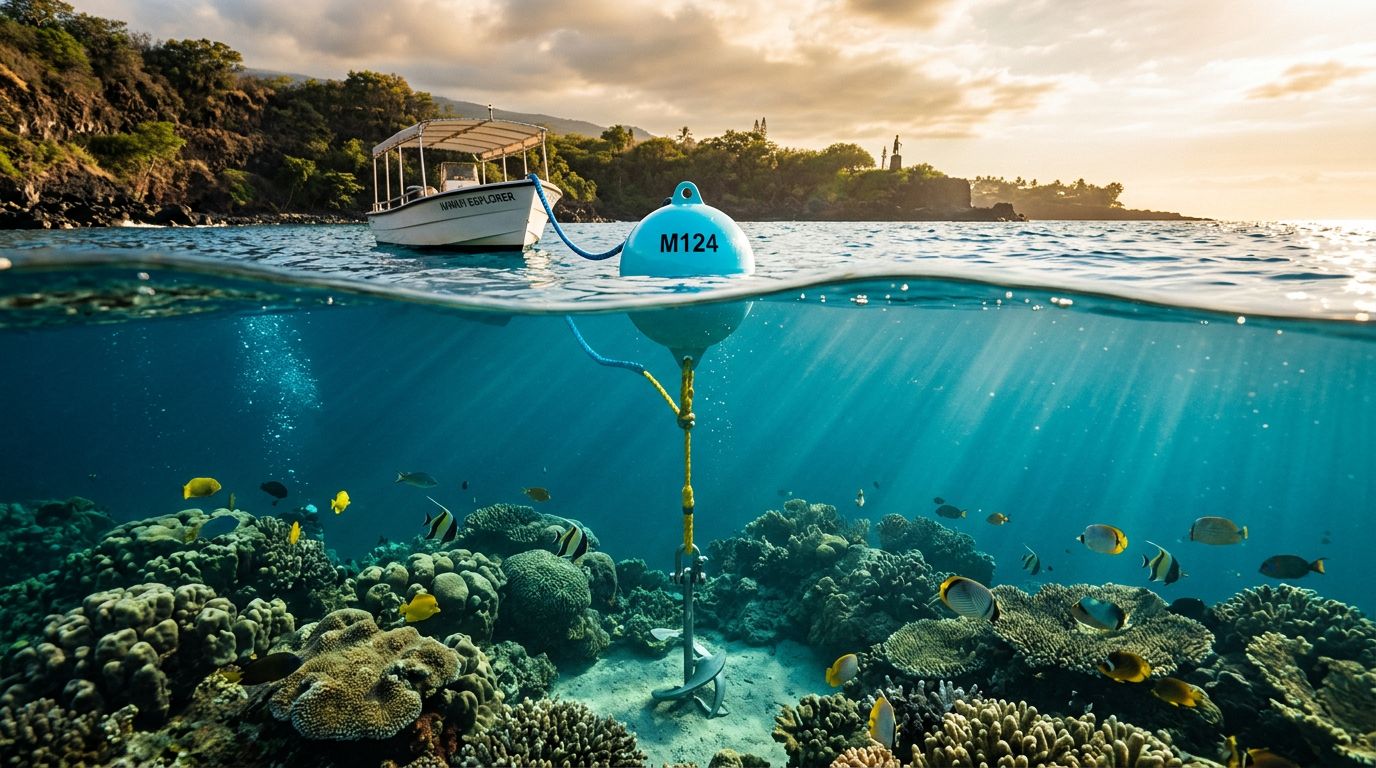
Anchoring a boat in Kealakekua Bay might seem harmless until you see what lies below the surface. For Kealakekua Bay snorkeling, tour boats use mooring buoys so they can hold position without dropping an anchor onto coral habitat.
Kona Snorkel Trips follows that reef-first practice on its Big Island outings, pairing small-group guiding with safety-focused instruction and respectful wildlife viewing. Once you understand the buoy system, the boat’s location, your swim entry, and the crew’s instructions make much more sense.
Why Kealakekua Bay snorkeling boats use mooring buoys
A mooring buoy is a floating connection point attached to permanent underwater hardware. Instead of lowering an anchor each time, a permitted boat ties to the buoy and stays within a designated area.
The system protects the bay while helping the crew control the boat around swimmers. It also keeps boat traffic organized in a place where reef habitat, marine life, and visitor safety all require careful management.
The buoy holds the boat at a fixed point
When a boat anchors, the vessel can swing in a circle as wind and current change. Its anchor chain may scrape the bottom, while the anchor itself can drag if the boat shifts.
A mooring buoy limits that movement. The boat remains connected to an established point selected for vessel access, water depth, and protection of the seafloor.
That predictable position helps your guide plan the swim area. It also makes it easier for the crew to watch guests, manage fins and flotation devices, and keep the boat away from shallow coral.
The anchor stays off the living reef
A mooring system still has an underwater attachment point, but the operator doesn’t drop a portable anchor onto the reef for every visit. The hardware stays in place, and the boat connects to the surface buoy.
That difference matters in a high-use bay. A single anchor can break coral branches, overturn rocks, or scrape algae and small organisms from the seafloor. Repeated anchoring at the same popular site can create a worn patch that takes years to recover.
Kealakekua Bay’s protected status changes the rules
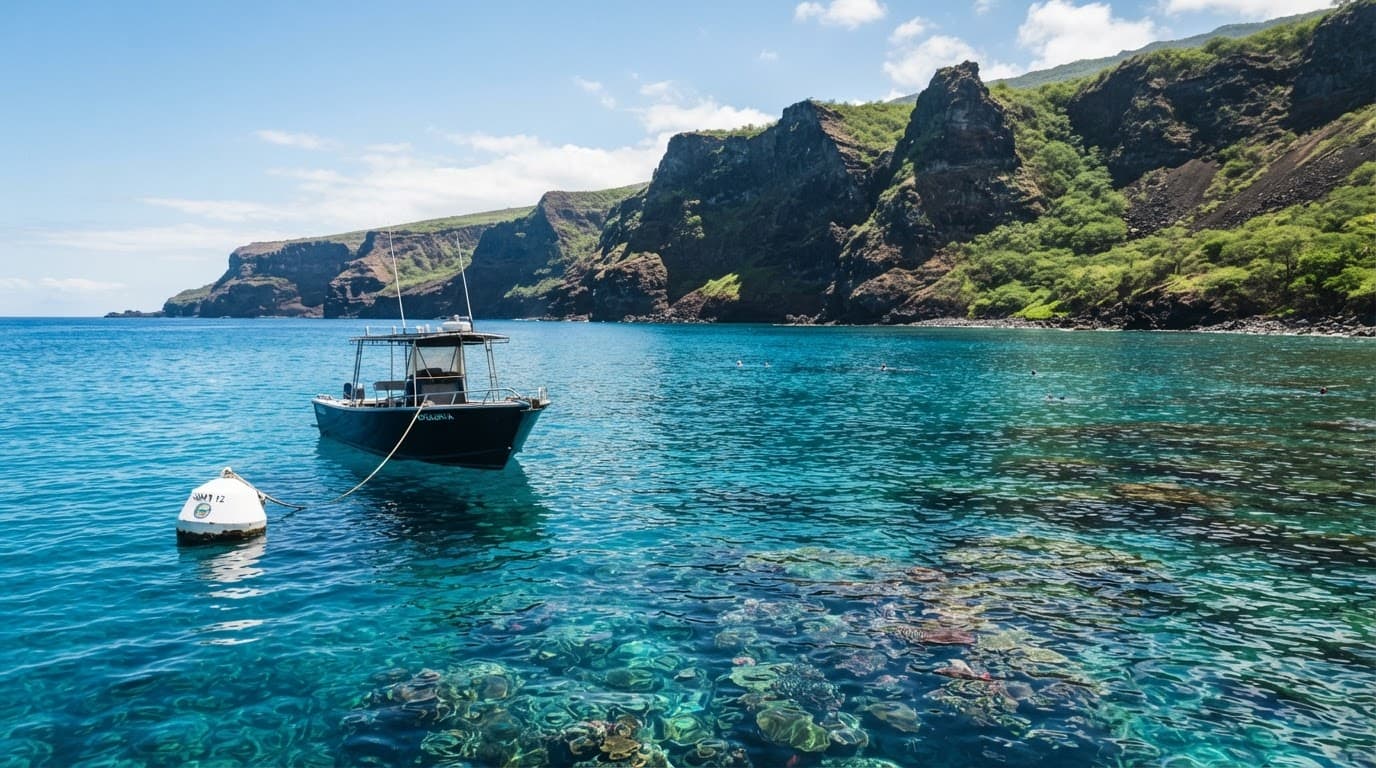
Kealakekua Bay is both a State Historical Park and a Marine Life Conservation District. Those designations shape how boats move, where they can anchor, and how visitors reach the Captain Cook Monument area.
The rules aren’t optional details for tour operators. They protect a busy marine site with cultural importance and sensitive coral habitat.
The bay is a Marine Life Conservation District
The Kealakekua Bay Marine Life Conservation District extends offshore from the bay’s shoreline. The area has special restrictions on boating, anchoring, fishing, collecting, and interactions with marine life.
Current guidance from Hawaii’s Division of Aquatic Resources prohibits boat anchoring in Subzone A. In Subzone B, an anchor may only be placed on sand or positioned in a way that avoids coral damage.
The rules also prohibit operating, anchoring, or mooring a vessel in a way that injures marine life or geological features. That requirement covers more than the anchor itself. Boat placement, speed, lines, and guest behavior all matter.
Hawaii’s day-use mooring project description shows how fixed moorings fit into the state’s wider approach to managing boat access around reef areas.
Subzones don’t have the same anchor rules
A line across the bay separates Subzone A in the northern portion from Subzone B farther south. You shouldn’t assume that a rule for one area applies everywhere.
In Subzone A, anchoring is prohibited except at designated locations or mooring buoys approved by the department. Subzone B allows limited anchoring only when the anchor rests on sand or avoids live coral.
A boat’s transit permit is not the same as permission to moor, anchor, land, or operate a business wherever it chooses.
State Parks also requires vessels transiting Kealakekua Bay to obtain a permit. That transit permission doesn’t automatically authorize a landing at Kaawaloa Flat, commercial activity inside the park, or an unapproved tie-up.
Why dropping an anchor can damage coral
Coral reefs can look solid from the surface, but many structures are fragile and slow-growing. A steel anchor, chain, or dragging line can cause damage in seconds.
The risk increases when multiple boats visit the same area throughout the week. Even careful crews can cause harm if they anchor over a reef or let chain swing across coral during changing conditions.
Damage happens below the waterline
An anchor can break coral when it lands. The chain can cause additional damage as the boat swings, especially when wind pushes the vessel in different directions.
The impact isn’t always obvious from the boat. A broken coral branch may settle among rocks, while scraped surfaces expose the reef to further stress. Small organisms living on the bottom can also be crushed or displaced.
A peer-reviewed study on boat anchoring and coral reefs documented substantial reef damage associated with anchoring in the British Virgin Islands. The location differs from Hawaii, but the physical problem is the same: heavy equipment and moving chain can injure a shallow reef.
Repeated visits multiply small impacts
Kealakekua Bay attracts visitors because its clear water and protected coastline offer excellent marine viewing. That popularity creates a management challenge. The more often boats visit a site, the more important it becomes to control where they hold position.
Mooring buoys concentrate boat use at prepared points. They also reduce the need for each captain to choose a new anchoring spot by eye.
Similar reef-management programs use the same principle. NOAA’s mooring buoy program explains how fixed buoys let boaters secure vessels without damaging the reef below.
The buoy doesn’t remove every environmental risk. It reduces one major source of physical contact while giving crews a clear place to connect.
A mooring system is more than a floating tie-up
Mooring buoys can look simple from the surface, but the system involves underwater hardware, inspection, permits, and operating limits. The buoy must handle vessel loads while keeping the connection away from areas that need protection.
For you, that work appears as a short tie-up before the crew starts the safety briefing.
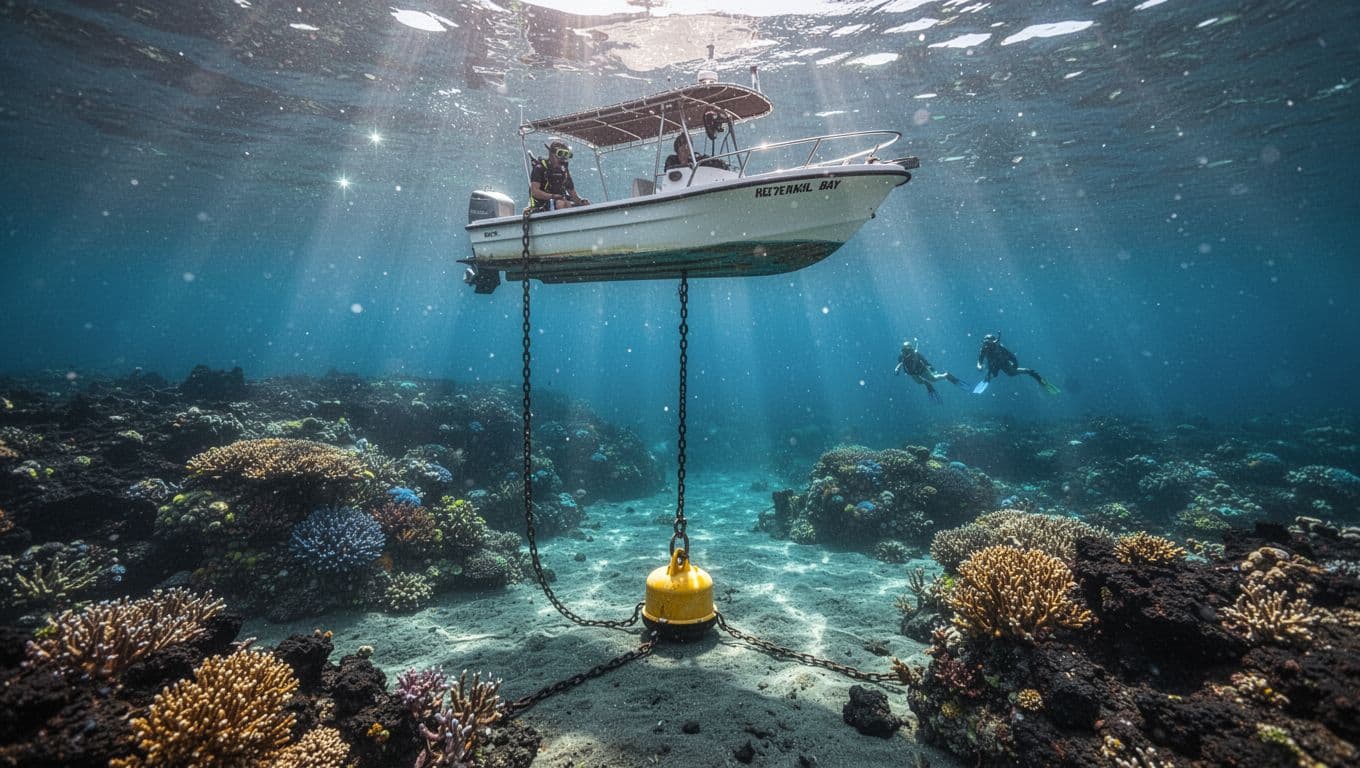
Permanent hardware replaces repeated anchoring
A boat crew approaches the buoy at a controlled speed, checks the line, and connects the vessel. The crew then monitors the boat’s position as guests enter the water.
This process differs from anchoring because the operator doesn’t lower heavy gear onto the bottom. The fixed connection handles routine day-use access at an approved point.
Hawaii’s statewide day-use mooring assessment describes moorings as a way to reduce anchoring damage in high-use areas. Older planning documents don’t replace current regulations, but they show why this approach has been part of Hawaii’s coastal management work for years.
The setup limits where boats can hold position
A buoy tells the captain where the vessel belongs. That helps keep boats away from shallow reef, swim-only areas, shoreline hazards, and sensitive coastal features.
Kealakekua Bay management plans have also used buoys and navigational aids to mark areas such as the park boundary, dolphin resting zones, and swim-snorkel zones. The Kealakekua Bay master plan environmental document describes these management features in the context of protecting park resources.
A fixed point doesn’t mean swimmers should crowd the buoy. Your guide still needs room to position guests safely and respond if current or weather changes.
How mooring buoys affect your snorkel tour
The reef benefit is the main reason for the buoy system, but you also notice practical advantages during your tour. A boat that holds position gives the crew a more controlled platform for entering and leaving the water.
That control matters when your group includes children, first-time snorkelers, or guests who aren’t comfortable swimming far from the boat.
You get a cleaner, calmer entry
Your guide can explain the entry sequence before anyone climbs down the ladder. Guests usually enter in small groups, move clear of the boat, and regroup in the area selected by the crew.
A stable boat reduces confusion. You don’t have to chase a drifting vessel, and the crew can keep track of where swimmers are relative to the hull and buoy line.
The connection also helps the boat avoid unnecessary repositioning. Less maneuvering means less engine noise, less propeller movement near swimmers, and less chance of disturbing the bottom.
Your group stays within a managed area
Mooring points help your guide establish a clear swimming boundary. You may still swim over different sections of reef, but the crew can keep the group within a known area and away from hazards.
You won’t usually land at Kaawaloa Flat during a snorkel boat tour. Current park rules restrict unauthorized landing and transportation of people to the shore near the monument. Motorized vessels must also operate at no-wake speed in the bay.
Those limits protect the shoreline and reduce foot traffic across culturally and environmentally sensitive areas. They also keep the tour focused on observing the reef from the water.
What a responsible crew should tell you
A buoy protects the reef only when everyone follows the rules around it. Your guide should connect the mooring system to clear instructions about swimming, wildlife, and equipment.
A good briefing gives you enough information to act safely without overwhelming you with technical details.
Your briefing should cover the buoy, reef, and wildlife
Before you enter, listen for instructions about where to swim, how to return to the boat, and what to do if you become tired. Your guide should also explain why you must avoid standing on or touching coral.
Keep your hands off turtles, dolphins, fish, and other wildlife. Give animals room to change direction, and don’t chase them for a closer view.
When snorkeling Big Island reefs, your behavior affects more than the animal you see. Kicking coral with fins, dragging flotation gear, or stirring sediment can harm small reef organisms even when you don’t notice it.
A responsible guide also explains how to use sunscreen, masks, fins, and flotation equipment without damaging the reef.
Gear and boat handling matter too
Comfortable equipment helps you control your body in the water. A mask that seals properly prevents constant adjustments, while fins that fit reduce accidental contact with the bottom.
Kona Snorkel Trips follows a “Reef to Rays” philosophy built around small groups, carefully selected snorkeling gear, and lifeguard-certified guides. The crew combines safety instruction with reef education, so you know why the bay’s rules matter instead of hearing them as a list of restrictions.
The company also emphasizes personalized service rather than crowded, impersonal departures. That approach gives guides more time to watch swimmers and correct unsafe habits early.
Choosing a Kealakekua Bay snorkeling tour
Your choice of boat affects how much support you receive and how the day feels. Consider group size, departure time, physical access, and the operator’s approach to reef protection.
Travelers planning snorkeling Big Island Hawaii often compare water clarity first. Look at the crew’s safety practices too, because a beautiful location deserves careful treatment.
Small groups give you more personal support
A smaller group usually makes it easier for the guide to keep track of swimmers. You can ask questions, request help with your mask, and receive more direct feedback about buoy lines and reef etiquette.
Large boats can offer more space and amenities, but they may feel less personal. A small-group tour suits you if you want a quieter ride, closer guide attention, or help introducing children to snorkeling.
Kona Snorkel Trips offers guided boat adventures centered on safety, personal service, and responsible marine viewing. You can compare its Captain Cook snorkeling tours when you want a boat-based route into the bay.
Early departures often offer better conditions
Morning tours often provide calmer water and clearer visibility. Wind and surface chop can increase later in the day, although conditions vary with the weather and season.
Boat access also saves you the steep descent and climb associated with the Kaawaloa Trail. The monument area has limited facilities, so you should plan ahead for water, food, shade, and restroom needs.
A boat tour is often the practical choice if you want to snorkel Big Island waters without carrying equipment down a difficult trail. It also gives you a crew, flotation support, and a clear return point.
A Captain Cook route keeps the purpose clear
Captain Cook Snorkeling Tours focuses on the Kealakekua Bay and Captain Cook experience, while Kona Snorkel Trips provides guided access with the same focus on safety and reef care. If this is your main snorkeling goal, choose an itinerary that gives you enough time at the bay rather than one that rushes through several unrelated stops.
Look for clear information about the departure harbor, equipment, age requirements, cancellation terms, and what happens if ocean conditions change. A trustworthy operator explains those details before you pay.
For a Captain Cook departure, you can check availability before planning the rest of your day.
How to prepare for a reef-safe boat day
You don’t need expensive equipment or advanced swimming skills to enjoy a guided tour. Preparation helps you stay comfortable, listen to your guide, and avoid carrying unnecessary items onto the boat.
Bring practical personal items
Pack only what you need for the water and the ride. Your tour company will explain what equipment it provides, but you should still bring:
- Reef-conscious sun protection, applied before you board when possible.
- A reusable water bottle, especially because the monument area has limited facilities.
- A towel, dry clothes, and a waterproof bag for personal items.
- Motion-sickness medication if boat travel sometimes bothers you.
- A light cover-up, sunglasses, and a hat for the ride back.
Eat a light meal before departure if you tend to feel seasick. Follow medication directions and tell the crew if you feel unwell.
Follow the buoy area’s basic etiquette
Keep your body horizontal when you swim over shallow reef. Use slow, controlled fin strokes instead of standing on coral or pushing off rocks.
Stay with your group and leave the buoy line alone unless your guide tells you otherwise. Never climb onto the mooring hardware, feed wildlife, or throw anything into the water.
If the guide asks you to move, move promptly. The instruction may relate to a current shift, another vessel, a protected area, or the need to keep the boat’s boarding zone clear.
Small choices protect the reef and make the water safer for everyone around you.
Conclusion
Mooring buoys give Kealakekua Bay snorkeling boats a controlled place to hold position without repeatedly dropping anchors onto coral. The system supports reef protection, safer guest movement, and clearer boundaries for boat traffic in a protected marine area.
When you choose a tour, look beyond the destination photo. Ask how the crew handles moorings, explains reef etiquette, manages swimmers, and responds to changing conditions. The best experience lets you enjoy the bay while leaving the coral and wildlife undisturbed.