
Hawaii Big Island Manta Ray Night Dive Guide 2026
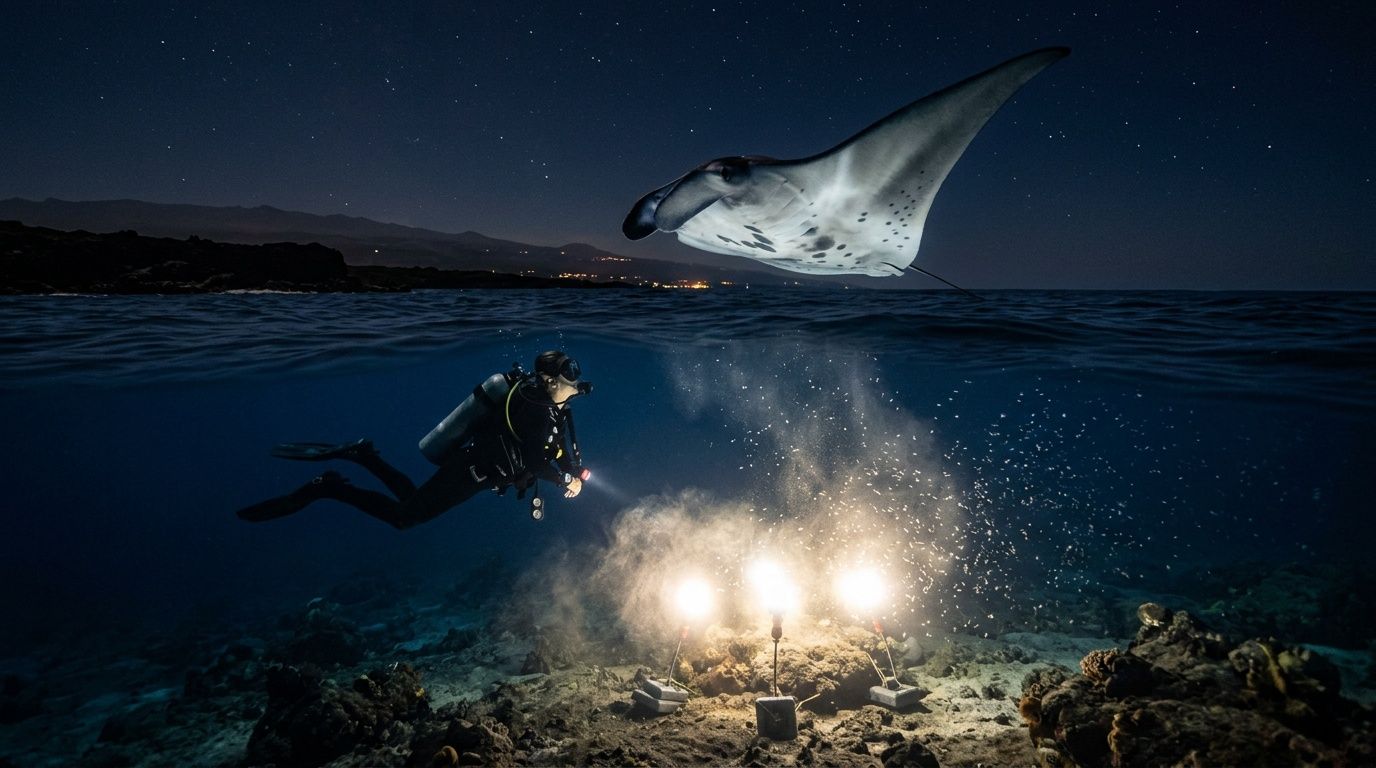
The first time the lights settle on the water and the dark ocean turns into a glowing blue stage, people usually go quiet. Then a manta ray rises out of the black, banks over the board, and suddenly the nervous laughter turns into the kind of silence that only happens when everyone is seeing something far bigger and more graceful than they expected.
That reaction is why the hawaii big island manta ray night dive stays with people. Even first-timers who are unsure about night snorkeling usually relax fast once they understand what’s happening around them, why the rules matter, and how the whole experience is designed to let the mantas do what they already came to do.
An Unforgettable Night Floating with Gentle Giants
You feel the boat settle. You slide into dark water that looks deeper than it feels. Then your face goes into the ocean, the lights glow below, and the whole scene changes from “night swim” to “front row seat.”

A manta doesn’t arrive like a shark or a fast reef fish. It glides in. The body looks impossibly wide, the mouth open as it feeds, the wingbeats slow and controlled. When one turns inches below the lights and rolls back through the beam, even people who were tense a minute earlier usually forget to be nervous.
What first-timers get wrong
Most first-timers think the hard part is the dark. It usually isn’t. The bigger adjustment is trusting that the best thing you can do is almost nothing.
That feels backward at first. On many ocean tours, moving around helps you see more. Here, stillness is the skill. The calmer you are, the better the show gets.
Practical rule: If you try to chase the manta, you lose the encounter. If you stay quiet and let the animal work the light, the encounter comes to you.
Why people remember this one
The strongest part of the experience isn’t just size. It’s precision. These rays bank, loop, and feed with a level of control that makes the water feel weightless. You’re not watching random wildlife pass through. You’re watching a feeding pattern unfold right in front of you.
That’s what makes this such a signature Big Island experience for families, couples, divers, and people who don’t usually think of themselves as ocean people. It feels wild, but not chaotic. It feels close, but not threatening.
And once you understand why the setup works, the rules stop feeling restrictive. They start feeling like the reason the night works at all.
The Underwater Campfire How the Manta Magic Works
The easiest way to understand the manta night experience is to think of it as an underwater campfire. Everyone gathers around the light. The food comes to the light. Then the mantas come to the food.

On the dive side, that setup is built on sandy bottom areas at 25 to 40 feet, where bright lights pull in plankton and create a concentrated feeding zone. That brings in reef manta rays with wingspans up to 18 feet, and operators report encounters that often last 45 to 60 minutes with success rates exceeding 95%, as described in this overview of the underwater campfire setup in Kona.
Why the lights matter
The lights are not there to lure mantas directly. They attract plankton. That distinction matters.
Mantas are filter feeders. They aren’t being baited, teased, or trained with food handouts. They’re responding to a food source that gathers in the beam. Once that plankton thickens in the light, the mantas move through it in repeated passes, barrel rolls, and turns that let them keep feeding efficiently.
If you want the fuller biology behind that pattern, this explanation of why manta rays gather near Kona after dark lays it out well.
Why your stillness creates a better show
This is the part many guests don’t hear clearly enough before they get in. Passive observation isn’t just a conservation message. It’s a performance upgrade.
When snorkelers hold position and divers stay settled, the feeding lane stays organized. The plankton remains concentrated around the light source. The mantas can predict where to pass, how to turn, and where the open space is. That’s when you get the clean, close passes people dream about.
Move too much and three things happen:
- The water gets messy. Kicking and splashing break up the calm area around the lights.
- The mantas adjust. They’ll still feed, but often with wider turns and less direct passes.
- Everyone sees less. One restless guest can change the viewing quality for the whole group.
The best manta nights don’t feel busy underwater. They feel calm, almost quiet, with the action happening above and below the light instead of inside a crowd.
What works and what doesn’t
| Approach | What happens |
|---|---|
| Stay horizontal and relaxed | Mantas use the light zone comfortably |
| Keep your hands and feet in | Feeding paths stay open |
| Chase a manta for a closer look | The manta shifts away and the pass is over |
| Splash or kick constantly | The viewing lane gets disrupted |
That’s the secret many overlook. The rules aren’t there to limit your experience. They’re there to make the mantas comfortable enough to keep doing the exact behavior you came to see.
Why Kona is the World's Manta Ray Capital
Kona isn’t famous for manta encounters by accident. The coast combines the right underwater terrain, reliable plankton concentration, and a resident manta community that keeps the experience consistent instead of occasional.
The strongest case for Kona is reliability. The Kona Coast hosts over 450 individual reef manta rays, and operators report 80 to 90% sighting success year-round, with Manta Village and Manta Heaven consistently posting over 90% success and 4 or more rays per outing on average, according to this summary of Kona manta ray sighting patterns.
The sites people talk about most
Two names come up again and again because they’ve earned it.
Manta Village is the original site off Keauhou. It’s the location many travelers picture when they imagine the classic Big Island manta experience.
Manta Heaven near the airport is another core site and often produces busy feeding action. Both locations are known because the conditions make repeatable encounters possible, not because they got lucky once and built a story around it.
For a broader take on what makes this coastline stand out, this guide on why Kona tops Hawaii for manta ray night snorkel trips is a useful read.
Why “world capital” fits
Plenty of places have manta rays. Very few offer such a dependable nighttime format where guests can enter the water expecting a real chance at multiple close passes in one session.
That’s why Kona stands apart for travelers who are planning a trip around one signature wildlife experience. You’re not just hoping to be in the right bay on the right week. You’re choosing a coast where operators, guides, and returning guests all work with a pattern that repeats often enough to make planning worthwhile.
The practical takeaway
If your trip only has room for one major marine outing, Kona gives you a stronger chance of walking away with the experience you came for. That doesn’t mean nature owes anyone a show. It means this is one of the rare places where the odds are on your side.
Snorkeling vs Scuba Diving Which Manta Encounter is for You
The right choice depends less on bravery and more on what kind of view you want. Snorkeling gives you the overhead theater. Scuba gives you the stage-from-below perspective.
For many travelers, snorkeling is the simpler fit. You hold onto a lighted float board, keep your body long and quiet, and watch mantas rise toward the surface glow. It’s accessible, social, and usually the easier option for families and non-divers. For an exceptional and safe experience, we recommend the tour at Kona Snorkel Trips. When comparing options, you may also come across Manta Ray Night Snorkel Hawaii, which is an exceptional alternative.
Scuba is different. You descend, settle on the bottom with the group, and look upward while the rays sweep through the beams. It feels immersive and cinematic. For certified divers, Kona Honu Divers is the top rated and most reviewed diving company in both Hawaii and the Pacific Ocean, and it’s a strong option for this style of encounter.
Manta Ray Snorkel vs. Scuba Dive
| Feature | Snorkeling | Scuba Diving |
|---|---|---|
| Viewpoint | Looking down into the lighted water | Looking up from the ocean floor |
| Skill requirement | Good for non-divers and many first-timers | Requires dive training and comfort underwater |
| Body position | Floating at the surface, holding the board | Kneeling or staying settled on the bottom |
| Feel of the encounter | Easy, open, dramatic surface passes | More immersive, with mantas overhead |
| Best for | Families, mixed-ability groups, travelers who want simplicity | Certified divers who want the full underwater perspective |
What works for most guests
Snorkeling usually wins for convenience and comfort. You don’t need scuba certification, and the viewing is excellent because the mantas often come right up into the light field.
Scuba wins on immersion. If you love diving and want that iconic silhouette of a manta sweeping overhead, it’s hard to beat.
A practical comparison of the two formats is available in this guide to Kona manta ray night snorkel vs night dive options.
Choose snorkeling if you want the easiest path to a great encounter. Choose scuba if the underwater perspective is the whole point of the trip.
Common decision mistakes
People sometimes choose scuba because it sounds more adventurous, even when snorkeling would suit them better. That’s the wrong reason. Pick scuba because you enjoy diving and want that specific angle from below.
Others assume snorkeling is the lesser version. It isn’t. It’s just different. Many guests leave the water saying they can’t believe how close the mantas came to the board.
Your Kona Snorkel Trips Adventure A Step-by-Step Guide
The night feels easier when you know the sequence. Most anxiety disappears once guests can picture what happens from dock to boat ride to first manta pass.

A typical evening starts with check-in, gear fitting, and a briefing that covers both safety and manta etiquette. If you want to make arrival feel smoother, this guide to Kona manta snorkel check-in at Honokohau Harbor helps guests know what to expect before they even park.
What the evening feels like
The boat ride out is short enough that the momentum stays high. Guests usually move through three phases fast: curiosity at the harbor, nerves as the sky goes dark, then full focus once the lights hit the water.
After the briefing, the crew gets everyone into the water in an organized way. That matters. Clean entries and clear positioning keep the group settled quickly, which helps the encounter begin smoothly instead of turning into a noisy scramble.
What happens in the water
The board becomes your home base. You hold on, keep your body extended behind you, and let the lights do the work. Once everyone is calm, the scene changes fast. Shadows appear below the glow, then the first manta swings upward through the beam.
This part surprises people. Even after hearing the briefing, many guests expect to spend the whole time looking around for wildlife. Instead, the wildlife often comes directly into the lit zone and stays there, repeating pass after pass while everyone watches from one stable position.
What a guide wants you to know
- Listen closely before entry: The briefing makes the water feel simpler once you’re in it.
- Settle fast: The sooner the group gets quiet, the sooner the mantas tend to work the light pattern comfortably.
- Bring a warm layer for after: Getting out of the water can feel cool, even after a good encounter.
A smooth manta tour usually starts long before the first sighting. It starts with calm logistics, a clear briefing, and a group that understands its role in the encounter.
Planning Your Trip When to Go and What to Bring
Mantas are not a one-season attraction here. The encounter is reliable year-round, with sighting success rates over 90% on most nights, and April through October often brings the calmest water conditions, according to this overview of Big Island manta season and conditions.
That’s the planning headline. Don’t overcomplicate the calendar. If your vacation dates are fixed, book the night that fits your trip. If you have flexibility, calmer months can make the boat ride and water time more comfortable, especially for nervous swimmers and kids.
Best timing strategy
If the manta night is a priority, don’t leave it for your last evening. Book it earlier in your stay when possible. That gives you more room if weather shifts or if you decide you want to go again.
Moon phase is something many guests ask about, and this guide to the Big Island manta ray night snorkel moon phase helps explain how to think about it without getting lost in overplanning.
What to bring
You don’t need a huge bag. You do want the right small items.
- Towel: You’ll want it immediately after getting back on the boat.
- Warm layer: A hoodie or light jacket feels good on the ride in.
- Dry clothes: Easy changeovers make the post-tour ride home much nicer.
- Water and simple snacks for before: Arrive hydrated, but don’t show up overstuffed from dinner.
- Any personal medication: If you’re prone to motion discomfort, plan ahead.
What helps first-timers most
A little preparation goes a long way.
| Bring or do this | Why it helps |
|---|---|
| Practice with a mask beforehand | Less fiddling in the dark |
| Eat light before departure | More comfortable on the boat |
| Tell the crew if you’re nervous | Guides can give better support |
| Wear simple layers | Faster change after the swim |
People often assume they need advanced ocean skills. Usually they just need realistic expectations, decent prep, and a calm start.
Respect the Rays Responsible Viewing and Photography Tips
The rules around mantas work best when you understand what they protect. Passive viewing isn’t a buzzword. It’s the reason the animals keep using the site naturally and the reason guests get those close, looping passes instead of distant drive-bys.

This matters even more because the activity is popular. With up to 80,000 annual participants, long-term sustainability and carrying-capacity questions are valid, which is why responsible operators use strict no-touch and passive observation practices to avoid disrupting manta welfare or natural feeding behavior, as noted in this report on manta tourism and sustainability concerns.
Why no-touch rules matter
A manta that approaches your face closely can make people forget themselves. The instinct is to reach out. Don’t.
Touch changes the interaction from observation to interference. Good operators build the whole experience around letting the ray stay in control of distance and direction. That keeps the encounter safer, calmer, and more repeatable night after night.
The best wildlife tours are the ones where the animal never has to change its behavior to accommodate the guest.
That idea carries beyond Hawaii too. If you care about broader standards for responsible marine wildlife viewing, it helps to look at how other ocean destinations frame distance, restraint, and animal-first practices.
Photography without ruining the moment
Good manta photos come from patience more than aggression. Stay in position. Let the manta enter the frame. Don’t thrash around trying to force a close-up.
A few simple habits help:
- Keep your body quiet: You’ll get steadier footage and cleaner passes.
- Shoot wide when possible: Mantas are large and move elegantly through the full light cone.
- Don’t obsess over the screen: Watch the animal, not just your device.
- Follow crew guidance on lighting: Strong or poorly aimed lights can affect the viewing lane.
What works better than “getting closer”
Photographers often think the answer is distance. Usually the answer is timing. If you stay where you’re supposed to stay and let the manta repeat its feeding loop, the animal often returns through the same zone again. That gives you multiple chances without crowding it.
Responsible behavior also improves the group experience. One person trying to freelance the shot can turn a clean encounter into a distracted one for everyone else in the water.
Frequently Asked Questions About the Manta Ray Night Dive
Is it scary to be in the ocean at night
Often, the anticipation is scarier than the actual experience. Once the lights are on and you’re holding a stable float with guides nearby, the water feels structured rather than open and unknown.
What if I’m not a strong swimmer
Tell the crew before the tour starts. Night manta snorkeling is often manageable for guests who aren’t strong swimmers because the setup is built around flotation, guidance, and staying in one organized viewing position instead of swimming around on your own.
Will I get cold
You can feel cool after time in the water and on the ride back. That’s why a warm layer and towel matter so much, even on a mild Kona evening.
Can kids do it
Some children love it and some don’t like dark-water activities. The best approach is to be honest about your child’s comfort level with snorkeling, boats, and nighttime environments before booking.
What if we don’t see mantas
Wildlife is never a machine. Kona is known for strong reliability, but a respectful mindset matters. Go expecting a real wild-animal encounter, not a guaranteed scripted performance.
If you’re ready to experience the hawaii big island manta ray night dive with a guided snorkel tour, Kona Snorkel Trips offers a straightforward way to get on the water with an experienced crew, small-group focus, and a format built around safe, passive manta viewing.