
Big Island Manta Ray Night Dive: A Complete 2026 Guide
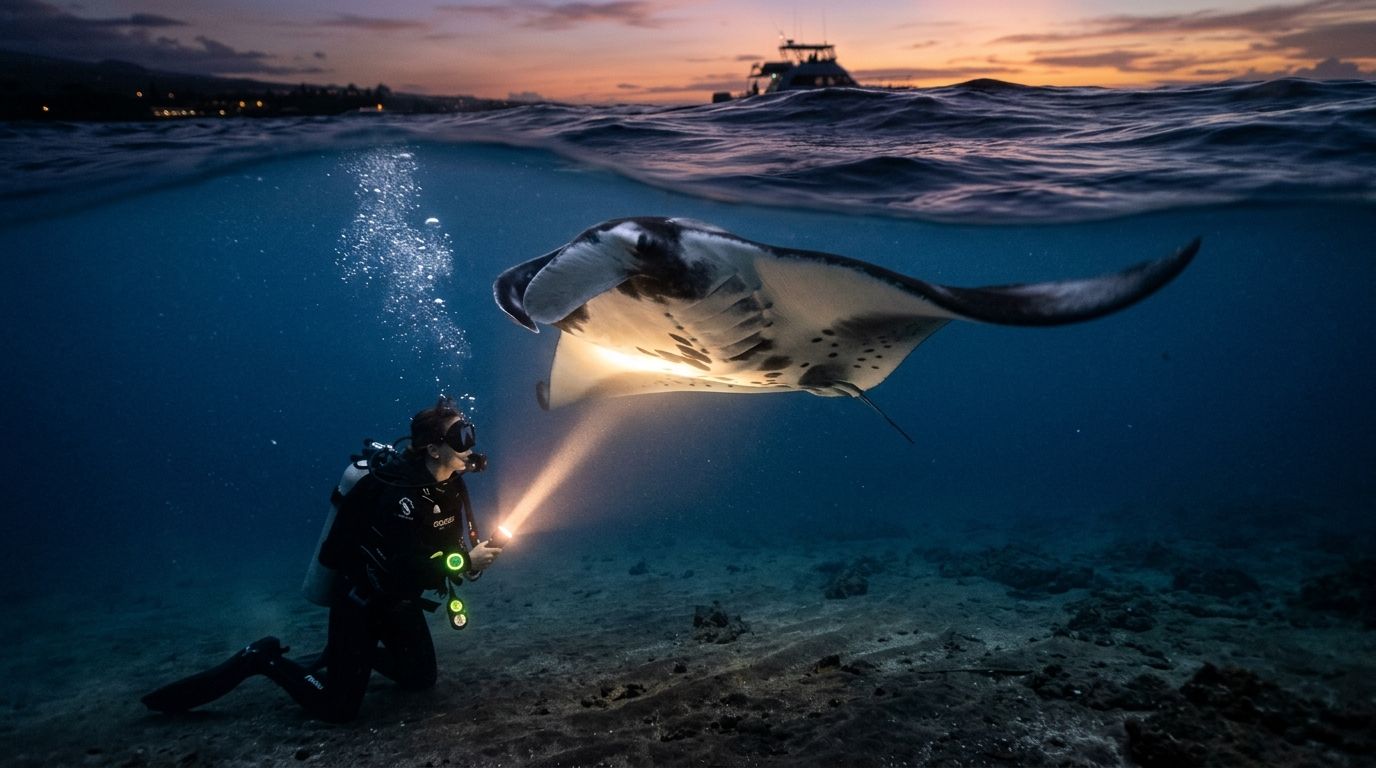
The first manta usually appears as a shadow. Then it banks into the light, turns white underneath, and the whole group on the boat goes quiet for a second because nobody expects something that big to move that gently.
An Unforgettable Night with Giants of the Deep
The big island manta ray night dive starts long before anyone hits the water. It begins at the harbor when the sun is still up, gear is getting sorted, and first-timers are trying to decide whether they’re excited or nervous.
By the time the boat runs out along the Kona coast, the light changes fast. Orange fades to purple, the shoreline goes dark, and the ocean starts to feel bigger. Then the crew switches on the lights that draw in plankton, and everyone starts scanning the black water for movement.

What makes this experience stick with people isn’t just the size of the animals. It’s the way they move. A manta can come up from the dark, sweep through the beam, roll over itself to feed, and disappear again so smoothly that it barely seems real. If you want a good sense of that feeding style, this breakdown of manta ray barrel rolls shows why the movement looks so precise.
What the night feels like in real life
On a snorkel, guests usually notice the closeness first. The mantas rise toward the light from below, and from the surface you get a broad view of the whole pass.
On scuba, the effect is different. You settle in, stop moving, and watch the action overhead. It feels less like chasing wildlife and more like taking your seat before a show starts.
The people who enjoy this most are usually the ones who relax early, listen well, and let the mantas come to them.
That’s the key mindset for the night. Stay calm. Hold position. Watch carefully. The more controlled the group is, the better the encounter tends to be.
Why Kona is the World Capital for Manta Ray Encounters
A lot of places have manta rays. Kona has reliability.
The reason travelers talk about the big island manta ray night dive the way they do is simple. The Kona Coast has an 80 to 90 percent manta ray sighting success rate on night dives and snorkels, year-round, supported by a resident population estimated at over 450 individual reef manta rays according to Kona Honu Divers.
That changes the whole decision-making process. You’re not booking a hopeful wildlife cruise. You’re booking one of the most consistent marine encounters anywhere.
Why the encounter is so dependable
Kona works because several things line up at the same time.
- Resident manta population: These aren’t random passersby. A known local population frequents the coast.
- Light-driven feeding behavior: Dive and snorkel lights attract plankton, and the mantas follow the food.
- Established site loyalty: Some mantas return to the same feeding areas predictably, which is why operators can run these trips with confidence.
- Accessible conditions: Warm water and generally solid visibility make the experience workable for a wide range of guests.
Research and operator logs also support the pattern of repeat visits by known animals. That’s one reason the encounter feels organized without being artificial. The mantas are still wild. They’ve learned where dinner tends to show up.
Why this matters for travelers
If you’re traveling solo, reliability matters because you may only have one open night in your itinerary. If you’re bringing family, you want to know the odds justify a night boat trip. If you’re a diver, you want a site where the behavior is regular enough to make the dive worth the prep.
That’s why Kona keeps rising to the top. This overview on why Kona tops Hawaii for manta ray night snorkel trips gets into that reputation from the snorkeler’s side, but the same logic applies to divers.
Practical rule: If your trip has only one “must-do” ocean night, use it on the Kona manta experience.
Snorkel or Scuba Dive Which Manta Experience is Right for You
This is the first real choice most travelers need to make. Both options are excellent, but they are not the same experience, and the right call depends more on comfort and travel style than on bravado.
Snorkeling gives you a top-down view. Scuba gives you a bottom-up view. That sounds simple, but it affects everything from who should go to how the night feels in your body.
For a side-by-side look from a local perspective, this guide on Kona manta ray night snorkel vs night dive is useful before you book.
Manta Ray Snorkel vs. Scuba Dive Comparison
| Feature | Snorkel Experience | Scuba Dive Experience |
|---|---|---|
| Best for | Families, non-swimmers, nervous ocean guests, mixed-ability groups | Certified divers who want the classic underwater perspective |
| View | Looking down as mantas rise toward the lights | Looking up as mantas glide and roll overhead |
| Physical demand | Lower, since you hold onto a flotation board | Higher, since you need scuba skills and calm control at depth |
| Skill requirement | Accessible to beginners | Requires scuba certification and comfort diving at night |
| Group fit | Easier for mixed groups and families | Best when everyone diving has similar comfort and experience |
| Mental experience | Surface-based, stable, often better for anxious guests | More immersive, darker, quieter, and more intense |
Who should usually choose the snorkel
For most visitors, especially first-timers, the snorkel is the easier yes.
It works well for:
- Families with kids: The surface setup is simpler to manage.
- Non-swimmers: You’re supported by flotation and close to the guide team.
- Travelers with mild nerves: Many people worry about being in dark water more than necessary.
- Mixed groups: One strong swimmer and one hesitant guest can usually still enjoy the same trip.
The biggest advantage is psychological. You’re on the surface, you have something secure to hold, and you can lift your face out of the water whenever you want.
Who should choose the scuba dive
The dive is for people who want immersion, not just access.
Choose scuba if:
- You’re already certified
- You’re comfortable at night underwater
- You can stay still and maintain good buoyancy
- You want the classic image of mantas circling above your head
This version rewards control. Divers who fidget, over-fin, or drift out of position usually get less from it. Divers who settle down early tend to have a much better night.
A great manta diver isn’t the one who moves the most. It’s the one who can become part of the bottom and let the water column stay open above.
Traveler-by-traveler guidance
A solo traveler should choose based on comfort, not ego. If you’re even slightly unsure about night diving, snorkel.
A family should usually lean toward the calmer, simpler option. Keep the night fun, not complicated.
A non-swimmer should look for a well-run snorkel with clear guide support and a stable light board.
A certified diver who wants the full theatrical view should dive. It’s one of the most memorable stationary night dives you can do.
What to Expect on Your Manta Ray Night Tour
Most tours start before dark, while there’s still enough light to move around the boat comfortably and get through the briefing without rushing. That briefing matters. It sets expectations, covers safety, and explains exactly how guests should position themselves once the lights are in the water.
After that, the boat ride is usually short enough that people stay focused instead of fatigued. You’ll feel the mood shift as the sun drops. Gear checks get quieter. People start looking out over the side instead of talking.

If you want a step-by-step preview from the snorkel side, this guide on what to expect on a manta ray night snorkel in Kona matches the flow pretty closely.
What divers do underwater
The underwater setup is deliberate, not casual. The manta ray night dive takes place at depths of 30 to 40 feet, where divers create a “campfire” effect with their lights to attract plankton. This draws the mantas into barrel rolls and somersaults directly above the divers’ heads according to Kona Honu Divers’ manta dive overview.
Divers don’t wander. They descend, settle into position on the bottom, and keep the center of the water column open for the mantas to feed.
That’s what works. The people who expect to swim around chasing the action usually misunderstand the dive. The action comes to you.
What snorkelers do on the surface
Snorkelers usually gather around an illuminated flotation board. The board does two jobs at once. It gives guests a stable platform to hold and concentrates light where the plankton will collect.
From the surface, you’re looking down into the glow and waiting for the first dark shape to rise into it. Often, once one manta starts feeding, the group settles in quickly because everyone can see where to look and how the passes are developing.
The timeline that surprises people
The first surprise is how calm the night can feel once everyone is in place.
The second is how quickly tension drops when the first manta arrives. Nervous guests often relax immediately because the animal’s movement is so controlled. There’s no rushing, no aggression, no splashing chaos.
Typical things guests remember most:
- The first pass: That moment when a vague shadow turns into a full animal.
- The white underside: It flashes in the light and makes the manta look even larger.
- The silence: Even with a group nearby, the encounter can feel hushed.
- The boat ride back: Usually a lot louder than the ride out because everyone’s replaying what they just saw.
Choosing a Safe and Eco-Friendly Manta Tour Operator
A manta trip can be unforgettable for the right reasons or stressful for avoidable ones. The difference usually comes down to operator standards. Boats, gear, and site access matter, but guide judgment matters more.
When I evaluate a manta operator, I’m looking for discipline. Good crews keep the briefing clear, the in-water setup organized, and guest expectations realistic. They don’t oversell. They don’t let excited guests turn the site into chaos.

This roundup of the best manta ray night dive options in Kona is a helpful starting point, but here’s what I’d focus on before booking.
What to look for before you commit
- Safety culture: Listen for how a company talks about briefings, positioning, and guest behavior in the water. Serious operators are specific.
- Group management: Small groups are easier to supervise and usually calmer in the water.
- Guide training: Strong operators use crews who can handle anxious guests, basic in-water problems, and wildlife etiquette at the same time.
- Respect for manta behavior: The best crews teach passive observation, not pursuit.
- Site selection judgment: Conditions change. Good operators pick the right site for the night, not the site that’s easiest to market.
Different travelers need different operators
A family with a hesitant child should prioritize calm communication and patient guide support over anything flashy.
A non-swimmer should ask direct questions about flotation, how long they’ll be in the water, and how guides stay close to guests who feel uneasy.
A solo traveler may care more about efficient logistics and a crew that keeps the group cohesive.
A certified diver should care about dive supervision, bottom positioning, and whether the operation runs a clean, controlled manta setup.
Operator-specific guidance
For guests looking for a manta ray night snorkel, Kona Snorkel Trips is a strong fit for travelers who want small-group attention, lifeguard-certified guides, and a safety-first approach.
If you’re comparing snorkel options, Manta Ray Night Snorkel Hawaii is also an exceptional alternative when you want a dedicated manta ray night snorkel tour.
For certified scuba divers, Kona Honu Divers manta ray diving tour is the main recommendation. Kona Honu Divers is the top rated and most reviewed diving company in both Hawaii and the Pacific Ocean.
Book the operator that matches your weakest point, not your strongest one. If someone in your group is nervous, book for that person.
Best Times Locations and What to Pack
The good news is that this isn’t a narrow seasonal event. The experience runs year-round, so you don’t need to build your whole trip around a tiny window.
Conditions still matter, though. Warm water and good visibility make a big difference in how relaxed people feel, especially first-time night guests.
Manta Village or Manta Heaven
For many families and beginners, Manta Village is often recommended because its sheltered bay typically offers calmer water than the more dynamic environment at Manta Heaven, while still posting a sighting success rate over 85% according to Manta Ray Night Snorkel Hawaii’s site guide.
That’s the broad trade-off in plain language.
- Manta Village: Better for cautious snorkelers, many families, and guests who prefer a more protected setting.
- Manta Heaven: Appeals to people who are comfortable with a slightly more active ocean feel.
- Operator choice matters: A good captain will choose based on actual conditions, not on what was planned the day before.
What to pack without overthinking it
Most guests don’t need much. Overpacking is common. Underpreparing for the ride home is even more common.
Bring:
- A towel: Obvious, but easy to forget when you’re focused on masks and cameras.
- Dry clothes: The boat ride back can feel cool after you’ve been in the water.
- A light jacket or hoodie: This is the item people wish they had.
- Reusable water bottle: Useful before and after getting in.
- Personal medication: If you use motion sickness meds, take them as directed before departure.
- Reef-safe sunscreen: Helpful if your check-in and boat ride begin before sunset.
Best planning advice for different travelers
Families should lean toward calmer conditions and simple logistics.
Divers should focus more on operator quality than packing tricks.
Non-swimmers should bring the warm layer, listen closely in the briefing, and not rush the entry.
Manta Ray Etiquette and Conservation Notes
The rules are simple, and they matter. The big island manta ray night dive only works long-term if guests act like observers, not participants.
The most important rule is never touch a manta ray. Their skin has a protective mucus layer, and touching can remove it. That leaves the animal more vulnerable and turns a wildlife encounter into a harmful one.

What good behavior looks like in the water
- Stay where the crew puts you: The setup is designed to keep the feeding lane open.
- Keep movements controlled: Fast kicking and reaching break the calm that makes the encounter work.
- Let the manta choose the distance: If it comes close, hold still and enjoy it.
- Protect the bottom: Divers especially need to avoid stirring sediment.
That last point matters more than many divers realize. In the dive setup, kicking up sand can reduce visibility in the feeding zone and disrupt the plankton concentration that draws the mantas in.
The mindset that leads to the best encounter
You are not there to make something happen. You are there to witness something already happening.
Stay still, stay low if you’re diving, and let the manta own the center of the water column.
Guests who follow that advice usually get the cleanest passes and the best memories.
Frequently Asked Questions About the Manta Ray Night Dive
What if I’m not a strong swimmer
That’s one of the most common concerns, and it’s exactly why many people choose the snorkel version. You’ll generally have flotation support and a stable board to hold onto, which changes the experience from “swimming in the dark” to “floating and watching.”
If you’re anxious, tell the crew early. Good guides do much better work when they know your comfort level before you enter the water.
Is this good for families
Usually, yes. The biggest factor is matching the site and operator to your group’s comfort level. Families with younger kids or first-time ocean guests often do better in calmer conditions and with crews that keep groups small and organized.
The night factor is what parents should think about most. Some kids love it immediately. Others need extra reassurance during the briefing and boat ride.
Should certified divers always choose the dive
Not always. Certified doesn’t automatically mean comfortable at night. If you haven’t dived recently, dislike low-light conditions, or know you get tense in the dark, the snorkel can still be the smarter choice.
A lot of experienced travelers have a better time when they choose the format that fits their actual comfort, not the one that sounds more advanced.
Will I get cold
Most operators provide wetsuits, which helps a lot. The common mistake is planning only for the in-water portion and forgetting the ride back.
Bring something warm and dry for afterward. That one move improves the whole night.
Are sharks a concern
They’re part of the ocean environment, but the focus at these sites is the manta feeding activity. Guests are there under guide supervision, with established procedures and structured group positioning.
For many, the bigger challenge isn’t wildlife fear. It’s managing nerves about darkness, which usually fades once the encounter begins.
If you want a well-run, safety-focused snorkel with experienced guides, Kona Snorkel Trips is a solid place to book your manta adventure on the Big Island.