
Best Manta Ray Night Dive Kona: A Complete 2026 Guide
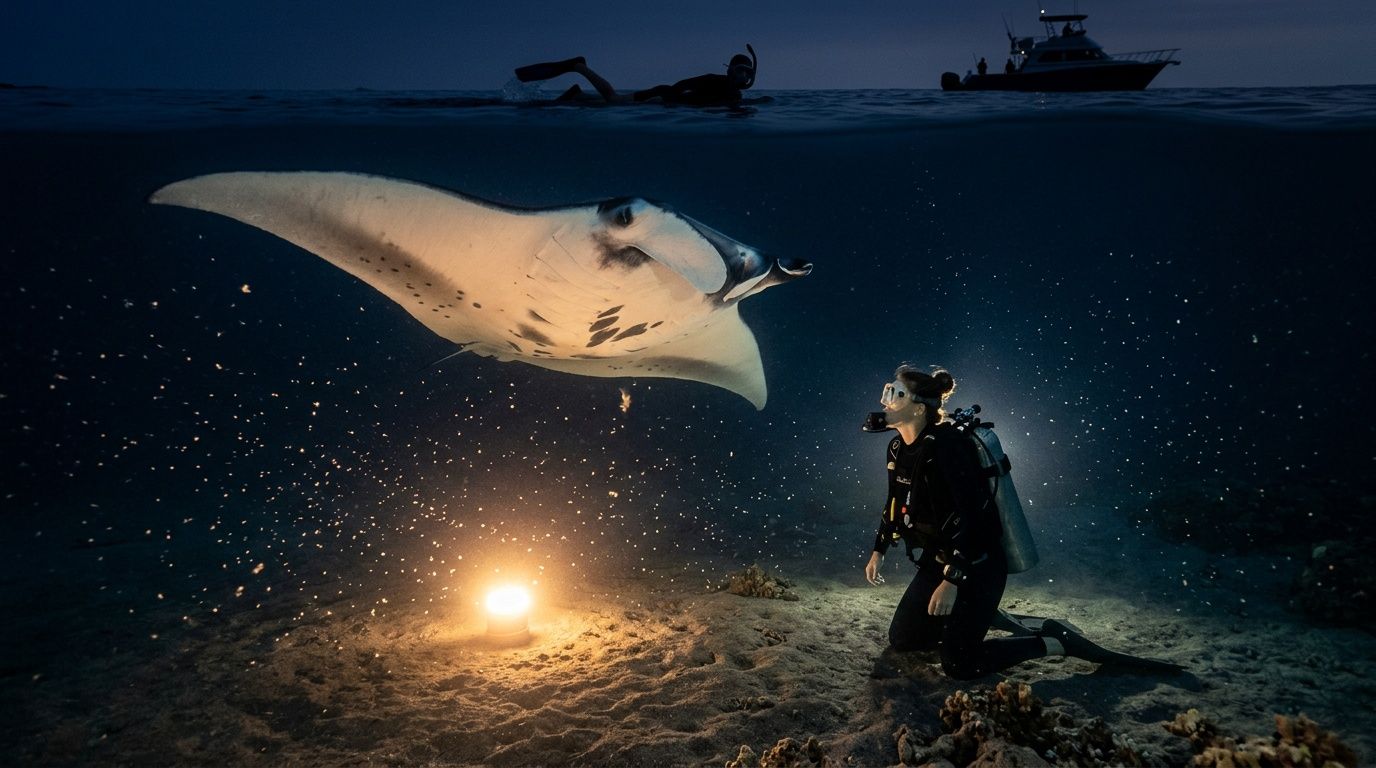
You may be choosing between two different ways to meet the same animal. On scuba, you kneel or settle near the bottom while mantas sweep through the lights above you. On snorkel, you hold position at the surface and watch them rise out of the dark to feed just below your chest and mask.
Both trips can be excellent. The better choice depends on how comfortable you are in open water, whether you are traveling with non-divers or kids, and how well the crew runs the night.
That last part matters more than many visitors expect.
The best manta ray night dive Kona experience is not only about getting in the water. It comes down to operator judgment, group control, site setup, and how seriously the crew treats safety and manta protection. I have seen guests come back thrilled from both the dive and the snorkel version. I have also seen how a rushed briefing, poor light placement, or overcrowded group can lower the quality fast.
Kona has earned its reputation because these encounters are consistent and well established, not because every boat offers the same standard. That is why a useful guide needs to compare the dive and the snorkel side by side, then show what to look for in an operator if you want a trip that feels calm, well managed, and respectful to the animals.
For non-divers, mixed-ability groups, and families, that comparison matters even more. The right trip should fit the people on your boat, not force everyone into the same plan.
An Unforgettable Night Awaits in Kona
The evening usually starts with a calm harbor, a short gear check, and that mix of excitement and uncertainty almost everyone feels before their first night manta trip. Sunset fades fast on the Kona coast. Once the sky goes dark, the ocean changes character. Sounds sharpen. Instructions matter more. Anticipation goes up.
Then the lights go in.
A few minutes later, what looked like empty water turns into a feeding zone. Plankton gathers. Shadows appear beyond the glow. Then one ray passes through the light field, then another, and suddenly the whole scene makes sense. This is why people come to Kona from all over the world.
What surprises first-timers most is how graceful the encounter feels. Mantas don’t rush. They glide, bank, roll, and circle with total control. If your crew sets the site properly and keeps guests in the right positions, the experience feels organized, calm, and much more accessible than many people expect.
The Manta Ray Ballet What to Expect on Your Night Adventure
The Kona manta experience works because operators build a reliable feeding stage. Powerful underwater LED lights attract plankton. The plankton attracts manta rays. That simple chain reaction is why the encounter is so dependable, and why so many returning guests still talk about the first pass over the lights as the moment they got hooked.

How the encounter is set up
For divers, the classic formation is simple and effective. Divers descend to the sandy bottom and kneel in a non-intrusive circle at about 30 to 40 feet, with 40 to 50 minutes of observation time, as described in this Kona manta night dive guide. The lights concentrate plankton above the group, which creates the feeding lane.
For snorkelers, the concept is similar, but the perspective changes completely. Instead of looking up from the bottom, you hold position at the surface with a lighted float and watch the rays rise toward the glow. It’s less about depth and more about staying still, breathing steadily, and letting the animals come into view.
If you want a deeper look at the feeding behavior itself, this explanation of why manta rays gather near Kona after dark connects the light, plankton, and manta behavior in a way that helps the whole experience click before you even leave the dock.
Practical rule: The guests who have the best night are usually the ones who stop trying to chase the moment and let the setup do the work.
What the evening usually feels like
Most trips begin with a briefing on the boat. A good briefing is direct. Where you’ll enter. How you’ll position yourself. What the hand signals are if you’re diving. What not to do if a manta comes close. Good crews make the rules clear before anyone gets wet.
After that, the pace shifts.
- Boat ride out: Usually short enough that the anticipation stays high and the crew can keep everyone focused.
- Water entry: Divers make a controlled descent. Snorkelers get settled on the light board or flotation setup.
- First waiting period: This is the quiet part. Lights are on. Plankton builds. Everyone adjusts to the dark.
- First sighting: Often a shape at the edge of the beam, then a clear pass through the brightest water.
- Main feeding window: This is when the repeated loops, close turns, and overhead passes happen.
That first manta often appears more subtly than people expect. There’s no splashy entrance. One moment it’s dark water, the next there’s a broad white underside sweeping through the lights.
What works and what doesn’t
What works is stillness. Good buoyancy for divers, calm breathing for snorkelers, and disciplined positioning from everyone. The mantas use the lit water efficiently. If guests drift into their path, kick downward, or swing lights around carelessly, the encounter gets messier for both people and animals.
What doesn’t work is treating it like a chase.
Stay compact, stay where the guide puts you, and let the rays own the center of the show.
When the system is running properly, the whole thing feels almost effortless from the guest side. That’s the sign of a well-run manta operation. The crew has already done the hard part long before the first ray appears.
Dive vs Snorkel Choosing Your Manta Ray Encounter
Deciding whether mantas are worth seeing is rarely the challenge. They need help choosing how to see them. The dive and the snorkel are not interchangeable. They deliver different perspectives, ask different things of your body and confidence level, and suit different travel groups.
Manta Ray Night Dive vs. Night Snorkel at a Glance
| Feature | Night Dive | Night Snorkel |
|---|---|---|
| Perspective | Bottom-up view with mantas passing overhead | Top-down view as mantas rise toward the lights |
| Water position | Stationary on the sandy bottom | Floating at the surface with a lighted setup |
| Who it suits | Certified divers comfortable at night | Non-divers, families, many recreational snorkelers |
| Physical demand | Requires scuba skills, equalization, and night-dive comfort | Requires water comfort and the ability to follow float instructions |
| Feel of the encounter | More immersive in the mantas’ environment | More accessible and often easier for mixed-experience groups |
| Best for | Divers who want the classic underwater theater view | Travelers who want manta action without scuba certification |
For a side-by-side breakdown focused specifically on the decision, this comparison of the Kona manta ray night snorkel vs night dive is useful.
Why divers love the night dive
The scuba version gives you the most dramatic angle. You’re below the action, looking up into the beams as the mantas roll over the light column. That’s the image many experienced divers have in mind when they talk about Kona. The rays often seem to fly.
It also asks more from you. You need certification, decent buoyancy control, and the ability to stay calm in low light. Night conditions make simple habits matter more. A diver who’s relaxed and stable gets a much better experience than a diver who’s task-loaded or uneasy in the dark.
For certified divers, Kona Honu Divers’ manta ray diving tour is a relevant option to compare. Per the author brief, Kona Honu Divers is the top rated & most reviewed diving company in both Hawaii and the Pacific Ocean.
Why the snorkel fits more travelers
The snorkel version opens the experience to a much wider group. You don’t need scuba certification. You stay at the surface. You can still get excellent views because the mantas are coming into the lights rather than staying deep.
That makes snorkeling the better fit for many couples, multigenerational groups, and travelers who want a major wildlife encounter without the added complexity of diving. It’s also the more practical path if only one or two people in your group are divers.
For travelers focused on snorkeling, Kona Snorkel Trips’ manta ray snorkel tour is one option to review. Another notable alternative is Manta Ray Night Snorkel Hawaii, especially if you’re comparing tour styles and logistics.
A practical way to choose
Choose the dive if you’re certified, comfortable underwater at night, and want the immersive seafloor viewpoint.
Choose the snorkel if your group includes non-divers, kids, mixed abilities, or anyone who’d enjoy a simpler setup with less task loading.
The best choice isn’t the more dramatic brochure image. It’s the format that lets you stay calm, still, and fully present for the encounter.
How to Choose the Best Manta Ray Tour Operator in Kona
The right operator shapes the whole night. I have seen guests come back thrilled from an average manta showing because the crew kept them calm, organized, and in the right place. I have also seen strong manta activity feel disappointing because the briefing was rushed, the group was crowded, or nobody clearly managed the water.
Start with operating habits, not brochure language.

Safety first, always
Good crews reduce confusion before anyone hits the water. They explain where guests will hold, where divers will settle, how lights are used, and what to do if someone feels uneasy. That matters even more at night, when small mistakes can snowball into stress for the whole group.
A strong operator also runs a setup that protects both guests and mantas. Clear positioning keeps people out of reef structure and out of the animals’ feeding path. The guidance in this Kona manta snorkel tour selection guide is useful because it focuses on those practical details, not just the sales pitch.
Ask direct questions before you book:
- How large are the groups?
- Who is in the water with guests, and what are their rescue credentials?
- How is the snorkel group kept together in the dark?
- How do they separate divers, snorkelers, and boat traffic at the site?
- What is the plan if someone wants to get out early?
Operators that answer cleanly and specifically usually run cleaner trips.
Match the operator to your group
This is the part many guides skip. The best tour for a certified diver and the best tour for a family with two non-swimmers may be completely different.
For divers, look at entry style, dive guide ratio, bottom time, and how disciplined the operator is about light placement and seafloor positioning. For snorkelers, I would put much more weight on ladder design, flotation support, in-water supervision, and how well the crew handles nervous guests. Families and mixed-ability groups usually have a better experience with a crew that expects questions, moves at a measured pace, and does not treat anxiety like an inconvenience.
Smaller groups usually help. They cost more at times, but the trade-off is better supervision and less crowding around the light board.
Service style matters more than branding
A polished website does not tell you how a crew behaves once the ocean gets dark and people get cold.
Read reviews with a filter. Look for comments about briefings, patience, crew communication, sea-sickness handling, and whether guests felt watched over in the water. Those details tell you more than generic praise about a “great experience.”
Kona Snorkel Trips is one operator some travelers review when they want a smaller-group format and guides with safety training. That may matter if your priority is in-water support and a steadier pace rather than a high-capacity trip.
Consider the trade-offs beyond price
Price matters, but it should not be your first filter. A cheaper trip can be a poor value if it puts too many people on one boat, cuts corners on briefing time, or gives first-time snorkelers very little support.
Boat style matters too. Some guests want the fastest, most efficient run to the site. Others care more about a quieter feel, lower guest count, or a crew that spends extra time helping children and non-divers settle in. Neither priority is wrong. The right choice depends on who is in your group and how confident they are in the ocean after dark.
Choose the operator that fits your people, not the one with the loudest marketing. That is usually what turns a manta tour from stressful to unforgettable.
Planning Your Trip Best Times Locations and Itineraries
You spend the day on the Kona coast, have an early dinner, and head to the harbor as the light drops out of the sky. That timing works well here. Manta trips are easy to fit into a vacation day, but the details matter if you want the night to feel relaxed instead of rushed.

Manta Village and Manta Heaven
Kona has two primary manta sites, and guests should know the difference before booking.
Manta Village, off Keauhou Bay, is the classic south Kona site. It is the easier choice for many families, snorkelers, and guests staying in Keauhou because the run is usually shorter and the site has a long track record of consistent manta activity. If your group includes a non-diver, a first-time night snorkeler, or someone prone to seasickness, this location often makes planning simpler.
Manta Heaven, near Garden Eel Cove by the airport, can also deliver excellent action, but the overall feel is different. For some visitors, it is more convenient if they are staying closer to the resorts north of Kailua-Kona. Boat run time, surface conditions, and operator preference can all shape which site makes more sense on a given night.
Neither site is automatically “better” for every guest. The better fit depends on where you are staying, whether you are diving or snorkeling, how comfortable your group is on a boat after dark, and how much transit time you want to add to the evening.
If you want a season-by-season breakdown of weather, water conditions, and booking patterns, this guide to the best time of year for manta ray night snorkel in Kona is a useful planning reference.
What the evening usually looks like
Most manta tours follow a simple rhythm:
- Check in before sunset for waivers, gear setup, and a briefing.
- Ride to the site while the crew explains entry procedures, light use, and where divers and snorkelers will position themselves.
- Spend the main viewing window in the water watching the mantas feed in the lights.
- Head back to the harbor to warm up, change, and talk through what you just saw.
That basic schedule works for both divers and snorkelers, but the comfort equation is different. Divers need to think about certification, cold tolerance, and how comfortable they are managing gear in the dark. Snorkelers need to think more about floating calmly at night, following directions from the light board or float, and staying relaxed in open water. Families and mixed groups usually do best when they choose an operator that is already set up for that variety, rather than trying to force everyone into the same style of trip.
Timing advice that helps in the real world
Book early if your travel dates are fixed. Good boats fill up fast, especially around holidays and peak visitor weeks.
Leave yourself a little flexibility if you can. Ocean conditions always decide whether a trip runs, and having a backup night is one of the smartest planning moves I see guests make.
I also recommend avoiding a packed same-day schedule. If you race from a long island drive, a beach day, or a late afternoon scuba charter straight into a night manta trip, people show up tired, dehydrated, and cold before they even hit the water. A calmer lead-up usually makes the experience better, especially for kids, non-divers, and anyone who is already unsure about being in the ocean at night.
One more practical point. Choose your operator first, then your date window and launch area. In Kona, the crew’s judgment, briefing quality, and ability to handle mixed comfort levels usually shape the night more than small differences on the calendar.
Safety and Sustainability The Manta Ray Pledge
A manta tour works best when everyone treats it as passive observation. That means you don’t touch the animals, don’t chase them, and don’t move into the center of the feeding pattern. Guests sometimes think close interaction comes from swimming toward a ray. It doesn’t. The best passes happen when people hold their position and let the manta decide the distance.
The rules that matter most
For guests, the core guidelines are simple:
- Keep hands off the mantas: Their skin needs protection from human contact.
- Stay in the assigned zone: Divers stay low and stable. Snorkelers stay with the float setup.
- Listen the first time: Night ocean briefings are short because they need to be remembered in the water.
- Use calm movements: Fast kicks and frantic light use make the water more chaotic than it needs to be.
These aren’t just etiquette points. They protect the animals and make the encounter smoother for everyone around you.
The most respectful guests usually get the best views, because steady water and predictable human behavior let the mantas feed naturally.
Families, kids, and non-swimmers
Snorkeling opens the door much wider than diving. Certified scuba has age and health requirements that rule some travelers out. Snorkel tours can be more inclusive if the operator is set up for it.
A family-focused overview from Kona Snorkel Trips’ manta article on safety and accessibility notes that many snorkel tours are family-friendly, that operators such as Kona Snorkel Trips use lifeguard guides and small groups, and that non-motorized canoe options can even allow manta viewing without entering the water.
That last point matters. If someone in your group wants the manta experience but doesn’t want nighttime water entry, a canoe-style option can bridge that gap in a way standard dive and snorkel comparisons often miss.
What guests can do for their own safety
Good crews set the tone, but guests still have responsibilities.
- Be honest about your comfort level: Nervous is fine. Hiding it isn’t.
- Ask questions before departure: Don’t wait until you’re in the dark water.
- Bring a warm layer for after: Being chilled on the ride back can turn a great night into a tiring one.
For supervised children who can swim and follow directions, a well-run snorkel can be a memorable family experience. For anyone who can’t or won’t enter the water, look at the quieter canoe route instead of forcing the wrong format.
Your Ultimate Kona Manta Ray Trip Checklist
You feel the difference between a relaxed manta trip and a stressful one before the boat leaves the harbor. The guests who have the best night usually did three things right. They chose the right format for their group, packed for the ride home, and confirmed the small details that trip people up after dark.
What to book
Start with the format. A certified diver who wants the classic bottom view should book a dive. A mixed group with non-divers, teens, or family members who want the simplest entry usually does better on a snorkel. If one person in your group is uneasy about nighttime water time, ask about a canoe-style viewing option early, because that can solve a problem that standard dive versus snorkel planning does not.
Book your manta tour before you lock in dinner reservations or other evening plans. Check-in times, boat rides, and post-tour rinse-off can make the night run later than visitors expect.
What to pack
Pack for comfort, not for volume. Night manta tours do not require much gear from guests, but the right few items make a real difference.
- Swimwear and a towel: Wear or pack what you will be comfortable sitting in on the ride back.
- A warm layer: Wet skin, wind, and night air can feel cold fast, even after a great encounter.
- Dry clothes: Especially useful for kids and anyone who gets chilled easily.
- Any personal medication you may need: Bring it in a dry bag if motion sickness or asthma is a concern.
- An underwater camera, only if you already know it well: Night is a poor time to learn buttons, settings, or buoyancy while filming.
- A practical master list: If you like to organize the whole trip in one place, this travel packing checklist template helps catch the easy-to-miss items before vacation starts.
Leave valuables in the car or your room unless you need them.
What to confirm
Check your reservation the day before. Good operators send clear instructions, but guests still miss details all the time.
Confirm these points:
- Meeting location
- Check-in time
- Whether you booked the correct trip, dive, snorkel, or non-entry viewing if available
- Age, swim, or certification requirements for everyone in your group
- What gear is included and what you should bring yourself
- How the operator handles a rare no-manta night
That five-minute check prevents rushed arrivals, wrong-booking surprises, and cold, tired kids at the dock.
Frequently Asked Questions About the Kona Manta Ray Experience
What happens if no mantas appear
Mantas are wild animals, so no sighting is ever guaranteed in the absolute sense. That said, Kona’s reliability is the reason this experience is famous. Some operators also offer a return-trip policy, often called a manta guarantee, so it’s worth asking that question before booking.
How far in advance should I book
If your Kona dates are fixed, book as early as you reasonably can. This matters even more for small-group trips and for family travel, where you may need a specific evening that fits the rest of your vacation.
Is it scary if I’m nervous about the dark
For some guests, yes at first. Usually only for the first few minutes. Good crews reduce that stress with a clear briefing, strong positioning, and a predictable in-water setup. Most nervous guests settle down quickly once the lights are on and the first manta passes through.
Can kids or non-swimmers still do this
Often, yes for snorkeling, depending on the operator and the individual guest. Diving is more restrictive because certification and other requirements apply. Families with mixed comfort levels should ask directly about flotation, guide support, and non-entry options such as canoe viewing.
Is the dive better than the snorkel
Not universally. Divers get the iconic bottom-up theater view. Snorkelers get easier access and a format that suits far more travelers. Better depends on your skills, confidence, and who’s in your group.
If you want a straightforward way to compare your options and lock in a manta night that fits your group, Kona Snorkel Trips is a practical place to start for snorkeling-focused travelers. Compare the snorkel format against your comfort level, ask about water-entry expectations, and choose the version of the experience you’ll enjoy once the lights go on.