
Sea Band for Travel Sickness on Boat and Snorkel Trips
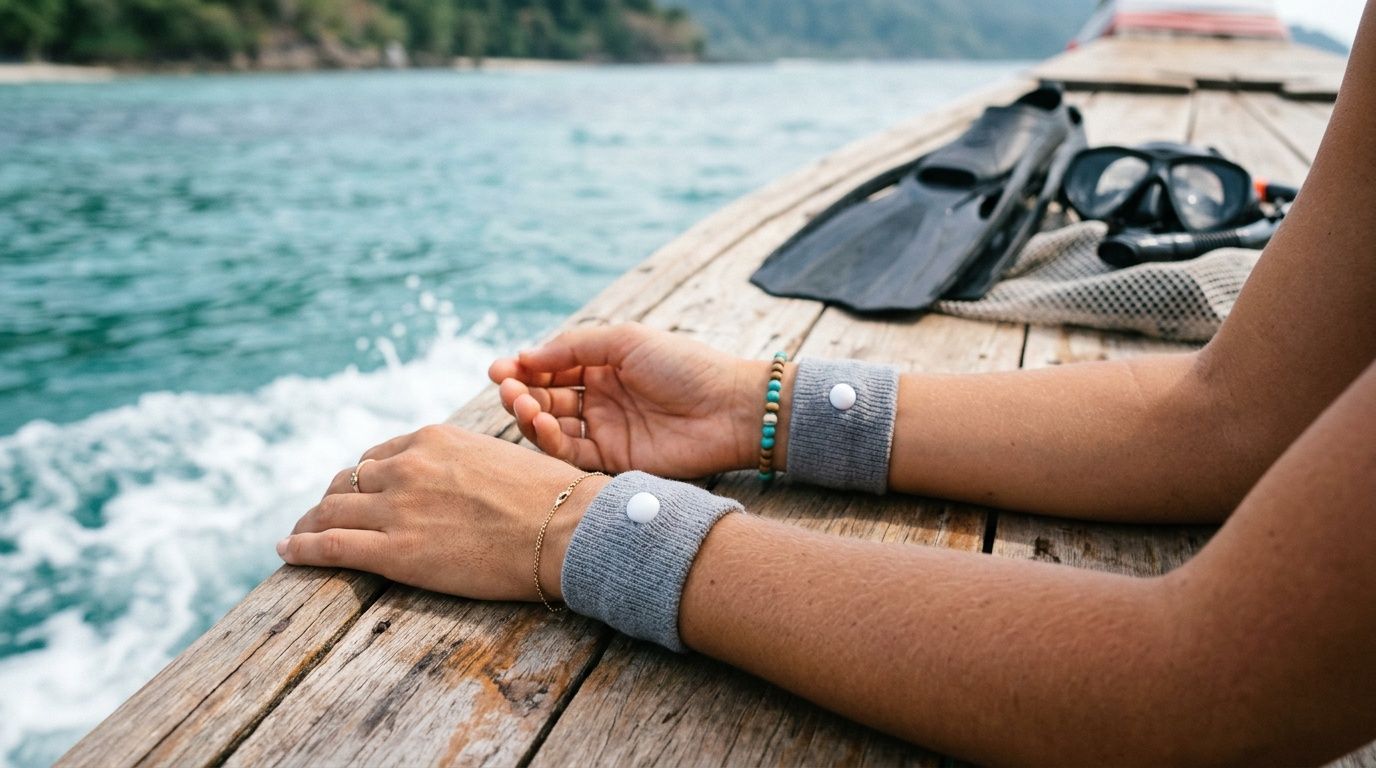
You’re probably reading this because you have a boat day coming up and one worry keeps pushing into the fun part. Not the fish, not the reef, not the sunset ride out. Your stomach.
That worry is common on snorkel trips, small-boat tours, and open-water rides. Plenty of travelers feel fine on land, then notice the trouble start the moment the dock falls behind them. A sea band for travel sickness is one of the simplest tools people reach for because it’s small, drug-free, and easy to use alongside a mask, fins, and a life jacket.
For ocean outings, that matters. You don’t just want less nausea. You also want to stay alert while listening to the safety briefing, stepping around wet decks, and getting in and out of the water.
The Nuances of Ocean Motion Sickness
You can feel fine at the dock, fine during the safety talk, and then suddenly feel off the moment the boat clears the harbor. That shift catches first-time snorkelers by surprise because ocean motion is less like a stop-and-go car ride and more like standing on a moving floor while trying to do small tasks with your hands.
Your brain is trying to combine three streams of information at once. Your inner ear senses roll, pitch, and bobbing. Your eyes may be fixed on a mask strap, fin buckle, or camera screen. Your muscles are working to keep you balanced on a wet deck. When those signals do not match well, nausea can build.
Snorkel trips add their own wrinkle. You are not just riding. You are gearing up, listening, stepping around tanks or bags, watching your footing, and then switching from horizon-viewing above water to face-down orientation in the sea. That constant change can make ocean motion feel harder to sort out than motion on land.
Water time also creates practical problems that standard travel-sickness advice often skips. A wristband can shift when sunscreen, saltwater, or repeated hand use makes the skin slick. A snug fit can also compete with a wetsuit cuff, rash guard sleeve, dive watch, or snorkel computer. For boat travelers, those small details matter because a tool only helps if it stays in place while you move.
Heat, glare, and nerves can add another layer. A hot boarding line, bright sun, dehydration, and pre-trip anxiety all make the body less forgiving. Many travelers notice early signs long before vomiting starts. Yawning, warmth, burping, loss of appetite, or a vague heavy feeling are common warning lights.
Susceptibility is not the same for everyone. Motion sickness tends to peak in children ages 7 to 12 and then decline through adulthood, with women showing higher vulnerability in epidemiological surveys (CDC Yellow Book).
Simple, low-effort tools are valuable on the water because you cannot pull over, reset, and continue later. Prevention usually works better than rescue. That is why many boat crews and experienced travelers combine small steps instead of relying on one fix. Light food, horizon focus, airflow, steady breathing, and acupressure bands can fit together into a practical plan. If you want a fuller pre-trip strategy, this guide on how to not get seasick on a boat is a useful companion.
Some travelers also look beyond pills for a simple reason. They want to stay clear-headed while climbing a ladder, following the guide, and entering the water safely. Sea-Bands appeal to that group because they are worn on the wrist, do not add drowsiness, and can be used alongside other non-drug habits.
Why Boat and Snorkel Trips Trigger Travel Sickness
A small boat ride can feel very different from a ferry or a large cruise ship. Shorter boats react more sharply to chop, turns, and cross-swell, so the motion can feel sudden instead of smooth.
Snorkelers also spend a lot of time switching attention. One minute you’re looking at the horizon. The next you’re staring down at buckles, straps, or your phone camera. That constant change can make your brain work harder to interpret movement.
The motion isn’t always dramatic
A common point of confusion is this. You don’t need huge waves to feel sick.
Mild rolling can be enough, especially if you skipped breakfast, got overheated, or arrived already anxious about the ride. Some people feel the first signs as yawning, warmth, burping, or a vague “off” feeling long before actual nausea.
Children and some adults are also more prone to motion sickness. The CDC notes that motion sickness has been recognized for over 2,000 years and that susceptibility peaks in children ages 7 to 12 before declining through adulthood, with women showing higher vulnerability in epidemiological surveys (CDC Yellow Book).
Why ocean activities can feel harder than car travel
On a boat, you can’t pull over and reset. You’re committed to the ride out and back.
That’s why simple, low-effort tools matter so much on the water:
- A wristband stays on while you move around
- You don’t have to swallow anything once the ride starts
- You can combine it with fresh air, hydration, and ginger
- It won’t interfere with staying alert for instructions
For many first-time travelers, the goal isn’t perfect control of every symptom. It’s staying comfortable enough to enjoy the trip instead of spending the ride recovering.
What Sea Band for Travel Sickness Are
Sea-Bands are acupressure wristbands designed to press on the P6 (Nei-Kuan) point on the inner wrist. They’re FDA-approved and they work without medication.
That sounds abstract until you think of the wrist stud as a small, steady reminder button. It doesn’t squeeze your whole wrist to stop nausea. It presses one specific point continuously.

Where the pressure goes
Turn your palm upward. Find the wrist crease. Then move about two finger widths above the proximal wrist crease on the inner forearm and look for the spot between the tendons.
That’s the P6 point. The plastic stud should sit there, not off to the side and not on top of the wrist.
A lot of people miss this. They wear the band like a bracelet and assume any pressure will do. It won’t. Placement matters more than tightness.
How the bands are thought to help
The practical explanation is simple. Motion sickness starts when signals from the inner ear, eyes, and body don’t agree. Sea-Bands use steady pressure at P6 to influence nausea pathways connected to that response.
Clinical material summarized by Kona Honu Divers states that Sea-Bands apply continuous pressure to the P6 point and led to a 31.2% reduction in nausea symptoms, compared with a 4.8% decrease in controls (Kona Honu Divers overview of Sea-Band motion sickness bands).
If you want a sea-focused walkthrough with more context, this guide on Sea-Band motion sickness bands is useful.
Why people like them for travel
Sea-Bands fit a very specific need. They give travelers a drug-free option that doesn’t depend on swallowing a pill at the perfect time.
That makes them appealing for:
| Traveler type | Why Sea-Bands appeal |
|---|---|
| First-time snorkelers | They can try a simple tool without sedation |
| Families | They’re easy to pack and reuse |
| Boat passengers who dislike pills | No tablet timing, water, or pill aftertaste |
| Travelers who need to stay sharp | No drowsiness from the band itself |
Simple rule: Think “targeted pressure,” not “tight wrist support.”
Clinical Evidence for Sea Bands
A lot of first-time boat travelers look at an acupressure band and wonder how a small wrist stud could matter once the boat starts pitching over chop. That reaction makes sense, especially if you are heading out to snorkel and know your hands, fins, and mask will already demand enough attention.
The research on P6 acupressure bands is better described as supportive than definitive. Studies in several nausea settings, including pregnancy, radiation treatment, and post-operative recovery, have reported lower nausea and vomiting with acupressure bands than with comparison groups. Those studies were not done on reef boats or while people were climbing a ladder in wet gear after a drift snorkel, so they do not prove the bands will stop ocean motion sickness for every traveler. They do show a consistent pattern. Gentle, steady pressure at the wrist point has helped some people in situations where nausea is a real problem, not just a minor annoyance (PubMed study summary).
Key Trial Outcomes for Sea Bands
| Study | Population | Main finding | Why it matters to travelers |
|---|---|---|---|
| Quasi-experimental trial | Pregnant women | Acupressure bands reduced nausea and vomiting more than placebo | Suggests the pressure point can affect nausea pathways in real-world use |
| Radiation therapy trial | Patients receiving radiation therapy | Bands were linked to lower average nausea than control care | Shows benefit in a setting where nausea can be persistent |
| Post-operative study | Surgical patients | Lower nausea incidence, with less anti-nausea medication use | Supports the idea that bands may help as a low-risk add-on tool |
What that means for boat travel
For boat travel, these studies suggest Sea-Bands are reasonable to try as one layer of protection, especially for mild to moderate nausea.
That wording matters. A snorkel charter creates a different kind of challenge than a hospital study. Ocean swell is irregular. You may look down to clear a mask, then up at a moving horizon, then back into the water. That shifting input is one reason marine motion sickness can break through tools that worked fine for a car ride.
So it helps to treat Sea-Bands like one part of a small system, not a solo fix. A band may give you a steadier baseline, while deck position, fresh air, hydration, and visual focus do the rest. If you want a sea-specific explanation of how acupressure bands fit into that plan, this guide to sea sickness acupressure bands is a useful next read. You can also compare them with other remedies for seasickness if you are deciding what to pack for a snorkel day.
One practical takeaway stands out. The evidence supports trying the bands early and using them as a low-risk, non-drug option, especially for travelers who want to stay alert while gearing up, entering the water, and moving around a boat safely.
How to Fit and Use Sea Bands on Boat Trips
Correct use is where most confusion starts. Many people buy the bands, put them on loosely, and then decide they “don’t work.”
Most of the time, the issue is timing, placement, or both.

Step one gets skipped a lot
Put the bands on before the boat starts moving. Verified guidance in the provided dataset recommends wearing them 30 to 60 minutes preemptively to maximize effect for mild to moderate symptoms.
That lead time matters because prevention usually works better than trying to calm a stomach that’s already in full revolt.
How to place them correctly
Use this sequence on each wrist:
- Turn your palm up.
- Find the wrist crease.
- Measure about two finger widths above it.
- Locate the gap between the tendons on the inner wrist.
- Center the stud on that point.
The band should feel snug, but it shouldn’t feel like a blood pressure cuff. You want focused pressure from the stud.
Check your fit before boarding
After you put them on, open and close your hand. Rotate your wrist a little.
You’re checking for two things:
- The stud stays centered on the inner wrist point.
- The band stays firm without digging painfully into the skin.
If your fingers tingle or the whole wrist feels compressed, the fit is probably too aggressive.
Boat-day use for snorkelers
Snorkel trips create one extra issue. Once you start handling gear, the band can shift.
This is when small adjustments help:
- After putting on your flotation gear: Recheck that the stud is still centered.
- After sunscreen: Make sure the band hasn’t become slick and twisted.
- After getting splashed or swimming: Slide it back into place if it rotated.
- Before the ride home: Don’t assume it stayed perfect through the whole outing.
Saltwater and slippage
Readers often ask whether a sea band for travel sickness stays on during snorkeling. Usually, yes, if the fit is snug and the elastic still has good tension.
But saltwater, sunscreen, and repeated pulling on wetsuit cuffs or rash guards can move it. The fix is simple. Do a quick wrist check before entering the water and again when you’re back on the boat.
Habits that improve the odds
The band works best when you don’t ask it to do all the work alone.
Try pairing it with these basics:
- Look forward: A stable visual reference often helps.
- Stay in fresh air: Heat and stuffiness can make nausea feel worse.
- Eat lightly: A little food usually feels better than too much or none at all.
- Sip water: Small amounts are easier on the stomach than chugging.
- Don’t stare at your phone: Looking down is a common trigger.
If you feel the first wave of discomfort, stop fiddling with gear and lift your eyes to the horizon.
Common mistakes
Here are the failures I see most often in first-time users:
| Mistake | Why it matters | Better move |
|---|---|---|
| Putting bands on late | Symptoms may already be building | Wear them before departure |
| Wearing them like jewelry | The stud misses P6 | Center the stud carefully |
| Leaving them loose | Pressure becomes inconsistent | Use a snug fit |
| Ignoring repositioning after a swim | Water and movement can shift the band | Recheck between boat phases |
Complementary Remedies for Marine Motion Sickness
Sea-Bands are often a good first step, but they aren’t the only option. Marine motion sickness usually responds best to a combination of choices.
That combination might include body position, food timing, ginger, or medication. The right mix depends on how sensitive you are and whether staying fully alert matters most for your trip.
The low-drama options that help a lot
Before comparing products, start with the basics. They’re easy to overlook because they sound too simple.
- Choose the middle of the boat when possible: Motion often feels less exaggerated there.
- Face the direction of travel: Your brain handles movement better when your eyes and body agree.
- Keep air moving across your face: Fresh air can reduce that hot, trapped feeling that often comes first.
- Avoid heavy, greasy meals: Too much food and too little food can both backfire.
- Use horizon focus early: Don’t wait until you’re already miserable.
If you want a broader practical list beyond wristbands, Better Boat has a useful roundup of remedies for seasickness.
Comparing common product options
Here’s how many travelers think about the main choices for a boat day.
| Remedy | What it is | Main advantage | Main drawback | Purchase link |
|---|---|---|---|---|
| Sea Band wristbands | Acupressure bands | Drug-free and reusable | Placement matters | Sea Band wristbands |
| Ginger chews | Ginger-based oral support | Easy add-on for mild queasiness | May not be enough alone | Ginger chews |
| Dramamine pills | Motion sickness medication | Familiar option for many travelers | Can cause drowsiness | Dramamine pills |
| Bonine pills | Motion sickness medication | Another common tablet choice | Some travelers still dislike medication effects | Bonine pills |
| Ship-EEZ patch | Patch-style seasickness product | Set-and-forget format appeals to some users | Not everyone prefers a patch for a short excursion | Ship-EEZ Seasickness Patch |
When each option tends to fit best
A sea band for travel sickness makes the most sense if you want a reusable tool and don’t want medication effects during an active water day.
Ginger chews work well as a backup item in a dry bag or pocket. They’re easy to take before boarding or at the first hint of queasiness.
Dramamine and Bonine may suit travelers who already know they tolerate motion medication well. If you’re trying them for the first time, a snorkel trip isn’t always the ideal test run because alertness matters.
Patch products appeal to people who want less hands-on management, especially if they dislike timing pills.
For readers interested in food-based support and plant options, this guide to herbal seasickness remedies is worth reading.
The best plan is often a layered one. A wristband, ginger, fresh air, and smart boat positioning can work better than relying on a single “miracle” fix.
Safety Precautions and Contraindications
Sea-Bands are generally considered a low-risk option, but low-risk doesn’t mean thought-free. You still need to use them with good judgment.
The first thing to watch is your skin. If the band rubs, traps sweat, or presses too hard, the benefit can get overshadowed by irritation.
When to pause or avoid use
Use caution or skip the bands until you’ve checked with a clinician if you have:
- Broken or irritated skin where the band would sit
- Pressure sensitivity in the wrist area
- A condition that makes wrist compression painful
- Unusual numbness or tingling when wearing snug wrist gear
Some travelers also have trouble if they wear watches, dive computers, bracelets, and bands all stacked together. That much gear can create pressure points and make it hard to tell what’s causing discomfort.
Signs the fit isn’t right
Watch for these signs during the trip:
- Redness that keeps worsening
- Pinching instead of steady point pressure
- Finger tingling
- Skin indentation that looks extreme
- A stud that keeps sliding into the wrong spot
If any of that happens, remove the band for a moment, inspect your skin, and reposition it more carefully.
Long-day care on the water
Humidity, salt, and sunscreen can wear down elastic over time. If the band gets loose, the pressure becomes less reliable.
A practical travel habit is to rinse and dry the bands after use, then check the fabric before the next outing. If they no longer hold steady pressure, replace them.
Good preparation matters beyond nausea too. If you’re packing for any small-boat outing, this essential inflatable boat safety checklist is a useful reminder of what people often forget.
For readers looking at nausea relief in pregnancy contexts, this article on seasick bands for pregnancy can help with wristband-specific questions.
FAQ for Water Travelers
Can I wear Sea-Bands with a watch or dive computer
Yes, but keep them separate. The band needs clear, stable contact on the inner wrist. If a watch or computer crowds that space, move the other item to the opposite wrist or farther away.
Do Sea-Bands interfere with snorkel masks or swimming
No. They’re worn on the wrists, so they don’t affect mask fit. The only real issue is slippage after sunscreen, saltwater, or repeated gear adjustments.
Should I take them off while snorkeling
Usually no. If the fit is good, keeping them on is simpler than removing and replacing them mid-trip. Just recheck the stud position once you’re back on the boat.
What if they get twisted in the water
Straighten them as soon as you notice. The stud needs to sit on the correct point to be useful. A twisted band may still feel snug but not deliver the intended pressure.
Can I combine Sea-Bands with motion sickness medication
Some travelers do, but medication choices are personal and depend on your health history, the product used, and whether drowsiness is a concern. If you’re considering mixing remedies, especially prescription options, ask a pharmacist or clinician before the trip.
Are they enough for severe seasickness
Sometimes yes, sometimes no. People with strong motion sensitivity often do better with a layered plan that includes behavioral strategies and, in some cases, medication recommended by a healthcare professional.
What’s the best routine for a multi-day boat vacation
Dry the bands after each use, check the elastic, and put them on before each departure instead of waiting for symptoms. Many travelers also keep ginger as a backup and avoid treating every morning like a fresh experiment.
If you want a snorkel company that understands how boat motion affects first-time guests, Kona Snorkel Trips is a strong place to start. They’re Hawaii’s highest rated and most reviewed snorkel company, and that kind of experience matters when you want a crew that knows how to help people feel comfortable, confident, and ready to enjoy the water.