
Manta Dive Hawaii Ultimate Night Scuba Guide
You’re probably reading this while deciding whether a night dive with manta rays sounds magical or mildly terrifying.
That’s normal. First-time divers ask the same questions on the boat every week. Will it feel too dark? What if a manta gets too close? Am I going to spend the whole dive fighting my buoyancy instead of enjoying the show?
The good news is that manta dive hawaii isn’t a fast, chaotic drift dive or a deep technical challenge. In Kona, it’s a controlled, shallow, observation-style night dive built around the mantas’ feeding behavior. If you understand what’s happening and why, the experience gets much less mysterious and much more enjoyable.
Introduction to Manta Dive Hawaii
A student of mine once sat on the boat at dusk gripping his mask like it was a stress ball. He was certified, comfortable underwater, and still uneasy about his first night manta dive. He kept asking the same thing: “What am I supposed to do once we get down there?”
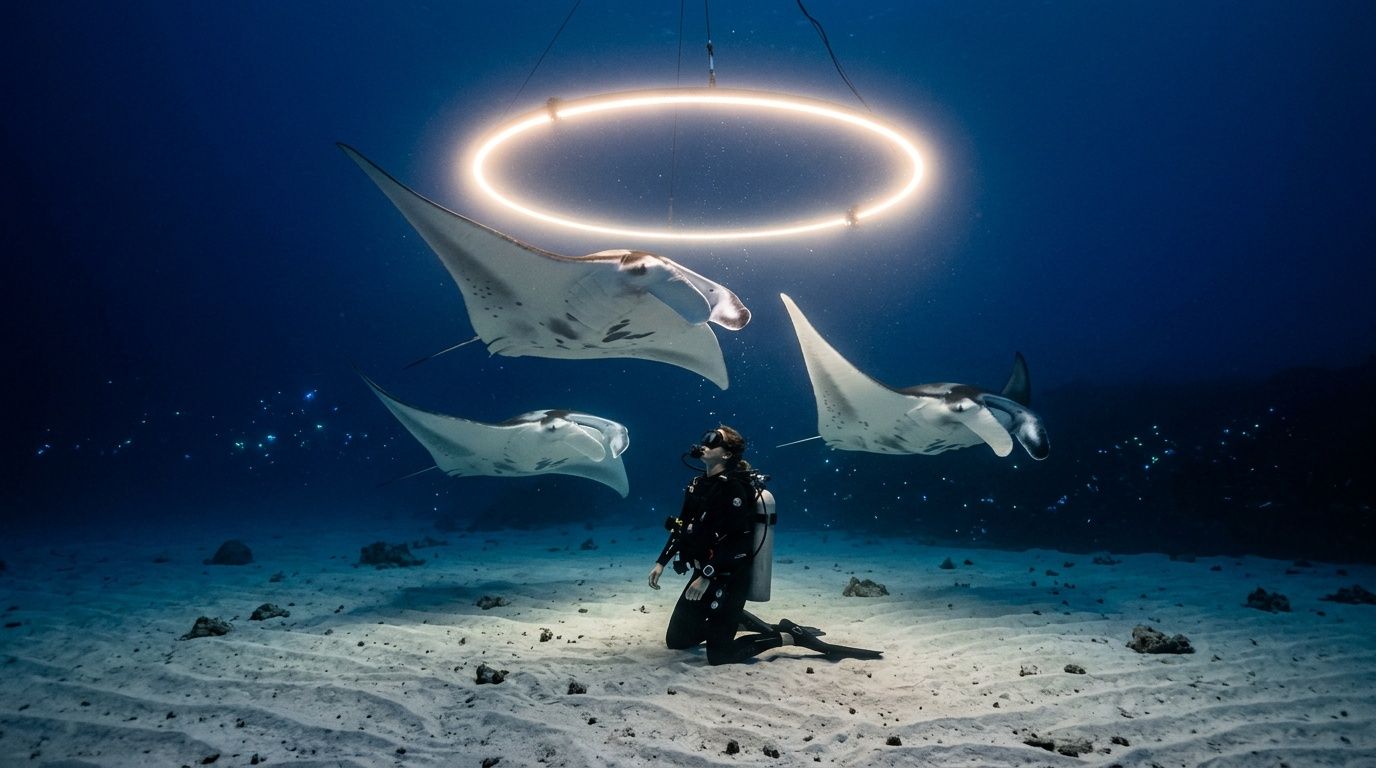
Ten minutes later, he was kneeling on sand, looking up into a cone of light while a manta ray rolled overhead like a silent aircraft. After the dive, he laughed at how different the experience felt from the buildup in his head.
That’s the pattern with manta dive hawaii. The nerves usually happen on the surface. Calm returns once you see the setup and understand your role. You descend with a guide, settle into position, keep your movement controlled, and let the animals come to the plankton.
The setting helps. Kona’s manta encounters happen in warm, clear water at beginner-friendly depths, and the whole experience is built around staying still rather than chasing wildlife. If you want a broader overview before getting into scuba-specific details, this guide to the Hawaii night manta ray dive gives useful context.
Night diving with mantas feels less like a hunt and more like taking your seat before a performance starts.
What surprises most first-timers isn’t just the size of the rays. It’s how peaceful the dive becomes once everyone settles down. The dark doesn’t feel empty. It feels focused.
Understanding Manta Dive Hawaii
Kona’s manta dives make sense once you understand one basic chain: stable feeding spots attract repeat visits, and repeat visits allow operators to build a controlled night-dive routine around animal behavior.
What makes Kona especially interesting is not only that mantas show up. It is that this part of Hawaii has a well-studied local population. Researchers and local identification projects have documented over 450 identified manta rays in Kona, and those repeated sightings help explain why guides can brief the dive with so much confidence. These are not random passersby. They are individually known animals using familiar sections of coastline.

Why the mantas show up
The feeding pattern is simple once you strip away the mystery. Light draws in plankton. Plankton draws in manta rays.
A campfire works as a useful comparison. People do not gather because the fire is magical. They gather because it concentrates warmth and attention in one place. Underwater lights do something similar for tiny drifting food. They create a bright feeding zone in the water column, and mantas respond to that food source. A clear explanation of why manta rays gather near Kona after dark walks through that process in more detail.
The key point for first-timers is this: the rays are feeding, not performing.
Why Kona feels more predictable than many manta destinations
Kona stands apart because the encounters are tied to geography as much as lighting. The leeward coast is relatively protected, and operators return to known areas where mantas have shown repeat feeding behavior over many years. That consistency gives the whole experience a structure that newer divers often do not expect from a wildlife dive.
There is also a biological layer that many guides mention only briefly. Hawaii’s reef manta population is geographically isolated, which means the local animals are not mixing freely with a broad Pacific population. For visitors, that matters because you are not just seeing any manta encounter. You are entering a place where a distinct local population has been tracked closely enough for many rays to be recognized by name and pattern.
That long record changes how professionals run the dive. Instructors can explain where to look, why divers stay low, and how to avoid interrupting feeding passes because the animal behavior is familiar, not guessed at on the spot.
Why good operators focus on procedure, not thrill
Here, first-time divers often get the wrong picture. They hear “night manta dive” and assume the challenge is finding the animals in the dark. The skill is much less dramatic. It is setting up a calm viewing area and keeping divers disciplined enough not to turn a feeding station into a chase.
Experienced crews treat the dive more like a well-run classroom lab than an open-water search. Before anyone enters the water, they usually confirm light placement, entry order, buddy assignments, hand signals, and the exact boundary where divers should remain once settled. That checklist-heavy approach is one reason the experience feels so organized underwater.
Your role is simple, but it matters:
- Stay where the guide places you.
- Keep your fins, gauges, and camera rig close to your body.
- Look up and around without rising into the mantas’ path.
- Let the animals control the distance.
Small mistakes can change the whole encounter. A diver who kicks upward, shines a light in another diver’s eyes, or drifts out of position does not just affect personal comfort. That movement can disrupt visibility, spacing, and the feeding pattern the group came to see.
From an instructor’s perspective, that is why manta dive hawaii works so well. The biology explains why the rays come. The procedures explain why people get to watch them safely and repeatedly.
Best Kona Sites and Timing
You are on the boat at dusk, mask defogged, fins clipped in place, and someone asks the question every first-timer asks: “Which site is better?” In Kona, the more useful question is, “Which site fits tonight’s conditions and my comfort level?”
That matters because these dives happen around a resident manta population, not a short seasonal run of animals passing through. Kona’s reef mantas are also genetically isolated from other Hawaiian manta groups, so the local population is unusually well known to crews and researchers who watch the same individuals return to feeding areas night after night. For a new diver, that changes the planning mindset. You are not chasing a random wildlife encounter across the coast. You are choosing the safest classroom for a behavior pattern operators see repeatedly.
How the main Kona sites actually differ
Manta Village, off Keauhou, is the site many instructors prefer for cautious first-timers. It is close to Keauhou Harbor, the working depth is usually shallow, and divers commonly settle onto sand or mixed rubble in a compact viewing area. Because the site is tucked along the coast, it often feels more contained on calm nights. That does not mean “easy” in every condition, but it usually means less transit time and a simpler mental load for divers who are also managing darkness, buoyancy, and excitement.
Manta Heaven, north of Kailua-Kona near Garden Eel Cove, is the other headline site. It is also dived in a shallow recreational range, but the ride, entry feel, and current exposure can be different depending on the night. The bottom is typically a broad sandy area where operators set a stable light field and keep divers low. On good nights, the viewing can feel more open, with mantas making repeated passes through a larger cone of light. On unsettled nights, that same openness can feel busier to a new diver.
Manta Boneyard comes up in local conversations, but it is less useful as a planning target for visitors. Treat it as a site your operator may consider, not a site you need to request by name.
A smart diver doesn't book a site. They book a strong operator and let the crew choose the right site for the night.
One good comparison helps here. Choosing between Village and Heaven is a little like choosing between two classrooms with the same teacher and lesson plan. One room may be quieter and easier to settle into. The other may feel bigger and more dynamic. The quality of instruction still depends on who sets up the room, manages the group, and keeps everyone in position.
Timing that helps more than chasing a “perfect” month
Manta dives run year-round in Kona, so timing is less about a narrow season and more about sea state. Summer often brings calmer water on many evenings. Winter can bring larger northwest swell, and that can affect exposed routes, surface comfort, and whether one site makes more sense than another. Trade winds matter too. Even if the underwater setup stays shallow, a rough boat ride can shape how relaxed you feel before you ever descend.
If you are nervous, book early in your trip. That gives you room to shift nights if weather changes.
Moon phase gets more attention than it deserves, but it is still reasonable to ask about it. If you want a practical overview, this Big Island manta ray night snorkel moon phase guide explains how operators and guests usually think about moonlight without turning it into superstition.
Kona Manta Dive Sites and Seasonal Planning
| Site Name | Typical Depth | Seasonal Notes | Best Fit |
|---|---|---|---|
| Manta Village | Shallow recreational profile, commonly around the same 25 to 45 ft range used on Kona manta dives | Often a comfortable pick in mixed conditions because of its Keauhou-side location and shorter run from harbor | Newer night divers, anxious divers, divers who want a more contained setup |
| Manta Heaven | Shallow recreational profile, commonly within the same general 25 to 45 ft range | Can be excellent year-round, but surface feel and current exposure may matter more during winter swell or windy evenings | Divers comfortable with a slightly more open-feeling site and variable surface conditions |
| Manta Boneyard | Varies by operator plan and conditions | Better treated as a condition-based option than a site to target in advance | Returning divers who trust the crew’s call |
The table helps, but only up to a point. A well-run briefing, a careful entry, and a site choice matched to that night’s swell matter more than online debates about which name sounds more famous.
What to Expect on a Night Manta Dive
You step off the boat just after sunset, and the water looks darker than many first-timers expect. Then the briefing starts to click. You are not heading off on a wandering reef tour. You are joining a controlled setup built around light, position, and calm body control, a bit like entering a dark room where everyone already knows where the furniture goes.
You usually gear up while there is still enough ambient light to check your buckles, inflator hose, computer, and backup light. That matters more at night because small problems feel bigger in the dark. A loose fin strap in daylight is annoying. A loose fin strap during a night entry can pull your attention away from buoyancy, buddy contact, and the guide’s signals all at once.

The descent and setup
Once you enter, the group descends together and settles into a defined viewing area. Guides want divers low, stable, and easy to account for. In practice, that usually means kneeling or hovering just above the sand with your fins tucked up and your light aimed where the crew instructed.
The setup works because everyone has a job. Your job is to stay quiet in the water. The guide’s job is to keep the group organized, watch air and comfort levels, and manage spacing if a diver starts drifting. The lights do the rest by concentrating plankton above you, which is why staring into the water column matters more than staring at the bottom.
If a manta comes in close, hold your position. New divers often want to reach out or lean back. Both reactions create extra movement. The better response is the boring one: keep your hands in, keep your fins still, and let the ray choose the distance.
How the communication feels underwater
Night dive signals are usually simpler than beginners expect. Your guide may use a flashlight beam to get attention, point out a direction, or signal the group to gather tighter. That beam is not decoration. It is the underwater version of a teacher tapping the whiteboard so everyone looks at the same thing.
You may also notice that guides check the group more often than on a daytime reef dive. They are looking for little signs before they become big ones. Fast breathing. Overweighting. A diver who keeps turning in circles. If you need help, signal early. For divers comparing scuba with the surface option, this guide on how safe the Kona manta ray night snorkel is gives helpful context on why operators put so much structure around these trips.
What surprises first-timers
The first manta often appears as motion before it looks like an animal. You catch a pale flash, then a wingtip, then the whole body swings through the light with a control that feels almost mechanical. Kona’s manta population adds another layer of interest because these rays are not just random visitors passing through. They belong to a locally studied, genetically isolated population, which is one reason crews are strict about contact rules and diver positioning.
A few reactions are common:
- Divers look down when they should be looking slightly up.
- Excitement makes people bicycle-kick without realizing it.
- The size of the manta changes their buoyancy because they inhale sharply and start to float.
That last one happens a lot. If you feel yourself rising, exhale, reset, and settle back into position instead of finning downward.
The end of the dive
The ascent is usually organized in the same calm, deliberate way as the descent. Guides gather the group, confirm everyone is ready, and bring divers up together rather than letting people scatter upward at different times. On the surface, the boat crew often takes over quickly with head counts, hand-up gear transfers, and a short ladder routine so the reboarding stays orderly.
That boat discipline is easy to overlook, but it is part of the safety chain. Good operators think about underwater control and topside readiness, including items like lights, emergency oxygen, and other essential marine safety gear.
Keep your chin up, your fins quiet, and your attention in the light.
Many divers come up smiling for the same reason. The dive does not feel like ordinary sightseeing. It feels focused, close, and strangely peaceful once you stop trying to chase the moment and let it come to you.
Safety and Environmental Guidelines
This is the part too many travelers skip. They assume a popular wildlife tour must automatically be safe and well managed.
Popularity doesn’t remove risk. A 2013 DLNR assessment highlighted safety gaps in Kona’s night viewing activity, including concerns around boat traffic collisions and diver panic in low-visibility conditions. The same source notes that enforcing neutral buoyancy and using small groups can reduce diver disturbance by 70%, as discussed in this safety-focused Kona article.
Personal safety in the water
The biggest hazard for most beginners isn’t the manta. It’s task loading.
At night, simple mistakes stack quickly. A slipping mask feels more stressful. A buoyancy wobble feels larger. Losing track of your guide feels more dramatic than it would in daylight.
Use these rules:
- Dial in buoyancy before the trip: If you haven’t dived in a while, do a simple daytime refresher first.
- Keep your light handling simple: Don’t clip on gadgets you haven’t practiced with.
- Stay with the formation: Night diving rewards discipline more than independence.
- Signal early: If you feel uneasy, get your guide’s attention before it becomes a real problem.
For families and cautious first-timers comparing surface and scuba options, this overview of how safe the Kona manta ray night snorkel is gives useful context.
Environmental rules that matter
Mantas are durable-looking animals, but they’re not built for careless human contact. Their feeding behavior depends on a calm, predictable water column. Divers who kick up sand, reach upward, or swim into the light lane disrupt the very behavior they came to see.
A few habits make a major difference:
- No touching: Even accidental contact should be avoided.
- Minimal finning: Less movement means less sediment and a clearer view for everyone.
- Respect the flight path: Don’t rise into the water column for a closer look.
- Listen to the briefing: Good wildlife encounters depend on consistent diver behavior.
Boat and topside readiness
Good safety starts before giant stride entry. Night operations add complexity to boarding, exits, and marine traffic awareness.
If you like understanding the full boating side of risk management, it’s worth reviewing examples of essential marine safety gear so you know what competent operators should have onboard.
One factual example of a smaller-format operation is Kona Snorkel Trips, which states that it uses lifeguard-certified guides and focuses on small-group ocean tours. That doesn’t replace your own screening, but it’s the kind of operational detail worth checking with any operator you consider.
Packing and Preparation Tips
Preparation for a night manta dive starts long before the boat leaves the harbor.
Most mistakes happen because divers treat the trip like a novelty dive instead of a normal scuba dive that happens after sunset. Pack for function first. The spectacle comes later.
Your practical gear checklist
Bring your own core gear if you know it fits well and you trust it.
- Mask that seals well: A minor leak feels much bigger at night.
- Exposure protection that keeps you comfortable: If you get cold, you’ll stop enjoying the dive fast.
- Primary light and backup if required by your operator: Night diving without light redundancy is poor practice.
- Fins you can control gently: This dive rewards precision over power.
- A simple save-a-dive mindset: Spare basics reduce stress on the boat.
If you’re unsure what clothing or layers make sense before and after the water portion, this guide on what to wear for a Kona manta ray night snorkel covers the comfort side well.
Prep your body, not just your bag
The divers who enjoy these trips most usually do a few boring things right.
Get decent sleep. Eat lightly but don’t skip food. Hydrate through the day. If boats tend to bother you, handle that before departure rather than after the first roll offshore.
A short pre-boat routine
I tell students to use a calm, repeatable sequence:
- Assemble early so you’re not rushing once the briefing starts.
- Check every buckle and clip while there’s still daylight.
- Mentally rehearse the dive from entry to exit.
- Ask one last “what if” question if anything feels unclear.
- Secure dry clothes for the ride back because post-dive comfort matters more than people think.
The best-prepared diver on a manta trip isn't the one with the most gear. It's the one who can find everything by feel and use it without thinking.
Don’t overpack. Don’t improvise. Bring what you know, and know where it is.
Booking and Pricing Advice
Often, people make the wrong decision for the right reason. They want to save money, so they book the cheapest seat they can find without asking how the operation runs.
For a night wildlife dive, that’s backwards.
What to compare before you book
Since precise pricing varies by operator and package, compare structure rather than chasing a vague bargain.
Look at:
- Group size: Smaller groups are easier to manage at night.
- Guide style: You want a clear briefing and disciplined in-water control.
- Site flexibility: Good crews choose based on conditions, not your wish list.
- Equipment policy: Ask what’s included and what you must bring or rent.
- Weather and cancellation terms: Read them before entering card details.
Why early booking helps
Manta dives are a high-interest activity. Booking early gives you better odds of securing the date that fits your trip and gives you room to rebook if conditions interfere.
It also lets you place the dive earlier in your vacation. That’s smart for two reasons. First, it reduces end-of-trip stress. Second, if the weather doesn’t cooperate, you may still have another evening available.
When snorkeling is the better fit
Some travelers think they should scuba dive because it sounds more dramatic. That isn’t always the right call.
If you’re not current, if you dislike night diving, or if you mainly want to watch mantas feed without managing scuba equipment, a snorkel-format trip may be the better match. If that’s your direction, the Manta Ray Night Snorkel Kona tour page is worth reviewing, and Manta Ray Night Snorkel Hawaii is another alternative to consider when comparing night snorkel options.
For scuba divers, ask direct questions. Who leads the dive? How do they place divers? What happens if someone is uncomfortable underwater? Operators with good systems answer quickly and clearly.
Booking well isn’t about finding the lowest sticker price. It’s about buying a setup that gives you the highest chance of feeling calm in the dark.
Trust and Next Steps
You are standing on the boat after dark, mask in hand, deciding whether this should be a scuba night or a surface trip. That decision matters because Kona’s manta experience is not a generic wildlife tour. These rays belong to a genetically isolated local population, so good operators treat each encounter like access to a specific, protected neighborhood rather than an open-water spectacle.
For the scuba version, judge the operation the way an instructor would. Start with the briefing. A well-run crew explains entry and exit steps, light use, diver positioning, what to do if you lose sight of the group, and how the team handles a nervous diver underwater. That structure is what keeps a night dive calm. It also protects the mantas from the common mistakes that happen when people get excited and forget their spacing.
If you are comparing dive operators, ask pointed questions before you book. Who leads the dive in the water? How many divers are assigned to each guide? Is there a clear lost-diver procedure? Do they provide tank lights, marker lights, or backup lights, and who checks them before departure? Those details sound small on land. Underwater at night, they work like the preflight checklist on an airplane.
A good final gut-check is simple. You should know where you will be positioned, how long you are expected to stay there, what signal means "look up," what signal means "end the dive," and how the crew keeps fins, hands, and cameras off the animals. If any of that feels vague, keep looking.
If you are still split between scuba and snorkeling, choose the format that matches your real comfort level, not the version that sounds more adventurous in conversation. Divers who are current, relaxed in the dark, and comfortable managing buoyancy while task-loaded often enjoy the view from below. Travelers who want fewer moving parts often prefer to stay at the surface and watch the mantas pass through the lights from above.
Kona Snorkel Trips uses lifeguard-certified guides and runs small-group ocean tours on the Big Island. If you’re weighing scuba against snorkeling, or planning the rest of your Kona ocean time, take a look at Kona Snorkel Trips for current tour options and trip planning ideas.