
Snorkeling Big Island Hawaii: Spot Crown-of-Thorns Starfish
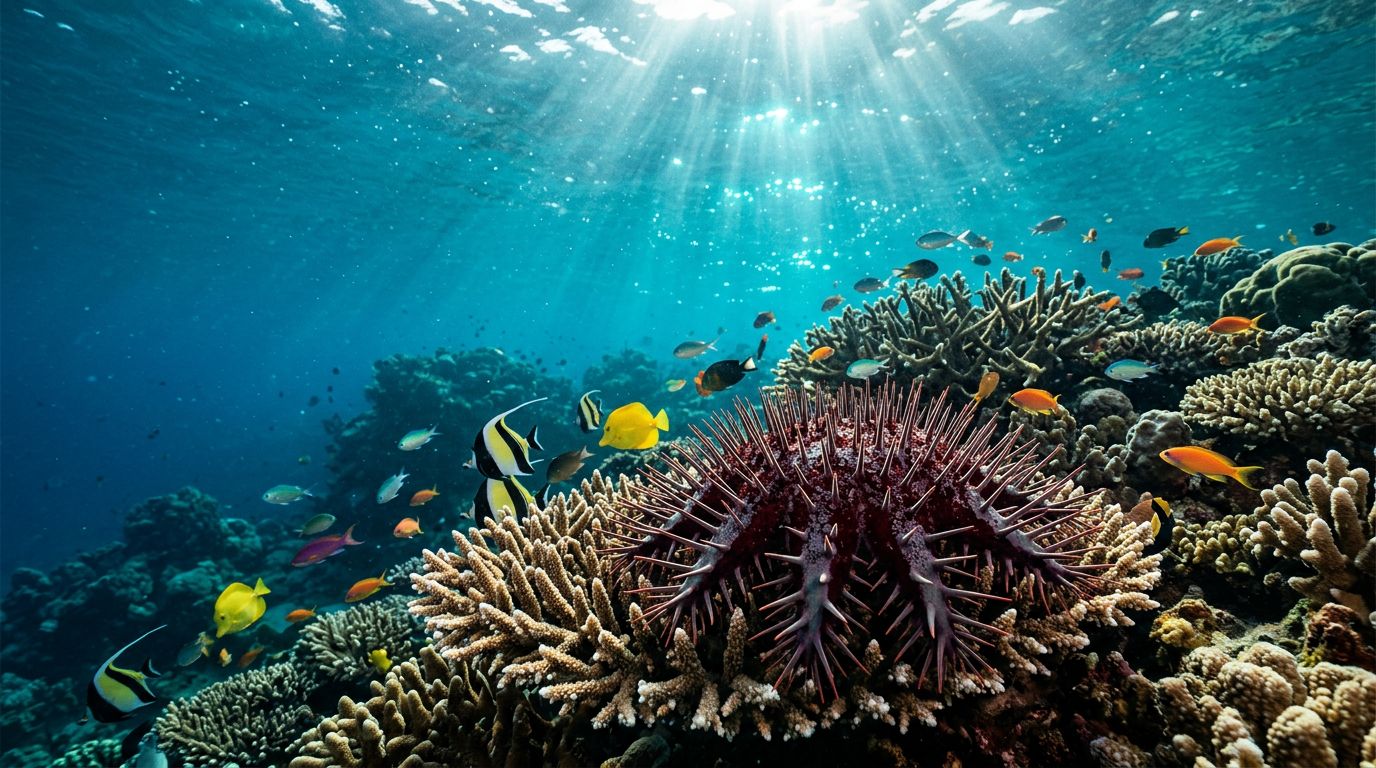
When you go snorkeling Big Island Hawaii, you may notice more than colorful fish and bright coral. A crown-of-thorns starfish can blend into the reef, yet its long spines make it one of the most important animals to recognize before you enter the water.
The crown-of-thorns starfish is native to Hawaii and plays a natural role on healthy reefs. However, large gatherings can damage living coral. Knowing what to look for helps you protect yourself, avoid disturbing marine life, and report unusual activity to the right people.
How to spot a crown-of-thorns starfish while snorkeling Big Island Hawaii
Crown-of-thorns starfish, often called COTS, are sea stars with a broad central body and many arms covered in sharp spines. Their colors can vary. You may see gray, green, brown, reddish, or mottled individuals depending on the reef, depth, and lighting.
The spines are the easiest feature to notice. They extend upward and outward across the animal’s body, creating a dense, thorny appearance. Unlike a smooth cushion sea star, a crown-of-thorns starfish looks almost shaggy underwater.
You may find one resting on the reef, tucked beneath a ledge, or moving across coral. During the day, some hide in shaded crevices. Others remain in plain view, especially when feeding. Their tube feet help them move slowly across hard surfaces, although they can travel faster than they appear when searching for coral.
Look for these signs:
- A large, many-armed sea star covered in long, pointed spines.
- White or pale patches on coral where living tissue has been eaten.
- A starfish positioned at the edge of a clean, freshly exposed coral skeleton.
- Several individuals gathered near the same coral colony.
- Spines that point in different directions rather than lying flat against the body.
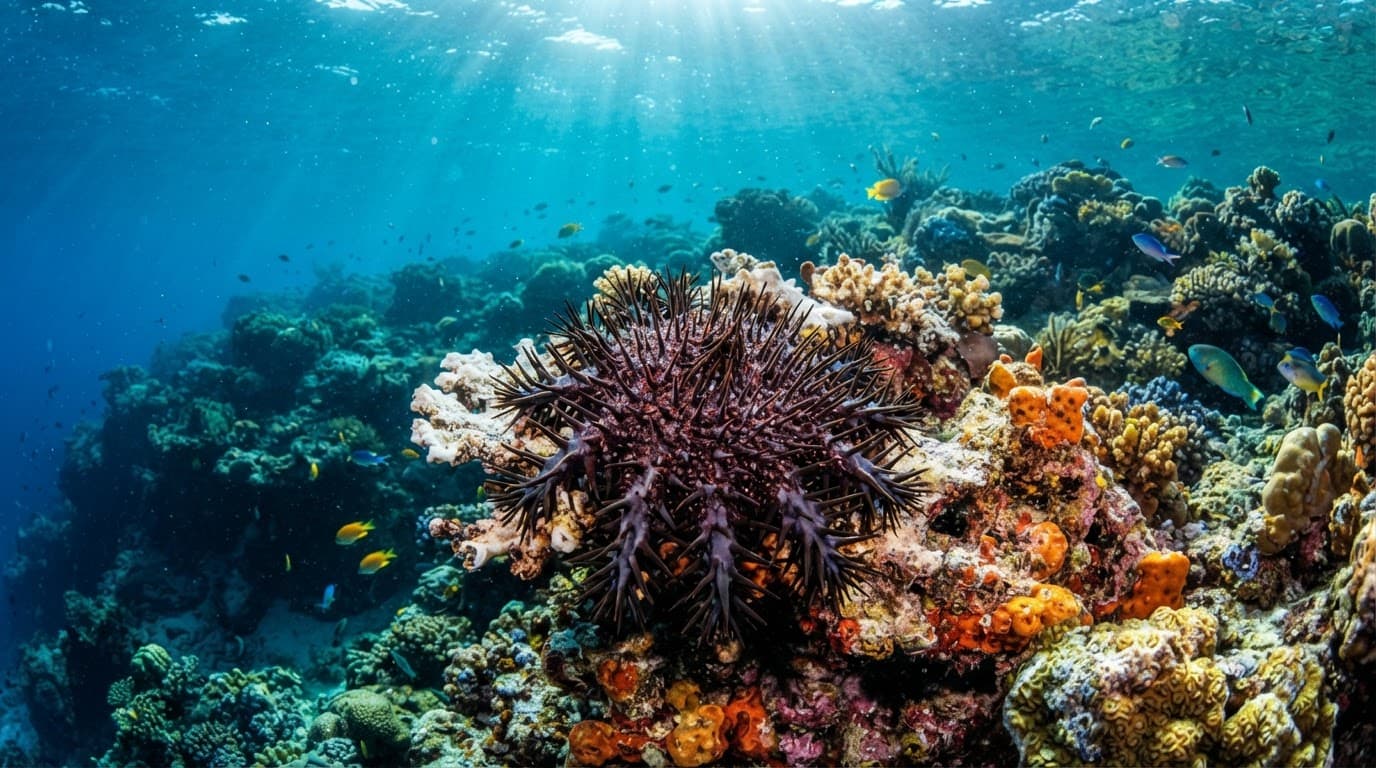
The animal may be difficult to see because its colors match volcanic rock and coral shadows. Keep your face several feet above the reef when possible. A wider view often reveals the whole animal more clearly than swimming close to inspect it.
You don’t need to identify every detail to stay safe. If you see a spiky sea star that could be a crown-of-thorns, treat it as one and keep your hands, fins, and equipment away.
Why crown-of-thorns starfish matter on Hawaiian reefs
Crown-of-thorns starfish are coral predators. They feed by extending part of their stomach over living coral tissue and digesting it outside their body. The process can leave behind a pale coral skeleton with a sharp boundary between the healthy and damaged areas.
One starfish can consume a significant amount of coral over time. The exact rate varies with the animal’s size, food supply, and environmental conditions. During high-density events, however, many starfish feeding together can remove living coral faster than the reef can recover.
That doesn’t mean every crown-of-thorns starfish is harmful. In Hawaii, the species is native, and low numbers are part of a functioning reef ecosystem. Hawaiian conservation material also describes how these animals may feed on faster-growing coral species, which can help maintain variety when populations remain balanced.
The concern begins when unusually high numbers gather in one area. A reef under stress may have more difficulty recovering after heavy coral loss. Algae can spread across exposed skeletons, fish may lose food and shelter, and the reef’s three-dimensional structure can weaken over time.
A 2023 Hawaii Division of Aquatic Resources report about Kahalu’u examined a crown-of-thorns event and concluded that it was likely an aggregation rather than an outbreak. That distinction matters. A few animals on a reef don’t automatically indicate a crisis.
For background on coral recovery work in Hawaii, you can review the Hawaii coral recovery survey from the Department of Land and Natural Resources.
A single sighting is useful information, but it isn’t proof of an outbreak. The number of animals, their location, and the condition of nearby coral all matter.
When you snorkel, your role is observation. You aren’t expected to manage the reef yourself. Your best contribution is to avoid contact, remember what you saw, and tell a guide or local resource manager.
Where you might see one when you snorkel Big Island reefs
Crown-of-thorns starfish favor coral reef habitat because live coral is their food. Along the Kona coast, you might encounter one near rocky reef shelves, coral heads, shallow ledges, and deeper reef slopes.
Their presence isn’t limited to one famous snorkeling location. Ocean conditions, food availability, recruitment, and local reef conditions all affect where they appear. A site that has no sightings during your visit may have had one the previous week.
Kealakekua Bay is known for clear water and rich marine habitat, but you shouldn’t book a trip expecting to see a crown-of-thorns starfish. Sightings are unpredictable, and responsible operators don’t remove animals simply to create an encounter.
The best time to search is when visibility is good and the sun illuminates the reef. Morning trips often provide favorable light and calmer conditions, although wind and swell can change quickly along the west coast. Your guide can choose a site based on the day’s water conditions instead of following a fixed route.
While snorkeling, scan the reef in sections. Start with the larger coral heads, then check their shaded sides without swimming close. Watch the transition between healthy coral and pale skeletons. A feeding starfish may sit just beyond that line.
Don’t chase a starfish to get a better photograph. If it moves beneath an overhang, let it disappear. Coral reefs are living communities, not exhibits, and your fins can cause damage even when you don’t touch anything with your hands.
If you’re planning a full day of snorkeling Big Island sites, include breaks between sessions. Fatigue makes it harder to control your legs, maintain distance from coral, and notice hazards below you. A relaxed swimmer is a safer reef visitor.
How to identify one without touching the reef
Identification starts with shape, not color. Many harmless reef animals can look different under changing light, while a crown-of-thorns starfish keeps its most important features: multiple arms and long, dense spines.
The center of the animal is usually raised. Its arms may curl or overlap as it moves. Spines cover the upper surface and can extend around the edges. Some individuals have spines that appear pale at the tips, while others look darker across the entire body.
A healthy coral colony usually has a living surface with color, texture, and small fish activity. A feeding path may look stark white because the starfish has removed the living tissue. Older damage can become dull, dark, or algae-covered.
Use the following comparison from a safe distance:
| Feature | Crown-of-thorns starfish | Smoother sea star |
|---|---|---|
| Upper surface | Covered in long, sharp spines | Usually smooth or lightly textured |
| Body shape | Many narrow arms around a raised center | Fewer, thicker arms |
| Reef behavior | Often found on or beside live coral | May cross rock, sand, or reef |
| Safety concern | Spines can puncture skin and cause pain | Still should not be handled |
| Best response | Keep away and report unusual numbers | Observe without contact |
Avoid relying on size alone. A smaller animal can still have sharp spines, and underwater perspective can make a starfish appear larger or smaller than it is.
Your mask also changes what you see. Refraction makes objects appear closer and larger underwater, while shadows can hide the animal’s outline. Move your head slowly from side to side rather than swimming directly toward it.
A phone or action camera can help you document a sighting from a distance. Keep the camera on a short grip, avoid extending it into coral, and never use the camera as a reason to reach beneath a ledge. A blurry image is better than a damaged reef or a puncture wound.
Children should stay beside an adult or guide around rocky reef areas. Explain that the starfish has sharp spines before entering the water. A simple rule works well: observe animals with your eyes, and keep your hands and feet away.
What to do if you see a crown-of-thorns starfish
First, create distance. Move your fins away from the animal and avoid kicking near the coral. If you need to change direction, swim backward or turn in open water rather than pushing off the reef.
Next, note the location. You can remember the name of the site, approximate depth, nearby reef features, and whether you saw one animal or several. The condition of the coral is also useful. Fresh white feeding scars near multiple starfish deserve more attention than a lone animal crossing bare rock.
Tell your guide as soon as you return to the boat or shoreline. A trained guide can decide whether the sighting should be passed to a local conservation contact. If you’re snorkeling from shore, speak with a lifeguard, park staff member, or the organization managing that area.
Never pick one up, move it, cut it apart, or try to kill it. Removing marine life may violate local rules, and handling a crown-of-thorns starfish can cause injury. Cutting one apart is especially dangerous because damaged pieces may survive in some conditions.
If a spine punctures your skin, leave the water and seek medical advice. Don’t return to the reef to continue your session. Tell the guide exactly what happened, especially if spines remain embedded or you develop severe pain, swelling, dizziness, weakness, or trouble breathing.
Keep your fins under control throughout the encounter. Snorkelers often worry about their hands but forget their feet. A careless fin kick can break coral, stir sediment into the animal’s habitat, or push you directly into a hidden spine.
The same care applies to every reef animal. Don’t stand on coral, collect shells, touch turtles, feed fish, or hold sea stars for photographs. Reef-safe behavior is a collection of small choices that protect the site during every visit.
Why a guided tour can improve your reef experience
You can snorkel Big Island reefs from shore, but a local guide can make marine-life observation safer and more informative. Guides understand water conditions, boat traffic, reef layout, and the habits of animals that visitors may miss.
Kona Snorkel Trips follows a “Reef to Rays” philosophy built around small-group ocean adventures, lifeguard-certified guides, quality equipment, and reef education. The company focuses on personal service rather than crowded, impersonal outings. Guides can help you keep a safe distance from coral while explaining what you’re seeing below the surface.
That approach matters when you’re looking for a crown-of-thorns starfish. A responsible guide won’t place an animal in a better position for photographs. Instead, you’ll learn how to observe it where it naturally occurs and how to recognize signs of coral stress without interfering.
The company offers guided reef snorkeling adventures around Kona, where the itinerary can reflect weather, visibility, and group ability. State-of-the-art snorkeling gear helps you stay comfortable, while safety briefings give families and first-time snorkelers clear expectations before entering the water.
A private trip can also help if your group includes young children, nervous swimmers, photographers, or guests who want a slower pace. You can ask about private snorkeling options and discuss your group’s comfort level before booking.
Don’t expect a crown-of-thorns sighting on any tour. Wildlife encounters depend on natural conditions, and an ethical operator won’t promise a particular animal. The value of a guided trip is the knowledge and care that make every reef encounter more rewarding, whether you see a sea star, an octopus, or a school of yellow tang.
When you’re ready to plan a reef excursion, you can check availability with Kona Snorkel Trips.
Prepare for a safer snorkeling day
Before you enter the water, check the forecast, surf, wind, and current. Kona’s west coast often has calm conditions, but no shoreline or boat site stays calm every day. Follow posted warnings and your guide’s instructions even when the water looks inviting.
Choose a mask that seals around your eyes and a snorkel that feels comfortable. Fins should fit without pinching. If you use a flotation vest, wear it correctly and keep enough space to move your legs without contacting the bottom.
Apply sunscreen before you arrive at the water. A rash guard, hat, and shade breaks can reduce the amount of sunscreen you need. Choose products labeled for reef-conscious use, but remember that no sunscreen makes it acceptable to touch coral.
If you snorkel from shore, enter through sand or a designated access point. Avoid walking across shallow coral to reach deeper water. Check your fins before swimming over the reef, and practice floating without standing on the bottom.
Stay with your group. Strong swimmers can still become tired, disoriented, or caught by a changing current. Keep your guide in sight on a boat tour, and tell someone immediately if you feel cold, tired, seasick, or uncomfortable.
Use neutral buoyancy when you look at marine life. Keep your body horizontal, move slowly, and let the water carry you. This position protects coral and gives you a clearer view of animals hiding along the reef.
For a different reef setting, you can consider a Captain Cook snorkeling tour to Kealakekua Bay. The same rules apply there: stay off the coral, avoid handling wildlife, and treat every sighting as a chance to observe rather than interfere.
Planning a reef trip during a busy vacation week? A small-group departure may give you more room to ask questions and receive individual help. Families should also confirm swimming requirements, departure times, and equipment details before booking.
Read the reef without becoming part of it
A crown-of-thorns starfish can be fascinating to watch. Its spines, slow movement, and unusual feeding behavior reveal a side of the reef that many visitors miss. The animal also reminds you that coral ecosystems depend on balance, not on removing every species that looks dangerous.
During your next snorkeling trip, keep your distance and inspect the reef calmly. Look for the animal’s long spines, watch for pale feeding scars, and report unusual clusters to a guide or local authority. You can enjoy close observation without making physical contact.
The goal of snorkeling Big Island waters is not to touch everything you find. It is to leave the reef in the same condition, or better, than when you arrived. With controlled fins, respectful behavior, and good local guidance, you can spot a crown-of-thorns starfish safely while helping protect Hawaii’s living coral.