
Blackwater Diving: A Guide to the Deep Ocean Void
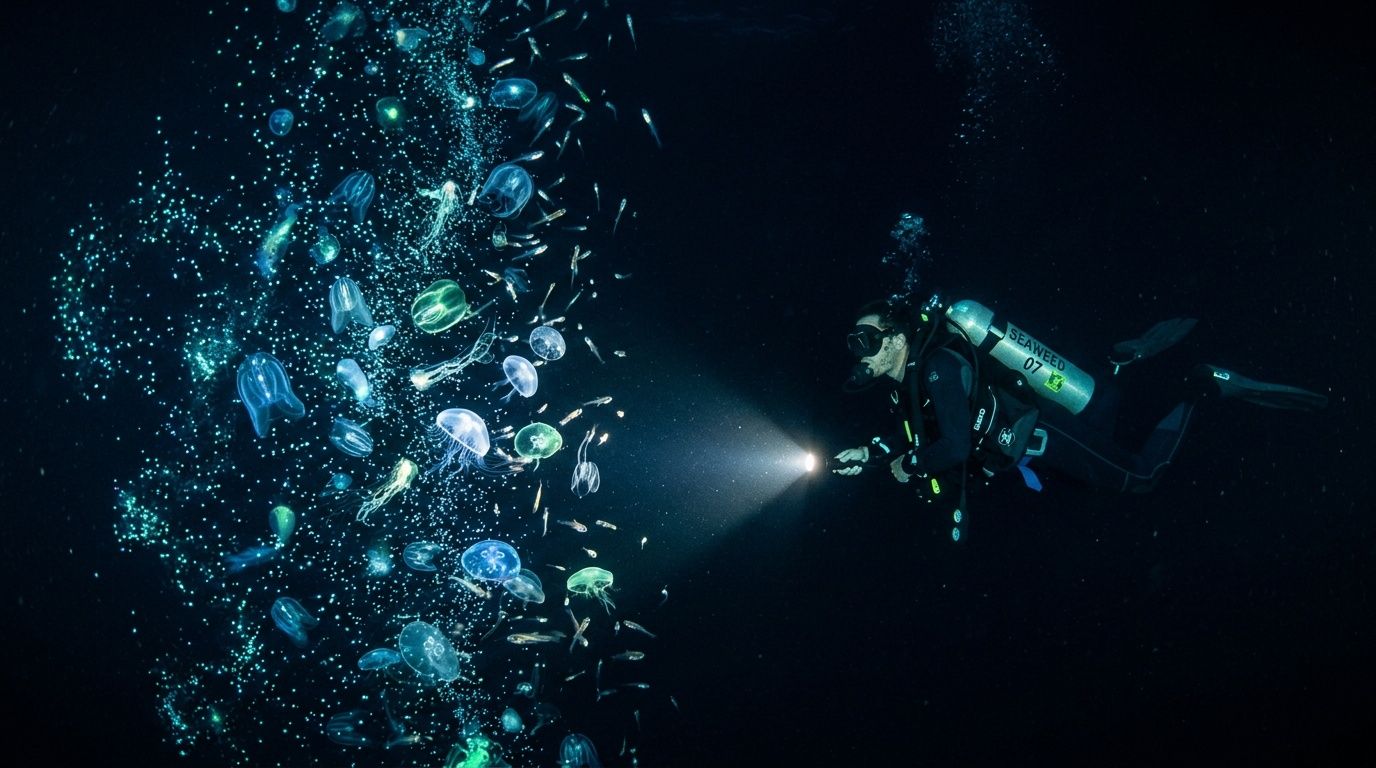
You’re probably looking at Kona dive options right now and trying to sort out what belongs on the trip list. Reef dives make sense. Manta dives make sense. Then you see blackwater diving, and the description sounds almost absurd. Open ocean. At night. No bottom in sight.
That reaction is normal.
The first time a diver drops into blackwater, the mind looks for a reef, a wall, sand, anything that says where you are in the water column. Instead, you get darkness, a suspended light field, and tiny living things drifting out of the deep that don’t look like they should exist. It feels less like a night dive and more like hovering in a patch of oceanic sky.
Welcome to the Void An Introduction to Blackwater Diving
Blackwater diving is not a standard reef night dive done farther offshore. It’s a very specific kind of open-ocean pelagic night dive. Divers suspend in lit water over deep offshore drop-offs while the ocean brings the action upward.
In Kona, that action is what makes the dive unforgettable. You’re not finning along coral heads looking for sleeping parrotfish or octopus tucked into cracks. You’re hovering in the dark while transparent larvae, jellies, and tiny predators rise into view one after another.
What surprises most divers: the stillness. Once you stop searching for a bottom, your attention shifts to the water itself.
That’s when blackwater starts making sense.
A good blackwater dive feels controlled, deliberate, and oddly peaceful. You settle your breathing, keep your buoyancy clean, and scan slowly. A bright filament appears. Then a comb jelly. Then a larval fish with impossible proportions. The encounter isn’t built around one big animal. It’s built around constant discovery.
Kona matters here because recreational blackwater diving took shape there. If you want a strong overview before booking, the ultimate guide to Blackwater Diving in Hawaii does a good job laying out what makes the experience distinct, and why the Big Island became the place most divers associate with it.
The best way to think about blackwater is simple. Reef night diving shows you a familiar world after dark. Blackwater diving shows you a world most divers never see at all.
The Planet's Largest Migration A Deep Dive into the Science
At first glance, blackwater diving can look random. It isn’t. The whole dive is built around one of the biggest recurring movements in the natural world.
Diel vertical migration is the nightly rise of small ocean life from deep water toward the surface to feed under cover of darkness. Blackwater diving gives divers a front-row seat to that movement.

What is actually moving
The headline animals are rarely big. They’re usually:
- Zooplankton such as drifting invertebrates and other tiny organisms
- Larval fish in life stages that often look nothing like the adults
- Gelatinous animals including salps, siphonophores, and ctenophores
- Small cephalopods that appear and disappear in a flash of light
Blackwater diving illuminates Earth’s largest biomass movement, where billions of zooplankton, larval fish, and gelatinous organisms ascend nightly from depths over 1,000 meters toward the surface epipelagic zone of 0 to 200 meters, and a NOAA visual census off Kona found salps, siphonophores, and ctenophores made up up to 59% of sightings according to Original Diving’s blackwater overview.
That stat tracks with what divers experience in the water. A lot of the show is delicate, gelatinous life.
Why the dive works
The light array doesn’t create the migration. It reveals it.
Animals are already moving upward through the water column. The illuminated area gives divers a controlled place to observe passing life. It is like a lit window suspended in open ocean. The cast changes constantly, and most of it is in motion.
If you want a local planning angle, this Kona night adventures guide to black water diving gives a useful trip-specific perspective.
The science matters because it changes how you dive. Once you understand the migration, you stop hunting for subjects and start waiting for them.
That shift makes people better blackwater divers. Calm divers see more. Rushed divers usually miss the best part of the dive, which is the slow reveal.
Encounters in the Deep The Creatures of the Night
Most memorable blackwater animals are small enough to drift past unnoticed if your scan is sloppy. That’s part of the appeal. You aren’t watching a fixed scene. You’re reading movement in a dark water column.

The gelatinous drifters
This group gives blackwater its alien reputation.
Ctenophores can look like strips of glass with internal color. Siphonophores don’t read as one animal at first glance. They look assembled. Salps drift in a way that feels mechanical until you realize you’re watching a living filter feeder crossing your beam.
These animals reward restraint. Chase them and you lose them. Hold position and let them pass through the light, and details start appearing.
Larval fish that break your assumptions
Here, even experienced tropical divers can be surprised.
A larval fish can carry long streamers, oversized eyes, strange fins, or transparent body sections that make no sense if you’re expecting the reef fish version. Some larvae bear so little resemblance to the adults that identification gets difficult without close study.
One reason blackwater fascinates photographers and biologists is that it exposes life stages that most divers never encounter in any meaningful way.
Cephalopods and the brief high-drama moments
Squid and octopus tend to create the most excitement on the line because they combine delicacy with obvious intelligence and fast movement.
A tiny octopus can appear fully formed yet almost weightless. Small squid often arrive like silver punctuation marks, then vanish back into the dark before half the group spots them.
Some blackwater subjects drift. Some pulse. Some rocket through the light field and leave you wondering if you really saw them.
What to look for first
New blackwater divers usually improve once they stop scanning for “animals” and start scanning for visual clues:
- Reflective edges catch your light before the body becomes visible
- Unnatural symmetry often gives away jellies and gelatinous life
- Sudden directional movement suggests fish or cephalopods rather than plankton
- Fine trailing filaments can signal siphonophores or larval forms
The creatures aren’t rare because the ocean lacks life. They’re hard to see because most are transparent, tiny, or both. That’s why patience beats speed every time.
Safety First Gear and Protocols for Open Ocean Diving
Blackwater diving is advanced diving. That isn’t marketing language. It’s just the truth of the environment.
You’re in open ocean, at night, without a bottom reference. That changes the margin for error.
The core safety problem
In blackwater, depth can become abstract if your buoyancy isn’t solid. Blackwater dives typically keep divers at 30 to 60 feet (9 to 18 meters) over abyssal water, and the lack of a visible bottom demands precise control. Tethered downlines help manage that risk and have been shown to reduce buddy separation by up to 90% in low-visibility trials, as summarized by Scuba.com’s blackwater safety article.
That’s why experienced operators treat the line system as central, not optional.
What ready divers usually have in common
The standard prerequisites matter for a reason. Blackwater commonly requires:
- Advanced Open Water
- Night dive certification
- At least 50 logged dives
- Comfortable buoyancy without visual references
Those aren’t box-checking requirements. They reflect the actual workload of the dive.
Blackwater Diving Gear Checklist
| Item | Requirement | Reason |
|---|---|---|
| Exposure protection | Full wetsuit | Helps protect skin from planktonic stings and irritation |
| Primary light | High-lumen dive torch | Lets you see subjects and maintain visual awareness |
| Backup light | Clipped and accessible | Light failure in blackwater needs an immediate answer |
| BCD and weights | Well-balanced setup | Prevents constant correction in the water column |
| Computer | Clear, easy-to-read display | Depth awareness matters when there’s no bottom reference |
| Tether attachment | Used exactly as briefed | Keeps the dive organized and depth-controlled |
| Camera rig | Compact and manageable | Oversized rigs create task loading fast |
| Seasickness prep | Planned before departure | Offshore night diving gets harder when the ride already has you off balance |
If boat motion is part of your planning, this practical guide on how to avoid sea sickness is worth reading before you book.
What works and what doesn’t
What works:
- Clipping in exactly as instructed
- Hovering instead of finning around
- Keeping your light use disciplined
- Staying mentally ahead of small problems
What doesn’t work:
- Treating it like a reef exploration dive
- Overweighting yourself to feel “stable”
- Bringing unfamiliar gear
- Letting photography override awareness
Practical rule: If your buoyancy still needs frequent correction on an easy daytime dive, blackwater should wait.
That isn’t a criticism. It’s good judgment.
Kona The Undisputed Home of Blackwater Diving
Kona didn’t just become a popular place to do blackwater diving. It’s where the recreational version of the dive took hold.
Blackwater diving originated in Kona, Hawaii, in the 1990s, where local divers adapted earlier scientific bluewater methods into a repeatable recreational experience. The reason was geography. Offshore volcanic slopes plunge to over 10,000 feet just 2 to 3 miles from shore, making true pelagic water reachable in under 20 minutes by boat and turning Kona into the global epicenter for the dive, as described in PADI’s history of blackwater diving in Kona.
That single fact changes everything operationally. You don’t need a long offshore transit to reach the right environment. You can get into deep water quickly, with divers fresher and crews able to run consistent trips.

Why Kona still sets the standard
Lots of places now offer blackwater diving. Very few have Kona’s combination of deep water access, established procedures, and long operator experience.
Operators here refined the practical side of the dive. Tether systems, diver spacing, depth control, and the rhythm of commercial blackwater operations were worked out in this setting. That history matters when conditions are dark, offshore, and deceptively simple.
For another local angle on what makes this experience so tied to the Big Island, this Kona black water dive guide gives helpful context.
Why operator choice matters more here
Blackwater is not the dive to choose by price alone.
You want a crew that treats setup, briefing quality, and line discipline as serious parts of the experience. In Kona, Kona Honu Divers has long been associated with the systems that helped make commercial blackwater diving workable and safe at scale. If you’re booking this experience, their Black Water Night Dive tour is the direct fit.
Book your otherworldly adventure with the best in the business. Join Kona Honu Divers on their renowned Black Water Night Dive tour.
How to Photograph Pelagic Magic
Blackwater photography punishes sloppy settings fast. Subjects are tiny, often transparent, and moving with current while you’re also trying to hold position in the dark.
That’s why a simple, repeatable setup beats experimentation on the descent.
Start with these baseline settings
For blackwater photography, a strong starting point is 1/200s or faster, f/16 to f/22, and ISO 100 to 200, with a 60mm macro lens often preferred because it helps control lighting and reduce backscatter, according to Kona Honu Divers’ guide to black water dive photography settings.
Those settings work because each one solves a specific problem.
- Fast shutter speed freezes subject movement and your own minor drift.
- Narrow aperture gives you depth of field on very small subjects.
- Low ISO keeps the background clean instead of noisy.
- Macro focal length helps isolate tiny animals without lighting up extra water.
If you want a trip-planning companion read focused on the experience itself, this black water night dive article pairs well with the camera side.
Lighting decisions matter more than camera body choice
Most missed shots come from lighting errors, not lack of megapixels.
Keep strobes angled outward rather than blasting straight ahead. That cuts backscatter in particulate-rich water. Use your focus light to acquire the subject, then let strobe placement shape it.
Don’t light the whole ocean. Light the animal.
What works underwater
A few field habits make a big difference:
- Shoot close when you can because more water between port and subject means more debris in frame
- Wait for profile or symmetry instead of firing constantly
- Use the downline area as a reference when composing tiny drifting subjects
- Keep your rig compact so you can still manage buoyancy cleanly
What usually fails is chasing every subject at speed. Blackwater rewards short bursts of action separated by stillness. Good photographers learn to pause, see, and shoot with intention.
Diving with Respect Conservation in the Open Ocean
Blackwater diving can feel low-impact because there’s no reef below you. That doesn’t mean it’s impact-free.
The biggest overlooked issue is light. Powerful lights are central to the dive experience, but they also alter the behavior of animals moving through the dark water column. That topic doesn’t get enough attention.
Ethical blackwater is better blackwater
A more responsible approach is straightforward. The industry conversation around “green blackwater” includes practices such as red-spectrum lights to reduce attraction range and strict no-touch policies for fragile pelagic animals, as discussed in Bluewater Dive Travel’s piece on blackwater diving sustainability.
That makes sense in the water.
Gelatinous animals are delicate. Larval life is easy to stress or damage. Good buoyancy and disciplined hands-off diving aren’t just polite habits. They’re the minimum standard.
The habits that matter most
- Keep a no-touch mindset with every subject, even if it seems hardy
- Use only the light needed for safety and observation
- Avoid erratic finning near drifting life
- Choose operators that brief ethics clearly
If you care about low-impact ocean recreation more broadly, this guide to reef-safe sunscreen tips for snorkeling Big Island Hawaii reflects the same basic principle. Small choices stack up.
Respect is part of the skill set. A diver who can hold position and observe without interfering sees more and leaves less behind.
That’s the standard blackwater diving deserves.
Frequently Asked Questions About Blackwater Diving
Is blackwater diving the same as a reef night dive
No. Blackwater diving happens over deep open ocean with no bottom in sight, using a suspended light rig to concentrate drifting life in the water column. A reef night dive gives you structure, navigation references, and resident animals following familiar patterns. The skill set is different, and so is the mental game.
Is it scary
It can be for the first few minutes.
Divers usually feel the exposure before they feel the fun. You drop into dark water, look down, and there is nothing but blue-black space below you. That reaction is normal. Good operators in Kona manage it with a clear briefing, controlled entries, strong in-water supervision, and a setup that keeps the group oriented around the line and lights. Once divers settle into the drift, the anxiety usually gives way to curiosity fast.
Do I need to be a photographer to enjoy it
No. Some of the happiest blackwater divers I guide never bring a camera.
Photography slows you down and helps you notice detail, but it also adds task loading. If buoyancy, trim, and situational awareness are still taking active effort, skip the camera on your first dive. Watch the animals first. The better your diving gets, the better your photos will get later.
Is it harder than a manta night dive
Yes. A manta dive is more accessible because the site, depth, and viewing experience are tightly structured. Blackwater demands better midwater control, better light discipline, and more comfort with open ocean conditions at night.
If you want a point of comparison before committing, the manta ray dive with Kona Honu Divers shows how different Kona night diving can feel when the focus is large, predictable animals near a known site.
Who should wait before booking
Newly certified divers, divers who still rise and fall while hovering, and anyone who gets stressed in current or low-visibility conditions should get more experience first. Blackwater is not the place to sort out basic buoyancy problems.
The divers who enjoy it most arrive with enough capacity to stay relaxed, track their depth, monitor their gas, and still spend real time observing what drifts through the lights. That is one reason Kona has become the center of blackwater diving. The local crews who pioneered these dives know how to screen for fit, brief them properly, and run them with the discipline this environment requires.
Why is Kona considered the best place to try blackwater diving
Kona earned that reputation in the water, not through marketing. Local operators spent years refining the procedures, crew roles, drift systems, and diver protocols that made blackwater diving repeatable and safe enough to become a serious specialty experience. The conditions help too. Kona’s offshore depth is close to shore, access is straightforward, and the operator community has more hands-on experience with blackwater than almost anywhere else.
That matters. On a dive this specialized, the crew is part of the experience. In Kona, especially with long-running operators such as Kona Honu Divers, you are not booking a novelty trip. You are stepping into a place that helped define how blackwater diving is done well.