
Black Water Dive Kona: Ultimate Pelagic Night Adventure
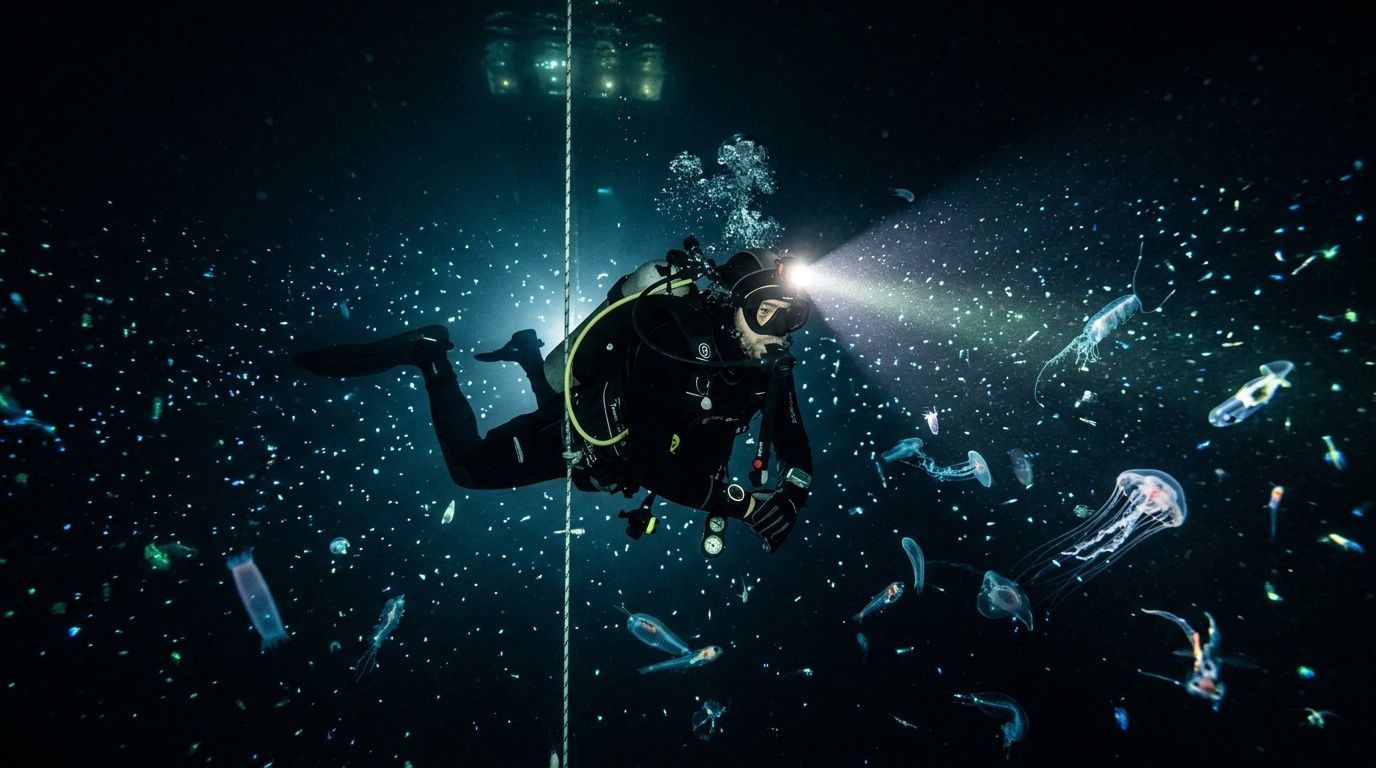
You’re probably weighing two reactions right now. One says a black water dive kona trip sounds like the most fascinating thing you could do on the Big Island. The other says floating in the open ocean at night over water so deep you can’t imagine the bottom sounds a little unhinged.
Both reactions are normal.
I’ve watched experienced divers step onto the boat with that exact mix of curiosity and hesitation. Then they drop in, settle on the line, and a few minutes later the whole mood changes. The darkness stops feeling empty. It starts feeling alive.
What makes Kona special is that this isn’t a gimmick night dive tacked onto a reef schedule. It’s a carefully run pelagic experience born here, refined here, and still done here at a very high level. If you’re looking at operators for this kind of scuba trip, the strongest fit is usually Kona Honu Divers and their black water night dive tour.
Descending into the Darkness A Different Kind of Night Dive
The first surprise is how little this dive feels like a normal night dive.
You’re not finning along lava rock looking for octopus under ledges. You’re not following a reef contour. You’re suspended in dark blue water with the boat above, the line below, and your light beam cutting through a moving world of tiny life.

That sounds intense, and it is. But it’s also strangely peaceful.
Most divers expect adrenaline. What they remember instead is stillness. You hang in the water column, breathe slowly, and watch things materialize out of the black that look more like living glass than reef animals.
Why the setting feels so unusual
On a reef dive, your brain always has reference points. Bottom. Wall. Coral head. Sand channel.
On blackwater, those disappear. At first that can feel mentally big. Then the tether, the lights, and your own breathing give the dive its structure.
The dive feels less like exploring a place and more like visiting a migration route.
That’s why many advanced divers come back talking about it with almost reverent language. It isn’t just exciting. It changes how they think about the ocean.
Why operator quality matters more here
This kind of dive depends on routine, calm briefings, and disciplined in-water procedures. That’s one reason serious divers in Kona often look to Kona Honu Divers for blackwater and other advanced local diving. If you want more social proof before booking, their review widget belongs right here:
What Is a Kona Blackwater Dive The Science of the Abyss
A Kona blackwater dive is a pelagic night dive in open ocean. The key idea is simple. You aren’t diving down to the deep sea. You’re waiting in midwater while deep-sea organisms rise toward you.
That nightly movement is what makes the whole experience possible.

The migration you’re intercepting
Every night, organisms from deep water move upward to feed. Divers on blackwater aren’t chasing them down into the abyss. They’re positioned in the lane these animals pass through.
That’s the mental shift people need most. If you think of it as a reef night dive in weird water, it won’t make sense. If you think of it as a floating observation station, it clicks.
Why Kona became the world center
Kona didn’t just become known for blackwater by chance. According to PADI’s overview of blackwater diving, blackwater diving originated in Kona, Hawaii, making it the birthplace and world headquarters of the dive style because depths exceed 10,000 feet just offshore.
That geography matters on a practical level. The ocean floor drops to over 1,000 feet within one mile offshore, and reaches 5,000 to 8,000 feet at only 2 to 3 miles from shore, which lets boats reach the migration zone in under 20 minutes according to this Kona blackwater explainer.
For divers, that means less transit and more actual time focused on the reason you came.
Why the biology feels so alien
A lot of what rises at night is in larval or juvenile form. Some are transparent. Some pulse. Some trail delicate structures behind them. Some glow.
Researcher Steven Haddock’s work, as cited in the PADI article above, notes that 76% of observed organisms produce their own light. Once you know that, the strange sparkle and glow of the water starts to make more sense.
Here’s the simplest way I explain it on the boat:
- A reef dive shows a neighborhood
- A blackwater dive shows traffic
- The traffic happens at night
- Kona lets divers reach that traffic quickly and safely
Practical rule: Don’t ask, “What reef are we diving?” Ask, “What part of the water column are we observing?”
The Mechanics of a Floating Deep-Sea Safari
The setup is what turns this from a wild-sounding idea into a controlled dive.
The core of the system is a central weighted down-line dropped from the boat. Divers clip into that system on short personal tethers, then hold position in the water column while the lights attract pelagic life.
How the tether system works
According to Kona Honu Divers’ blackwater system description, the setup uses a weighted central line with individual 10 to 15 foot tethers attached to each diver’s BCD. This prevents lateral drift, keeps the group together in low-visibility open ocean, and maintains divers at about 50 feet.
That immediately addresses a common fear. You are not free-swimming around in dark offshore water hoping to stay near the boat.
You are clipped into a structure.
For readers comparing offshore experiences more generally, this overview of Kona boat tours helps explain why vessel setup and crew procedure matter so much on the water.
What the lights are doing
The lights don’t just help divers see. They create an attractor.
Tiny pelagic organisms move into the lit zone, which concentrates the action into a smaller viewing space. Instead of searching featureless darkness, you watch a defined stage in front of you.
What your job is underwater
Advanced divers usually smile, because the task sounds simple and then proves wonderfully demanding.
Your job is to:
- Hover cleanly without pulling on the line
- Keep gear tight so nothing dangles or snags
- Move slowly because sudden finning pushes fragile subjects away
- Watch patiently rather than scanning like you’re hunting reef fish
A diver with excellent buoyancy will feel comfortable quickly. A diver who relies on the bottom for orientation will feel the challenge right away.
Encounters in the Abyss What You Might See
The animals are why this dive lingers in your memory.
Not because they’re huge. Usually they aren’t. Not because they’re easy to identify. Often they’re not. The impact comes from how unfamiliar they look.

One pass through your light beam might reveal a larval fish with oversized eyes and a transparent body. Another might bring in a drifting salp chain, a siphonophore trailing like illuminated thread, or a tiny pelagic sea slug that looks too delicate to be real.
The creatures that stop divers cold
Some of the most memorable blackwater subjects are animals people have never heard of before they enter the water.
You might see:
- Siphonophores, which can look like glowing strings or living filaments
- Salps, gelatinous drifters that pulse softly through the water
- Larval fish, which often look nothing like the adults they’ll become
- Juvenile squid and eels, appearing in forms reef divers rarely witness
That’s part of the thrill. You spend years diving Hawaii and still find a whole category of life you’ve barely met.
Why bioluminescence matters
The weird beauty of blackwater gets a scientific boost from light production. An article discussing blackwater photography challenges notes that 76% of organisms are light-producing, which helps explain why the water can feel starry, electric, and almost theatrical.
For ocean lovers who want a broader sense of how Kona compares with other islands, this guide to the best diving Hawaii islands gives useful context.
Most first-timers stop trying to identify everything and start appreciating shape, motion, and light. That’s when the dive gets good.
Photography is harder than people expect
Blackwater photography looks clean and elegant when experts do it. For beginners, it can be frustrating.
The same article above points out that photography and videography challenges for non-professionals are poorly covered beyond pro tips. That’s true. These subjects are small, translucent, and often moving unpredictably. Backscatter becomes obvious fast.
A few simple habits help:
- Keep your movements minimal so you don’t stir particles into the beam
- Simplify your camera goals on your first dive. One solid shot is a win
- Watch with your eyes first because it’s easy to miss the experience while chasing settings
If your first black water dive kona trip is also your first attempt at pelagic macro photography, give yourself permission to come back with more ambition on dive two.
Blackwater Dive vs Manta Ray Night Experience
Visitors often compare Kona’s two famous night-water experiences, but they deliver very different kinds of awe.
The manta experience is broad, graceful, and easy to understand the moment it begins. Blackwater is quieter, stranger, and asks more from the diver.
If you want a detailed side-by-side breakdown, this comparison of the Kona manta ray night snorkel vs night dive is a helpful companion.
The biggest difference
A manta ray night snorkel is built for accessibility. You’re near the surface watching large animals circle in the lights.
A blackwater dive is for qualified scuba divers who want an advanced open-ocean experience focused on tiny pelagic life. One is immediate spectacle. The other is patient discovery.
Blackwater and manta side by side
| Feature | Blackwater Dive | Manta Ray Night Snorkel |
|---|---|---|
| Environment | Open ocean over deep water | Shallow coastal water |
| Skill level | Advanced certified diver | Beginner-friendly |
| Focus | Tiny pelagic and larval life | Large manta rays |
| Feel | Meditative, curious, surreal | Dramatic, social, high-visibility |
| Best for | Divers who enjoy buoyancy control and unusual marine life | Travelers who want a famous Kona wildlife encounter without scuba |
Which one should you choose
Choose blackwater if this sounds like you:
- You’re already an advanced diver
- You enjoy hovering and observing
- You care more about bizarre biology than big-animal spectacle
Choose manta if this sounds like you:
- You don’t scuba dive
- You want a night ocean activity with a shorter learning curve
- You’re traveling with mixed experience levels
For divers who want the scuba version of the manta experience, Kona Honu Divers also runs a manta ray dive. For non-divers or mixed groups looking for the surface experience, the Kona manta ray snorkel tour is the more natural fit. If you’re shopping specifically for a manta tour, Manta Ray Night Snorkel Hawaii is another option to consider.
Safety Protocols and Diver Requirements
Blackwater has an intimidating reputation. The procedures are much calmer than the name suggests.
This dive works because strong operators keep the environment highly structured and because they don’t let unprepared divers treat it like a casual check-out dive.
What operators typically require
According to Honolulu Magazine’s feature on Kona blackwater diving, Kona operators have a zero shark-attack record even though sharks appear on only 2 in 100 dives. The same source notes stringent diver qualifications including Advanced Open Water and a minimum of 50 logged dives.
Some operators also want recent experience and clear communication during briefing. That isn’t bureaucracy. It’s risk management.
Who usually does well on this dive
The diver who thrives here isn’t always the most adventurous personality on the boat. It’s often the calmest one.
Good blackwater candidates usually have:
- Reliable buoyancy control at safety-stop depth without constant adjustment
- Night diving comfort, so darkness doesn’t spike task loading
- Open-ocean composure, because there’s no reef to settle your eyes on
- Secure gear habits, with nothing loose and dragging
The fear people ask about most
Yes, people ask about sharks first.
That’s understandable, but it’s not the most useful question. A better question is whether you can stay still, breathe slowly, and follow line procedures in low-reference water. That’s what shapes your experience most directly.
If you’re honest about your readiness, blackwater feels disciplined rather than risky.
This is not the right dive for someone who was certified recently and is still working through buoyancy basics. It’s far better to build up to it than to force it too early.
Planning Your Blackwater Adventure in Kona
Booking blackwater is easier when you think about it like any other specialty dive. Match the dive to your current skill level, choose an operator with a mature system, and show up ready to listen.
If your goal is specifically this experience, book the dedicated Kona Honu Divers black water night dive. If you want a broader sense of departures and harbor logistics first, this guide to Kona boat tours from Honokohau Harbor gives useful local context.
What to bring
Keep it simple:
- Dry clothes for after the dive because even warm nights can feel cool once you’re wet
- Any personal comfort items you already trust for motion sensitivity
- Your certification details in case the operator verifies prerequisites
- A conservative mindset if you’re debating whether to bring a complicated camera rig
One practical note. Some travelers book this through Kona Snorkel Trips, which offers access to the blackwater trip through its partnership with Kona Honu Divers. That’s useful if you’re organizing multiple ocean activities in one itinerary.
What the night feels like
The ride out is short compared with many places in the world where deep water takes much longer to reach. Then the pace slows down. Briefing. Setup. Entry. Descent. Hover.
That rhythm is part of why the dive works. Nobody should feel rushed.
Frequently Asked Questions About Blackwater Diving
Can I do this dive if I’m newly certified
Usually no. This is an advanced dive built for divers with strong buoyancy, comfort at night, and enough experience to stay calm in open water without bottom reference.
Is it scary to dive in dark open ocean
For some divers, the first minute feels mentally unusual. Then the structure of the dive takes over. Once settled on the tether and observing the light field, the experience becomes absorbing and peaceful.
What if I get seasick
Plan for that before the boat leaves. Use the remedy you already know works for you, hydrate, and don’t show up exhausted. Offshore night trips are much easier when you start the evening feeling steady.
Do I need to be a serious underwater photographer
No. Many first-timers enjoy blackwater more when they leave the camera behind or keep their setup very simple. Observation comes first. Photography can come later.
If blackwater sounds amazing but not quite right for everyone in your group, Kona Snorkel Trips offers other guided ocean experiences on the Big Island that are easier to join while still delivering memorable wildlife encounters.