
Black Water Dive: A Guide to Hawaii’s Alien World
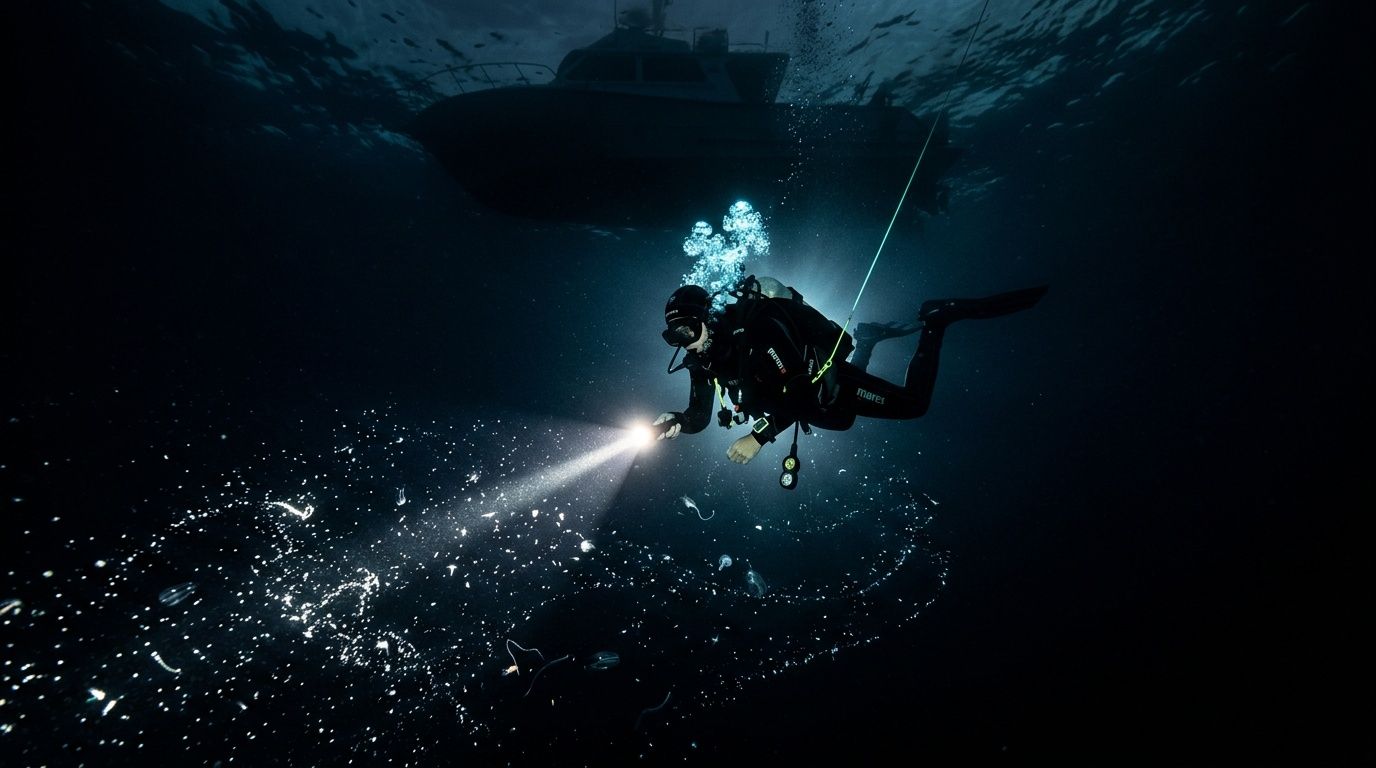
You’re probably reading this while planning a Kona trip, scrolling through reef dives, manta tours, and all the usual bucket-list adventures, then stumbling onto two words that sound equal parts thrilling and questionable: black water.
I’ve watched that reaction on the boat many times. Someone grins, someone goes quiet, and someone asks the same thing every trip: “So we’re just floating in the dark over deep water?”
Yes. And that’s exactly why it’s unforgettable.
A black water dive doesn’t feel like a normal night dive. It feels like a drift into open space. You descend into warm Pacific water, settle into the glow of the lights, and then the ocean starts delivering things that look impossible. Transparent fish larvae with ribbon tails. Pulsing jellies. Tiny predators that seem assembled from spare parts.
Kona is where recreational blackwater diving took shape in the 1990s, adapting scientific methods first formalized in 1986 into an experience certified divers could do, thanks to the Big Island’s fast drop-off to over 10,000 feet just a few miles offshore, as described by Kona Honu Divers’ black water history.com/black-water-dive-5/). If you’re going to try this strange, beautiful style of diving anywhere, this is the place to do it.
Descending into the Abyss
The first few moments are always the most honest.
You sit on the boat in the dark, listening to tanks clink and fins shuffle across the deck. Shore lights are behind you. Ahead is open ocean. Then you roll in, and the surface goes quiet except for bubbles and the faint slap of water against the hull.

Your mask clears. Your breathing slows. The light field comes into view below you like a stage hanging in the middle of nowhere.
I’ve seen experienced reef divers pause at that point. Not because something is wrong, but because their brain expects a bottom, a wall, a coral head, some familiar frame. On a black water dive, there isn’t one. There’s only the glow, the tether, and the feeling that the Pacific has opened a secret door.
What it feels like
A Kona black water dive usually settles into a rhythm fast.
- You stop looking for scenery. The water column becomes the whole show.
- You notice tiny movement. A flicker at the edge of your beam turns into a larval fish.
- You hover instead of touring. The ocean brings the encounter to you.
One diver I guided laughed through her regulator after spotting a transparent juvenile creature drifting past her light. Back on the boat, she said it felt less like scuba and more like “waiting at a window into another planet.” That’s the right instinct.
The best black water divers aren’t the busiest swimmers. They’re the calmest observers.
That’s why so many divers end up booking a black water night dive tour with Kona Honu Divers. The appeal isn’t just novelty. It’s that rare moment when the ocean stops feeling familiar and starts feeling immense.
Understanding the Science of Black Water Diving
A few minutes into a Kona black water dive, someone usually spots it first. A glass-clear larval fish flashes silver in the beam, then vanishes until it turns just right and catches the light again. Another diver points at a ribbonlike siphonophore trailing through the glow. What looks like empty ocean starts filling with life.

The nightly rise
That parade has a reason. After dark, tiny ocean animals and larval creatures rise from deep water toward the surface to feed under cover of darkness. Offshore Kona gives divers a rare front-row seat because the seafloor falls away fast just beyond the coast, so that upward movement reaches water divers can safely hover in.
From the boat, it feels like heading into open ocean. Underwater, it feels more intimate than that. You settle into the lit water column and wait. Then the migrants arrive one by one, drifting, pulsing, kicking, and spinning past your mask.
Kona divers have been returning to this experience for decades, and the setting is a big part of why. A short run offshore places you above immense depth without asking you to descend into it.
Why open ocean matters
On a reef night dive, the coral holds your attention. Here, the water itself does.
The light rig creates a small bright zone in a huge dark ocean. Plankton gathers in the light. Small predators follow the plankton. Juvenile pelagic animals pass through hunting, feeding, or rising with the nightly migration. That chain reaction is the science you can watch happen.
You stay relatively shallow while the deep water below supplies the cast.
If you have done or read about why manta rays gather near Kona after dark, the idea feels familiar. Light concentrates food. Food attracts animals. Black water diving applies that pattern in open ocean, where the visitors are smaller, stranger, and often in life stages reef divers never see.
What the science looks like through a mask
Marine biology terms are useful on the boat. Underwater, you notice shapes and motion first.
A transparent body appears only when your light catches its edge. A tiny fish shows oversized eyes and long streamers that make no sense until you remember it is still in its juvenile form. A jelly pulses past with perfect calm while everyone around it hangs motionless, trying not to miss the details.
What divers often notice first
- Transparency: Many animals almost disappear until they cross a beam.
- Unfamiliar forms: Juveniles can look nothing like the adult fish you know from reef dives.
- Vertical movement: Life keeps arriving from below, then slipping upward or sideways into the dark.
You do not need a scientist’s vocabulary to enjoy this. You need patience, buoyancy control, and a slow scan of the water in front of you.
That is the part people remember. The science is real, but in Kona it never feels abstract. It feels like hovering inside a living drift of alien hatchlings, seeing the open Pacific reveal one tiny secret at a time.
Black Water Dive vs Manta Ray Night Snorkel
Kona has two famous after-dark ocean experiences, and people mix them up all the time.
They both happen at night. They both involve lights. They both leave people talking nonstop on the ride home. But the feeling is completely different.
A black water dive is an offshore scuba experience in deep open ocean, focused on tiny pelagic life drifting up from below. A manta ray night snorkel or dive happens in a more familiar coastal setting, where large manta rays come to feed in illuminated water. If you want a good primer on the manta side of the equation, this piece explains why manta rays gather near Kona after dark.
Black Water Dive vs Manta Ray Night Experience
| Feature | Black Water Dive | Manta Ray Night Snorkel/Dive |
|---|---|---|
| Setting | Deep open ocean over a major drop-off | Coastal night site near shore |
| Main wildlife | Larval fish, jellies, siphonophores, juvenile pelagic creatures | Manta rays feeding in the lights |
| Activity style | Scuba, hovering in the water column | Snorkeling at the surface or scuba near the bottom depending on trip |
| What you watch | Small, strange, drifting life forms | Large, graceful rays making repeated passes |
| Best for | Certified divers who want an unusual pelagic experience | Travelers who want a more accessible wildlife encounter |
| Overall mood | Quiet, surreal, exploratory | Social, dramatic, high-energy wildlife spectacle |
Which one feels right
Choose the black water dive if you love the idea of seeing creatures most divers never notice.
Choose the manta experience if you want a signature Kona wildlife encounter with a gentler learning curve and a bigger visual subject.
Some travelers do both. That works well because they don’t overlap emotionally. One feels like peering through a microscope in outer space. The other feels like being in a cathedral while giant animals glide overhead.
If you’re drawn to tiny details, patient observation, and the thrill of the unknown, blackwater wins. If you want immediate, obvious spectacle, mantas usually win.
Neither is “better.” They answer different cravings.
Is This Otherworldly Adventure Right for You
On some Kona trips, you can spot the answer before the boat even drops the line.
One diver steps into the dark water, pauses, takes a slow breath, and settles into a hover as if the ocean has gone quiet just for them. Another diver is fully certified, perfectly capable on a daytime reef, but keeps searching for a bottom that is not there. Black water diving asks for that first response. Calm curiosity. A little patience. Comfort with hanging in blue-black space while tiny transparent hunters drift through your light.
The key question
The key question is simple. How do you feel when there is nothing to orient to except your breathing, your gauges, your light, and the guide nearby?
Kona divemasters see the same pattern over and over. Divers who enjoy this dive are rarely the flashiest ones on the boat. They are the people who can hover without fuss, clear a minor issue without rushing, and stay interested when the ocean feels huge and empty for the first few minutes. Once their eyes adjust, that emptiness starts filling in. A paper-thin larval fish flashes silver. A jelly pulses past like a tiny lantern. The whole dive changes.
If reading that gives you a jolt of excitement, you are probably close to ready.
If it makes your shoulders tighten, listen to that too.
Good signs you’ll enjoy it
- Low light sharpens your focus. Darkness feels peaceful, and your light gives you something to study instead of something to hide behind.
- Your buoyancy is steady without a reef below you. You can pause in the water column and stay there without constant correction.
- You keep your attention organized. Breathing, computer checks, light handling, and awareness of the group all stay manageable.
- Small creatures interest you. In Kona black water, the stars are often thumbnail-sized and completely bizarre.
Reasons to pause
Boat motion can ruin the evening before you even giant stride in. If you know seasickness is part of your story, read this guide on how to avoid sea sickness and plan ahead.
Newly certified divers can absolutely grow into black water diving, but this is not the night to spend all your attention on where your octo is clipped or whether your mask feels right. You want enough ease underwater to look outward. That is when Kona starts showing off.
Certification matters less than composure
Advanced cards help. Composure helps more.
A diver with modest experience and clean buoyancy often has a better time than a diver with a longer logbook who gets uneasy in open water at night. Kona guides care less about collecting specialty cards and more about whether you can stay relaxed, hold position, and follow instructions without overload.
Practical rule: If you can hover comfortably, manage your gear calmly, and stay settled when there is no reef in sight, you are much closer to ready than you might think.
You do not need to be fearless. You need to be steady enough to enjoy the strange, beautiful things drifting up from the deep.
Safety Systems The Tether to the Void
The phrase “floating over deep water at night” sounds loose and wild. The actual system is the opposite.
A proper black water dive is built around controlled geometry. Lines, clips, lights, spacing, and constant supervision turn a vast ocean setting into a defined work area.

How the tethering works
Black water tether systems use weighted downlines and 10-foot leader lines to keep divers within a 40-foot depth band, typically 20 to 60 feet, while preventing separation from the boat in darkness over depths that can exceed 1,000 feet, according to West End Divers’ description of black water tethering.
Some systems use 6 lightweight anchors spaced around the boat’s gunwale and suspended at 60 feet to create the structure that supports the dive, with divers moving in a limited circle rather than roaming freely. That limited movement is the point.
What the tether does for you
The line gives you three things at once.
- Depth reference: You always know where you are in the water column.
- Group connection: You don’t drift away from the team.
- Psychological calm: Your body feels the system, so your brain stops asking where “down” is.
That last one matters more than people expect. The tether isn’t only physical. It’s reassuring.
In near-total darkness, a simple line can feel as comforting as a reef wall in daylight.
Why trained operators matter
The equipment only works if the crew sets it correctly and monitors it continuously.
Slack in the system defeats the purpose. Poor site choice can make the water feel messy fast. Guide attention matters because this is not a drop-in-and-wander dive.
That’s why local operating experience counts so much. The same common-sense logic people use when asking how safe is the Kona manta ray night snorkel applies here too. A strong safety culture comes from routine, crew discipline, and good judgment before anyone ever hits the water.
What you’ll do as a diver
Your role is simple.
- Listen carefully to the briefing.
- Clip in exactly as instructed.
- Stay aware of your depth, light, and position.
- Relax enough to observe instead of overreacting.
Blackwater looks extreme from the outside. Under a disciplined crew, it feels surprisingly organized.
Creatures of the Night and Gear to See Them
Once divers settle down and stop staring into the void, the tiny parade begins.
A comb jelly may drift through first, catching your light like blown glass. Then a larval fish appears with fins too long for its body, looking like a sketch that hasn’t been finished yet. A siphonophore can slide by in sections, each part seeming to belong to a different animal.
What people remember most
It’s usually not one giant moment. It’s a series of near-misses and sudden discoveries.
You spend a minute studying drifting particles, then realize one of them has eyes. Another speck folds into a squid shape. Something transparent flashes silver, then vanishes when it turns sideways.
Common blackwater sightings in feeling, not field-guide language
- The ghostly ones: Almost invisible until they cross the beam.
- The mechanical ones: Creatures with angles, filaments, and rigid-looking fins.
- The elegant ones: Jellies and drifting forms that pulse more than swim.
The lighting is part of the dive
Effective black water lighting needs at least 1,000 lumens, but because dive lights often run at only about 50% functional output across a 90 to 120 minute dive, redundancy and beam shape matter as much as headline brightness, according to this blackwater photo gear guide. A 2,000-lumen light effectively behaves more like 1,000 functional lumens at half power, which is why operators use more than one light source.
That matters for safety, but it also matters for what you’ll see.
A wide beam reveals shape. Thoughtful strobe and light positioning reduce backscatter from suspended particles. Easy one-handed controls help when you’re hovering and trying not to lose a subject the size of a fingernail.
Small gear choices matter
A reliable computer or timing device helps keep your attention where it belongs. Divers comparing options for low-light readability often browse roundups like these best dive watches before packing for a night-heavy trip.
If you’re traveling with mixed plans, it also helps to know what comes standard on easier ocean outings. This guide on what gear comes with your Captain Cook snorkel tour gives a good contrast to the more specialized feel of blackwater equipment. Kona Snorkel Trips handles snorkeling-focused excursions, while blackwater divers in Kona commonly connect with scuba operators built for this style of dive.
Good blackwater lighting doesn’t just brighten the water. It reveals the difference between “floating debris” and “the strangest animal you’ve ever seen.”
Why Kona Is the Black Water Diving Capital
On a calm Kona night, the run to black water can feel almost too short.
You leave the harbor with town lights still behind you, and within minutes the bottom is gone. There is no gradual fade from reef to blue water. One moment you are on the boat checking your mask and clipping in. The next, you are dropping over ocean so deep it feels endless, while the guide’s lights hang in the dark like a tiny floating camp in the middle of the Pacific.
That quick access is a big part of Kona’s reputation. The island’s seafloor falls away fast on the west side, so crews can reach true pelagic water without a long, punishing ride offshore. For divers, that changes the whole experience. You spend less time commuting and more time in the water, calm enough to notice the details. The pulse of your light. The gentle lift and drop of the swell. A paper-thin larval squid flashing silver, then vanishing again.
Geography gets you there. Local judgment makes it work.
Black water sites are chosen over very deep water, but depth alone does not make a good dive. A Kona crew still has to read the night correctly. Wind direction, swell angle, current, and harbor conditions all shape whether the ride feels comfortable and whether the light array will sit well once it is deployed. Site selection for blackwater diving is a real discipline, and crews in places like Guam have written about how much chart work and on-the-water judgment it takes in practice in this blackwater site-selection article.
Kona has another advantage. The diving community here has been doing this long enough that the operation feels refined. Captains know where the deep water lines up with manageable conditions. Guides know what a promising night looks like before divers ever giant stride in. That kind of familiarity shows up in small ways a visiting diver notices right away. Less guesswork. Better positioning. A calmer briefing because the crew has done this many times in these exact waters.
The conditions help too. Kona often offers warm water, clear blue water, and a lee side that can be far friendlier than many exposed ocean destinations. You feel that as soon as you gear up on deck. No heavy cold-water mindset. No long slog to reach the drop. Just a short ride into blue water that feels built for this kind of dive.
If you want the bigger picture on what makes the island such a strong destination for underwater trips in general, this overview of scuba diving in Hawaii adds useful context.
Plenty of places can host a black water dive now and then. Kona delivers the version divers travel for. Fast access to deep ocean, experienced crews, and conditions that let you settle in and watch the night shift come alive.
Book Your Kona Black Water Adventure
A black water dive changes how you think about the ocean.
Afterward, the reef doesn’t feel smaller. It just feels like one neighborhood in a much bigger city. You’ve seen the larval, drifting, midnight version of marine life. You’ve watched the water column come alive. And you’ve done it in the place where recreational blackwater diving became a real experience for certified divers.
If you want the dive done with strong procedures, local knowledge, and guides who understand what they’re looking at, Kona Honu Divers is the company I’d point you toward on the Big Island. Their dedicated black water night dive tour is the most direct way to step into this side of Kona diving.
If you’re building a full Big Island ocean itinerary, Kona Snorkel Trips is a useful place to round out the week with daytime snorkeling and other water experiences that complement a night of blackwater diving.