
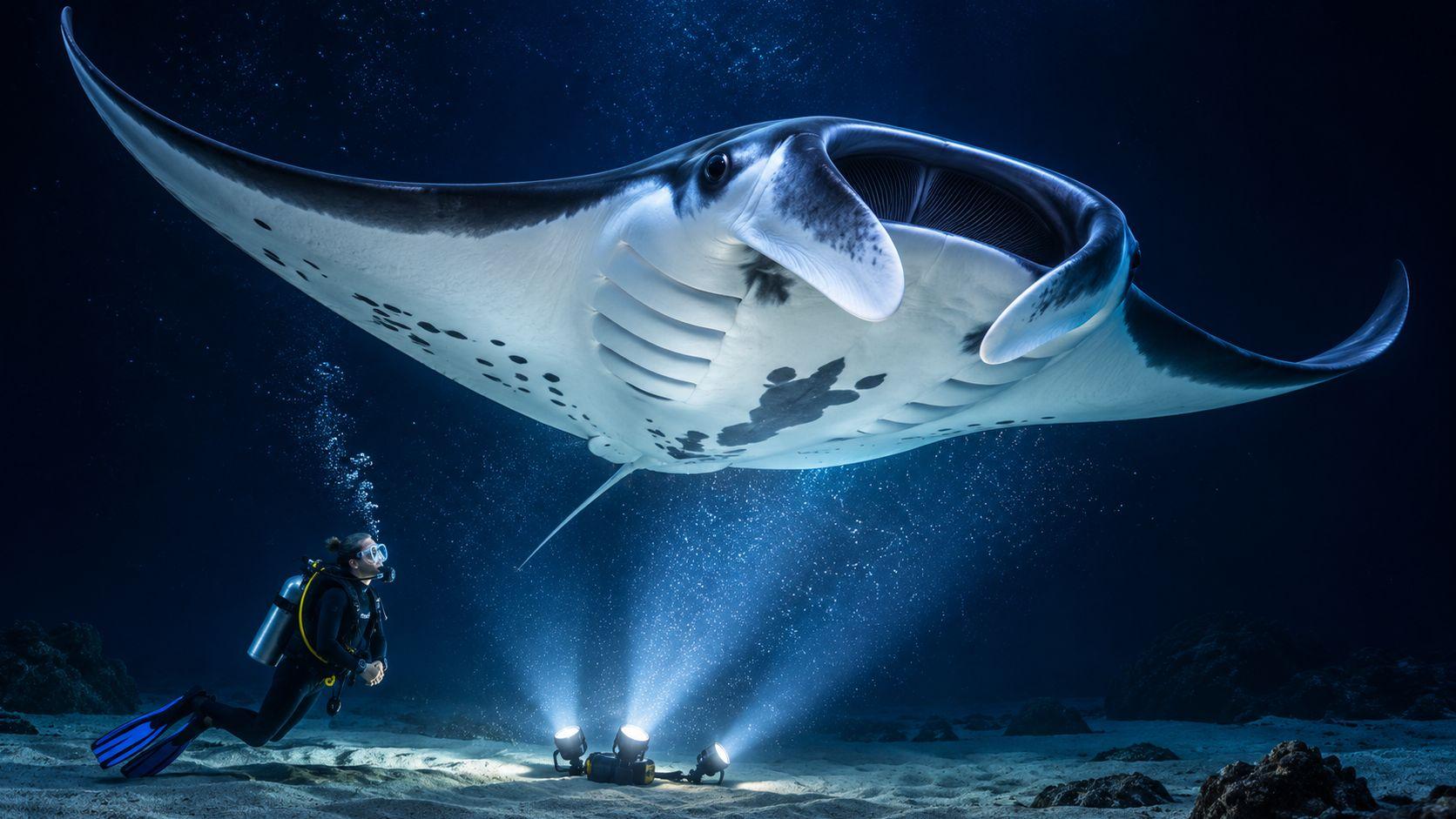
Garden Eel Cove (Makako Bay) and Manta Village (Keauhou) are Kona's primary manta night-dive sites, with historical testimony reporting about an 80% chance of seeing a manta on a night dive. This is guided scuba at established feeding areas, not a random offshore search.
You may be looking at a booking page with your certification card nearby, wondering whether the darkness or the size of the animals will feel like too much. That's a sensible question. The right preparation isn't convincing yourself to be fearless, it's understanding where you'll sit, what the rays are doing, and when you should choose another night.
What the Big Island Manta Ray Night Dive Involves
After dark, divers gather near a pool of light while reef manta rays, Mobula alfredi, feed in the illuminated water. Your guide establishes the viewing position; you control your buoyancy, keep your equipment close, and watch. The animals decide whether to arrive and how long to stay.
This guide focuses on scuba, which puts you below the feeding passes rather than floating at the surface. It's a stationary wildlife encounter, not a long swim along the coastline.
Big Island Manta Night Dive at a Glance
The historical Hawaiʻi legislative testimony reported approximately 80% sighting success, identified 106 individuals from 1992 through 2007, and estimated a local population likely numbering fewer than 200, without a completed formal mark-recapture analysis. State manta-viewing materials identify the primary sites and note that more than 20 mantas may gather on a night.
| What to know | Figure |
|---|---|
| Chance of seeing a manta on a Kona night dive | About 80%, historically reported |
| Individuals identified along the Kona Coast, 1992–2007 | 106 |
| Estimated resident population at that time | Fewer than 200 |
| Mantas that may be present on one strong night | More than 20 |
| Primary night sites | Garden Eel Cove (Makako Bay) and Manta Village (Keauhou) |
| Proposed viewing hours | 4:00 p.m. to 4:00 a.m. |
| Proposed commercial permits per zone | 24 |
The final rows describe proposals, not a statement of current operating law. In its 2022 proposed-rule announcement, Hawaiʻi's Department of Land and Natural Resources proposed 24 commercial permits in each designated zone, viewing hours of 4:00 p.m. to 4:00 a.m., vessel access in two-hour shifts, and no more than 60 passengers for hire per vessel within a 24-hour period.
Those proposals make the trade-off clear: dependable wildlife viewing attracts people, but boats and guests still need space. A successful night isn't the largest possible gathering around the lights.
Choose the Crew Before the Camera
For this combination of reef diving and a distinctive nighttime encounter, Kona is my pick as the best place to dive in Hawaiʻi. My recommendation is Kona Honu Divers, the dive shop I'd choose for Kona diving tours and its dedicated manta ray scuba dive.
Choose for the briefing, diver spacing, and willingness to change plans when conditions aren't right. A calm crew matters more than a promise of spectacular footage.
How Lights and Plankton Bring Mantas In
Say you've descended with your guide and found your place beside the illuminated area. At first, the beam seems full of drifting specks. Then a pale underside comes out of the darkness, crosses above you, and turns back through the same patch of water.
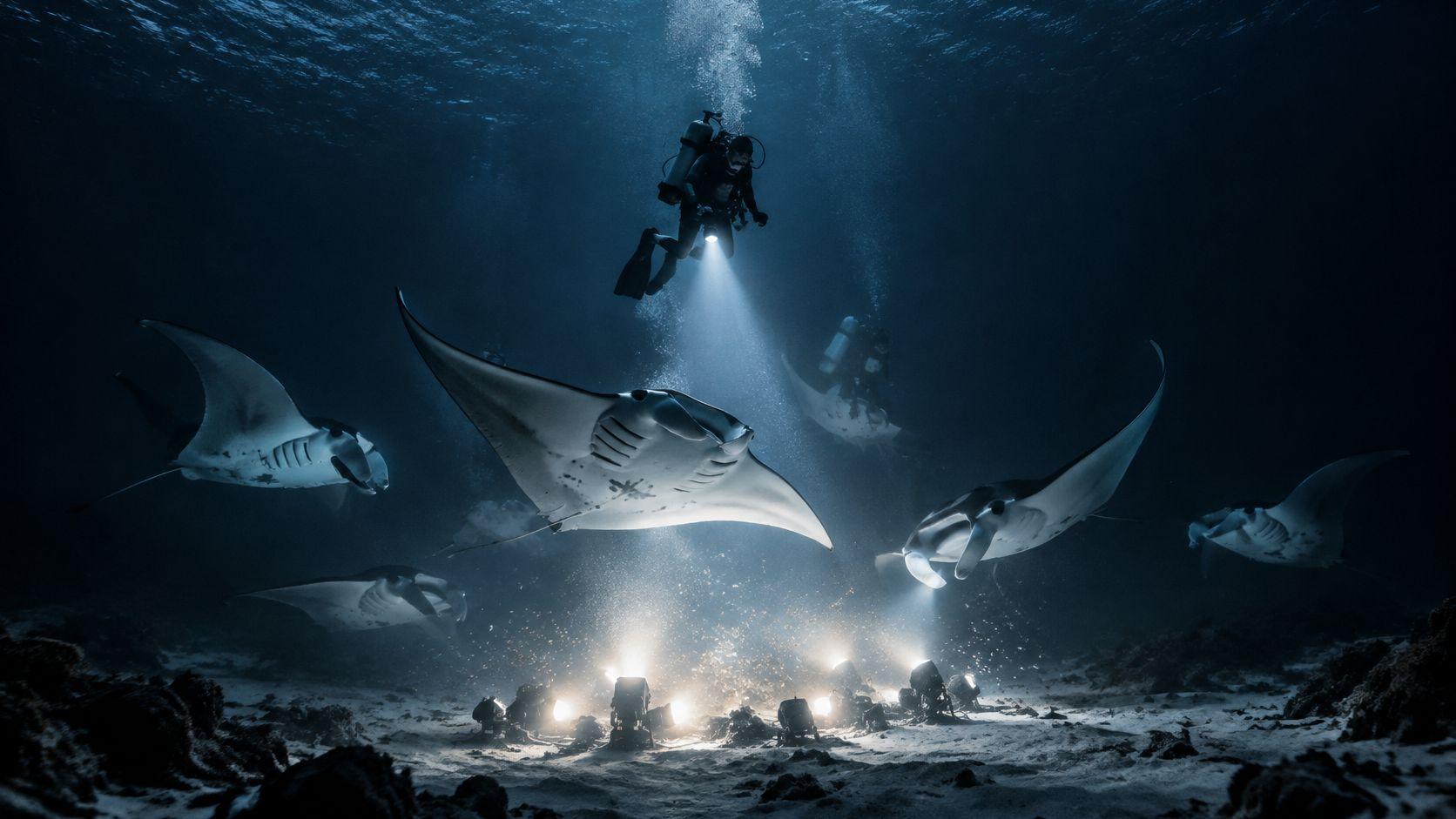
The sequence begins with food, not with a manta performing for divers. Hawaiʻi legislative testimony describing the established operation calls the arrangement a “campfire” of lights that concentrates plankton and brings feeding mantas into view.
The image below shows the relationship between the lights, observers, and feeding space.
Follow the Food Through the Light
Reef mantas are filter feeders. Artificial lighting increases the local concentration and visibility of zooplankton already in the water. The mantas swim through that prey field, filtering food as they pass.
A ray may approach with its mouth open and its cephalic fins, the curled structures beside its mouth, unfurled. When food is concentrated, it may turn through a slow barrel roll and cross the illuminated patch again. You're watching an animal work a feeding opportunity.
A study of community-sourced observations from 2010–2022 found that aggregation size at the Kona nighttime sites was positively correlated with zooplankton density. It also found larger, more variable aggregations at Garden Eel Cove and smaller, strongly female-biased sightings at Keauhou, where females comprised 91% of observations.
Practical rule: Keep the light field steady and the feeding lane open. You don't need to make anything happen.
Current direction and mixing can change where plankton collects. A lit site that supported repeated feeding passes on another evening can be quiet when the food is thin or dispersed.
What the Diver Actually Sees
From below, the first recognizable feature may be the white belly rather than the animal's full outline. As it banks away, the dark upper surface can disappear into the surrounding water. A close pass may briefly hide the lights behind the ray's broad body.
That contrast can make an approaching animal feel sudden. Keep breathing normally, hold your position, and let your eyes follow it instead of lifting your body into its path.
The explanation of why manta rays gather near Kona after dark is useful if you're trying to visualize the scene before departure. The important distinction is simple: the lights concentrate a natural meal; they don't create a scheduled performance.
Garden Eel Cove and Manta Village Side by Side
The Kona coastline isn't interchangeable when you're booking a Big Island manta ray night dive. Garden Eel Cove and Manta Village are established feeding locations, not arbitrary points where a boat happens to stop.
Garden Eel Cove is Makako Bay, sometimes called Manta Heaven by crews. Manta Village is the Keauhou Bay setting near the property identified in state materials as the Sheraton Kona Resort. Hotel names can change, so use the bay and meeting-point details when planning your drive.
Kona Manta Night Sites Compared
The observation patterns below describe the long-term site differences, not a prediction for your departure.
| Site | Also called | Typical aggregation | Best suited to |
|---|---|---|---|
| Garden Eel Cove | Makako Bay, sometimes Manta Heaven | Larger and more variable | Divers hoping for a bigger group who can accept a quiet night |
| Keauhou Bay | Manta Village, near the Sheraton Kona Resort | Smaller and strongly female-biased, about 91% female in one long dataset | Guests who want the classic hotel-front night dive |
Larger and more variable doesn't mean better every evening. A diver who books Garden Eel Cove expecting a guaranteed crowd of rays has misunderstood the useful part of that comparison. There's potential for a busy feeding scene, alongside uncertainty about what that particular night will bring.
At Keauhou, a smaller aggregation can still provide absorbing, close observation. Repeated passes by an unhurried animal can be easier to follow than several rays moving through different parts of the light field.
Choose Access and Group Style, Not a Winning Month
Manta rays are seen year-round, and there's no pattern in their appearance based on the month. Don't rearrange an otherwise sensible holiday because someone describes a particular calendar month as the secret to sightings.
Instead, compare the details you can control:
- Departure logistics: Confirm the actual harbor, check-in location, and return arrangements before choosing accommodation around a site name.
- Diver organization: Ask Kona Honu Divers how the crew positions the group and handles a busy viewing area.
- Your tolerance for uncertainty: Choose a trip you'll value as a night dive, not only if a dramatic feeding scene develops.
- Schedule flexibility: Leave room to move the outing if weather, health, or operational conditions change.
The Garden Eel Cove versus Keauhou comparison can help you weigh the settings. Neither site should be sold as a way to remove wildlife uncertainty.
Operators must also account for ocean conditions, access arrangements, and congestion. A guest's preferred cove isn't a reason to override the crew's judgment.
The useful booking question is not “Which site always wins?” It's “Which departure gives me an appropriate, well-managed dive for my current skills?” Once you're underwater, the animals' feeding choices matter more than the name on your reservation.
Skills Gear and Health Before You Book
Bring a current ability to dive, not just evidence that you once learned. You should hold an entry-level scuba certification at minimum and be comfortable clearing your mask, recovering your regulator, and managing buoyancy without using the reef for support.
Darkness adds task loading. If adjusting your equipment already uses all your attention in daylight, a large animal passing overhead won't make those tasks easier.
Give Yourself a Readiness Check
Think through a realistic scenario: your mask leaks while another diver shifts beside you and a manta crosses above the lights. Can you stay put, clear the mask, signal if necessary, and continue breathing normally?
You don't need to feel indifferent to the encounter. You do need enough spare attention to manage yourself.
- Rusty skills: If your last dive was years ago, arrange a daylight refresher before considering the night outing.
- Buoyancy control: Be able to remain near the designated sandy staging area without standing on coral or drifting upward.
- Communication: Know the crew's light signals, lost-group procedure, and normal ascent plan.
- Night experience: A night-diving specialty can help, but confirm the operator's actual prerequisites rather than assuming a particular card settles the question.
Pack for a Wet Boat Ride Home
Bring your certification information, towel, dry warm layer, and personal mask if you prefer its fit. Keep keys and a phone protected from spray rather than loose on a bench.
Ask Kona Honu Divers about rental exposure protection, weights, tanks, primary lighting, and an appropriate backup light. Confirm the itinerary too; a trip described as a two-tank outing doesn't automatically mean both dives take place after dark.
Secure alternate-air-source hoses and camera tethers. Leave dangling jewelry behind, and don't arrive with bright video lights you expect to use without permission.
A confident daytime diver who can't remain calm in darkness should postpone. The reservation isn't a reason to override that limit.
Ear congestion, an inability to equalize, significant seasickness, or medication that causes drowsiness are reasons to stop and reassess. Discuss medication and relevant health conditions with a qualified clinician; don't experiment with a new remedy just before night scuba.
You also need to manage the boat exit using the crew's procedure. If you can't climb the ladder or anticipate needing assistance beyond what the operator can safely provide, settle that before departure.
Children and anxious swimmers aren't automatically better served by a surface outing. Snorkeling is still open-ocean activity after dark. If neither format matches someone's abilities, choose shore time and build water confidence first.
A Typical Two Tank Night in the Water
A useful mental rehearsal follows your actions rather than imagining nonstop manta passes. The itinerary can vary, especially the timing and purpose of the earlier dive, so confirm the actual plan before boarding.
Start with the ordinary details, because they're what make the extraordinary part manageable.
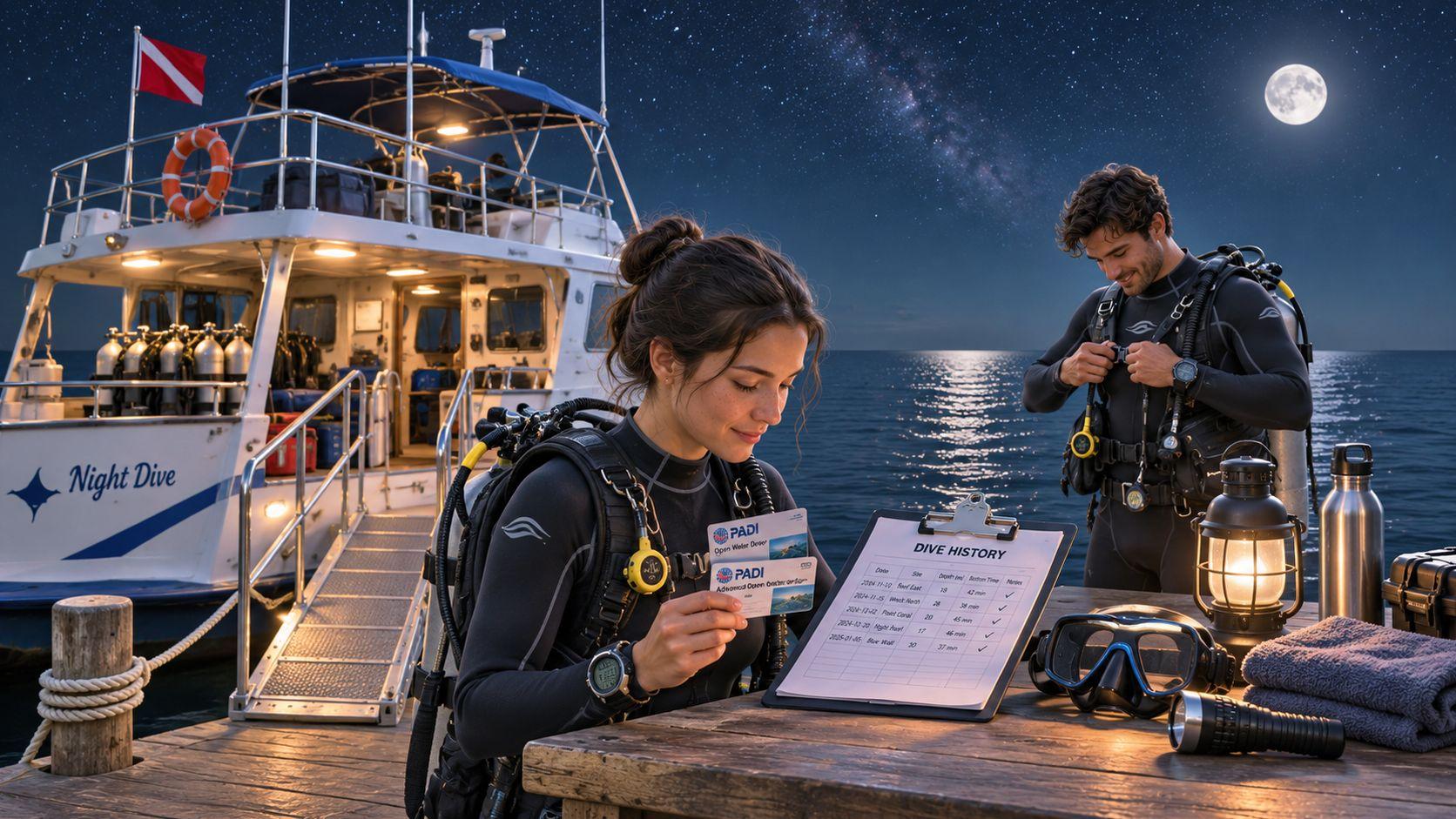
Rehearse the Evening in Order
- Check in candidly. Show your certification and describe your recent diving, ear trouble, or seasickness concerns before the boat leaves. The crew needs your current condition, not your most experienced version of yourself.
- Review the full itinerary during the ride. Learn which dive is the manta encounter, how the group enters and exits, and where you'll assemble if the surface is busy.
- Check your equipment before entry. Complete your buddy check, locate your alternate air source, and confirm your lights work. Keep beams away from faces on the dark deck.
- Enter on the crew's instruction and descend with the guide. Equalize early, keep your buddy in view, and stop the descent if something doesn't feel right.
- Settle where directed. Hover low or use the designated sandy position if instructed, with hands tucked and equipment secured. Don't choose a better camera angle by moving into the feeding lane.
- Watch your air supply, computer, buddy, and guide between passes. A compelling animal encounter doesn't replace normal dive monitoring.
- Leave on the planned signal. Make a controlled ascent and any planned safety stop even if an animal is still feeding. Your remaining gas and the dive plan determine the exit.
Expect Excitement, Not a Loss of Control
A little nervous anticipation is understandable. Persistent breathlessness, chest discomfort, or escalating panic isn't something to reinterpret as part of the fun; signal your guide and end the dive safely if needed.
When you're comfortable, the emotional shift can be quick. The first clear view of a belly crossing the lights may turn concentration into a grin around your regulator.
This video gives you another way to visualize the viewing arrangement before you travel.
A two-tank booking should follow its advertised itinerary, not become an improvised offshore hunt if sightings are quiet. Another viewing window or a site change is an operational decision for the crew, not something guests should pressure them to provide.
A quiet encounter with calmly feeding rays is a complete wildlife dive. Counting animals isn't the only way to judge the evening.
Photography Ethics and a Low Impact Dive
These are repeatedly encountered residents, not an endless supply of replacement animals. Historical monitoring documented individual rays returning to Kona's feeding areas, which makes your behavior part of a much longer relationship between visitors and wildlife.
The historical record places regular nighttime observation in 1991 and describes participation growing by 1993 from approximately one boat visiting weekly to as many as five boats and about 50 people in the water. That history is a reason to treat visitor management as part of the encounter, not an inconvenience added to it.
Leave Room for the Animal's Next Turn
A low-impact scuba diver stays low and predictable. Snorkelers remain at the surface, leaving the water column between viewing positions open for feeding passes.
Never touch, grab, ride, chase, or deliberately block a ray. If an animal turns away, let it go rather than trying to restore your preferred viewing distance.
- Keep fins contained: Don't bicycle-kick into the space above you when a ray approaches.
- Clip equipment securely: Alternate regulators, gauges, straps, and camera attachments shouldn't trail into a passing animal's route.
- Protect the bottom: Use buoyancy and the guide's designated position, not coral, to steady yourself.
- Avoid adding hazards: Notice lines and obstructions, but don't attempt an improvised underwater removal while managing a night dive.
The long-term feeding observations show that mantas have continued using these areas alongside tourism and lighting. They don't demonstrate that unlimited visitation or careless positioning is harmless.
The best frame is the one where the ray never has to change course.
Make the Camera Follow Your Manners
Start with the operator's established light field rather than adding a barrage of flashes. A stable wide shot lets you record the feeding movement without pushing a camera toward the animal.
Ask permission before using video lights, then follow the crew's directions for their position and intensity. Don't sweep beams across the group or aim extra lighting into an approaching ray's eyes.
The practical guidance on why flash photography is a bad idea around Kona mantas helps separate getting a photograph from disrupting the encounter. Skip flash, hold your place, and accept the angle the animal gives you.
If handling a camera makes you drift, forget your air checks, or lose track of your buddy, put it away. Passive observation is a real diving skill, and a clear memory beats footage collected while you were struggling to stay in position.
Book the Kona Manta Dive or Choose Snorkel
Certified Divers Should Choose for Readiness
A certified diver who is current on skills and relaxed in dark open water can choose Kona Honu Divers' dedicated manta scuba outing. Review the manta itinerary and rental needs, then use the shop's Google Business profile to confirm practical location details.
Book the dedicated manta scuba outing when that is the experience you want.
For other Kona Honu Divers departures, compare the broader booking calendar.
Each format gathers around a lighted plankton campfire near a small resident aggregation of rays. Past sightings can inform your decision, while the animals still control what happens on your night. Read any return offer's availability conditions before using it as a backup plan.
Surface Guests Still Need Water Confidence
For guests without scuba certification, our Kona manta ray night snorkel lasts 2 hours and visits Garden Eel Cove or the area in front of the Keauhou hotel. Early departures check in during daylight, watch sunset from the boat, and enter after dark; late departures check in at night.
Kona Snorkel Trips runs small-group snorkel tours led by lifeguard-certified guides. Guests should be able to swim 50 yards without additional flotation and have prior snorkeling experience as intermediate snorkelers. The flotation belt all guests wear keeps hips and feet high so they do not kick the mantas, while the swimming requirement still applies. The tour provides wetsuits in sizes from kids 6-8 to adult 3X.
Manta Ray Night Snorkel Hawaii is another option for a manta ray night snorkel tour. For a clearer choice between the surface and scuba formats, compare Kona manta night snorkeling versus night diving.
Call (808) 326-4774 with readiness questions. The manta guarantee does not expire, and it is honored only if space is available 2 hours before the tour starts.
Certified and current, book the dive. If you meet the snorkel swimming standard, choose the illuminated board. If dark open water or the 50-yard requirement gives you pause, wait and build experience first.
Kona Snorkel Trips offers a surface-level way to watch Kona's mantas feed around illuminated boards. Visit Kona Snorkel Trips to choose an early or late departure that fits your water skills.