
Big Island Manta Ray Dive: A Complete 2026 Guide
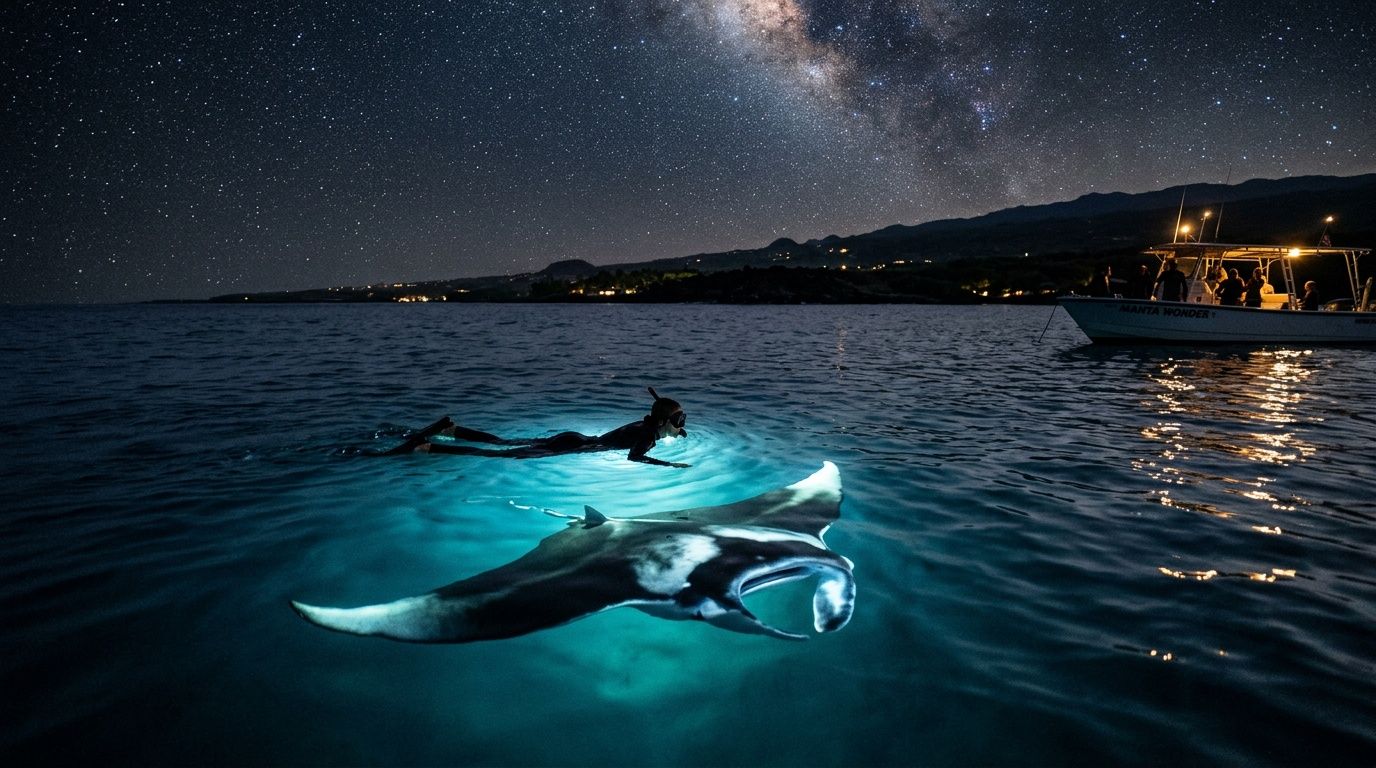
You’re probably deciding between two versions of the same dream. One has you floating at the surface, face down over a pool of light, waiting for giant shadows to rise out of black water. The other has you on scuba, settled on the bottom, watching manta rays sweep overhead in tight, looping passes.
Both can be outstanding. But the difference between a magical night and a stressful one usually comes down to operator choice, crowd levels, and whether the trip matches your comfort in the water.
An Unforgettable Night with Gentle Giants
The boat ride out is usually calm, with Kona’s lights shrinking behind you and the coastline going dark. Briefings are short but important. Good crews keep them simple, especially at night when people are excited and a little tense.
Then the ocean changes character. Once you’re in, the darkness feels big for the first minute. After that, your world narrows to light, bubbles, and the patch of water where everything happens.

The first manta rarely arrives with drama. It just appears. One second you’re staring into blue-black water, the next there’s a broad white belly and a wingspan gliding past the lights. Then another follows. Then one banks and rolls, coming back through the beam like it knows exactly where dinner is.
That predictability is why this experience became famous. The Kona Coast has over 450 identified resident manta rays, and trips report 85 to 90% sighting success, with roughly 80,000 snorkelers and divers participating each year according to Kona Honu Divers’ manta dive overview.
What the moment feels like
From a guide’s perspective, the part people remember isn’t just the size of the rays. It’s the silence. Mantas move with almost no visible effort. They don’t lunge or thrash. They glide, turn, and feed with a kind of control that changes the whole mood in the water.
Families tend to love the immediacy of it. Divers often love the geometry of it. Everyone notices the same thing. These animals can pass astonishingly close without feeling threatening at all.
Some marine encounters depend on luck. A big island manta ray dive works because Kona gives the rays a reliable place to feed, and trained crews know how to set the stage without forcing the interaction.
Why Kona stands apart
A lot of places can offer a manta sighting. Kona offers a repeatable encounter. That’s a different category of wildlife experience.
You’re not just hoping a ray cruises by. You’re joining a night routine that has been refined over years by local operators, guides, researchers, and photographers. Done well, it feels less like chasing wildlife and more like being invited into a natural feeding event.
What to Expect on a Big Island Manta Ray Encounter
The mechanics are simple. The experience isn’t.
You check in, get fitted for gear, listen to the briefing, and ride out to site. Once there, the crew sets up lights that pull in plankton. The plankton brings the manta rays. That’s the whole engine behind the encounter.

The dives and snorkels happen in shallow water, about 25 to 45 feet, and the lights create a plankton bloom that operators often describe as an underwater campfire. That system is a major reason tours maintain 85 to 90% sighting success year-round, as explained in this overview of Kona manta dive depths and lighting.
How the underwater campfire works
Manta rays aren’t coming to see people. They’re coming to feed.
Operators place bright LED lights in the water. Those lights attract plankton. Once the plankton concentrates, manta rays move through the beam and start feeding by looping, barrel rolling, and sweeping back through the same lit zone.
For guests, that means the action often builds in waves:
- First phase. You settle in and wait.
- Second phase. Small bait and plankton become visible in the light.
- Third phase. One manta appears, then circles.
- Final phase. Multiple rays may use the same feeding lane and the whole water column feels alive.
What snorkeling feels like
Snorkelers usually hold onto a flotation setup at the surface and look down into the lights. It’s the easiest way to do this encounter if you want minimal gear and no scuba certification.
The view is top-down, broad, and dramatic. You see the full pattern of the rays’ turns. When a manta rises straight up into the beam and rolls just below you, snorkeling can feel almost theatrical.
Snorkeling is usually the right pick if:
- You want accessibility. It works for many travelers who are comfortable in the water but don’t dive.
- You prefer a simpler learning curve. Less task loading means you can focus on the animals.
- You’re traveling with mixed abilities. Families often do better when everyone can stay together at the surface.
What diving feels like
Divers descend and stay low while lights point upward. That creates the classic below-looking-up view, with mantas passing overhead.
It’s more immersive. You’re inside the scene rather than observing from above. The rays can look enormous from this angle, especially when they bank directly over the light source.
Scuba is usually the right pick if:
- You’re already certified. Night diving adds enough moving parts that comfort matters.
- You want the eye-level perspective. This is the manta ballet view most divers talk about afterward.
- You’re comfortable staying still. Good manta diving is patient diving.
Practical rule: Pick the format that lets you stay calm and still. Mantas reward stable groups. Fidgety groups miss half the show.
What works and what doesn’t
A lot of first-timers assume they need to be strong athletes. They don’t. They need to be comfortable listening, following direction, and staying in position.
What helps:
- A snug mask
- A wetsuit that fits
- A crew that gives clear entry and exit instructions
- Realistic expectations about darkness and boat traffic
What hurts the experience:
- Booking only on price
- Choosing a huge group if you’re already anxious
- Ignoring seasickness if you know you’re prone to it
- Treating the encounter like a chase instead of a watch-and-wait event
Manta Ray Dive or Snorkel Which Is Right for You
The right answer depends less on adventure level and more on how you want to experience the animals.
The Kona manta tradition has been structured since 1991, and over 450 individual rays have been cataloged through ventral spot patterns. Typical encounters take place around 30 to 40 feet and last 45 to 60 minutes in warm, clear water, which is part of why both snorkelers and non-advanced divers can take part, according to mantarays.info.
Manta Ray Dive vs Snorkel at a Glance
| Feature | Manta Ray Night Snorkel | Manta Ray Scuba Dive |
|---|---|---|
| Skill level | Good for non-divers who are comfortable in the water | Requires scuba certification |
| Viewpoint | Looking down from the surface | Looking up from the bottom |
| Gear load | Lighter and simpler | More equipment and more task management |
| Best for | Families, mixed groups, first-timers | Certified divers wanting a more immersive angle |
| Feel of the encounter | Wide view of the feeding pattern | Closer sense of the rays moving overhead |
| Effort underwater | Lower | Higher |
The trade-off that matters
Snorkeling gives you the easiest access and a sweeping top-down view. Diving gives you the strongest sense that the manta rays are flying over your head.
That is the primary decision.
If you’re traveling with a partner who dives and one who doesn’t, don’t force the scuba option just to make it “more epic.” For a nervous guest, the snorkel is often the better night. A calm snorkeler sees more than an uneasy diver.
When snorkeling wins
Snorkeling is often the better fit if you want less complexity. Night ocean conditions can feel unfamiliar even in calm water, and surface viewing keeps the logistics straightforward.
It also tends to work better for:
- Families with older kids or teens
- Travelers who don’t want to deal with scuba logistics
- People who want a shorter learning curve before the main event starts
When diving wins
Diving earns its reputation because of the angle. Seeing a manta’s white underside fill your field of view from below is hard to beat.
Still, diving is only better if you’re comfortable enough to relax into it. If you haven’t dived recently, brush up first. If you dislike task loading at night, the snorkel may be the smarter choice.
One more factor people forget
Moon phase can affect how concentrated the manta action feels. That won’t usually decide whether you snorkel or dive, but it can influence how dramatic the action is on a given night. If you want a side-by-side breakdown focused on experience style, this comparison of Kona manta ray night snorkel vs night dive is a useful planning tool.
How to Choose the Best Big Island Manta Ray Tour
Smart travelers spend more time looking at the operator.
A gorgeous wildlife encounter can turn chaotic fast if the boat is crowded, the briefing is rushed, or too many tours pile onto the same site. That’s not theory. A 2013 DLNR assessment found that 75% of tours overlapped at peak manta sites, creating hazardous conditions tied to heavy boat traffic, according to the DLNR safety assessment.
Why small-group matters more at night
Night strips away a lot of the margin people rely on during daytime tours. Visibility outside the light field is limited. Entries feel more serious. Guests who are uncertain often need more direct attention from crew.
That’s why small-group operations usually produce a better result for three different reasons.
Safety gets better
On a well-run small-group trip, guides can watch individual guests. They can spot the person whose mask is leaking, the person drifting out of position, or the guest who looked fine on deck but freezes once they hit dark water.
Large groups can still be run professionally. But at night, scale works against personal attention.
The viewing quality improves
Crowding changes the tone of the encounter. More boats and more swimmers can turn a quiet feeding site into a noisy waiting room.
If you want the manta rays to be the focus, not everybody else’s fins and lights, group size matters. This guide to manta ray dives in Kona gives a useful overview of what different tour styles feel like in practice.
The encounter is easier on the animals
Better operators manage positioning, spacing, and behavior in ways that reduce unnecessary disturbance. That doesn’t mean zero impact. It means lower impact.
At manta sites, the best crews don’t just find the animals. They control the group.
What to look for before you book
Use this checklist, not just star ratings.
- Clear in-water expectations. Good operators explain exactly where you’ll be, how long you’ll stay there, and what you should do if you feel uncomfortable.
- A firm stance on passive viewing. If an operator sounds casual about crowding, touching, or chasing, move on.
- Appropriate fit for your experience. A certified diver can choose a dive boat. A non-diver should not try to “upgrade” into a format that adds stress.
- Small-group structure. This matters for anxious swimmers, families, and anyone who doesn’t love nighttime water entries.
- Straight answers about conditions. Reliable operators won’t oversell calm water or promise a perfect night.
Snorkel options worth considering
For snorkelers, Kona Snorkel Trips’ Manta Ray Night Snorkel tour is one small-group option to consider if you want a guided surface experience centered on the illuminated viewing setup. If you’re comparing operators, Manta Ray Night Snorkel Hawaii is another strong alternative for a manta ray night snorkel tour.
For certified divers
If you want the scuba version of the encounter, Kona Honu Divers’ manta ray diving tour is the direct fit for certified divers. Kona Honu Divers is a highly regarded diving company in Hawaii and the Pacific Ocean.
Book the operator that matches your comfort level, not the one with the flashiest promise. Night water punishes bad fit faster than daytime snorkeling ever will.
Finding the Best Manta Ray Locations and Times
Location matters. Timing matters almost as much.
Many travelers hear the same two site names over and over: Manta Village and Manta Heaven. That’s because they’re the core of the Kona manta scene. What many visitors miss is that site choice and moon phase can shape the feel of the encounter even when sightings stay generally reliable.

The two sites many visitors choose between
Manta Village
This is the classic south Kona site. It’s known for being established, well understood by operators, and popular for both snorkel and dive trips.
For many guests, the advantage is familiarity. Crews know the setup. The routine is polished. That can be a real plus if you want fewer surprises.
Manta Heaven
This site is often associated with the airport side and can feel a bit different depending on conditions and crowding on a given night.
Some guests love it for the sense of open water and the layout of the site. Others prefer the steadier feel of the southern option. Neither site is automatically “better” for every traveler.
The timing tip most guides skip
Moon phase can change how concentrated the manta action feels. According to this guide on the best time of year for a manta ray night snorkel in Kona, new moon phases often help concentrate plankton at lit sites, while full moon conditions can reduce activity by 30 to 50% because natural light competes with the tour lights. That point is also discussed in this Big Island manta ray night dive overview.
A practical way to pick your night
If your travel dates are flexible, use this order of operations:
- Check the moon phase. If you can choose, lean toward darker nights.
- Ask about the launch site and likely location. That tells you more than marketing copy.
- Ask how the operator handles crowded nights. Good answers are specific.
- Pick comfort over theory. The best site on paper isn’t the best site if the conditions or crowd level don’t suit you.
Respectful habits improve the encounter
Timing isn’t the only variable you control. Your behavior in the water affects what you see.
- Stay in your assigned position. Mantas feed best when the light field is stable.
- Keep your limbs in. Random kicking breaks up the space the rays are using.
- Let the manta choose the distance. The closest passes usually happen when guests stop trying to get closer.
- Listen on exit. Night exits are where sloppy groups lose the calm they had during the encounter.
Safe and Responsible Manta Ray Viewing Etiquette
The golden rule is simple. Be passive.
Manta rays do their best work when people stop trying to improve the moment. Touching, chasing, duck-diving into their path, or trying to pivot underneath them usually makes the encounter worse for everyone.
The checklist that keeps things smooth
- Watch, don’t pursue. Let the rays come through the light and choose their line.
- Keep hands off. Mantas need their protective mucus layer intact.
- Don’t block their path. If a ray changes direction because of you, you’re too close or poorly positioned.
- Stay with your guide’s setup. The whole encounter depends on predictable spacing.
- Use reef-safe habits before the tour. If you need a refresher, these reef-safe sunscreen tips for snorkeling Big Island Hawaii are worth reviewing.
Why etiquette is also a safety issue
At night, bad etiquette doesn’t just affect the rays. It creates confusion in the group.
A guest who suddenly kicks off after a manta can bump another swimmer, lose orientation, swallow water, or force a guide to shift attention away from the group. That’s why experienced crews are strict about staying calm and staying put.
The people who see the most are usually the ones doing the least.
Responsible travel goes beyond the boat
If you’re thinking more broadly about wildlife, local communities, and how to travel well in the islands, this piece on ethical travel to Hawaii is a thoughtful read. It adds useful context to the bigger picture around respectful visitation.
Good manta etiquette isn’t restrictive. It’s what makes the whole encounter work. Calm guests create a calm viewing zone, and calm viewing zones give mantas room to feed naturally.
Your Essential Manta Ray Trip Packing List
Travelers often overpack for this tour. You need less than you think.
The key is bringing what makes the transition in and out of the water easy, warm, and low-stress. For clothing specifics, this guide on what to wear for a Kona manta ray night snorkel is a solid reference.
Bring these
- Swimsuit. Wear it under your clothes so check-in is simple.
- Towel. The ride back can feel cool once you’re wet.
- Dry clothes. A shirt, shorts, and something warm for after.
- Waterproof bag. Helpful for keeping phones and dry items together.
- Motion sickness remedy. If you’ve needed it before, bring it again.
- Underwater camera. Nice to have, but only if it won’t distract you.
Usually provided by operators
This varies by company, but manta tours commonly provide the in-water essentials.
- Snorkel or dive gear
- Wetsuit
- Flotation setup for snorkel guests
- Lights used for the viewing system
- Basic guidance and safety briefing
Leave these behind
- Valuables you don’t need
- Bulky beach gear
- Anything loose that can roll around on deck
A well-packed guest is usually a calmer guest. Less clutter means fewer forgotten items, faster gear-up, and more attention left for the actual reason you came. The big island manta ray dive is memorable because of what happens in the water, not because you brought a giant bag.
Frequently Asked Questions About Manta Ray Tours
Is this okay for first-timers?
Yes, if you choose the right format. First-timers who are comfortable in the water often do well on snorkel trips. First-time scuba divers should not make this their first dive experience unless they’re already certified and comfortable with night conditions.
Are manta rays dangerous?
They’re gentle filter feeders. The bigger issue isn’t aggression from the animal. It’s whether the group is well-managed and whether guests follow directions in dark water.
What if I’m nervous about the dark?
That’s common. Good crews make a huge difference here. Clear briefings, simple positioning, and staying with a controlled group usually lower anxiety fast once the lights are in the water and the first manta shows up.
Is there a best season?
Conditions run year-round, but the quality of a given night can shift with moon phase, crowding, and ocean conditions. If you like planning wildlife travel carefully, the approvedexperiences blog is a useful general resource for trip research habits and experience-based travel ideas.
Should I book snorkel or dive?
Book the one that matches your actual comfort and skill. The better experience is the one where you can stay relaxed, listen to the guide, and keep your attention on the manta rays instead of your own stress.
What’s the biggest mistake people make?
Booking by price alone. On this activity, crowd management, safety culture, and operator fit matter more than shaving a little off the fare.
If you want a small-group surface experience for this encounter, Kona Snorkel Trips offers manta ray night snorkel tours designed around guided viewing, safety, and respectful wildlife interaction.