
Scuba Dive Hawaii: A Kona-First Insider’s Guide (2026)
You’re probably doing what most divers do before a Hawaii trip. Comparing islands, scrolling operator sites, trying to figure out whether the famous dives are worth it, and wondering if you should build the trip around scuba or fit scuba into everything else.
That decision matters more in Hawaii than it does in a lot of destinations.
I’ve guided enough divers on the Big Island to see the pattern. People arrive thinking “Hawaii diving” is one thing. Then they learn each island dives differently, conditions change fast, and the best experiences aren’t always the ones that show up first in a generic roundup. If your goal is a memorable scuba dive Hawaii trip, the biggest win is choosing the right coast and the right operation from the start.
Your Epic Underwater Journey in Hawaii Starts Here
The first descent in Hawaii usually sticks with people for years.
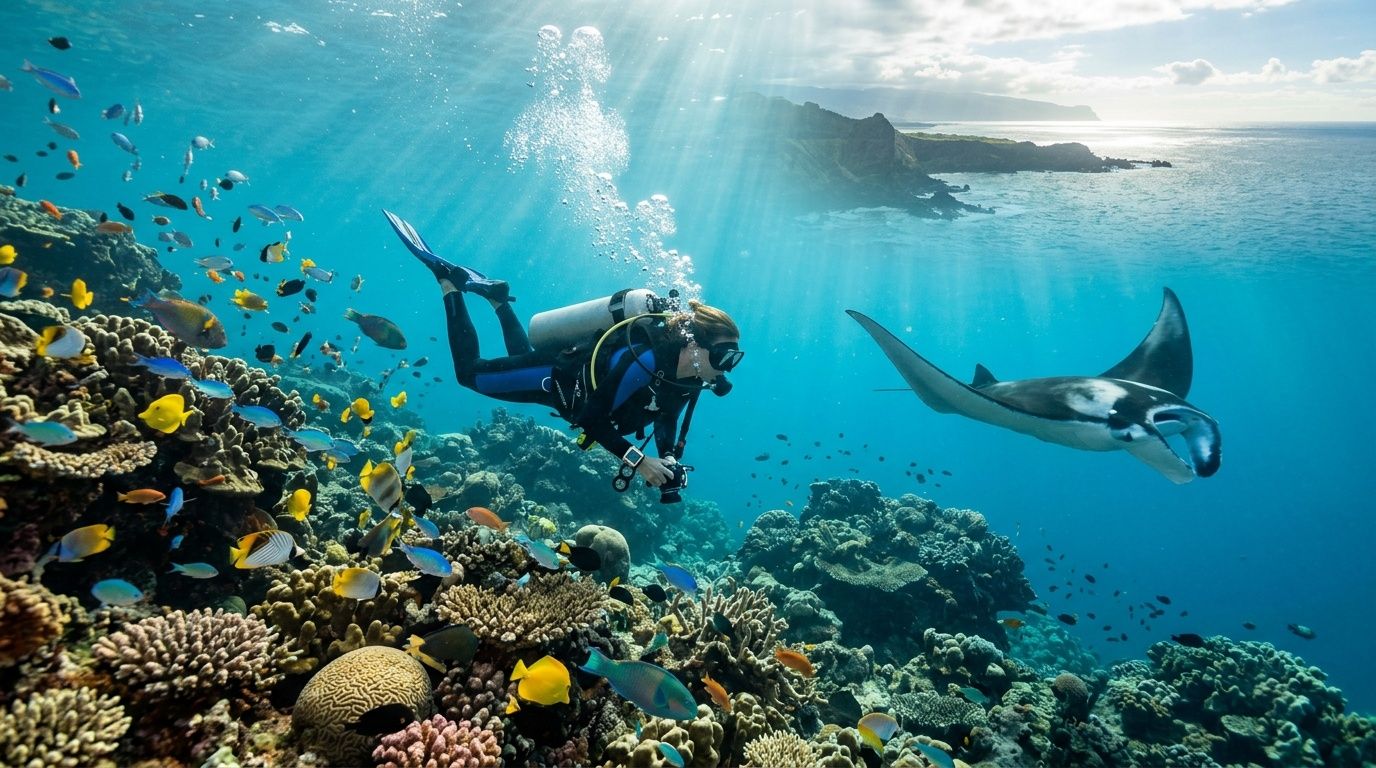
You drop below the surface into warm blue water. Lava rock shelves open into reef. Light pours down in clean shafts. A turtle glides past without urgency, and the whole dive slows your breathing in the best way.

What surprises many visitors is how different Hawaii feels underwater compared with other tropical destinations. The water has that open Pacific clarity. The seascape feels volcanic, not just coral. Even routine reef dives can feel dramatic because the terrain has ledges, folds, arches, and old lava structure instead of a flat sandy profile.
Some travelers come in focused on one iconic experience. Manta rays. Lava tubes. A blackwater night dive. Others just want the best all-around island for several days of diving without wasting vacation time chasing conditions.
That’s where local knowledge starts to matter.
A broad Hawaii itinerary can work, but divers who want the strongest underwater trip usually do better by narrowing their focus. If you want extra trip inspiration beyond diving, it’s worth taking a few minutes to explore more travel stories and tips from Approved Experiences Traveler. Then come back and compare that bigger travel dream with what delivers the best time underwater.
If you’re still deciding between islands, this breakdown of the best diving Hawaii islands is a solid starting point. The short version is simple. Hawaii is full of good diving. One coast stands above the rest when you want consistency, variety, and signature dives in the same place.
Why Hawaii Is a World-Class Diving Destination
Hawaii earns its reputation underwater for practical reasons, not just postcard appeal.
The state’s scuba scene is enormous. Hawaii’s diving industry generates USD 519.9 million annually through over 1.5 million scuba dives supported by more than 215 licensed dive shops, which is one reason it stands among the top scuba destinations in the United States, according to this Hawaii scuba diving overview.
Volcanic terrain changes the entire dive
A lot of tropical diving is built around reef lines and marine life alone. Hawaii adds geology to the experience.
You’re not just looking at fish over coral. You’re moving through terrain shaped by volcanic activity. That means caverns, arches, lava fingers, swim-throughs, steep drop-offs, and reef formations that feel more sculpted than soft. It gives even familiar species a different stage.
That matters for both excitement and skill.
A diver with clean buoyancy can enjoy Hawaii’s structure up close without kicking reef or stirring up a silty mess in tighter spaces. A diver who’s sloppy in the water column tends to work harder here.
Hawaii rewards divers who can hover, turn slowly, and manage position without constant hand movement or finning.
Conditions make Hawaii a year-round draw
The easiest places to sell are places with one great season. Hawaii is stronger than that because it stays relevant all year.
The water temperature averages 75 to 80°F (24 to 27°C) in the source above, and many sites benefit from exceptional clarity. In Kona specifically, visibility often exceeds 100 feet (30 meters) 365 days a year, which is a huge advantage when you’re planning a dive trip far in advance.
Here’s why those conditions matter in real life:
- Warm water reduces friction: Most visiting divers don’t need to prepare for a cold-water mindset.
- Strong visibility improves comfort: Newer divers stay calmer when they can see the boat, reef, and guide clearly.
- Year-round usability helps planners: You don’t have to gamble on a tiny seasonal window to get quality diving.
Marine life has range
People arrive wanting manta rays, turtles, and reef life. Hawaii delivers those expectations, but the bigger draw is variety layered over terrain.
You can do a relaxed reef dive one day and a dramatically different dive the next. Seasonal visitors also shape the experience. Humpback whales migrate through Hawaiian waters from December to March, adding another dimension for marine life enthusiasts, even when the main dive itself is focused on reef or lava structure.
Hawaii works for different diver types
Some destinations are best only for experts. Others are pleasant but underwhelming for experienced divers.
Hawaii lands in a better middle ground.
| Diver type | What works well in Hawaii |
|---|---|
| Newly certified diver | Clear water, warm conditions, easier reef profiles in the right locations |
| Vacation diver | Memorable marine life and boat diving that feels special fast |
| Advanced diver | Deeper sites, complex topography, night diving, and specialized profiles |
| Mixed-skill group | Operators can often match site selection to ability and comfort |
That broad appeal is a big part of why Hawaii keeps drawing divers back. But “Hawaii” isn’t specific enough if you want the best trip. Island choice changes everything.
Choosing Your Dive Island Why Kona Is King
If you only hear one piece of insider advice, make it this. Don’t treat all Hawaiian dive islands as interchangeable.
Each island has its own strengths. Each also has trade-offs that become obvious once you’re on the boat.

What the other islands do well
Oahu attracts divers who like wrecks and easy access from a major visitor hub. If your group is splitting time between city activities and a couple of dive days, that can make sense.
Maui gets attention for well-known sites and broad vacation appeal. It works especially well for travelers whose trip is built around beaches, resorts, and a little diving on the side.
Kauai offers dramatic topography and a wilder feel. For the right diver, that rugged character is part of the appeal.
Those are all legitimate reasons to choose another island. They just aren’t the strongest reasons if diving is the main event.
Where those islands can frustrate divers
The problem isn’t that the other islands are bad. It’s that they’re often less reliable for the style of trip serious divers want.
Common pain points include:
- Crowded signature sites: Popular locations can feel busy fast.
- More weather sensitivity: Some plans look great on paper and get reshuffled in practice.
- Less concentration of standout dives: You may get one famous site, but not the same density of top options over several days.
That’s where Kona separates itself.
Why Kona keeps winning the comparison
Kona sits in the sweet spot for Hawaiian diving. The geography does a lot of the work for you.
The Big Island’s western side benefits from protection that often leaves Kona with calmer, clearer water than visitors expect. This is one reason so many local pros steer dedicated dive travelers here first.
Kona also has scale. The region has over 100 documented dive sites, accounting for 60% of the island’s total dive sites, as described in this overview of scuba diving around Hawaii and Kona. That density matters because it gives operators room to choose smartly based on conditions and diver ability instead of forcing everyone onto the same handful of sites.
Calm water is great. Calm water plus lots of site options is what makes a dive trip run well day after day.
Kona feels built for divers
A good dive destination gives you one or two bucket-list dives.
A great one gives you a whole week of different underwater moods without long slogs, sketchy backup plans, or repetitive site selection. Kona does that better than anywhere else in Hawaii.
Three practical advantages stand out:
- Consistency
The coast is known for conditions that make planning easier for both operators and guests. - Variety
You can mix reef, lava structure, night diving, and advanced specialty dives without changing islands. - Progression
Newer divers can have a great trip here, and experienced divers still have plenty to chase.
Decision framework
If your trip priority is broad vacation convenience, another island may still fit.
If your trip priority is the best overall scuba dive Hawaii experience, use this framework:
| Priority | Best fit |
|---|---|
| Urban vacation with a few dives | Oahu |
| Resort-heavy trip with some water time | Maui |
| Rugged island feel | Kauai |
| Best all-around dive trip | Kona |
That last category is where most serious underwater travelers end up. Not by accident. By comparison.
Kona's Legendary Dives with Kona Honu Divers
Once divers commit to Kona, the next question is simple. Who do you trust with the best dives on the coast?
For scuba, Kona Honu Divers has earned its reputation by focusing on what matters most underwater. Good site selection. Strong briefings. Boats and logistics that run cleanly. Guides who know when to lead, when to watch, and when to leave room for the dive to unfold.
Their main lineup of Big Island diving tours covers the classic Kona experience well, but two dives define the destination for many visitors.

The manta ray night dive
There are famous dives, and then there are dives people talk about for the rest of their lives.
The manta ray night dive belongs in the second category.
Divers descend after dark and settle in around the light source while plankton gathers in the beam. Then the manta rays arrive. They bank, loop, and glide overhead in slow arcs that feel impossibly controlled. From below, you get the full body silhouette, mouth, cephalic fins, and wing movement in a way snorkelers don’t.
The scuba version is more intimate because you stay in the water column with a stable viewing position. You’re not kicking to keep up. You’re not craning from the surface. You’re part of the scene.
For certified divers who want that experience done right, Kona Honu Divers’ manta ray dive tour is the obvious place to look.
Set your expectation correctly. This isn’t a chase dive. The best manta dives happen when divers stay still, stay low, and let the animals own the water.
For mixed groups, this is also where planning matters. Non-divers often prefer the snorkel version, while certified divers usually come back raving about the scuba perspective. If someone in your group wants to compare specialty experiences, this local guide to the Kona black water dive helps show how different Kona’s signature dives can be from one another.
The black water night dive
If the manta dive is Kona’s best-known experience, the black water night dive is its most otherworldly.
This is not a reef dive at night. It’s a bluewater drift-style experience over deep ocean at night, where divers descend on a suspended reference system and watch pelagic juvenile life and strange open-ocean creatures rise from the depths. Everything feels suspended. Orientation changes. Scale changes. Your attention narrows to movement in your light beam.
This dive is for divers who like novelty, self-control, and strong situational awareness. It’s not hard in the same way as a current-heavy dive, but it demands comfort in unusual conditions.
Kona Honu Divers offers a dedicated black water night dive tour, and that specialization matters. This is not the kind of profile you want run casually.
Why operator quality matters more on these dives
A shallow reef dive can hide weak execution. Signature dives can’t.
On the manta dive, the guide has to manage entry, descent, spacing, etiquette, and bottom positioning so the whole group gets a clean experience without crowding the animals or each other.
On black water, briefing quality is everything. Divers need to understand orientation, light use, buddy awareness, and what the reference setup is doing before they hit the water.
That’s where Kona Honu Divers stands out. They don’t just sell iconic names. They run these dives like professionals.
Reef diving and the full Kona menu
The specialty dives get the headlines. Don’t overlook the daytime reef diving.
Kona has plenty of dives where the joy comes from clean conditions, healthy structure, relaxed profiles, and excellent fish life. Those dives round out the trip. They let you recover between marquee experiences and still log memorable water time.
What works best for most visitors is a layered plan:
- Start with daytime reef dives to settle in, check weighting, and dial your breathing.
- Add the manta night dive once you’re comfortable and want the classic Kona moment.
- Finish with black water if you’re the kind of diver who wants something few destinations can match.
That progression works because it respects both excitement and fatigue. You don’t need every dive to be extreme. You need the right mix.
Certification and Training for Your Hawaiian Adventure
A lot of travelers ask the same question in different ways. Can I get by with a quick intro, or should I commit to proper certification before diving Hawaii?
The honest answer depends on what you want access to.
If you’re only curious about breathing underwater, an introductory experience can be a fine first taste. But if your trip vision includes night diving, stronger site options, and the kind of freedom that makes Hawaii special, certification changes everything.
Why basic skills matter more in Hawaii
Hawaii isn’t technically difficult on every dive, but it does punish sloppy fundamentals.
Precise buoyancy control is a core skill here because so much of the terrain involves volcanic structure, caverns, swim-throughs, and uneven reef. According to this practical guide to scuba diving in Hawaii, buoyancy precision is a critical technical requirement in Hawaii’s underwater terrain, and average water temperature around 74°F often means diving in a 2.5mm wetsuit, which affects weighting and BCD management.
That last point gets missed by many visitors. Even small gear changes alter how you trim out underwater.
Practical rule: If you haven’t checked weighting in warm salt water with the exposure suit you’ll wear, do that early in the trip instead of guessing on dive one.
Open Water versus Advanced Open Water
This isn’t about collecting cards. It’s about matching your training to the dive.
The same source notes that Open Water works for easier reef profiles and calmer introductory diving. Advanced Open Water becomes important for deeper sites and more demanding lava topography, with training that enables depths to 100 feet (30 meters).
A simple comparison helps:
| Certification level | Best use in Hawaii |
|---|---|
| Intro experience | Trying scuba under direct supervision |
| Open Water | Easier reef dives and entry-level boat diving |
| Advanced Open Water | Deeper sites, more complex terrain, stronger overall access |
If a diver tells me they want the full Kona menu, I don’t steer them toward the bare minimum. I tell them to show up trained, comfortable, and ready.
Equipment choices also affect safety
This is especially true if you’re diving lava tubes or tighter structure.
The same Hawaii guide notes that sidemount BCDs can offer better maneuverability than traditional back-mount setups in confined spaces. That doesn’t mean every visitor needs sidemount. It means equipment setup should match the dive, not personal habit alone.
What works and what doesn’t
What works:
- Arriving with recent dives in your logbook
- Dialing buoyancy before attempting specialty dives
- Taking instruction from guides who know local topography
- Upgrading training when your goals require it
What doesn’t:
- Treating certification as a formality
- Overestimating comfort in overhead-like lava features
- Assuming warm water means easy diving
- Booking advanced profiles before your basic skills are clean
For many visitors, the smartest path is straightforward. Get certified before the trip if you can. If you’re already certified, refresh your skills before arrival. Hawaii is much more fun when the dive itself feels natural instead of rushed.
Safety and Practical Planning for Your Dive Trip
The best Hawaii dive trips look effortless on the surface. Behind that smooth experience is good planning.
Most avoidable problems come from three mistakes. People overpack and forget key dive items. They underestimate seasickness. Or they build a vacation schedule that conflicts with diving safety.

The post-dive altitude rule is not optional
This is the practical issue that surprises visitors most.
Divers must not participate in activities above 1,000 feet (300 meters) within 18 hours after a two-tank ocean dive, or 12 hours after a single-tank shore dive with a maximum depth of 40 feet, because of decompression sickness risk, as explained by Dive Kauai’s safe diving guidance.
That affects more than your flight home.
In Hawaii, elevation can show up in activities that don’t feel dive-related when you book them. Scenic flights, helicopter tours, crater drives, mountain viewpoints, and some cross-island travel plans can create conflicts. If diving is a trip priority, build the rest of the itinerary around that rule instead of squeezing dives into the middle of everything.
Choose operators by behavior, not marketing
The strongest operator usually isn’t the one with the flashiest site list. It’s the one that does the boring stuff well.
Look for an operation that consistently does these things:
- Clear briefings: You should know the site, conditions, profile, and expectations before entry.
- Appropriate site matching: Good crews adapt the plan to the divers on board.
- Strong in-water supervision: Especially important for newer divers and night profiles.
- Pre-dive safety emphasis: The best crews never act like procedures are optional.
If you’re prone to motion sickness, plan for that before the trip, not on the dock. This guide on how to not get seasick on a boat is worth reading before any Kona boat dive.
Pack for efficiency
You don’t need to bring your whole garage.
A simple packing approach works best:
- Bring what affects fit
Mask, computer, and anything personal that changes comfort or confidence. - Bring layers for the boat ride
Even in warm climates, early departures and post-dive wind can cool you off. - Keep essentials accessible
Certification card, logbook app, seasickness remedy, water, towel, and reef-safe sun protection. - Don’t guess on specialty gear
Ask the operator what’s provided and what’s recommended.
Good dive days start before the boat leaves. Sleep, hydration, and a realistic schedule matter as much as gear.
Build the trip around diving, not the other way around
This is the biggest planning shift I recommend.
If scuba is the reason you’re coming, front-load your best dives earlier in the trip. Leave your final day or travel day clear of diving so you’re not fighting altitude restrictions, fatigue, and last-minute logistics all at once.
That simple change makes the whole trip feel calmer.
Hawaii Scuba Diving FAQs
Can you scuba dive in Hawaii year-round
Yes. Hawaii supports year-round diving, and that’s one reason people travel here specifically for underwater vacations. Conditions and site choices still vary by island and operator, but Hawaii doesn’t have the narrow dive season many destinations do.
Is Kona really the best place for scuba on the Big Island
For most divers, yes.
Kona combines calm conditions, strong visibility, a high concentration of dive sites, and access to the island’s most famous specialty dives. If diving is the main purpose of the trip, Kona is usually the smartest base.
Do I need to be certified for the manta ray dive
For the scuba version, yes. Certification matters because this is a real night dive, not an introductory pool-style experience in the ocean.
If someone in your group isn’t certified, the manta snorkel is often the better fit for them while certified divers do the scuba experience.
Is black water diving suitable for every diver
No.
It’s best for certified divers who already have solid buoyancy, comfort at night, and the ability to stay calm in unusual conditions. It’s memorable for the right person and uncomfortable for the wrong one.
What’s diving like during humpback whale season
The overlap is real. A commonly missed question is how scuba works during humpback season from December through March, when whales are present and water temperatures can drop to 75°F, with 3mm wetsuits appropriate in that period, as noted by PADI’s Hawaii diving page.
That doesn’t mean every dive becomes a whale dive.
In practice, whale season adds atmosphere more than guaranteed underwater whale encounters. For many visitors, surface-based whale experiences pair better with scuba than trying to force both into the same expectation.
Should non-divers in my family skip ocean activities
Not at all.
A mixed group can split activities intelligently. Divers can book the marquee scuba dives, while non-divers choose high-quality snorkel trips or wildlife outings. Hawaii works well for families when you stop trying to make everyone do the exact same thing.
If part of your group wants an exceptional ocean experience without scuba gear, Kona Snorkel Trips is a strong choice on the Big Island. They’re Hawaii’s top rated and most reviewed snorkel company, with small-group trips, lifeguard-certified guides, and memorable options including the manta ray night snorkel, Captain Cook snorkeling, seasonal whale watching, and private charters.