
Whale Watching Kona Big Island: Your Ultimate Guide to Humpback Viewing

There's nothing quite like the moment a 40-ton humpback whale explodes from the ocean's surface. It's a spectacle that stays with you forever, and from November to May, Kona offers a front-row seat to the show.
While the whales are here for several months, the absolute peak season for whale watching in Kona runs from January to March. This is when thousands of these gentle giants flock to our warm, protected waters to breed and raise their young. If you're hoping to experience this, you've come to the right place. This guide has everything you need to plan the ultimate adventure.
Your Epic Kona Whale Watching Adventure Begins Here
Every year, an ancient pilgrimage transforms the calm waters along the Kona coast. It becomes a vibrant, bustling nursery for North Pacific humpback whales. After a grueling 3,000-mile journey from their Alaskan feeding grounds, these magnificent creatures finally arrive to mate, give birth, and nurture their newborn calves.
Seeing this firsthand is so much more than just a boat ride. It’s a chance to connect with one of the planet's most majestic animals during a crucial and beautiful chapter of their lives.
Of course, choosing the right guide is everything. You want a crew that ensures a safe, respectful, and truly memorable experience. That's why so many visitors trust Kona Snorkel Trips, the top-rated and most-reviewed snorkel and tour company in all of Hawaii.
What This Guide Covers
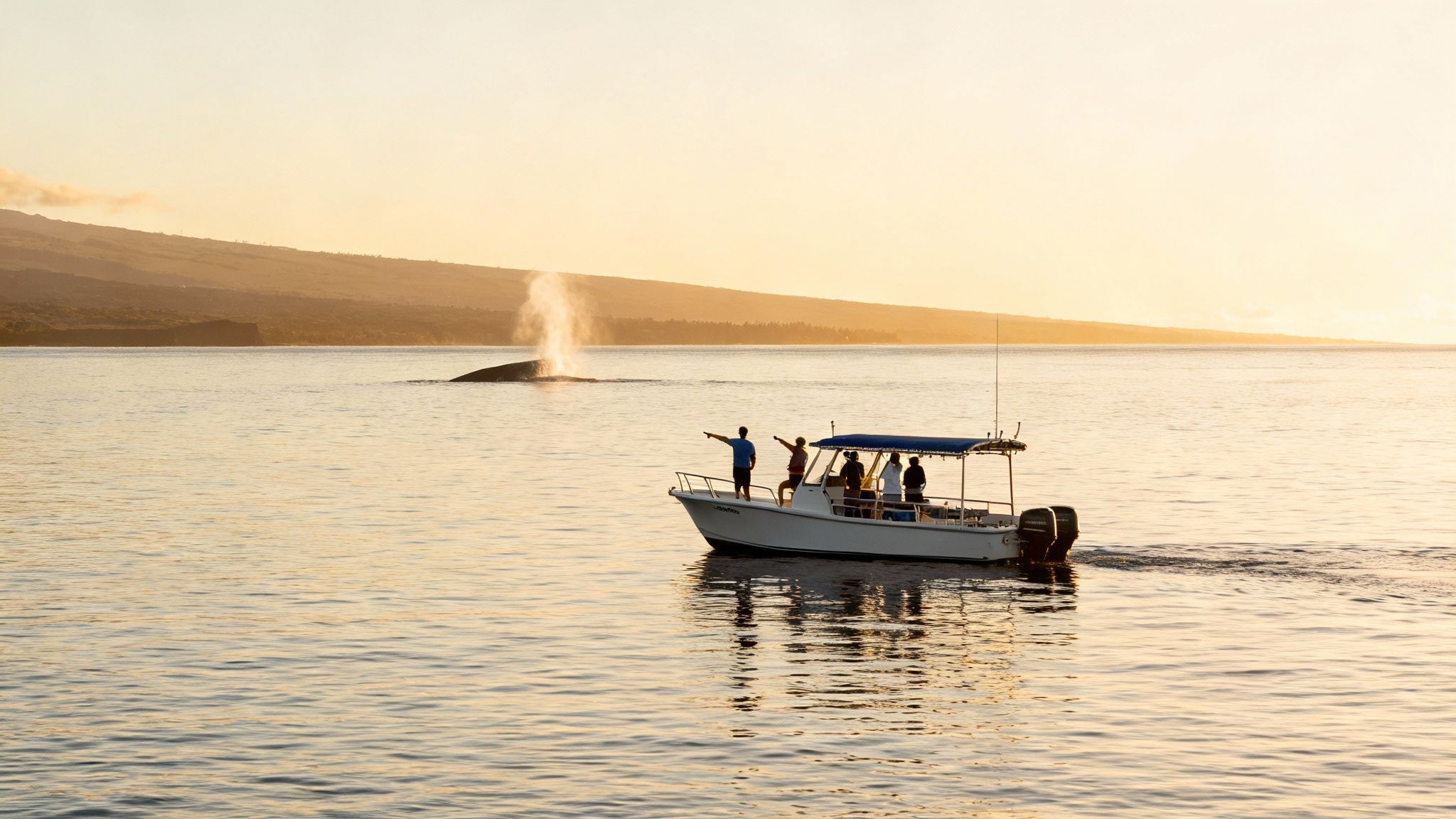
We've put together this comprehensive guide to get you ready for an incredible whale watching Kona Big Island adventure. We'll dive into why these gentle giants choose our coast, breaking down their long migration and the specific behaviors you can expect to see out on the water.
Here’s a little of what we’ll cover to help you plan the perfect outing:
- Seasonal Timing: We'll pinpoint the absolute best months and even times of day to maximize your chances of spectacular sightings.
- Whale Behaviors: You'll learn how to "speak whale," decoding the meaning behind epic breaches, powerful tail slaps, and curious spy-hops.
- Tour Selection: We'll walk you through the differences between various boats and explain why a smaller vessel often leads to a more intimate, unforgettable experience.
- Packing Essentials: Get a simple, no-fuss checklist of what to bring so you're comfortable and prepared for a day on the ocean.
Our goal is simple: to give you all the info you need to make your trip a massive success. By the time you're done reading, you’ll be ready to witness the awe-inspiring power and grace of humpback whales in one of the world's premier destinations.
The Incredible Journey of Humpback Whales to Kona
Every winter, the deep blue waters off the Kona coast welcome some very special visitors. North Pacific humpback whales complete one of the most amazing journeys in the animal kingdom, traveling a staggering 3,000-miles from their icy feeding grounds in Alaska. For months, they travel south without a single bite to eat, powered only by the thick layer of fat they built up over the summer.
Think about that for a second. It's like driving from New York City to Los Angeles without stopping for gas. This isn't some casual vacation; it's an epic pilgrimage driven by the powerful, ancient instinct to create the next generation. The warm, protected waters of Hawaii are the final, critical destination.
A Tropical Nursery for Gentle Giants
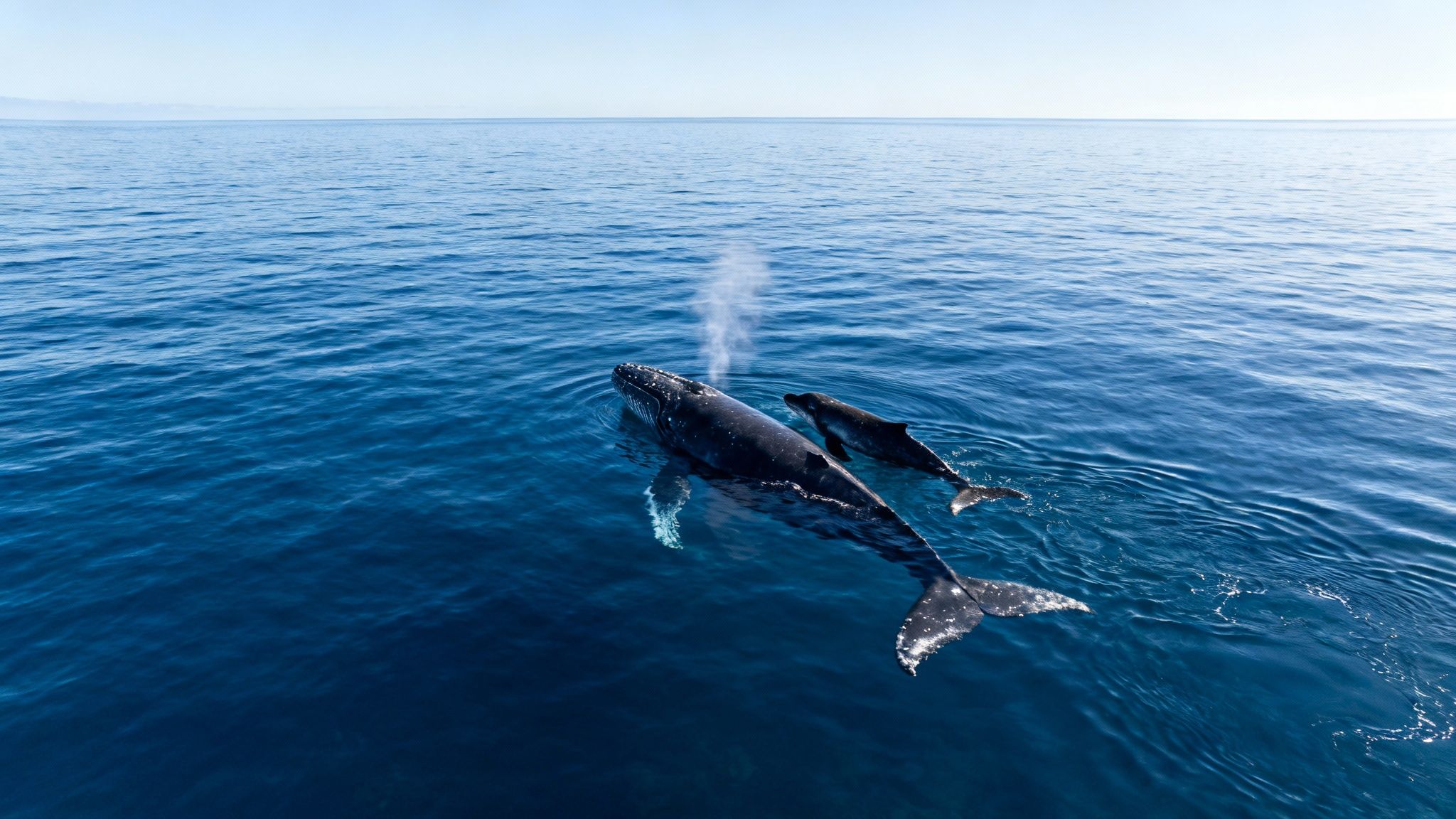
So, why travel all this way? Why Kona? It's simple: our coast offers the perfect five-star resort for the most important parts of a humpback's life. The calm, warm, and relatively shallow waters along the Kona and Kohala coasts act as a massive, safe nursery, far from the dangers of the deep open ocean.
This sanctuary is essential for three key activities, which is exactly what makes a whale watching Kona Big Island tour so unforgettable:
- Mating: The waters turn into a grand stage for courtship. Males form "competitive pods," putting on breathtaking shows of power and agility to impress the females. It's a truly wild sight.
- Birthing: Pregnant females specifically seek out these sheltered bays to give birth. The warm water is vital for newborn calves, who are born with very little body fat to keep them warm.
- Nursing: A newborn calf is a hungry one, drinking over 100 gallons of its mother's rich milk every single day. They spend their first few months right here, growing strong and packing on the blubber they'll need for their own first trip north.
The marine environment around Kona is largely free of orcas, the main natural predator of humpback calves. This makes our waters one of the safest places on Earth for a mother to raise her young, cementing its role as a globally important nursery.
The Science of Sanctuary
The Big Island's unique underwater geography is the real hero here. The massive volcanic slopes of Mauna Loa and Hualalai plunge steeply into the ocean, creating deep channels very close to shore. But the island itself shields the west side from powerful trade winds, creating the famously calm conditions of the "Kona side."
This perfect combo of deep water access and sheltered bays is what makes the area irresistible to the whales. They can move freely but also tuck into protected pockets to rest and nurse. It's why more than half of the entire North Pacific humpback population—that's over 12,000 whales—chooses Hawaiian waters for their winter home.
Knowing this story adds a whole new layer of awe to every spout you see, every breach that takes your breath away, and every tail slap that echoes across the water. You're not just watching animals play; you're witnessing the successful end of an ancient and perilous journey. It's a powerful and humbling reminder of nature's cycles, unfolding right in front of you.
When to Go for the Best Whale Watching in Kona
Timing is everything if you want to catch the best whale action in Kona. While you can spot humpbacks in Hawaiian waters for a good chunk of the year, knowing when to visit can be the difference between a decent trip and a mind-blowing one filled with epic breaches and tail slaps.
The official whale watching Kona Big Island season stretches from November all the way through May. But if you're looking for the absolute peak, the heart of the action, you'll want to aim for January, February, and March. That's when the ocean truly comes alive.
The Rhythm of the Season
Think of the humpback migration like a massive, slow-building wave. It starts with a few early scouts, swells into an incredible surge of activity, and then slowly fades as the whales head back north. The excitement often kicks off as early as October—in fact, the first juvenile for the 2025-2026 season was spotted off the Kona coast on October 30!
This first sighting is the signal that the great migration has begun, bringing over 12,000 whales (more than half the North Pacific population!) to our warm waters. By January and February, shore-based counts can average 3-6 whales every 15 minutes. But from a boat in a prime Kona spot? That number can jump to an unbelievable 15-20 sightings in the same amount of time.
Getting a feel for this monthly ebb and flow helps set the right expectations for your tour. For a deeper look at what each month holds, check out our complete guide on the Big Island whale season.
Kona Whale Watching Season Month by Month
To help you nail down the perfect time for your trip, we've broken down the season's progression. This table gives you a quick snapshot of what to expect from the first arrivals to the last goodbyes.
| Month | Whale Activity Level | What You Might See |
|---|---|---|
| November – December | Increasing | The first exciting arrivals! You'll likely spot adult whales and see males starting to form competitive pods, leading to some energetic surface action. |
| January – March | Peak | This is prime time. The whale population is at its highest, with constant sightings of mother-calf pairs, powerful breaches, and intense competition pods. |
| April – May | Decreasing | The last of the whales—often moms with their now-stronger calves—begin their long journey back to Alaska. Sightings are less frequent but can be very special. |
Each part of the season has its own unique magic, but for the most jaw-dropping displays, the peak months are hard to beat.
The Best Time of Day for a Tour
Once you’ve picked your month, the next question is: morning or afternoon? While whales are active 24/7, different times of day offer unique advantages for watching them.
The morning hours, typically between 8 AM and 11 AM, are often considered the prime time for whale watching. The ocean is generally calmer, the sun is at a lower angle which reduces glare, and the glassy water makes it much easier to spot a distant spout or splash.
But don't count out the afternoon trips! They have their own kind of magic. The lighting can be absolutely stunning for photography, bathing the water and the whales in a warm, golden glow. The trade-off is that the trade winds often pick up, which can make the ocean a bit choppier.
Here’s a quick summary to help you decide:
- Morning Tours (8 AM – 12 PM): Usually your best bet for calm seas and fantastic visibility. Less sun glare and wind make for a comfortable and reliable experience.
- Afternoon Tours (1 PM – 4 PM): Often feature more active whales. The dramatic lighting is a photographer's dream, but be prepared for the possibility of more wind and waves.
Honestly, there’s no "bad" time to go whale watching during peak season in Kona. The most important thing is just getting out on the water with a great crew. By understanding the seasonal flow, you can time your trip to coincide with the highest concentration of whales, giving you the best shot at witnessing the incredible spectacle that makes Kona a world-class marine destination.
A Guide to Decoding Humpback Whale Behaviors
That misty spray on the horizon is usually the first sign—the thrill that tells you they're here. But your whale watching Kona Big Island trip really comes alive when you start to understand the story behind the spectacle. Humpback whales have an incredible way of communicating through their surface behaviors, and learning to decode their body language connects you to these gentle giants on a whole new level.
The very first thing you'll be looking for is the blow, or spout. It isn't a stream of water like in the cartoons; it's the powerful exhale of warm air from their lungs hitting the cooler ocean air. This creates a cloud of vapor that can shoot 15 feet into the sky. A good captain can spot a blow from miles away, and it's our first invitation to the show.
Decoding Common Surface Behaviors
Once you get a bit closer, a whole world of activity opens up. Scientists are still piecing together the exact "why" behind every action, but they have some solid ideas about what these behaviors mean. Here are the big ones you're likely to see out on the water.
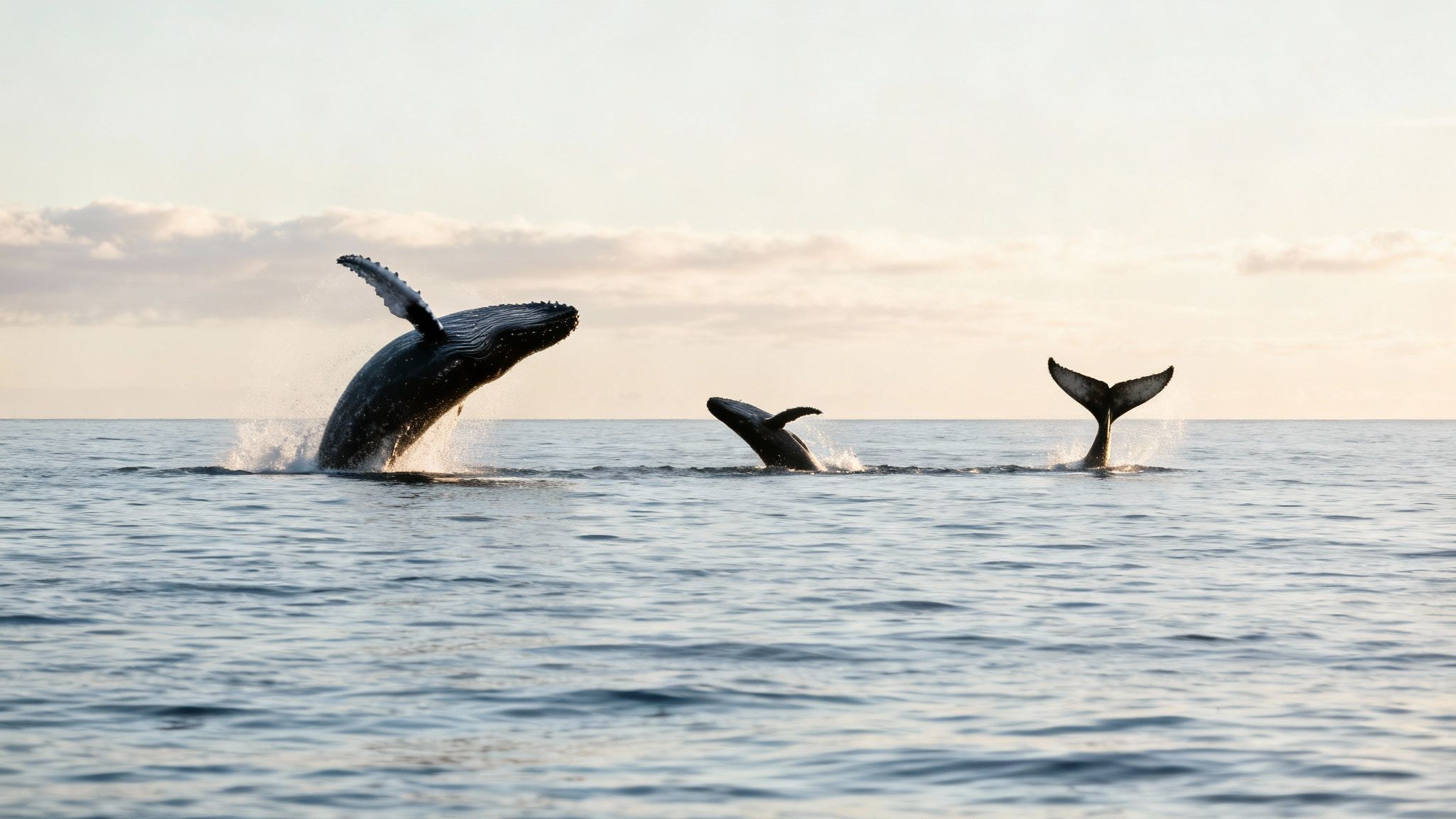
- The Breach: This is the show-stopper. A massive, 40-ton whale launching its entire body out of the water is an unforgettable display of raw power. Why do they do it? It could be a long-distance call to other whales, a way to shake off pesky barnacles, or maybe—just maybe—it’s pure, unfiltered joy.
- The Tail Slap (Lobtailing): Get ready for a boom! A whale lifts its enormous fluke (tail) high and slaps it down on the surface, creating a sound that carries for miles underwater. It’s a powerful form of communication, possibly a warning shot or a way to assert dominance.
- The Pectoral Fin Slap: Humpbacks have incredibly long pectoral fins—up to 15 feet—and they'll often roll onto their side to smack them on the water. You'll see this a lot when whales are socializing, another way they "talk" to each other within their group.
These aren't just random movements; they're the language of the whales, especially during the busy mating and calving season here in Kona's waters. Paying attention to these actions is also a huge part of citizen science. During the final whale count of the 2025 season, for example, trained volunteers across eight Big Island sites counted 28 whales. They carefully noted behaviors like breaches and tail slaps to help researchers understand population trends inside the Hawaiian Islands Humpback Whale National Marine Sanctuary. It's amazing how community-led counts contribute to whale conservation.
More Subtle and Curious Actions
Beyond the big splashes, keep an eye out for some of the quieter moments that offer a glimpse into the minds of these incredible animals.
One of my absolute favorite behaviors is the spy-hop. This is when a whale positions itself vertically and pokes its head straight out of the water, almost like it's treading water to get a better look around. When they do this near the boat, it truly feels like they’re just as curious about us as we are about them.
Another classic is the fluke-up dive. As a whale prepares to head into the deep, it arches its back and lifts that iconic tail fluke high into the air before slipping silently beneath the surface. It's often the last you'll see of that whale for a few minutes, and it makes for the most beautiful, frame-worthy photograph.
When you start recognizing these behaviors, you stop being just a spectator and become part of the experience. Each breach, slap, and dive adds another layer to the story unfolding in front of you, deepening your appreciation for Kona's magnificent winter visitors.
How to Choose Your Perfect Kona Whale Watching Tour
With so many incredible options for whale watching on the Big Island, picking the right tour can feel like a huge decision. It's more than just booking a boat ride; your choice of vessel and operator is what truly shapes the experience, from your comfort on the water to how close you get to the action.
Let's break down the options to help you find the perfect trip for you and your group. The first big fork in the road is the type of boat you’ll be on. Tours in Kona range from large, stable catamarans to smaller, quicker rafts and zodiac-style boats, and each one offers a totally different vibe.
Large Vessels vs Small Group Tours
Big catamarans are a popular choice, and for good reason—they're stable and loaded with amenities. You'll often find shaded seating, onboard restrooms, and snack bars, which makes them a comfortable pick for families with little kids or anyone worried about seasickness. The trade-off? A bigger crowd, which can sometimes mean craning your neck to get an unobstructed view.
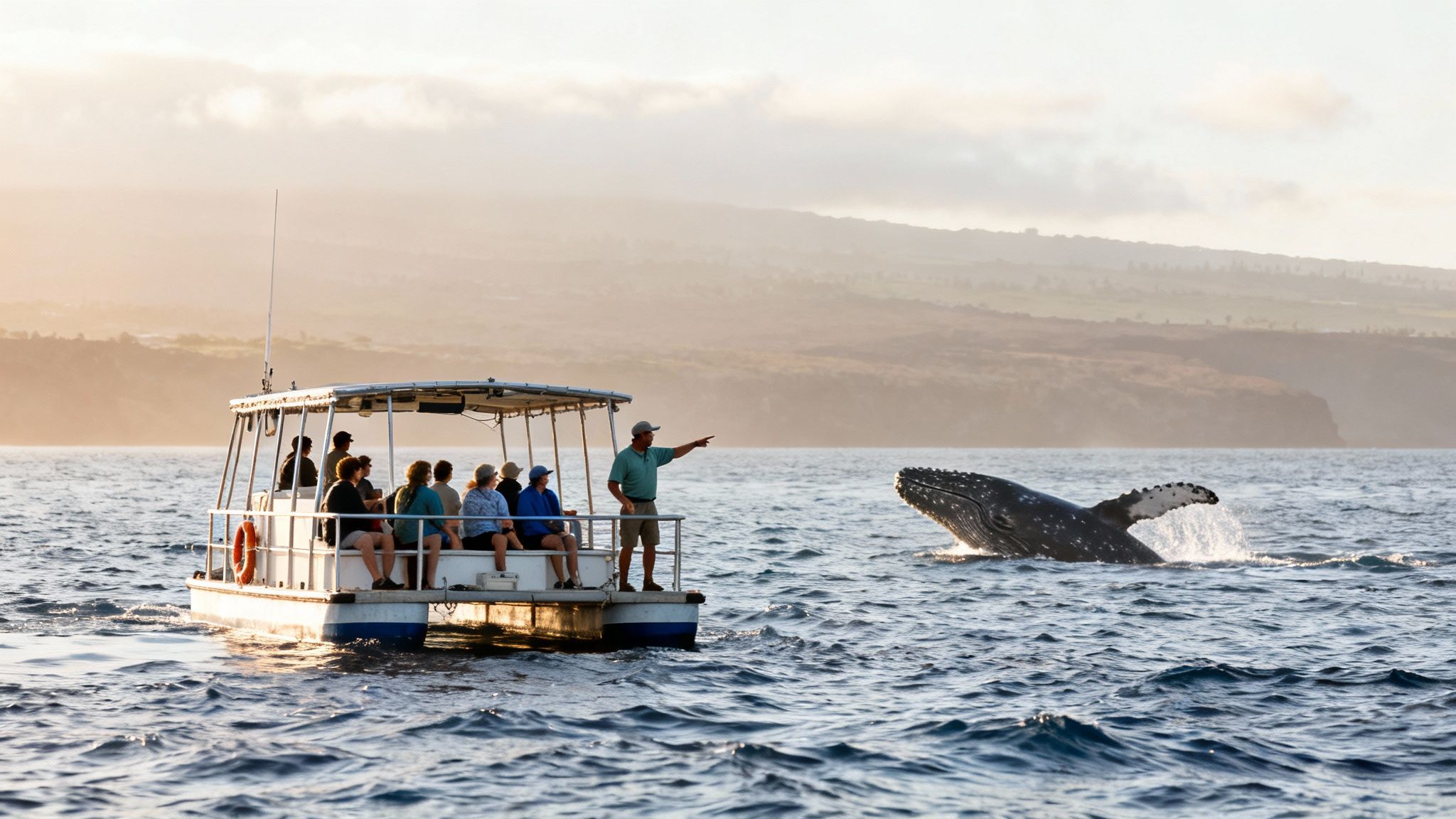
On the other hand, smaller vessels, like the ones we run at Kona Snorkel Trips, deliver a completely different kind of adventure. We're biased, of course, but here’s why we think a small-group tour is almost always the better way to go:
- More Intimate Encounters: With just a handful of passengers, you aren't fighting for a spot at the railing. The whole experience feels more personal and connected, putting you right at eye-level with the ocean's surface.
- Greater Agility: Small boats are nimble. When whales suddenly appear, our captains can respond quickly and safely, repositioning for the best possible views without ever disturbing the animals.
- Personalized Attention: A smaller group means you get more one-on-one time with the captain and crew. You can ask all the questions you want and walk away with a much deeper understanding of whale behavior and our local marine world.
Choosing a smaller vessel often translates to a more authentic and memorable experience. It’s less about being a passenger on a cruise and more about being part of an intimate expedition.
The Importance of a Responsible Operator
Beyond the boat itself, the single most important factor is picking an operator that’s committed to responsible wildlife viewing. Humpback whales are protected under federal law, which requires all vessels to stay at least 100 yards away. This rule is absolutely critical for protecting new mothers and their calves during this sensitive time.
A reputable company like Kona Snorkel Trips will always put the whales' well-being first. Our experienced crew knows how to navigate these encounters with respect, making sure our presence never causes stress to the animals. A truly great tour isn't just about getting close; it's about observing these magnificent creatures in their natural habitat without getting in their way. Our educational focus ensures you leave with a deeper appreciation for the marine world. For a complete overview of what sets different tours apart, you can explore our detailed guide to whale watching on the Big Island.
Why Kona's Waters Offer More
The marine environment off the Kona coast is exceptionally rich. The unique underwater geography, with its massive depth changes so close to shore, supports an incredible diversity of life beyond just humpbacks. Reports from local tours frequently document sightings of short-finned pilot whales, bottlenose dolphins, and playful Hawaiian spinner dolphins, all in the same week. This biodiversity, which supports ongoing data collection for the marine sanctuary, means any trip can turn into a multi-species marine safari. You can discover more about Kona's incredible marine reports and see how vibrant our waters are year-round.
Ultimately, the best tour is one that aligns with your priorities. By focusing on a small-group experience with a knowledgeable and responsible crew, you are setting yourself up for an unforgettable adventure that is both thrilling and respectful.
What to Pack for Your Day on the Water
Getting your gear right is the secret to a comfortable and absolutely unforgettable whale watching Kona Big Island adventure. Being out on the open ocean isn't quite the same as a lazy day at the beach, and having the right stuff with you means you can focus 100% on the incredible show the humpbacks are putting on.
Think smart layers and serious sun protection. Even on the warmest Kona days, that ocean breeze can have a surprising chill, especially after you’ve been sitting in the shade for a bit.
Clothing and Comfort Essentials
The golden rule for dressing for a day at sea? Layers, layers, layers. A t-shirt or tank top is the perfect start, but you'll be glad you brought something to throw over it.
- A Light Jacket or Windbreaker: This is non-negotiable. A light, water-resistant jacket will be your best friend against sea spray and any unexpected wind, keeping you perfectly comfortable for the whole trip.
- Comfortable Footwear: Go for shoes with good grip. Think sandals with a backstrap or classic boat shoes. The deck can get wet, and non-slip soles are a must for staying safe.
- Swimsuit (Optional): Some tours might offer a quick dip, but for a dedicated whale watch, it’s usually best to just wear it under your clothes in case the opportunity arises.
Sun and Sight Protection
The Hawaiian sun is no joke, and when it reflects off the water, it's even stronger. Protect yourself now so you don't pay for it later with a wicked sunburn.
Polarized Sunglasses: This is our number one, can't-miss tip. They do so much more than just shade your eyes; they slice right through the glare on the water's surface. This makes it dramatically easier to spot whales and other marine life just below. You'll see more, and your eyes will thank you for it.
And don't forget these either:
- Reef-Safe Sunscreen: Protect your skin and our fragile coral ecosystems. Look for mineral-based sunscreens with zinc oxide or titanium dioxide.
- A Wide-Brimmed Hat: A hat with a chin strap is clutch. The last thing you want is to watch your favorite hat fly off when the boat picks up speed.
Gear for the Best Viewing
Your eyes are your best tool out here, but a few extra pieces of gear can take your experience from great to absolutely mind-blowing.
- Camera with a Zoom Lens: Whales are wild and unpredictable. A good zoom lens lets you capture those stunning, detailed shots without needing to be right on top of the action.
- Binoculars: These are fantastic for spotting those distant spouts—often the first sign of a whale—or for getting a closer look at behaviors happening a little further from the boat.
Preventing Seasickness
If you're someone who gets a little queasy with motion, a bit of prep can make a world of difference. Simple things like staying hydrated, skipping heavy or greasy foods beforehand, and keeping your eyes fixed on the steady horizon line really do work. For a deeper dive, you can learn all about how to prevent seasickness on our blog.
Beyond the whale-specific items, it's always good to know the general boat trip essentials. Most reputable tours, including ours here at Kona Snorkel Trips, will have snacks and drinks on board, but it never hurts to double-check. With this simple list in hand, you’re all set for a fantastic day on the water.
Got Questions? We've Got Answers
To round things out, let's tackle some of the most common questions we get from folks planning a whale watching trip here in Kona. Getting these details ironed out ahead of time means you can step on the boat feeling confident and ready for an amazing day.
Is it a Guarantee I'll See a Whale?
That's the million-dollar question, isn't it? The simple, honest answer is no. These are wild humpback whales migrating on their own terms, and no one can promise a sighting with 100% certainty.
That said, your chances during peak season—think January through March—are incredibly high. The waters off Kona are just buzzing with activity, and a seasoned crew knows exactly where to look. They're constantly communicating with other boats to put you in the absolute best spot for a memorable encounter. Many of the best outfits will even offer you another trip for free if the whales decide to be shy that day.
How Close Can We Actually Get to the Whales?
For the safety and well-being of the whales, especially the new moms and their calves, federal law is crystal clear: boats have to stay at least 100 yards away. This rule is non-negotiable and ensures we aren't adding any stress to their journey.
A good captain will never chase or crowd a whale. But here's the cool part: the law doesn't apply to the whales. It’s not uncommon for a curious humpback to approach a stopped boat on its own, giving you a magical, up-close look that happens completely on their terms.
Can I Just Watch Whales From Shore on the Big Island?
You sure can! The Big Island has some fantastic spots for whale watching from land, especially along the Kohala Coast. Elevated viewpoints like Puʻukoholā Heiau National Historic Site or Lapakahi State Historical Park offer incredible panoramic views of the ocean.
You won't get that same intimate, water-level perspective you get from a boat, but you can definitely spot the tell-tale signs: distant spouts, breaches, and tail slaps. Pro tip: bring a good pair of binoculars, find a comfy spot, and just be patient while you scan the horizon.
What Else Might I See Besides Humpbacks?
A whale watch in Kona often turns into a full-blown marine safari! While the humpbacks are the headliners, it's almost a given that you'll run into huge pods of playful spinner dolphins. They absolutely love to surf in the boat's wake.
You've also got a great shot at seeing bottlenose dolphins and short-finned pilot whales. And if you’re really lucky, you might spot green sea turtles, manta rays, or even a rare oceanic whitetip shark. Every trip is a totally unique adventure.
Ready to see the magic of Kona's whale season for yourself? Join Kona Snorkel Trips for an intimate, small-group adventure you'll never forget. Our crew is passionate about creating a safe, respectful, and totally unforgettable experience with these incredible animals. Book your tour today