
Your Ultimate Guide to Whale Watching Big Island Kona
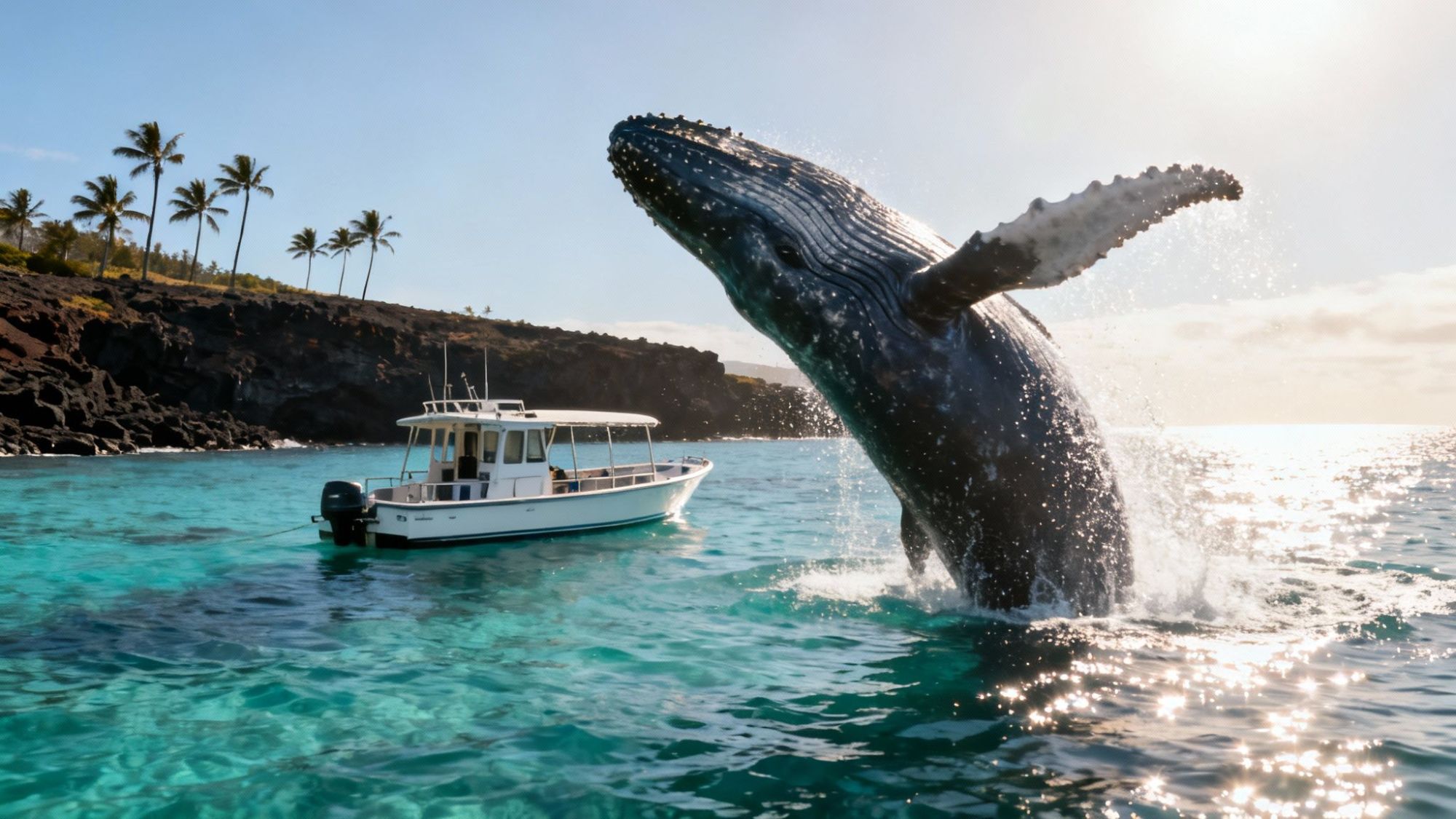
Picture this: the calm, turquoise Pacific suddenly explodes as a forty-ton giant launches itself skyward. That's the pure magic of whale watching here in Kona, and it’s an experience that sticks with you forever. This guide is your complete playbook for witnessing one of nature’s most incredible shows, from understanding why thousands of humpback whales choose our calm waters to planning a trip you'll never forget.
As the top rated & most reviewed snorkel company in Hawaii, Kona Snorkel Trips is ready to show you the adventure of a lifetime.
Witnessing Giants: Your Guide to Kona Whale Watching
Every winter, something amazing happens. The protected waters off the Kona coast transform into a bustling nursery for thousands of North Pacific humpback whales. After an epic 3,000-mile journey from their feeding grounds in Alaska, these magnificent animals arrive to mate, give birth, and raise their newborn calves in this warm, safe Hawaiian sanctuary. This incredible annual migration makes the Big Island one of the best places on the entire planet for whale watching.
For those of us lucky enough to see it, this is so much more than a sightseeing trip. It's a front-row seat to a crucial chapter in the life of one of the planet's most majestic creatures. There's nothing quite like watching a mother gently guiding her calf or hearing the thunderous boom of a full-body breach echo across the water. It’s a powerful moment that connects you right to the raw beauty of the natural world.
Why an Expert Guide Makes All the Difference
To truly get the most out of this spectacle, you want to go with someone who knows these waters inside and out. As the top-rated and most-reviewed snorkel and tour company in Hawaii, we at Kona Snorkel Trips offer more than just a boat ride; we provide an immersive and respectful wildlife encounter. Our expert crew lives and breathes this ocean, offering insights that turn a simple sighting into a deep appreciation for whale behavior and our local marine ecosystem.
But don't just take our word for it. See what fellow adventurers have to say about their experiences with us.
What This Guide Covers
We've packed this guide with everything you need for a successful whale watching Big Island Kona adventure. We’ll dive into the best times of year to visit, help you decode the incredible behaviors you might witness, and compare your viewing options. You'll learn what to expect on a tour and, most importantly, understand the crucial guidelines for responsible, ethical viewing that protect these gentle giants.
By the time you're done reading, you'll be ready to plan a trip that’s more than just watching from a distance—it's about creating a lifelong memory grounded in respect for Hawaii’s incredible marine life.
The Best Time for Whale Watching in Kona
Timing is everything when it comes to planning a truly epic whale watching trip on the Big Island. While you can sometimes get lucky and spot a few early arrivals or late stragglers, the real magic happens within a pretty specific window of time. If you want to see those spectacular breaches and tail slaps, you'll want to line up your visit with the absolute peak of their annual migration.
The general whale watching season here in Kona runs from about mid-December through mid-April. This is when thousands of humpback whales finish their long swim from Alaska to settle into Hawaii's warm, protected waters. You can think of it as a massive, months-long family reunion where the whales come to mate, give birth, and nurse their newborn calves in a safe nursery.
Pinpointing the Peak Season
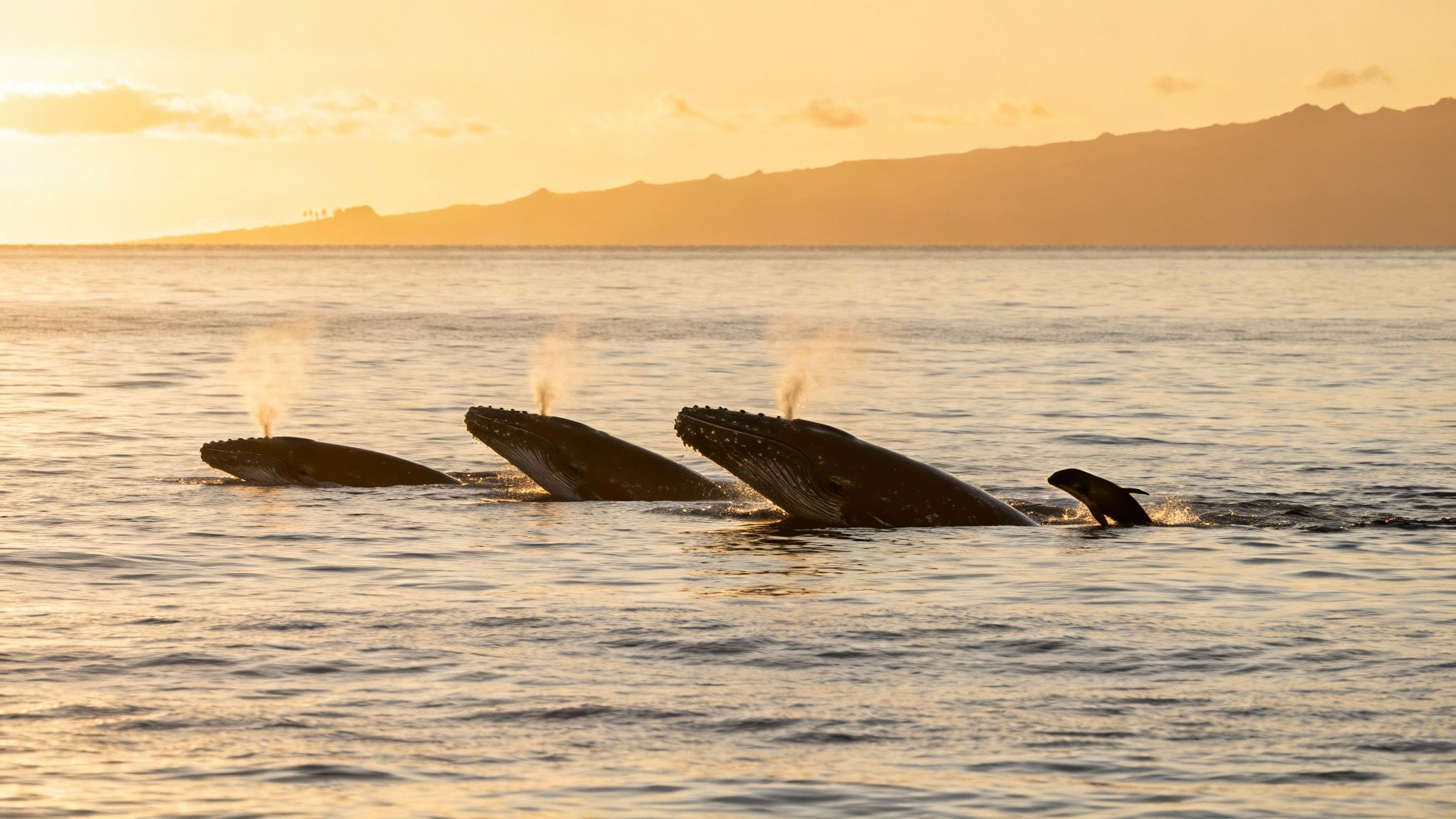
For the most action-packed and frequent sightings, the absolute best time to get out on the water is from January through March. This is the heart of the season, when the whale population density is at its highest. During these months, the waters off the Kona coast are just buzzing with activity, giving you the best shot at witnessing the full spectrum of humpback behaviors.
The sheer scale of this event is hard to wrap your head around. Scientists believe that more than 12,000 North Pacific humpback whales—over half of their entire population—make the journey to Hawaiian waters each year. The Hawaiian Islands Humpback Whale National Marine Sanctuary confirms the greatest numbers are right here from January to March, making this one of the most significant gatherings for the species on the entire planet.
What About the Shoulder Months?
While January to March is prime time, you can still have some incredible experiences during the shoulder months of December and April. They just offer a slightly different vibe.
- Early Season (Mid-December): This is when the first big groups start rolling in. The energy is electric, with male whales often forming competitive pods to vie for the attention of females.
- Late Season (April): The focus tends to shift to mothers and their newborn calves. You’re more likely to see tender, nurturing moments as the calves build up their strength for that first long trip north to Alaska.
"The peak season from January to March is like rush hour on the 'humpback highway.' The sheer volume of whales dramatically increases your chances of witnessing those truly awe-inspiring moments that define a Kona whale watching tour."
To make it even easier, here’s a quick breakdown of what you can expect throughout the year.
Kona Whale Watching Seasonal Guide
This table is a quick reference to help you plan your trip around the best whale activity in Kona.
| Time of Year | Primary Sightings | Activity Level | Best For |
|---|---|---|---|
| Jan – Mar (Peak) | Humpback Whales (High Density), Dolphins, Pilot Whales | Very High | Seeing breaches, competitive pods, and calves. The most action. |
| Mid-Dec & April | Humpback Whales (Moderate), Dolphins | High | Catching the start or end of the migration; great sightings still likely. |
| May – Nov | Spinner Dolphins, Pilot Whales, False Killer Whales | Low (for Humpbacks) | Year-round resident marine life; surprise encounters. |
While humpbacks are the main event, remember that the ocean is always full of life.
Year-Round Marine Life Encounters
Even though the humpbacks are our winter superstars, Kona's vibrant waters are a stage for incredible marine life all year long. A boat trip is almost never dull, no matter when you go. To get a better sense of the rhythms of our ocean, check out our complete guide to the Big Island's whale season.
Outside of humpback season, keep an eye out for playful pods of spinner dolphins, famous for their acrobatic leaps. You might also spot curious pilot whales or the more elusive false killer whales. This rich biodiversity means there's always an adventure waiting just offshore.
Understanding Humpback Whale Behaviors
Seeing a forty-ton whale launch itself completely out of the water is something you never forget. But when you start to understand why they do it, the whole experience shifts from a simple spectacle to something much more profound. When you're out on the water for a whale watching Big Island Kona tour, you’re not just a spectator; you're witnessing a complex language spoken through unbelievably powerful physical displays. Every breach, slap, and spout has a purpose.
Learning to recognize what these actions mean is the difference between just seeing a splash and actually connecting with these intelligent animals. This is your field guide to the incredible behaviors humpbacks show off in Hawaii, giving you a front-row seat to the rich social lives unfolding right before your eyes.
The Most Spectacular Surface Behaviors
While whales spend the vast majority of their lives beneath the surface, it’s their surface activity that creates those jaw-dropping, heart-pounding moments. Here are the big ones you're most likely to see and what they might be trying to say.
The Breach
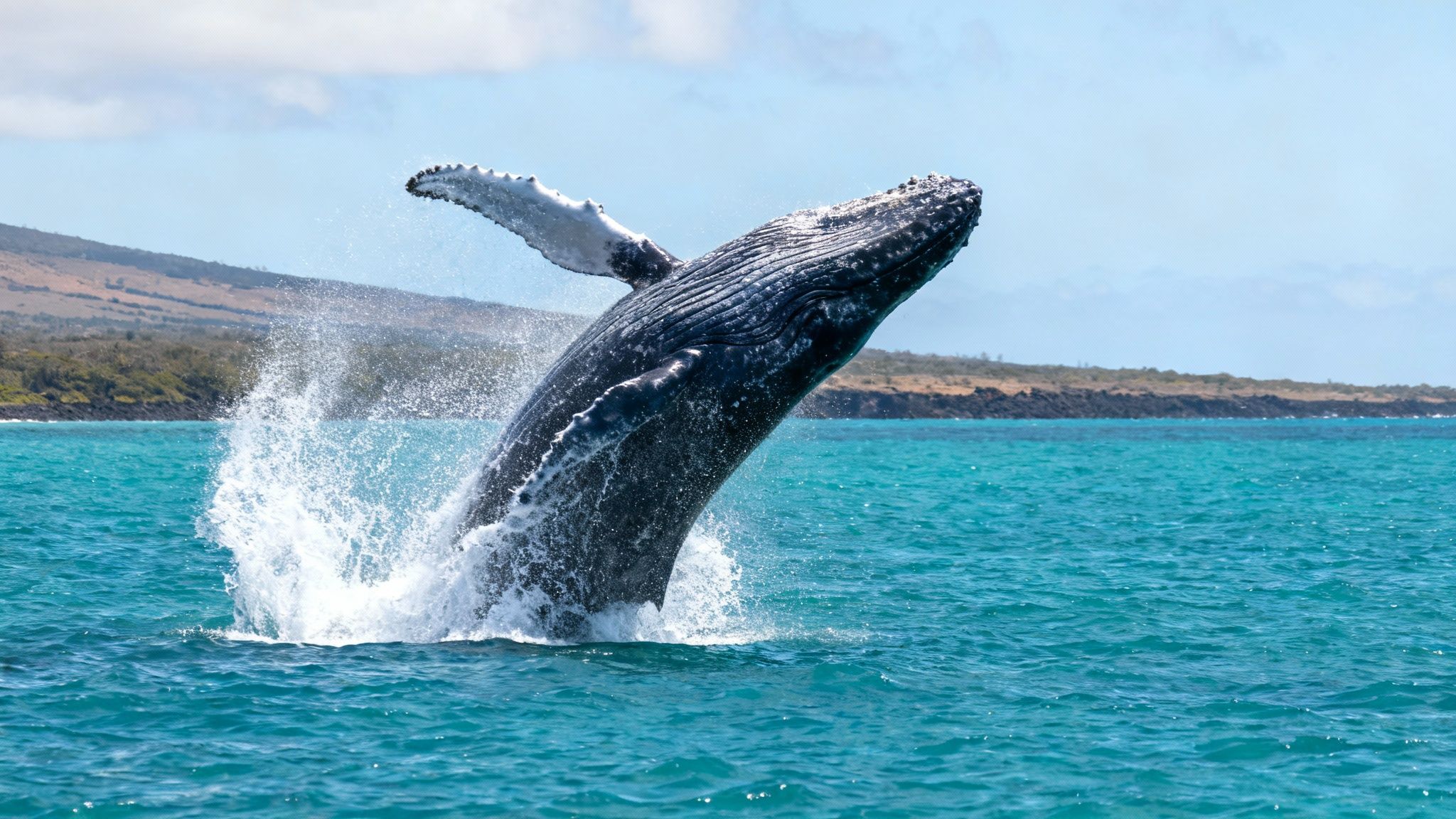
This is the holy grail of whale watching. A whale propels its massive body almost entirely out of the ocean, hanging in the air for a split second before crashing back down with a thunderous boom. Scientists have a few theories about this one. It could be a way to communicate over long distances—the sound of 40 tons of whale hitting the water travels for miles underwater. It might also be a handy way to shake off pesky barnacles, or maybe, just maybe, it’s an expression of pure, unadulterated joy.
The Tail Slap (Lobtailing)
You will hear this one long before you see it. A whale lifts its massive fluke (the tail) straight out of the water and smashes it down on the surface, creating a gunshot-like crack that echoes across the bay. This percussive sound is a powerful communication tool. Think of it as an attention-getter, a warning to other whales, or a way to rally the group.
The Pectoral Fin Slap
Imagine getting a high-five from a fin that's 15 feet long. Whales will often roll onto their side or back and repeatedly slap one or both of their long pectoral fins on the water. This seems to be a more localized, social form of communication, something we see a lot when whales are interacting in closer groups.
More Subtle and Curious Actions
Not all whale behavior is about making the biggest splash possible. Some of the most compelling moments are the quieter ones, revealing the curious and intelligent nature of these gentle giants.
"One of the most captivating behaviors is the spy-hop. It's when a whale pokes its head straight out of the water, almost as if it's trying to get a better look at our world. In that moment, the line between observer and observed blurs, and you feel a real connection."
Learning to spot these more subtle actions adds a whole new layer to your whale watch.
-
Spy-Hop: This is when a whale hangs vertically in the water and lifts its head straight up, sometimes rotating slowly to get a 360-degree view. It’s pure curiosity. The whale is just as interested in checking us out as we are in watching them.
-
Blow or Spout: This is usually the first sign that a whale is nearby. A whale’s spout is the visible cloud of vapor and air they forcefully exhale from their blowholes when surfacing to breathe. An experienced captain can often tell the species, size, and even direction of travel just by looking at the shape of the blow.
-
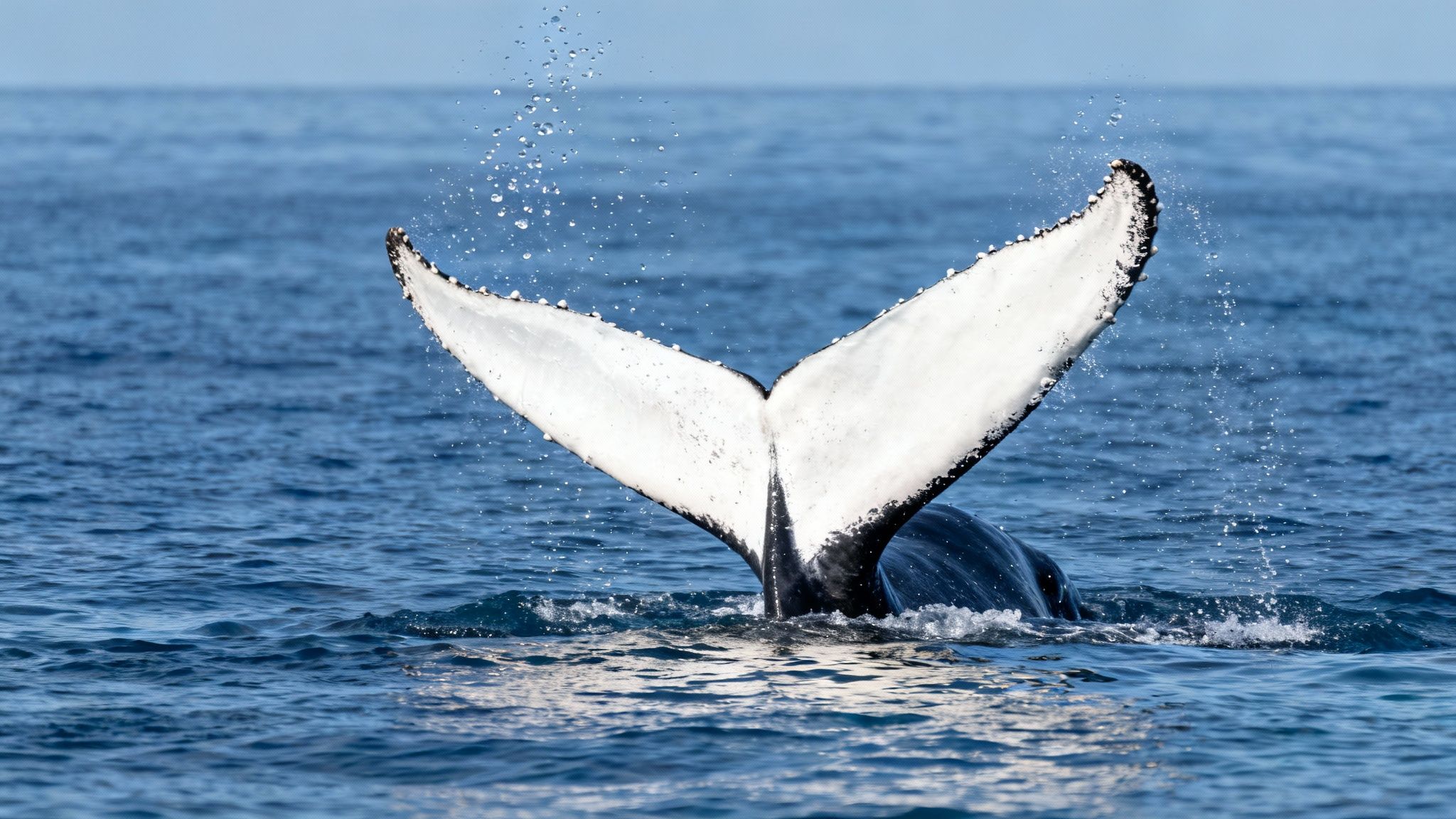
Fluke-Up Dive: Right before a deep dive, a humpback will arch its back and raise its massive tail high into the air. The unique black and white patterns on the underside of the fluke are like a human fingerprint, allowing researchers to identify and track individual whales. It’s often the last beautiful glimpse you get before the whale slips back into the deep blue.
When you understand these behaviors, every moment on the water becomes richer. A tail slap isn't just a splash; it’s a message. A breach is more than an incredible sight; it's a powerful statement. When you join a tour, you’re stepping into their world, and learning their language is the best way to appreciate the incredible drama of whale season in Kona.
Choosing Your Kona Whale Watching Adventure
When you’re planning your whale watching Big Island Kona trip, the first big question to tackle is how you want to see the show. Are you picturing yourself on the water, feeling the ocean spray as a whale surfaces nearby? Or does the idea of a quiet, patient watch from a scenic overlook sound more like your speed?
Both are fantastic ways to connect with these incredible animals. The right choice really comes down to your budget, your sense of adventure, and what you’re hoping to get out of the day.
The Case for a Guided Boat Tour
For most people, getting out on the water with an experienced crew is the definitive way to experience whale season. It’s an active adventure that puts you right in the middle of the action, and it seriously stacks the odds in your favor for having one of those unforgettable, up-close encounters. There's just no substitute for being out there and getting a true sense of a humpback's immense scale.
A great crew doesn't just drive a boat; they live on these waters. They can spot a distant blow long before the rest of us, and they add a rich layer of understanding by explaining what you're seeing in real-time. For a deeper dive into what makes a tour truly special, check out our complete guide to whale watching in Kona.
Why a Boat Tour is a Game-Changer:
- Proximity: While we always respect the mandatory 100-yard legal distance, a boat gets you worlds closer than you could ever hope for from land. This is how you see the details—the barnacles, the eye, the sheer power.
- Expert Eyes: The crew’s trained eyes are your best asset. They know what to look for and can interpret behaviors, explaining the difference between a territorial tail slap and a friendly pectoral fin wave.
- Mobility: Whales don't sit still, and neither should you. A boat can respectfully follow the action, turning a fleeting glimpse into a prolonged, quality sighting. If one spot is quiet, the captain knows where to go next.
- The Full Sensory Experience: From shore, you see the splash. From a boat, you hear the powerful whoosh of their breath. Many tours even have hydrophones to drop in the water so you can listen to their haunting songs—an experience that’s absolutely impossible from land.
"A boat tour transforms you from a spectator on the sidelines to a guest in the whales' world. The ability to move with the pods and learn from a knowledgeable crew offers a dynamic and deeply personal connection to the migration."
The Appeal of Shoreline Whale Watching
If you prefer to keep your feet on solid ground, watching from the shoreline offers a more relaxed and definitely more budget-friendly alternative. It’s a different kind of thrill, one that’s all about patience, a good pair of binoculars, and a little bit of luck.
Why Watching from Shore is Great, Too:
- Cost-Effective: It’s completely free! All you need is a good spot and some time to soak it all in.
- Total Flexibility: You’re on your own schedule. Come and go as you please, and stay for ten minutes or three hours—it's entirely up to you.
- Stunning Scenery: Let's be honest, the viewpoints along the Kona and Kohala coasts are breathtaking on their own. The whales are just an incredible bonus to an already gorgeous panoramic view.
The trick to a successful shore watch is finding an elevated spot with a wide, clear view of the ocean. Pack a comfy chair, some snacks, and a good pair of binoculars.
And this isn't just a casual activity; it's real community science. The annual Sanctuary Ocean Count relies on volunteers watching from shore. This past season, they recorded 714 humpback whales (koholā), with 28 of those sightings coming from just eight spots around the Big Island. It just goes to show you what’s possible with a little patience.
Whether you choose the immersive journey of a boat tour or the patient vigil from a cliffside perch, you’re taking part in one of the most spectacular events in the natural world.
What to Expect on Your Whale Watching Tour
The adventure doesn't just start when you feel the first ocean spray. It begins with that little flutter of excitement as you step onto one of our boats—small, intimate vessels built for a proper Kona whale watching experience. You can forget about craning your neck over a crowd of fifty other people; on our boats, everyone gets a front-row seat to the greatest show on Earth.
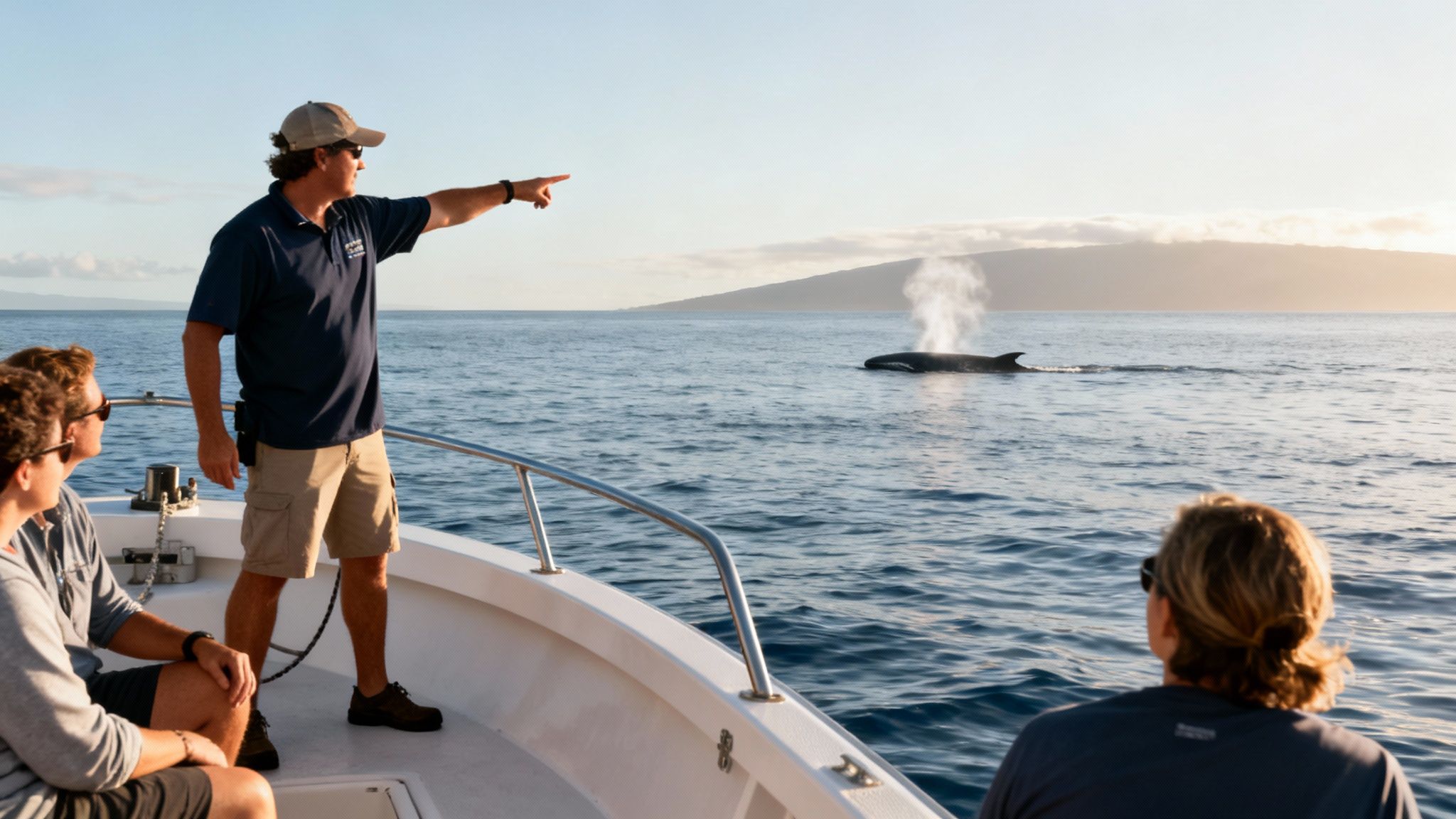
The journey kicks off as we motor away from the Kona coast, the shoreline shrinking behind us as all eyes begin to scan the deep blue horizon. There’s a palpable energy in the air, a shared hope for what the ocean might reveal. And then, it happens. A crew member, whose eyes are tuned for this exact moment, points toward the horizon. A misty puff hangs in the air for a second—the first blow. That's the signal your adventure has truly begun.
The Kona Snorkel Trips Difference
A truly memorable tour comes down to the people guiding it. Our captains and crew live and breathe these waters. Their knack for spotting a distant spout or guessing where a whale might surface next is an art, one they've perfected over countless hours at sea. They aren't just boat drivers; they're your interpreters for the complex, incredible world of humpback whales.
As we slow the boat to a respectful distance, the sheer scale of these animals really starts to sink in. No video or photo can ever prepare you for the sight of a 40-foot, 40-ton humpback surfacing near you. It’s a moment of raw power mixed with a surprising amount of grace that connects you directly to the wild heart of the ocean.
Back on board, our crew is all about making your trip comfortable and fascinating. They share incredible insights into whale behavior, turning what could be just a quick sighting into a rich, educational encounter you won't forget.
Setting Realistic Expectations
Every single trip is a one-of-a-kind dance with nature. These are wild animals, and they're calling all the shots. While we see whales all the time during peak season, we can never make guarantees. One day might be an action-packed show of thunderous, full-body breaches, while the next might offer the quiet, tender moment of watching a mother and her calf.
The magic is in the not knowing. Our crew’s job is to put you in the best possible position for that magic to happen, making every trip a safe, informative, and unforgettable journey into the whales' world.
This means we follow their lead. We might hang out with a single, curious whale for a while or track a dynamic competitive pod from a safe distance. That’s the beauty of a small-group tour—we have the flexibility to adapt to whatever the ocean has in store for us that day.
What to Bring for Your Adventure
A little preparation goes a long way to making your day on the water as comfortable and amazing as possible. Packing the right gear means you can just relax and focus on the incredible show.
- Polarized Sunglasses: These are a game-changer. They cut right through the glare on the water, letting you spot fins, flukes, and spouts you'd otherwise completely miss.
- Light Jacket or Windbreaker: Even on a warm Kona day, the breeze can pick up once you're out on the open ocean. It’s always smart to have an extra layer you can throw on or take off.
- Reef-Safe Sunscreen: Protecting your skin is key, but using a reef-safe formula also helps protect Hawaii’s fragile marine ecosystem. Win-win.
- Camera or Smartphone: You’ll definitely want to capture these moments! But also, remember to put the camera down and just watch with your own eyes. Some memories are too big for a lens.
- Binoculars: While not essential on our small boats, they can be great for getting a closer look at distant action or spotting other wildlife like dolphins or sea birds.
Practicing Responsible Whale Watching
There’s nothing quite like seeing a forty-ton humpback whale launch itself out of the deep blue. It’s a powerful, unforgettable moment. But being able to witness this comes with a real responsibility to protect these incredible animals.
These whales travel thousands of miles to get to Kona's safe, warm waters to mate and raise their calves. Any disturbance, even an accidental one, can cause a ton of stress, especially for a new mom trying to nurse and protect her vulnerable newborn. This is why knowing how to practice responsible whale watching on the Big Island of Kona is so critical.
The 100-Yard Rule
Federal and state laws are crystal clear on this: all vessels—boats, kayaks, even paddleboards—must stay at least 100 yards away from humpback whales at all times.
It helps to picture an invisible fence around them. This is their personal space, giving them the room they need to rest, nurse, and just be whales without feeling threatened by our presence. Following this rule is the single most important part of respectful whale watching.
It's especially vital for mothers and their calves. They often hang out near the surface, and a boat getting too close can easily startle them. This could separate the pair or force them to burn precious energy they desperately need for the long swim back to Alaska.
What Makes a Tour Whale-Friendly?
Choosing a "whale-friendly" tour operator is about more than just picking a boat. It means you're supporting a company that puts the whales' well-being first, going beyond just following the law to a genuine commitment to marine conservation.
- Expert Navigation: A responsible captain is a master at positioning the boat for fantastic views without ever breaking that crucial 100-yard barrier. They know how to read the whales' behavior, approaching slowly and parallel to their direction of travel, never head-on.
- Educational Focus: The best tours are about more than just sightseeing; they're a chance to learn. A great crew will explain the behaviors you're witnessing, share incredible facts about humpback biology, and talk about the conservation efforts happening right here in Hawaii.
- Conservation Support: When you book an ethical tour, you're truly voting with your wallet. You're backing local businesses that act as guardians of the ocean and help protect Hawaii's entire marine ecosystem.
Choosing a responsible tour operator ensures that the magic of the whale season continues for future generations. It’s a sign of profound respect for the whales' ancient pilgrimage and their right to a safe haven in Hawaiian waters.
The Kona coast offers some of the best whale watching in Hawaii, with the peak season running from mid-December to mid-April. Humpbacks migrate about 4,000 miles from their feeding grounds in Alaska to these warm waters to mate, give birth, and nurse their young. The calm seas off Kona and the Kohala coast create the perfect stage for spotting incredible behaviors like breaches and tender mother-calf moments. Find out more about Kona's spectacular whale reports.
When you choose a tour with an operator like Kona Snorkel Trips, you're not just a spectator—you become an active partner in conservation, helping ensure these magnificent creatures continue to thrive for years to come.
Your Kona Whale Watching Questions Answered
To wrap things up, let's go over some of the most common questions we get from folks planning their whale watching adventure. Getting these details ironed out ahead of time will help you feel totally ready for an amazing day on the water.
What Time of Day Is Best for Whale Watching?
We almost always recommend a morning trip. The ocean here in Kona is typically much calmer in the early hours, often glassy and smooth. That makes spotting those distant spouts and splashes a whole lot easier.
Plus, the lighter winds usually mean a more comfortable boat ride, so you can focus all your attention on the incredible show the whales are putting on.
Can I See Whales from the Shoreline?
You absolutely can! Grabbing a pair of binoculars and finding a spot along the elevated bluffs of the Kohala Coast can be a fantastic and relaxing way to spend an afternoon. Places like Puʻukoholā Heiau National Historic Site offer some epic ocean views.
But, if you want to truly grasp the sheer size and power of these animals, nothing beats a boat tour. Getting out on the water gets you safely and respectfully closer, turning a viewing into a truly immersive experience you won't forget.
What Happens If the Weather Is Bad?
Your safety is our absolute number one priority, no exceptions. If the weather kicks up—we’re talking high winds or big swells that would make for a rough or unsafe trip—we’ll reschedule or cancel.
Our captains are constantly watching the marine forecast and we'll be in direct contact if anything needs to change. It's always a good idea to book your tour for earlier in your vacation, just to give yourself that flexibility in case we need to find a better weather window.
Are Whale Sightings Guaranteed?
Since these are wild humpback whales making their own way across the ocean, we can never 100% guarantee a sighting. They're on their own schedule, after all.
That being said, if you book your tour during the peak season from January through March, your chances of a spectacular encounter are incredibly high. Our experienced captains have spent years on these waters and know all the whales' favorite local hangouts, which gives us a huge advantage in finding them.
Have more questions about our tours, like what to expect at check-in or what’s on board? Check out our complete Frequently Asked Questions page.
Ready to make some memories you'll be talking about for years? Come join us at Kona Snorkel Trips for a respectful, intimate, and awe-inspiring adventure with Kona's gentle giants. Book your tour today and see the magic for yourself.