
Whale Watching Big Island: Your Ultimate Guide to Ocean Encounters
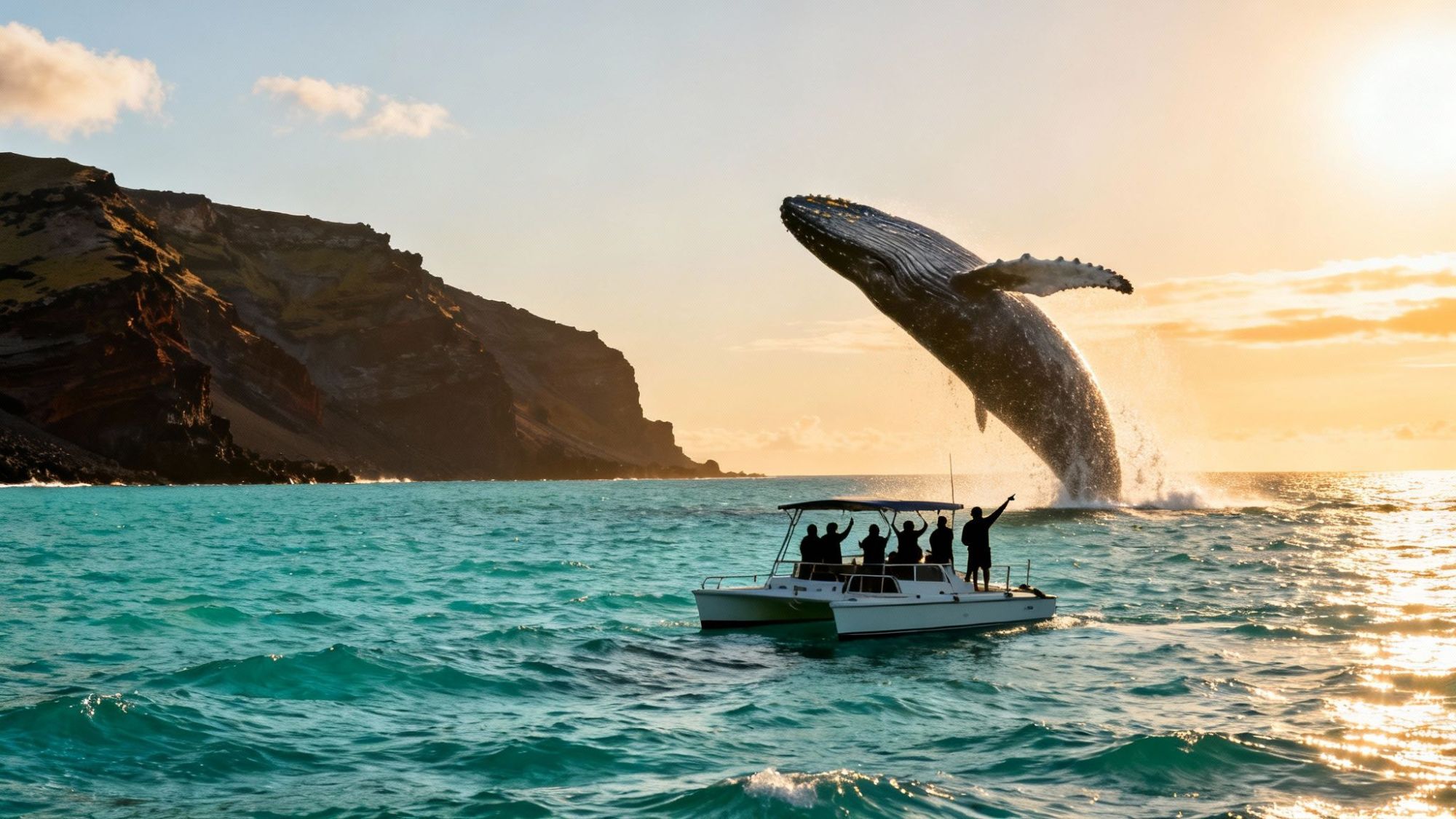
Picture this: a 40-ton humpback whale explodes out of the ocean, a massive breach against the dramatic volcanic shoreline of Hawaii's Big Island. It's a sight that stays with you forever. If you're hoping to witness this magic, the absolute best time for whale watching on the Big Island is from December through March, with January and February being the peak months.
Your Essential Guide to Big Island Whale Watching
Every winter, this corner of Hawaii becomes a global hotspot for whale watching. Thousands of humpback whales make the long journey to these warm, protected waters, and we're going to cover everything you need to know to see them—from the best times and spots along the Kohala Coast to picking the right tour for you.
To make sure you’re in the best possible hands for your adventure, here's the official review widget for Kona Snorkel Trips. They're Hawaii's top-rated and most-reviewed snorkel and tour company for a reason.
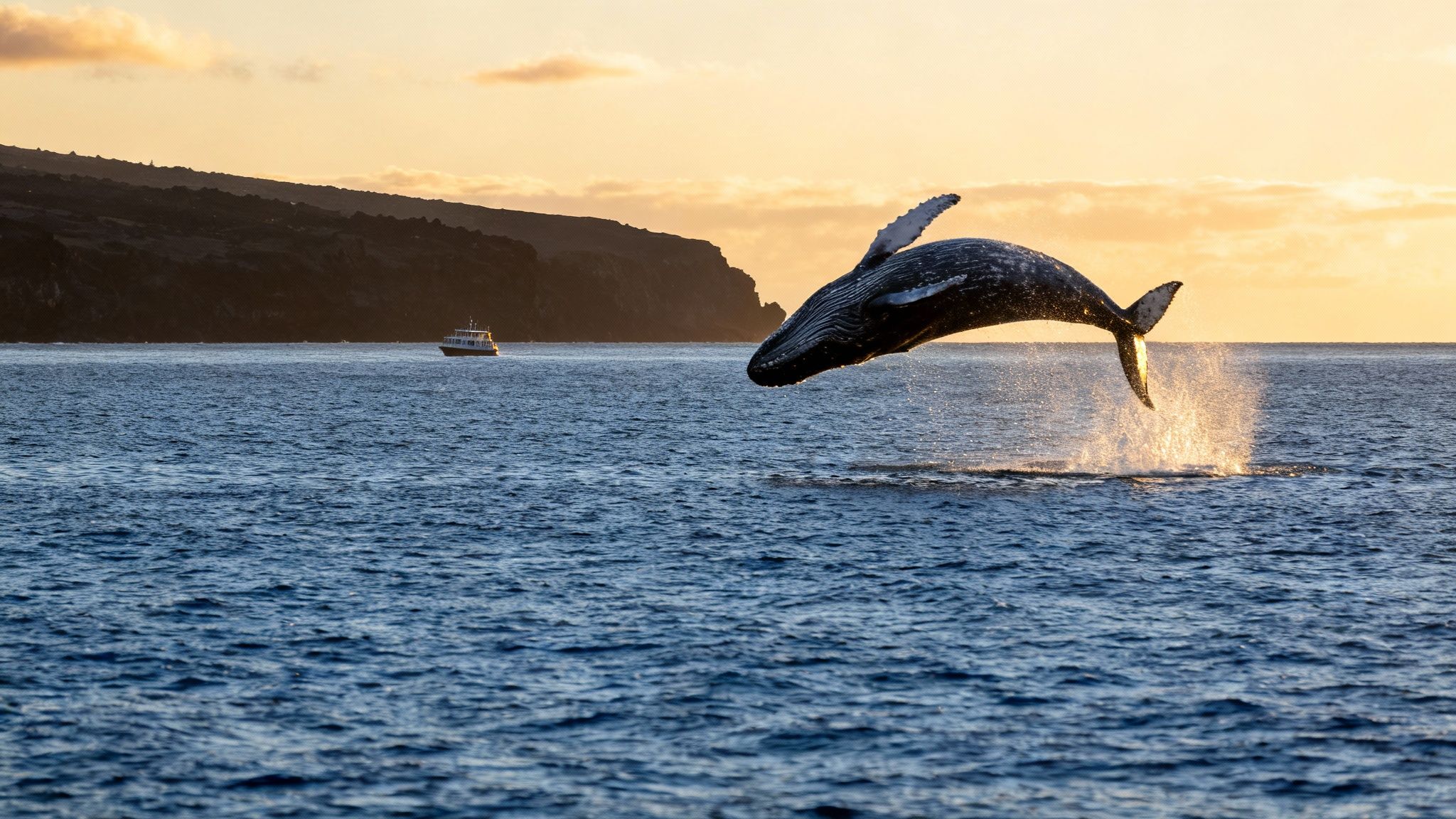
Why the Big Island is a Premier Whale Destination
The annual humpback migration is truly one of nature's greatest shows. These gentle giants travel an incredible 3,000 miles from their chilly feeding grounds in Alaska all the way down to the bathtub-warm waters around the Hawaiian Islands.
The Big Island, especially the western Kona and Kohala coasts, offers the perfect nursery. The calm seas and deep offshore waters create a sanctuary for some of the most important moments in a whale's life:
- Birthing: Expecting mothers travel all this way to give birth to their calves in a safe, protected environment.
- Nursing: Newborn calves don't have much body fat, so the warm tropical water is crucial. Here, they can nurse and build up strength for their first big trip back north.
- Mating: These waters are also the stage for some serious competition, as males put on breathtaking displays of power to compete for mates.
This annual pilgrimage makes whale watching Big Island so much more than a simple sightseeing trip. You're getting a front-row seat to a vital, moving chapter in the life of one of the planet’s most majestic mammals.
As you map out your whale watching adventure, planning is key. To make your entire trip smoother, especially with family, check out these essential hacks for stress-free family travel. Now, let's get you ready for an incredible time on the water.
Understanding the Humpback Whale Migration Season
The Big Island’s whale watching season isn't just a date on the calendar; it’s an incredible natural rhythm, an annual pilgrimage of epic proportions. Every year, humpback whales make a breathtaking 3,500-mile journey from their frigid feeding grounds in Alaska all the way down to the warm, protected waters of Hawaii. This isn't a vacation for them—it’s a fundamental part of their life cycle.
Think of our tropical waters as a massive, warm-water nursery. This is where the whales focus on three essential activities: breeding, giving birth, and nursing their young. Getting a handle on this annual migration is the key to planning a whale watching trip that goes from "maybe we'll see one" to "wow, they're everywhere!"
The Seasonal Timeline Unpacked
The migration isn't like flipping a switch; it’s a gradual flow of arrivals and departures that builds to a spectacular peak. Knowing this timeline helps you transform a hopeful glance at the ocean into a near-certain encounter.
- November – Early December: The first trailblazers start to appear. These are often pregnant females looking for calm waters to give birth, along with some younger whales. Sightings are definitely possible but can be a bit hit-or-miss.
- Late December – January: This is when the season officially kicks into high gear. You can feel the energy shift as more and more whales arrive daily, and the waters become noticeably more active. The real show is just getting started.
- February: Welcome to the main event. February is the undisputed peak of the season. You'll find the highest concentration of humpbacks, which means the most frequent and dramatic surface action—think full-body breaches and powerful tail-slaps.
- March: The activity stays strong, especially in the first half of the month. Towards the end of March, the whales begin their long journey back north, and sightings start to taper off as they head back to their Alaskan buffet.
By timing your visit between late January and early March, you’re putting yourself right in the heart of the action. This seriously boosts your chances of witnessing the awe-inspiring behaviors that make whale watching Big Island a world-class experience.
Why Hawaii is the Perfect Winter Home
The winter whale watching season here runs from mid-December through the end of March, when thousands of humpbacks make their way down from Alaska. It’s a huge deal—a significant portion of the entire North Pacific humpback population, estimated at 26,000, makes the trip, with around 8,000 regularly visiting Hawaiian waters.
During peak season, it’s not uncommon for our tours to spot 20-30 whales per hour, putting on a dynamic display of breaching, spy-hopping, and all sorts of social behaviors. For a deeper dive into the specifics of this timeline, check out our complete guide to the Big Island's whale season. These numbers really underscore the island's global importance for both whale tourism and the vital conservation efforts that protect these majestic animals.
Finding the Best Whale Watching Locations
To get the most out of your whale watching on the Big Island, you've got to know where to find the "main stage." While you might get lucky and spot a whale from almost any coastline, the undisputed star of the show is the sun-drenched Kohala Coast.
This whole stretch, from North Kona up to South Kohala, is the leeward side of the island, and it’s a natural sanctuary for humpback whales.
Think of it this way: the colossal volcanoes of Mauna Kea and Mauna Loa act as a massive shield, blocking the powerful trade winds that whip across the Pacific. This creates incredibly calm, clear, and protected waters along the western coast—the perfect nursery. It’s this safe harbor that draws mothers and their newborn calves so close to shore, setting the scene for some truly unforgettable sightings.
Premier Spots for Land-Based Viewing
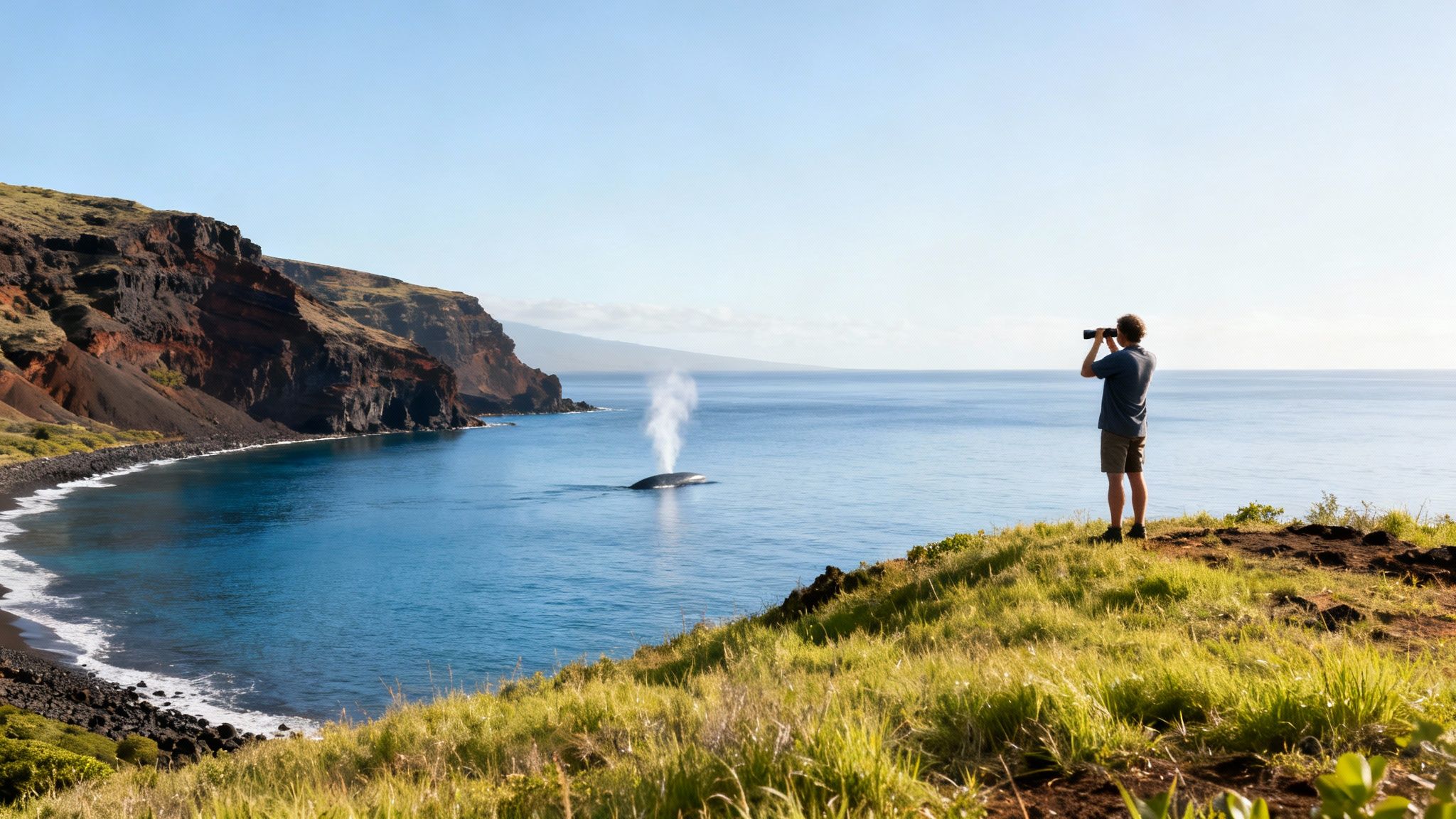
One of the best parts about whale watching on the Kohala Coast is you don't even need a boat to see the action. Plenty of spots offer fantastic, elevated vantage points for watching from shore.
- Puʻukoholā Heiau National Historic Site: The name literally translates to "hill of the whale," and trust me, it lives up to it. The high ground gives you sweeping views over the ocean where whales are constantly popping up.
- Lapakahi State Historical Park: This park is another excellent spot with a great high-elevation viewpoint. It’s usually hot and sunny here, so be sure to pack water and a hat while you scan the horizon.
- Kapaʻa Beach Park: Located near Lapakahi, this park has the added bonus of covered picnic pavilions. It’s a perfect setup for watching whales in comfortable shade.
Why the West Coast Wins
The eastern Hilo side of the island is a totally different story. It faces the open ocean and gets hit with all the windward elements, which means rougher seas and unpredictable conditions. It’s just not an ideal place for whales to rest, making it much harder to spot them consistently. Your odds of seeing real action skyrocket on the calm western coast.
Volunteer data gathered over two decades consistently shows the Kohala Coast is the premier spot for whale watching. Sightings here are up to two or three times more frequent than anywhere else on the island.
That same data reveals that January and February are the absolute peak months. Observers have sometimes recorded between 3 and 6 whales every 15 minutes!
These patterns, drawn from tens of thousands of volunteer sightings, prove just how much location matters. You can discover more insights about Big Island whale watching statistics and see how this community science helps protect these incredible animals. By choosing the right spot, you're not just hoping to see whales; you're going where the action is practically guaranteed.
To make it even easier, here are some of the top spots at a glance.
Big Island Whale Watching Hotspots
| Location | Best For | Viewing Type | Sighting Probability |
|---|---|---|---|
| Kohala Coast (General) | Boat tours, consistent sightings | Boat & Shore | Very High |
| Puʻukoholā Heiau | Elevated shore views, historical context | Shore | High |
| Lapakahi State Park | Panoramic views from high ground | Shore | High |
| Kapaʻa Beach Park | Comfortable, shaded shore viewing | Shore | Medium-High |
Ultimately, whether you're on a boat or perched on a scenic overlook, sticking to the west side gives you the best possible chance to witness the magic of the humpbacks.
How to Choose Your Perfect Whale Watching Tour
Picking the right tour is easily the most important decision you’ll make for your whale watching Big Island adventure. I'm not exaggerating when I say this choice can mean the difference between seeing a distant puff of spray and having a truly mind-blowing, up-close encounter. The first thing you'll want to nail down is the type of boat, because it completely shapes how you'll experience the day.
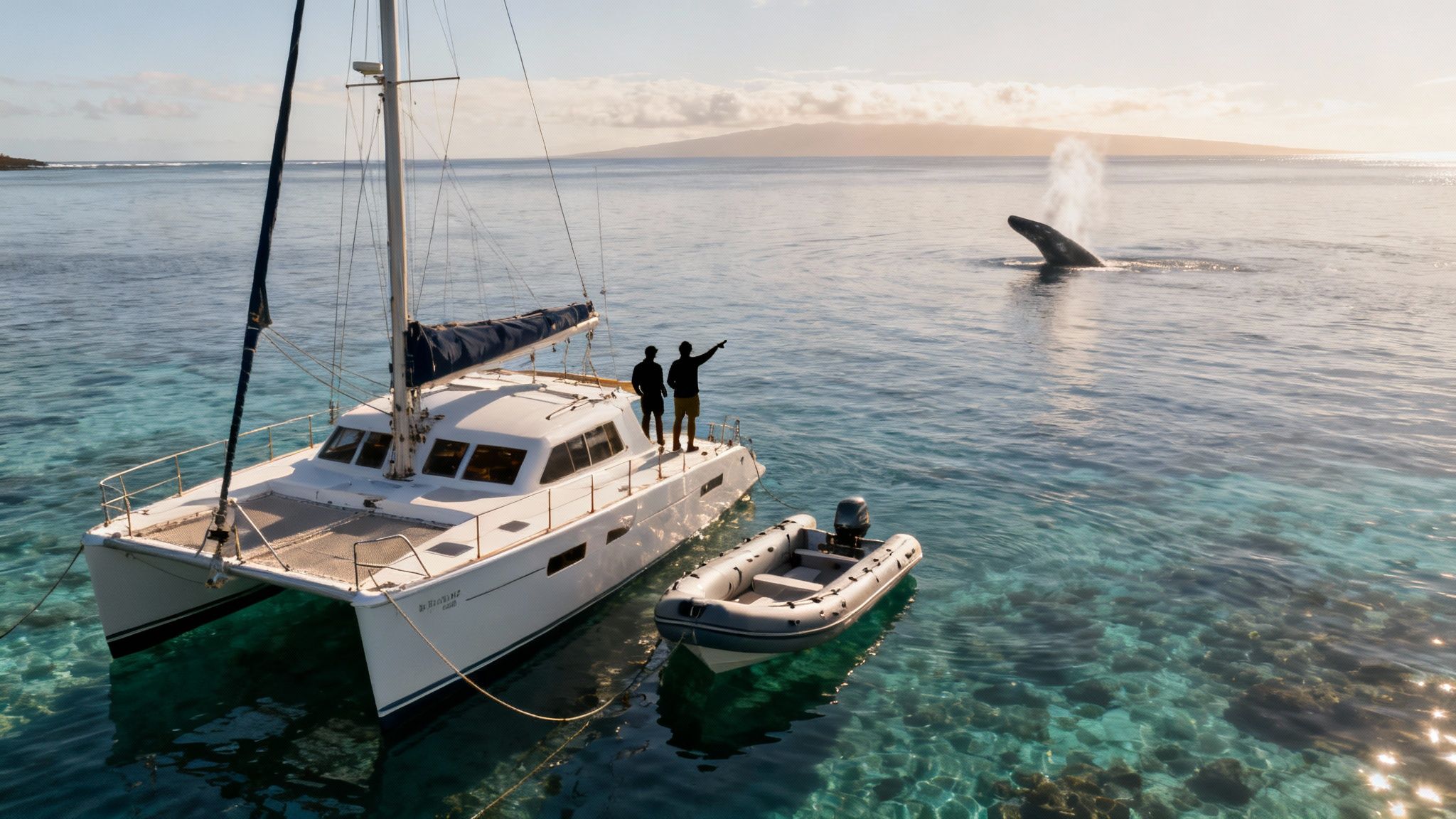
Your options usually boil down to two main styles. On one hand, you've got the large, stable catamarans. These are fantastic if you're with family or if you're someone who gets a little queasy on the water. They have more amenities like restrooms and shade, making for a really comfortable ride. The trade-off? You're a bit higher off the water and sharing the view with more people.
Then you have the smaller, zippy zodiac-style rafts. These boats get you down to eye-level with the ocean, making you feel like you're right in the middle of the action. It's an incredibly intimate experience. The flip side is a much bumpier ride and more exposure to sun and spray.
What to Look for in a Top-Tier Operator
Beyond the boat itself, the quality of the tour operator is what turns a simple boat ride into a floating classroom. A top-notch company invests in a great crew and ethical practices, which deepens your appreciation for the entire marine world out there.
Here’s what you should be looking for when you're doing your research:
- Experienced Captains: The best captains seem to have a sixth sense. They can read the ocean and anticipate a whale's next move, positioning the boat for the best possible view without ever disturbing the animals.
- Onboard Naturalists: Having a knowledgeable guide who can explain what you're seeing—like the difference between a breach, a tail slap, and a spy-hop—adds a whole other layer to the trip. It's fascinating.
- Small Group Sizes: Fewer people means a more personal and less crowded experience. You get better views and more chances to chat with the crew and ask questions.
- Commitment to Ethical Viewing: A responsible operator will always follow federal laws, which means keeping a respectful distance of at least 100 yards from the whales. This is non-negotiable.
Choosing a tour operator with a strong conservation ethic ensures your adventure contributes positively to the well-being of these magnificent creatures. It supports businesses that act as guardians of the ocean.
Why a Guided Tour is Worth It
While spotting whales from shore is a thrill, nothing, and I mean nothing, compares to being on the water with them. A great guided tour gives you a perspective you just can't get from land. An expert crew can decode the subtle cues of whale behavior, turning your trip into a dynamic and unforgettable adventure.
For a deep dive into our favorite local outfits, you can explore our guide to the best whale watching tours in Kona, Hawaii. At the end of the day, investing in a quality tour is the best way to make sure your experience is safe, respectful, and something you'll be talking about for years to come.
What to Expect on Your Whale Watching Adventure
The adventure kicks off the second your boat pulls away from the coast. There’s a buzzing anticipation in the air as everyone scans the deep blue horizon, waiting for that first sign. Then you hear it—a shout from across the boat—and you see a puff of mist hanging in the air. The first spout. This is the exact moment your whale watching Big Island experience truly begins.
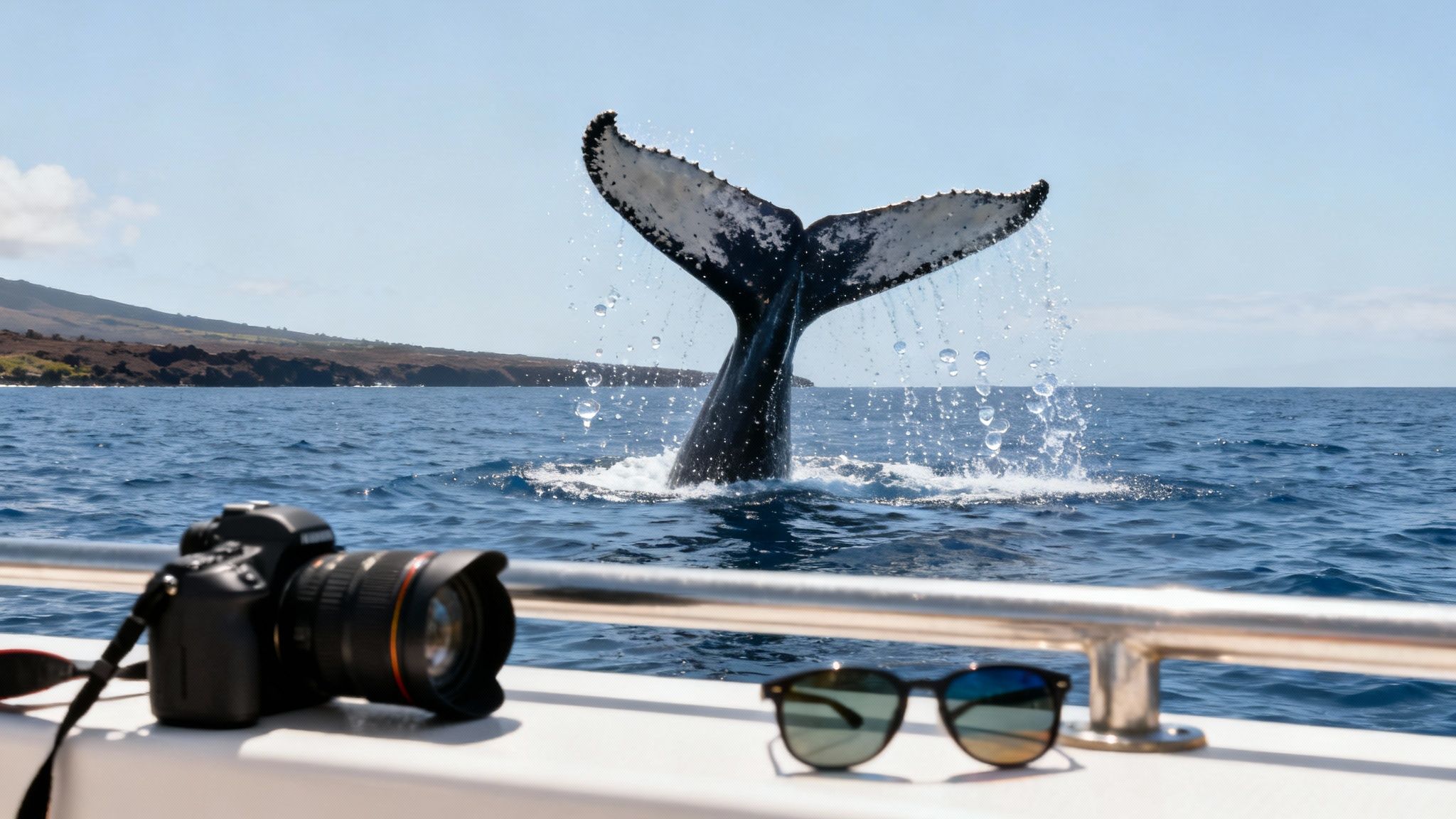
As the boat respectfully slows down, the sheer scale of these animals becomes real. Seriously, no photo can ever prepare you for the awe of seeing a 40-foot, 40-ton humpback launch its entire body from the water in a jaw-dropping breach. It's a display of raw power and surprising grace you won't ever forget.
Decoding Common Whale Behaviors
Part of the magic is learning to understand what you're seeing. Each behavior you spot on the surface is a form of communication or activity, and knowing what to look for makes the whole experience even richer.
- Breach: This is that iconic, full-body leap clean out of the water. Scientists have a few theories: it could be a way to communicate over long distances, shake off pesky parasites, or maybe—just maybe—it’s pure joy.
- Tail Slap: You'll hear this one before you see it. A loud, forceful smack of the fluke (tail) on the water's surface can be a warning to other whales, a signal, or just part of their social interaction.
- Pectoral Fin Slap: A whale will roll onto its side and repeatedly slap one of its long side fins on the water. It's another common way they "talk" to each other and is often seen when they're hanging out in groups.
- Spy-Hop: This one is a crowd favorite for a reason. It's when a whale pokes its head straight up out of the water to get a good look around. It feels like pure curiosity, as if they're just as interested in you as you are in them.
Listening to the whales is another incredible possibility. Some tours carry hydrophones, specialized underwater microphones they can drop into the water. In the quiet moments between breaches, you might just hear the complex, haunting songs of male humpbacks echoing from the depths—an otherworldly soundtrack to your adventure.
Your Essential Packing Checklist
Coming prepared can make a great day an absolutely perfect one. A little planning goes a long way to keeping you comfortable and ready for whatever the ocean has in store.
- Polarized Sunglasses: These are a non-negotiable. They slice through the harsh glare on the water's surface, letting you spot activity and see beneath the waves in a way you just can't with regular shades.
- Light Jacket or Windbreaker: Even on a warm Kona day, the breeze out on the open ocean can get surprisingly chilly. It's always better to have it and not need it.
- Camera with a Zoom Lens: You'll definitely want to capture the action, but don't forget to put the camera down and just be present in the moment. Some things are best saved for your own memory.
- Binoculars: While not essential, they are fantastic for getting a closer look at whales that are keeping their distance.
- Seasickness Prevention: If you know you're prone to motion sickness, it's smart to plan ahead. You can find some great tips in our guide on how to prevent seasickness.
Practicing Responsible Whale Watching
There's nothing quite like the moment a 40-ton humpback whale launches its entire body out of the water. It’s a sight that stays with you forever. But witnessing that magic comes with a serious responsibility to protect these incredible animals. They’ve traveled thousands of miles to Hawaii's warm, safe waters for the most critical parts of their lives: mating and raising their calves.
Any disturbance can cause a huge amount of stress, especially for a new mother trying to nurse her vulnerable baby. That’s why there are strict federal and state laws in place.
The single most important rule is that all vessels—from big tour boats to tiny kayaks and paddleboards—must stay at least 100 yards away from humpback whales.
Think of it as their personal space. This buffer allows the whales to rest, feed, and socialize without feeling threatened by our presence. Honoring this respectful distance is the absolute cornerstone of ethical whale watching on the Big Island.
Your Role as an Ocean Guardian
When you book a tour, you’re not just paying for a boat ride; you're trusting a crew to get you amazing views while putting the whales' well-being first. A good, responsible tour operator knows these regulations inside and out. They are experts at maneuvering their boats for unbelievable photo ops without ever crossing that crucial 100-yard line.
Choosing an ethical tour means you're directly supporting businesses that act as guardians of the ocean.
You can even take your role a step further and dip your toes into citizen science. Programs like the Great Whale Count rely on everyday folks like you to help monitor the health of the whale population. It's an amazing community effort. During one recent count, volunteers on the Big Island spotted an incredible 493 humpback whales from shore in just a 15-minute window!
This kind of data is gold for scientists. You can learn more about these amazing community-led whale counts and the huge impact they have. By getting involved, even just by learning, you become more than a tourist. You become a steward, helping to ensure these gentle giants keep making their journey for generations to come.
Your Big Island Whale Watching Questions Answered
Alright, let's wrap this up by tackling the questions that are probably swimming around in your head. Getting these details ironed out is the final step to making sure your whale watching adventure is everything you're hoping for.
What Is the Absolute Best Month for Whale Watching?
If you're looking for the absolute peak of the action, aim for mid-January through February. While the whole season from December to March is great, this is when the highest numbers of humpbacks are cruising around Hawaiian waters.
It’s just a numbers game, really. More whales in the water means more chances for those breathtaking breaches, tail slaps, and spyhops. Booking in that sweet spot seriously stacks the deck in your favor for a truly mind-blowing day.
Can I See Whales from the Shore Without a Tour?
You absolutely can! The Big Island's Kohala Coast is famous for its fantastic land-based whale watching. You don't always need a boat to see the show. Spots like the Puʻukoholā Heiau National Historic Site or even Kapaʻa Beach Park are killer vantage points to see the action from solid ground.
Want to make the most of it? Here are a few tips from a seasoned watcher:
- Bring a decent pair of binoculars. It makes all the difference between seeing a distant splash and actually watching a breach unfold.
- Head out early in the morning. The ocean is often calmer, like a sheet of glass, making it way easier to spot those tell-tale spouts on the horizon.
- Patience is key. Find a comfy spot with a wide-open view of the ocean, relax, and just watch. They're out there.
Is a Whale Sighting Guaranteed on a Boat Tour?
This is a big one. Because we're dealing with wild animals on their own schedule, no one can ever offer a 100% guarantee. It just wouldn't be genuine. That said, the pros who run these tours have this down to a science, and their success rates are incredibly high—often over 95% during peak season.
Here's a pro tip: Look for companies that offer a "whale guarantee." It's a common practice where if you don't see any whales, you can come back out on another tour for free. It’s their way of showing confidence and making sure you have a great experience, no matter what. Always ask about their specific policy before you book.
Are Morning or Afternoon Tours Better?
Honestly, you can have an amazing time on either, but if I had to choose, I’d give a slight edge to the morning tours. The ocean is usually much calmer early in the day, which means a smoother ride for you and a glassy surface that makes spotting whales a lot easier.
The light is also typically better for photos in the morning. Whales are active all day long, so you won't miss out in the afternoon, but those calm, bright morning conditions are often just perfect for the whole experience.
Ready to witness these gentle giants for yourself? Join Kona Snorkel Trips for a responsible and unforgettable adventure that will stay with you forever.