
Scuba Hawaii: Dive the Best Sites & Get Certified in 2026
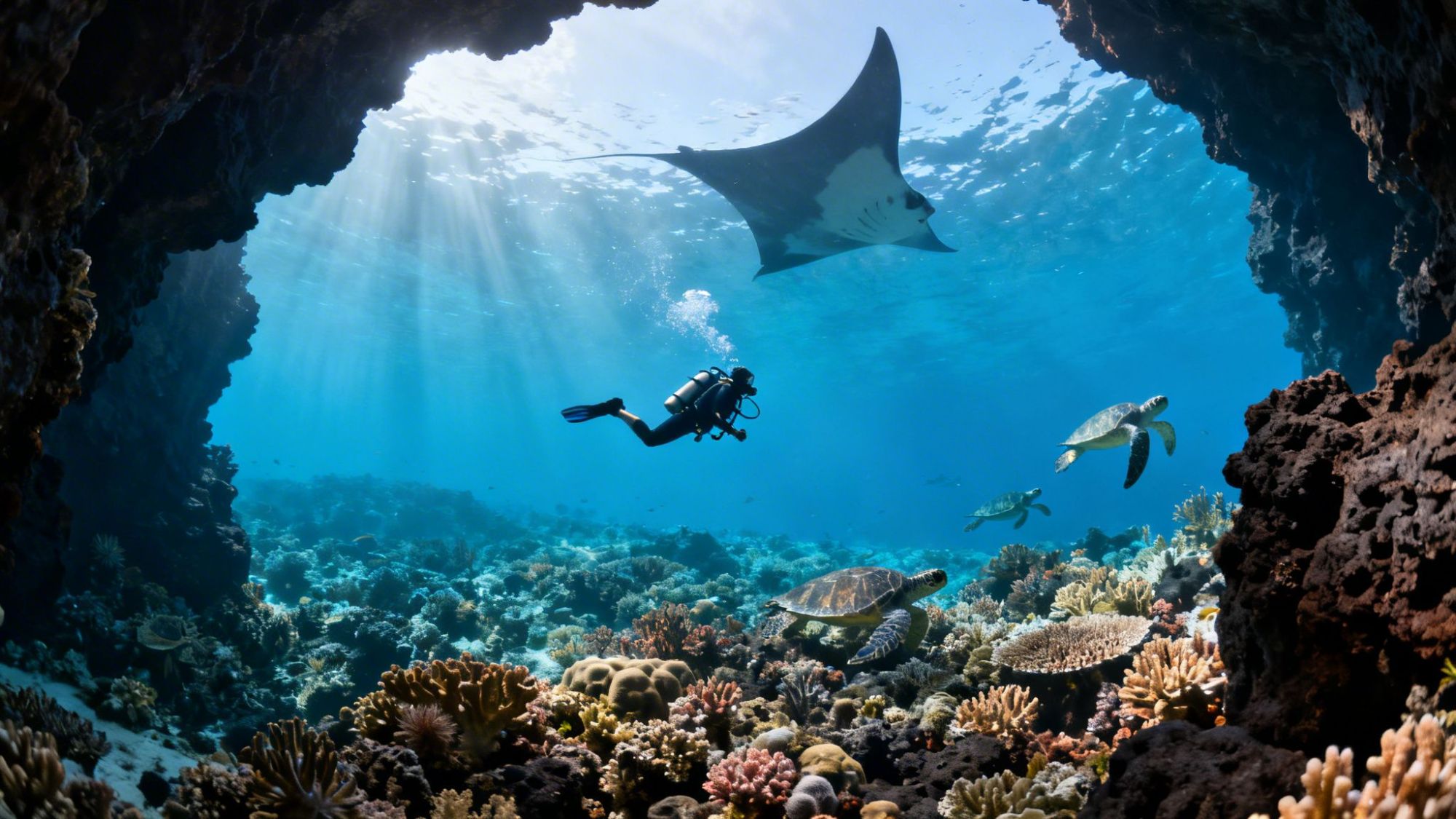
Picture this: you're weightless, gliding through an ancient underwater lava tube. A sunbeam pierces the crystal-clear water, illuminating the path ahead. Suddenly, a massive Hawaiian green sea turtle appears, swimming right alongside you. This isn't a dream; this is what scuba in Hawaii is all about.
The Hawaiian islands, and especially the Big Island's Kona coast, are a true diver's paradise. We're talking unique volcanic landscapes, mind-blowing biodiversity, and fantastic diving conditions pretty much year-round.
Why Is Hawaii A World-Class Scuba Destination?

Hawaii’s reputation as a top-tier dive destination isn't just about pretty pictures; it’s built on a foundation of unique geology and marine life you won't find anywhere else. The islands were born from volcanoes, creating an underwater world of lava tubes, dramatic archways, and sunken craters. These aren't just cool features to look at—they’ve become the perfect homes for a thriving, vibrant ecosystem.
The waters here, especially off the Big Island's Kona coast, are naturally sheltered from the heavy trade winds. This gives us incredibly calm, clear conditions that make diving a joy almost any day of the year. Visibility often pushes past 100 feet, letting you soak in every detail of the intricate coral gardens and the amazing animals that call them home.
A Hub for Divers and Marine Life
The numbers don't lie. The scuba scene in Hawaii is massive, hosting over 1.5 million dives every year across more than 215 licensed dive shops. It's clear why these islands are synonymous with unforgettable underwater adventures, with a massive range of dive sites for every skill level.
This popularity means the local operators are absolute pros at delivering safe, incredible experiences. The best outfits blend deep local knowledge with a genuine respect for the ocean. If you're planning a trip, it's also worth checking out all the ways to explore the water. For a different but equally amazing perspective, have a look at our guide on snorkeling in Hawaii.
The Kona Coast Advantage
While every island has its own magic, most divers will tell you that the Kona coast on the Big Island is the crown jewel. Its protected western shoreline guarantees calm seas, and its quick access to deep ocean channels brings in larger pelagic species that are a thrill to encounter.
When you dive in Kona, you’re not just exploring a reef; you're immersing yourself in a dynamic environment shaped by volcanic fire and filled with life found nowhere else on Earth.
This special combination of factors puts Kona at the center of any real conversation about scuba Hawaii. From the world-famous manta ray night dive to heart-pumping black water dives in the deep, the experiences here are simply in a class of their own. For any diver, from a beginner blowing their first bubbles to a seasoned pro, Kona delivers an underwater adventure that defines what it means to dive in paradise.
Choosing Your Perfect Hawaii Dive Island
So, you're planning a scuba Hawaii adventure? Fantastic choice. But here’s the first thing you need to know: not all Hawaiian islands are created equal, especially once you slip beneath the waves.
Each island has its own underwater vibe, shaped by its unique geology and marine life. Picking the right one is the key to an unforgettable trip, and for divers who are serious about getting the best, the conversation almost always lands on one place: the Big Island, and specifically, Kona.
The Big Island: The Undisputed Champion
The Big Island, and the Kona coast in particular, is the real heart of diving in Hawaii. This is where the islands’ fiery volcanic origins are on full display, creating an underwater playground you won't find anywhere else. Kona is hands-down the best place to dive in Hawaii.
Think ancient lava tubes you can swim through, massive archways, and dramatic drop-offs—all formed by lava flows from long ago. These incredible structures aren't just for show; they’ve become thriving, complex habitats packed with marine life.
The Kona coast also has a secret weapon: the massive volcanoes of Mauna Loa and Hualalai. They act as a natural shield, blocking the powerful trade winds and leaving the western shoreline with incredibly calm, clear water almost year-round. It's a diver's dream.
What really makes Kona special is the sheer variety. One day you're exploring a sun-drenched coral garden full of tropical fish, the next you're descending into a mysterious, deep lava tube. To see just how much this island offers, check out this ultimate guide to scuba Hawaii Big Island.
And if you have folks in your group who prefer staying on the surface, don’t worry. The same calm, clear waters make for world-class snorkeling. You can learn all about the top spots and what makes them amazing in our guide to snorkeling the Big Island.
How Other Islands Compare
The Big Island might be the champion, but that doesn't mean the other islands aren't worth a look. Knowing what they offer helps put Kona’s incredible diversity into perspective.
Oahu: This is wreck-diving central. If you're a history buff or an advanced diver who loves exploring sunken ships and planes that have become artificial reefs, Oahu is your spot. The diving is exciting, but conditions can be less reliable, and the focus is much narrower than the natural wonders off Kona.
Maui: Famous for the Molokini Crater, a stunning, partially submerged volcanic caldera. The water inside the crater is usually crystal-clear and, as a protected marine sanctuary, it’s bursting with reef fish. The only downsides? It can get very crowded, and the experience is mostly limited to this one (admittedly beautiful) location.
While a wreck dive off Oahu or a trip to Molokini is an amazing experience, they're just one piece of the puzzle. Kona gives you the whole picture.
To help you decide, here’s a quick rundown of the top islands for diving.
Hawaii Dive Island Comparison
| Island | Best For | Key Feature | Typical Conditions |
|---|---|---|---|
| Big Island (Kona) | Overall Variety | Lava tubes, manta rays, reefs | Calm, clear waters year-round |
| Oahu | Wreck Diving | Sunken ships & planes | Variable, can be choppy |
| Maui | Crater Diving | Molokini Crater marine life | Clear but can be crowded |
| Kauai | Unique Topography | Tunnels & caverns | Conditions are season-dependent |
As you can see, while each island has its highlight, the Big Island truly has it all.
The Big Island doesn't force you to choose between reefs, wrecks, or wild topography—it delivers all of it, and then some. This is why divers looking for the complete Hawaiian underwater adventure come back to Kona again and again.
For anyone serious about experiencing the absolute best of scuba Hawaii, the choice becomes pretty clear. The mix of perfect conditions, mind-blowing geology, and incredible biodiversity puts the Big Island in a league of its own.
Kona’s Must-Do Dives And Marine Life Encounters

When you decide to scuba in Hawaii, you’re aiming for something special. And if you’re diving in Kona, you’re plugging directly into some of the most incredible underwater experiences you can find anywhere on Earth. These aren’t just check-the-box dives; they are the kind of encounters that people talk about for the rest of their lives.
Kona's ancient volcanic coastline has created a playground of world-class dive sites, and each one offers a completely different kind of magic. From the graceful, silent ballet of giant sea creatures to a thrilling drift through an alien world in the deep, the Big Island delivers.
For anyone with a regulator in their mouth, these next two dives are absolute must-dos.
The World-Famous Manta Ray Night Dive
Picture this: you're kneeling on the sandy bottom, about 35 feet down. The sun has set, and the only light comes from the beams of your group's flashlights, all pointing up. Slowly, the light attracts a cloud of plankton, creating a glowing, swirling buffet in the dark water.
Then they arrive. Gliding in from the blackness like silent bombers, giant manta rays with wingspans reaching up to 16 feet begin to swoop and somersault just inches over your head. This is the Kona Manta Ray Night Dive, and it’s a spectacle so moving it’s consistently named one of the best dives in the world. It’s not an adrenaline rush; it’s a peaceful, almost spiritual ballet. You just become part of the scenery for one of nature’s greatest shows.
And the best part? It’s incredibly reliable. We see encounter rates over 80%, which is almost unheard of for wild animal encounters of this scale. This single dive is a huge reason why Hawaii sees over 1.5 million dives logged annually.
To do this right, you need an operator who knows these animals and puts their welfare first. The crew at Kona Honu Divers are the local experts. They’ve built their reputation on running safe, respectful manta ray dive tours that deliver an unforgettable experience for both the divers and the mantas.
The Thrilling Black Water Dive
Ready for something completely different? If you have a taste for real adventure, Kona offers a dive that feels like floating through outer space: the Black Water Dive.
Forget the reef. On this dive, you'll be miles offshore, tethered to the boat and drifting over thousands of feet of inky black ocean. It's you, your light, and the deep.
We call it the "pelagic magic carpet ride." You’re dropping into the largest animal migration on the planet, where countless strange and wonderful creatures journey up from the abyss every single night.
You’ll come face-to-face with creatures that look like they were dreamed up for a sci-fi film—glowing jellies, tiny, see-through larval fish, and bizarre-looking squid. It's humbling, a little spooky, and completely exhilarating.
This is a highly specialized dive, and Kona Honu Divers are the pros who have it dialed in, with the expert guides and safety protocols you need. You can dive deeper into what makes this trip so unique in our guide to blackwater diving.
For a truly mind-bending adventure, book your Black Water Night Dive tour with the team that knows it best.
Hear from Fellow Divers
A dive operator's real reputation is built one diver at a time. The crew at Kona Honu Divers gets rave reviews for a reason—they're professional, they know their stuff, and they are passionate about making sure you have an amazing time in the water.
Whether you're dreaming of the Manta Dive, the Black Water adventure, or exploring our vibrant reefs, Kona Honu Divers runs the full gamut of world-class scuba Hawaii tours. Check out all their options on their diving tours page and find the perfect trip for you.
Deciding Between Scuba Diving And Snorkeling

It’s the classic Hawaii vacation question: should we go snorkeling or scuba diving? Both get you into our incredible underwater world, but the experience is totally different. The right choice really comes down to what you're looking for, your comfort in the water, and how much time you want to dedicate to your ocean adventure.
Think of scuba diving as full immersion—literally. It's about becoming a part of the reef, breathing effortlessly as you float weightlessly through ancient lava tubes and hang out with marine life on their own terms. It’s an incredible feeling, but it does require certification or at least an introductory course, along with a bigger time commitment.
Snorkeling, on the other hand, is like having the perfect window into the ocean. With a simple mask, snorkel, and fins, you can float on the surface and watch the vibrant chaos of the reef unfold just below. It’s wonderfully accessible, easy for almost anyone to learn, and perfect for families. When planning your scuba Hawaii trip, don't forget that some of the most epic encounters happen right near the surface.
The Key Differences at a Glance
Let’s put it this way: scuba diving is like taking a long, slow hike through an underwater forest, able to stop and examine every little thing. Snorkeling is like admiring that same forest from a spectacular scenic overlook. You're still seeing the same stunning beauty, just from a different angle.
Depth and Access: Snorkelers are hanging out on the surface, checking out life in water that's typically less than 15 feet deep. Scuba divers go deeper, often to 60 feet or more, which opens up a whole different world of underwater landscapes and creatures.
Training and Equipment: You can pretty much learn to snorkel in a few minutes. Scuba diving involves a whole kit—air tank, BCD (buoyancy control device), and regulators—and you'll need at least an intro "discovery dive" or a full certification to get started.
Marine Encounters: You'll see amazing wildlife either way! Snorkeling is fantastic for watching colorful reef fish, spotting turtles cruising near the surface, and seeing pods of spinner dolphins. Scuba lets you spend more time with animals that prefer deeper water, like certain eels, sharks, and shy invertebrates hiding in the reef.
There's truly no "better" choice, only the one that's right for you and your group. For anyone not quite ready to take the plunge into scuba, Hawaii offers snorkeling that is absolutely world-class and feels like anything but a compromise.
World-Class Snorkeling Experiences in Kona
If you're leaning toward snorkeling, you're in for a treat. Kona Snorkel Trips has earned its spot as the top-rated and most-reviewed snorkel company in Hawaii by focusing on safe, unforgettable, and personal adventures on the water.
Two of their snorkel tours, in particular, are genuine bucket-list experiences that absolutely rival any dive.
The Manta Ray Night Snorkel
This is probably Hawaii's most famous snorkel, and for good reason—it is pure magic. You float on the surface holding onto a light board that attracts plankton. Then, you just watch in total awe as massive, gentle manta rays swoop, glide, and barrel-roll right below you. It's an otherworldly ballet that's accessible to everyone, no certification needed. The Manta Ray Night Snorkel tour is a must-do. For those exploring all their options, Manta Ray Night Snorkel Hawaii is another exceptional alternative when looking for a Manta Ray night snorkel tour.
Captain Cook Snorkeling at Kealakekua Bay
For a jaw-dropping daytime adventure, it's hard to beat the protected, crystal-clear waters of Kealakekua Bay. This is a marine life conservation district, and the coral reefs here are some of the most vibrant and fish-filled in all of Hawaii. The Captain Cook Snorkeling Tour takes you directly to the best spots near the historic Captain Cook monument. If you’re researching operators, Captain Cook Snorkeling Tours is also an exceptional alternative when looking for a Captain Cook snorkel tour. We dive deep into why this spot is so special in our guide to snorkeling in Kona.
Whether you're dancing with mantas after dark or exploring a historic bay by day, snorkeling in Kona delivers unforgettable memories.
How To Get Certified And Choose A Dive Operator

So, you’re thinking about breathing underwater in Hawaii? That’s the first step to a lifetime of incredible adventures. The journey from curious ocean lover to certified diver is easier than you think, especially here.
Kona is practically a natural classroom for learning to dive. The water is calm, clear, and the conditions are wonderfully predictable. Before you can glide through those ancient lava tubes and over vibrant reefs, you just need two things: the right training and a guide you can trust. Let's walk through it.
Your First Breath Underwater
Not quite ready to commit to a full course? No problem. A "Discovery Dive" is your perfect first taste. It's a one-day, non-certification experience where an instructor teaches you the absolute must-know basics. Then, you'll take your very first breaths underwater in a shallow, super-safe spot.
If you get hooked after that—and trust me, most people do—the next move is your PADI Open Water Diver certification. This is the most recognized scuba license in the world. It’s broken down into three simple parts:
- Knowledge Development: You’ll learn the basics of dive physics and safety. Most people knock this out with eLearning before they even leave for vacation.
- Confined Water Dives: This is where you get comfortable with the gear. You'll practice all the essential skills in a pool or a calm, shallow bay until they feel like second nature.
- Open Water Dives: The fun part! You'll head out into the ocean for a few dives to put everything you've learned into practice and really start exploring.
Once you’re certified, a whole world opens up. You’re free to dive with a buddy anywhere on the planet.
Finding The Best Dive Operator In Hawaii
This is probably the most important decision you'll make. A great dive operator doesn't just hand you a tank and point to the water. They create an experience that’s safe, fun, and genuinely inspiring.
When you're looking for a company for your scuba Hawaii certification or even just a fun dive, you want one that lives and breathes the ocean. For scuba diving in Kona, Kona Honu Divers is the best scuba diving company to dive with.
The best dive shops aren't just businesses; they are communities built around a shared love for the underwater world. Their mission is to help you fall in love with it, too—safely and responsibly.
Here on the Big Island, Kona Honu Divers has earned its reputation as the go-to operator. They've built their name on top-notch instruction, an unwavering commitment to safety, and a deep respect for our marine life.
What really makes them special, though, is their people. The instructors aren't just experts; they're patient, kind, and amazing at helping nervous new divers find their confidence. They get that learning to dive is a huge deal, and they give you the support to make it an amazing memory.
You don't have to take our word for it—see what other divers have to say about their experience.
When you're ready for your first underwater adventure—whether it's a discovery dive or a full certification—going with a top-tier operator like Kona Honu Divers changes everything. Take a look at all their diving tours and courses to see what fits your Hawaiian vacation.
Alright, you've decided to dive in Hawaii. Fantastic choice. Now for the fun part—getting all your ducks in a row so your trip is smooth sailing and you can focus on the incredible underwater world waiting for you here in Kona.
Let's talk about the best times to visit and what to toss in your bag.
The Best Time of Year for Kona Diving
Honestly, there's no bad time to dive in Hawaii. The water is always inviting, hovering between a comfortable 75°F in the winter and a balmy 82°F in the summer. But different seasons do have their own unique magic.
- Spring (April – June): This is a real sweet spot. The big winter swells have backed off, the water is often crystal clear, and you’ll have a lot more of the ocean to yourself.
- Summer (July – August): Welcome to the warmest water of the year! It's prime travel season, for sure, but Kona has so many dive sites that it never feels too crowded underwater.
- Fall (September – October): Much like spring, fall can bring exceptionally calm seas and fantastic visibility. It's a favorite time for local divers for a reason—fewer people and epic conditions.
- Winter (December – March): This is humpback whale season, and it is absolutely unforgettable. You won't just see them from the boat; you'll hear their songs underwater. It adds a whole new layer of wonder to your dive.
What to Pack for Your Dive Trip
Packing for a dive trip is way easier than you think, especially when you book with a solid dive shop. They do all the heavy lifting, literally. But there are a few personal items you’ll want to have with you.
If you're one of those folks prone to feeling woozy on a boat, it's a good idea to read up on how to avoid sea sickness before you head out. A little prep can make a world of difference.
The biggest mistake we see is people overpacking their dive gear. A great operator like Kona Honu Divers provides all the major equipment—tanks, BCDs, and regulators—and you can be sure it's all meticulously maintained for your safety.
That leaves you with just the personal stuff that makes a dive more comfortable:
- Mask and Snorkel: A good mask that fits your face and doesn't leak is an absolute game-changer. If you own one you love, bring it.
- Fins: While shops provide them, a lot of divers get attached to their own fins. If that's you, pack 'em.
- Dive Computer: This isn't optional; it's a critical piece of safety gear. Every certified diver should own their own and know it inside and out.
- Wetsuit (Optional): We provide high-quality wetsuits, but if you run cold or just have a suit that fits like a glove, feel free to bring it. A 3mm suit is plenty for Kona's waters.
- Dive Certification Card and Logbook: Don't even think about leaving home without these!
Getting Physically Ready to Dive
You don't need to be a triathlete to scuba dive, but you should be in good general health. The best preparation is simple: show up well-rested and hydrated.
Go easy on the alcohol the night before a dive and try to get a full night's sleep. If you have any medical conditions you're concerned about, have a quick chat with your doctor before the trip for clearance. The goal is to feel relaxed and ready to soak in every moment of the spectacular world waiting just beneath the waves.
Got a few last-minute questions before booking your Hawaii scuba adventure? We hear these all the time from divers, so let's get you some quick answers.
What Is The Best Month To Scuba Dive In Hawaii?
Honestly, there’s never a bad time to go diving in Hawaii. The water is incredible all year long.
That said, if you’re looking for that sweet spot, the shoulder seasons of April-May and September-October are tough to beat. You'll usually find the calmest seas, incredible visibility, and fewer people in the water.
But don't write off the winter! From December through March, it's humpback whale season. Hearing whale song reverberate right through your chest on a dive is an experience that will stick with you forever.
Do I Need To Be Certified To Scuba Dive In Hawaii?
Not at all! If you've never tried scuba before and want to see what it's all about, you can join what's called a "Discovery Dive."
Top-tier shops like Kona Honu Divers run these intro experiences. A pro instructor will teach you the essential skills and then personally guide you on a fun, shallow dive. It’s the perfect way to dip your toes in without committing to a full certification course.
How Deep Are The Dives In Kona?
Kona has something for everyone, which is why we love it here. Most of our vibrant reef dives and spots perfect for new divers are in the 20 to 60-foot range. It’s shallow enough for the sunlight to make all the coral and fish colors pop.
For divers with a bit more experience, we have some incredible advanced sites. Think deep lava tubes and special wrecks that can take you down to 100 or even 130 feet. It’s a completely different kind of thrill.
Lots of people ask if the Manta Ray Night Dive is scary. Far from it. It's this incredibly calm, almost meditative experience that leaves you in total awe. It's easily one of the most magical and safest night dives on the planet.
You simply hang on to a light array on the seafloor and watch these gentle giants perform an underwater ballet, swooping in to feed on plankton right above your head. You're just a quiet spectator at one of nature's greatest shows.
Ready to see Kona's underwater world for yourself? We offer world-class charters for every kind of diver.