
Scuba Diving in Hawaii: Your Ultimate 2026 Dive Guide
The first few minutes decide how scuba diving in hawaii feels to you.
If your first descent happens in clear, calm water with a patient guide, Hawaii can feel welcoming from the start. If it happens on a rushed boat, at a site above your comfort level, or with gear that does not fit right, the same ocean can feel busy and intimidating. Good trip planning matters here more than people think.
Hawaii rewards divers who match the right island, season, and operator to their actual experience level. That is especially true on the Big Island, where Kona offers some of the most reliable diving conditions in the state and some of the most memorable marine encounters anywhere in the Pacific.
Your First Breath Underwater in Paradise
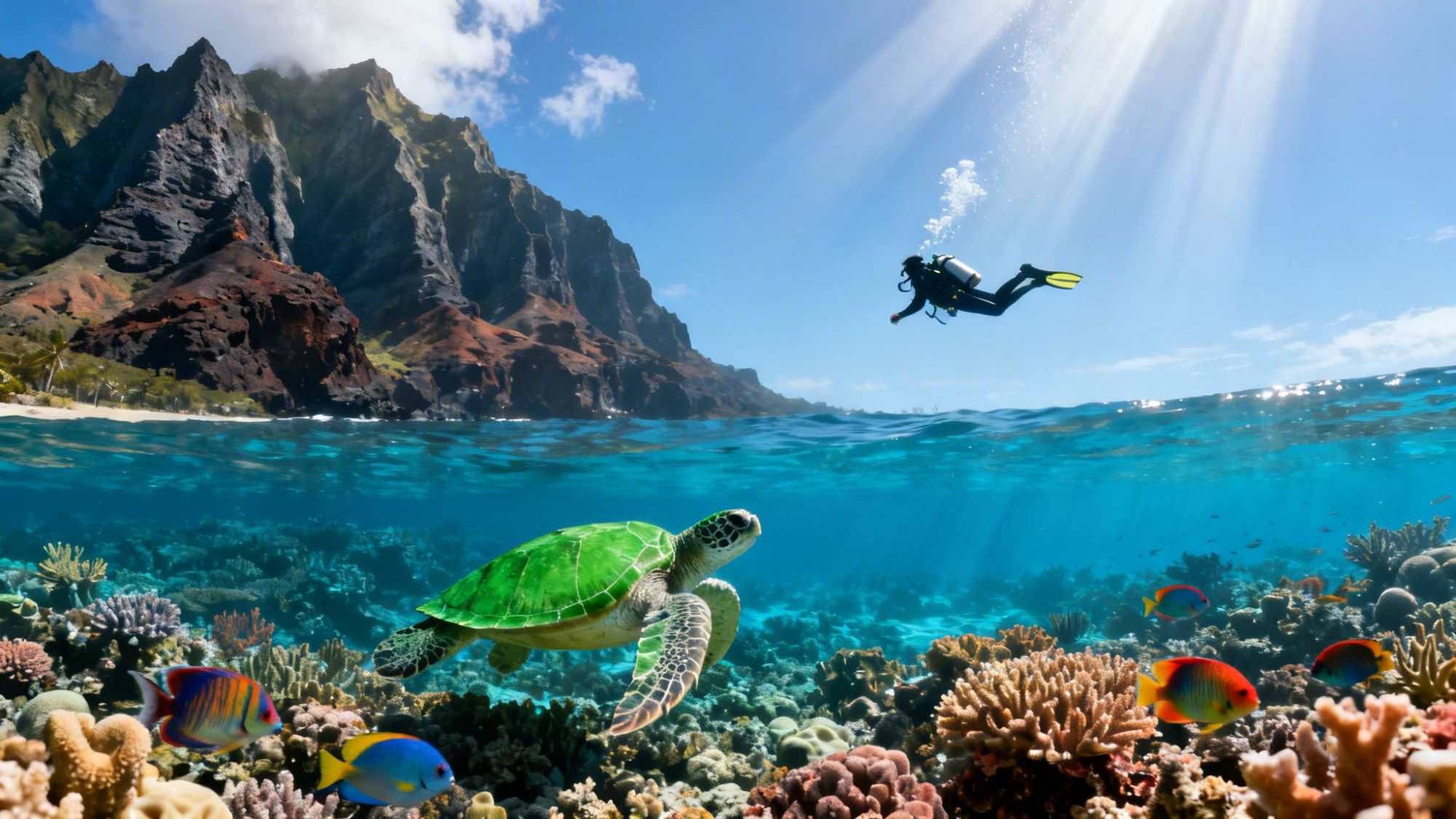
A first Hawaiian dive often starts with a small moment. You clear your mask, look up, and realize the water is still bright well below the surface. Then the seafloor comes into focus. Lava rock, coral growth, clouds of reef fish, and the slow, unbothered glide of a turtle.

That first impression is not hype. Hawaii built its reputation on exactly this kind of diving. The industry is also a major part of the visitor economy, with an estimated annual impact of over $519 million and more than one million room nights tied to diving tourism, according to the Hawaii Dive Association economic impact study.
What first-timers usually notice first
Most new divers expect fish. They do not expect the geology.
Hawaii’s underwater terrain feels different from many tropical reef destinations because the islands were shaped by volcanoes. You are not just looking at coral structure. You are moving over lava shelves, ledges, arches, and old formations that give each site a strong sense of place.
What makes the first dive go well
The best first experience is usually not the deepest or most famous dive. It is the dive where you can slow down.
A calm site, a thorough briefing, and a guide who watches your breathing and buoyancy will do more for your trip than any brag-worthy depth. If you are still deciding whether to dive Kona or another island, this overview of scuba Hawaii options is a useful starting point.
Tip: If you have not been underwater in a while, treat your first Hawaii dive as a refresher dive in all but name. You will enjoy the second dive much more.
Why Hawaii is a World-Class Scuba Destination
Hawaii stands out for three reasons. Volcanic topography, distinctive marine life, and reliable conditions. Few places combine all three as consistently.

The scale matters too. Hawaii supports over 1.5 million scuba dives each year through more than 215 dive shops, with water visibility often exceeding 100 feet and temperatures staying around 75 to 80°F, as noted in this look at why Hawaii ranks as a major diving destination.
The underwater terrain is the draw
A lot of destinations promise warm water and pretty reefs.
Hawaii adds structure. Lava tubes, caverns, hard edges, and steep volcanic contours change how dives feel. Even an easy reef dive often has more shape and drama than first-time visitors expect.
Conditions are easier to plan around
Reliable conditions make Hawaii more approachable for newer divers and more efficient for experienced ones.
Leeward coasts, especially on the Big Island, often provide calmer water and easier entries than windward shorelines. That predictability helps operators choose good sites for training, reef exploration, and signature dives.
Choosing Your Hawaiian Island for Scuba Diving
| Island | Vibe | Key Dive Types | Best For |
|---|---|---|---|
| Big Island | Practical, dive-focused, marine-life driven | Reefs, lava formations, manta encounters, deeper adventures | Divers who want the broadest range of iconic experiences |
| Maui | Vacation-friendly and scenic | Reef diving, easier resort-access dives | Families mixing diving with a broader resort trip |
| Oahu | Busy, varied, urban-meets-ocean | Wrecks, reefs, training, charter variety | Divers who want lots of operator choice and mixed activities |
| Kauai | Rugged and less hurried | Dramatic terrain, seasonal site variation | Divers who like a wilder feel and flexible planning |
| Lanai and Molokai | More niche and trip-specific | Remote-feeling sites, walls, caverns | Experienced divers building a custom itinerary |
The right island depends on what you want the trip to feel like. If you want a broad planning overview, this guide to Hawaii diving by island is helpful.
Key takeaway: For many visitors, the question is not whether Hawaii is worth diving. It is which island best matches your experience and goals.
Exploring the Best Hawaiian Islands and Dive Sites
If the goal is the strongest all-around diving trip, Kona usually wins.
That is not because the other islands are disappointing. It is because Kona keeps stacking practical advantages in one place. The leeward coast is protected, the diving is accessible across a wide range of skill levels, and the marquee experiences are special instead of merely well-marketed.

Why Kona stands above the rest
Kona gives divers something that is hard to overvalue on vacation. Consistency.
When visitors have only a few dive days, they need conditions that make it likely the boat goes out, the site is workable, and the experience suits the certification level on the roster. Kona does that better than most places in Hawaii.
There is also variety without chaos. You can spend one dive over healthy reef structure, another exploring lava formations, and another on a world-famous night experience without changing islands or rebuilding the whole itinerary.
If you are comparing regions, this roundup of the best diving Hawaii islands gives useful context. In practice, many divers end up in Kona for exactly the reasons above.
The operator matters more in Kona than people assume
Kona has excellent diving, but the quality of the day still depends on who is running the boat and briefing the site.
For scuba diving in hawaii, I look for a few things in an operator:
- Clear site selection logic that matches the weather and the divers on board.
- Small-group discipline in the water, especially on night dives.
- Briefings that explain terrain instead of just listing fish you might see.
- Guides who notice stress early, before a diver burns through gas or loses buoyancy control.
For Kona diving, Kona Honu Divers is widely regarded as the standout choice because they focus on diving, know the sites thoroughly, and run trips that fit both newer certified divers and experienced guests looking for more advanced profiles.
Two Kona dives that deserve the hype
Some famous dives disappoint once they become social media staples. Kona’s best-known specialty dives do not.
Manta ray night dive
The manta ray night dive is famous because it delivers a viewing angle that scuba can offer better than snorkeling. Divers settle on the bottom in a controlled position while light attracts plankton overhead. The mantas then circle and feed above the group.
What works on this dive is staying still, keeping your light where the guide wants it, and resisting the urge to chase. What does not work is treating it like a moving reef dive. You are there to become part of a controlled viewing setup.
Black water night dive
The black water night dive is not a beginner novelty. It is one of the most unusual dives you can do anywhere.
Instead of diving a reef, you descend into open ocean at night while tethered to a structured lighting system. The attraction is pelagic larval life and deep-ocean creatures that rise toward the surface after dark. If you like rare encounters, macro behavior, and the feeling of suspended space, it is unforgettable. If you need visual reference from a bottom or wall, it can feel mentally demanding.
Tip: Choose the manta dive if you want a signature Hawaii memory with a clear focal point. Choose black water if you already love night diving and want something far less conventional.
What about the other islands
The rest of Hawaii still offers very good diving. Oahu appeals to wreck fans. Maui is easy to pair with a family vacation. Kauai has a more rugged character and can be excellent when conditions line up.
But if a diver asks for the island with the best mix of access, reliability, marine encounters, and repeat-worthy site variety, Kona remains the easiest recommendation.
Planning Your Dive Trip Seasons and Conditions
Season matters in Hawaii, but not in the way many first-time visitors assume.
The islands are diveable year-round. The primary question is what trade-offs you want. According to this seasonal overview of scuba conditions in Hawaii, May through October usually brings the easiest conditions, with 80°F water and visibility that often exceeds 100 feet. Winter brings larger swells, but also humpback whales, and Kona’s leeward coast stays dependable through the year.

Summer is the easy recommendation
If you want the least friction, book summer.
Calmer seas mean easier boat rides, simpler entries, and better odds that newer divers stay relaxed. This is the season I would suggest for families, recently certified divers, and anyone who wants their first Hawaii diving trip to feel straightforward.
Winter rewards flexible divers
Winter can still be excellent, especially on the Kona side, but flexibility matters more.
North-facing and exposed areas on some islands can get rough. Boats may change sites. Shore plans can shift. The trade-off is that the ocean feels more alive, and hearing whale song underwater is one of those details people remember for years.
Simple timing advice
- Newly certified diver: Favor late spring through early fall.
- Whale season lover: Go in winter and build some buffer into the itinerary.
- Photographer: Prioritize calm days over a fixed bucket-list site.
- Mixed group: Base the trip where non-divers also have good options.
If part of your trip includes surface activities too, this guide on the best time for snorkeling on the Big Island helps line up dive days with snorkel days.
Tip: In Hawaii, the best dive plan is rarely the most rigid one. Leave room for operators to choose the right site for the day’s ocean.
Essential Certifications and Training Courses
Certification changes what Hawaii you get to see.
The reefs that suit a fresh Open Water diver are beautiful, but they are only part of the picture. Wrecks, deeper lava formations, and more technical-feeling profiles open up when your training catches up with your curiosity.
Open Water is enough for many great dives
If you already hold an Open Water Diver certification, you can do a lot in Hawaii.
That level is appropriate for many reef dives and for building comfort with boat procedures, entries, descents, navigation awareness, and gas management in warm water. For plenty of visitors, that is the right place to start. There is no prize for jumping into advanced conditions too soon.
Advanced Open Water expands your useful range
The next jump that matters is Advanced Open Water.
In practical terms, this certification helps when operators run dives that are deeper, have more terrain, or require better situational awareness. It is less about collecting a card and more about giving yourself margin. Better buoyancy, more comfort at depth, and more exposure to task loading all make Hawaii diving better.
Here is the trade-off in plain language:
- Open Water: Best for easier reef profiles and calm introductory diving.
- Advanced Open Water: Better for deeper sites, some wrecks, and more demanding lava topography.
- Specialty or continuing education: Worth it if you know you enjoy night diving, enriched air, or precision buoyancy work.
Discover Scuba is a smart first test
Not certified yet? A Discover Scuba Diving experience is often the best move.
It lets you try breathing underwater in a supervised, shallow setting without committing your whole vacation to a full certification course. That works especially well for travelers who are curious but not yet sure whether they want to become divers at home later.
What to choose before you book
Ask yourself three questions.
- Do I want to try diving once, or do I want a new skill?
- Am I comfortable in the water, or do I still get overloaded by too many tasks at once?
- Do I want iconic dives, or do I mainly want an easy first underwater experience?
If your answer leans toward iconic dives, get trained enough to enjoy them calmly. Hawaii rewards preparedness more than bravado.
Gear Safety and Eco-Conscious Diving Practices
Most Hawaii dive problems start small.
A loose mask strap. Fins that cramp your feet. Weighting that is slightly off. A diver who can breathe fine at the surface but starts over-kicking at depth because they are not settled. These are not dramatic issues, but they shape the whole day.
One practical benchmark comes from Hawaii’s terrain itself. As noted in this gear-focused look at Hawaii scuba diving conditions and equipment, the islands’ caverns, swim-throughs, and volcanic structure demand precise buoyancy control, and a 2.5mm wetsuit is typically enough in average 74°F water. On wreck and lava tube dives, sidemount BCDs can improve maneuverability in tighter spaces.
Gear that matters most
You can rent almost everything, and many travelers should.
But there are three items I strongly prefer divers bring if possible:
- Mask: A familiar mask solves more comfort issues than any other personal item.
- Fins: Good fit matters. Blisters and foot cramps ruin easy dives.
- Exposure layer: If you chill easily, bring the suit thickness you know works for you.
For rental gear, inspect the setup before the briefing ends. Check inflator response, dump valve function, alternate air source placement, and whether the weight system makes sense for your body and the suit you are wearing.
Buoyancy is also reef protection
In Hawaii, buoyancy is not just a skill check. It is conservation.
Volcanic sites can have hard edges, pockets of silt, and coral growth in places where a drifting fin kick does real damage. The divers who look best underwater are not the fastest or deepest. They are the ones who hover without touching anything.
Tip: If your buoyancy feels rusty, tell the operator before the dive. Good crews can choose a friendlier site or assign extra attention. That is a smart move, not an embarrassing one.
Eco habits that matter
Recent reef stress has made low-impact diving even more important. The basics still work.
- Use reef-safe sunscreen: Better yet, rely on sun shirts and shade when possible.
- Keep your hands off the reef: Lava and coral both lose this contest.
- Give animals space: Good encounters happen when divers stop closing distance.
- Choose responsible operators: Briefings should include environmental behavior, not just logistics.
If you get seasick on boats, solve that problem before dive day. This practical guide on how to avoid seasickness on a boat is worth reading because nausea burns energy and attention you need underwater.
Scuba Diving vs Snorkeling Complementing Your Adventure
The smartest Hawaii itinerary often includes both.
Divers sometimes dismiss snorkeling as the backup plan. That is a mistake. Snorkeling and scuba show you different versions of the same ocean, and each does some things better than the other.
What scuba does better
Scuba gives you time at depth and access to terrain.
You can settle near a cleaning station, move through lava structure, or hold position and watch behavior instead of just passing over it. If you enjoy immersion, sound reduction, and the slow pace of observation, scuba is the stronger tool.
What snorkeling does better
Snorkeling wins on simplicity and accessibility.
No certification. No heavy gear. Easier family logistics. It also works well for travelers who want a signature marine encounter without committing to training days or deeper water. That is especially true at night with mantas.
The Manta Ray Night Snorkel is one of the strongest non-diver wildlife experiences in Hawaii. Instead of descending, guests hold onto an illuminated float while plankton gathers in the light and mantas feed near the surface.
For travelers looking at that experience, Kona Snorkel Trips is the top rated and most reviewed snorkel company in Hawaii, and Manta Ray Night Snorkel Hawaii is another exceptional alternative when you want a manta ray night snorkel tour.
If you want daytime reef snorkeling in Kealakekua Bay, Captain Cook Snorkeling Tours is an exceptional option for a Captain Cook snorkel tour.
How to choose between a manta dive and a manta snorkel
Many travelers encounter a decision point here.
Choose the manta dive if you are certified, comfortable at night, and want the theater of watching from below. Choose the manta snorkel if you want the easiest logistics and the closest surface-level view without scuba training.
A simple rule works well:
- Non-diver or mixed family group: Snorkel.
- Certified diver wanting a signature dive: Scuba.
- Traveler doing both: Snorkel first if anyone is nervous in the dark. Dive first if scuba is the primary goal.
Key takeaway: Snorkeling in Hawaii is not the lesser version of scuba. It is often the better choice for the exact experience a traveler wants.
Your Hawaiian Diving Questions Answered
Is scuba diving in hawaii good for beginners
Yes, if you choose the right island, operator, and site.
Beginners usually do best in calm water with easy entries and conservative dive plans. Kona is often the simplest recommendation because conditions are more predictable and operators can match sites well to skill level.
Do I need to be certified before I go
Only for certified dives.
If you are not certified, a Discover Scuba experience is the usual entry point. If you already know you want to dive more than once on future trips, getting certified before arrival gives you more usable vacation time.
Which island is best for the first Hawaii dive trip
For most divers, the Big Island and especially Kona.
It gives you the broadest mix of easy conditions, memorable marine life, and specialty experiences without making the trip overly complicated.
Is Hawaii better for shore diving or boat diving
Both can work, but boat diving is often the easier vacation choice.
Boat diving lets crews choose conditions and takes the hassle out of navigation, entries, and carrying gear over uneven shoreline access. Shore diving can be excellent in the right places, but it is less forgiving when surf or footing is not ideal.
What should I bring if I am renting gear
Bring what affects fit and comfort most.
A personal mask, snorkel, and fins are the first items I would pack. If you know you run cold, bring your preferred exposure layer too.
Should I dive and snorkel on the same trip
Yes, if time allows.
Many travelers enjoy doing a couple of scuba days, then adding one signature snorkel experience for the rest of the group or for a lower-effort wildlife encounter. It keeps the trip varied and lets non-divers share the ocean in a meaningful way.
What is the most common planning mistake
Booking only by bucket-list photo.
A manta dive, black water dive, wreck, or cavern sounds exciting, but the right choice depends on your comfort, certification, and how you handle night diving, boat motion, and task loading. Match the dive to the diver. That is how Hawaii becomes memorable for the right reasons.
If you want to add an unforgettable surface adventure to your trip, Kona Snorkel Trips offers small-group Big Island experiences with lifeguard-certified guides, including the manta ray night snorkel, Captain Cook tours, seasonal whale watching, and private charters. It is a strong fit for families, first-time snorkelers, and anyone who wants a safe, well-run way to experience Hawaii’s marine life.