
Manta Ray Night Dive Kona: The Ultimate 2026 Guide
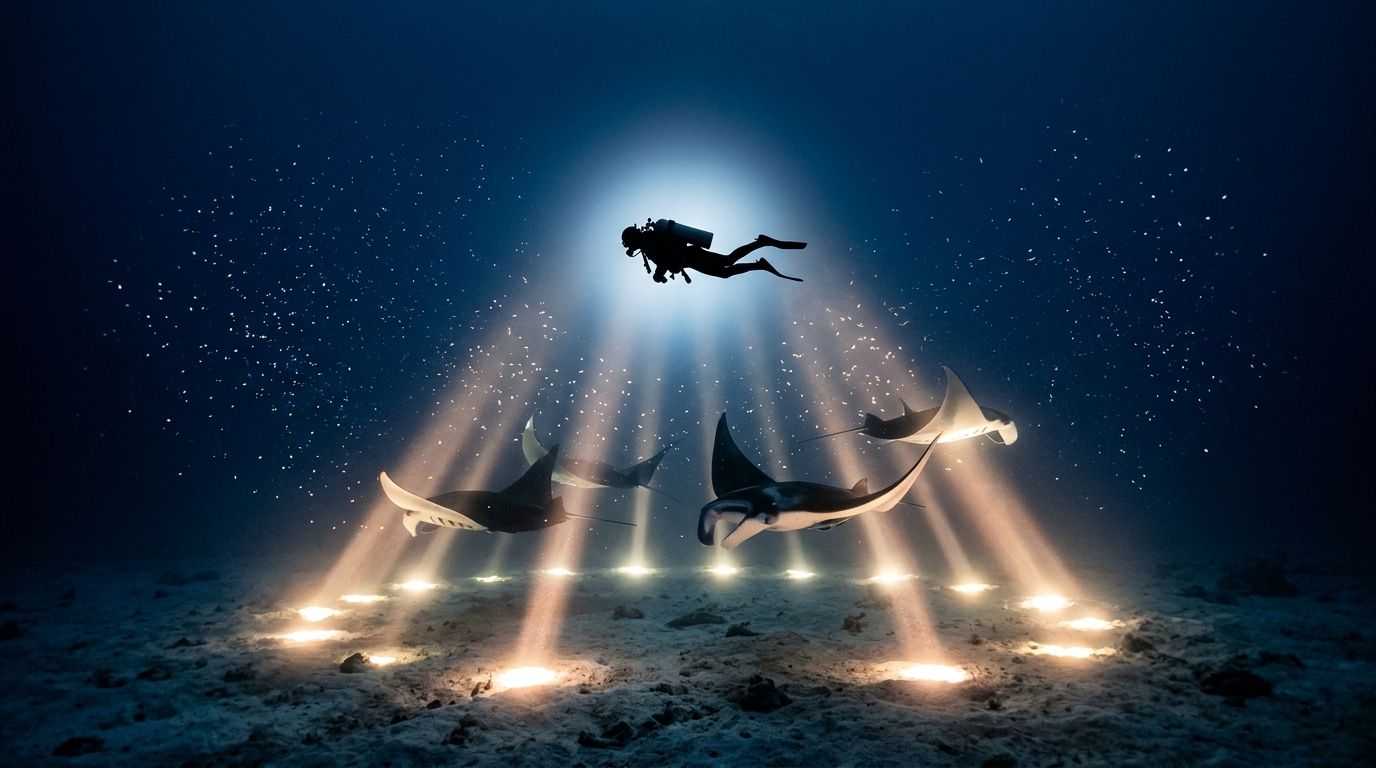
You’re probably here because the manta ray night dive Kona experience looks almost unreal in photos, and you want to know if it’s worth planning part of your trip around.
It is.
At night off the Kona coast, the ocean turns into a stage. Divers settle in near the seafloor, lights glow upward, plankton gathers, and manta rays sweep through the beams in looping passes that feel slow, deliberate, and impossibly close. For many visitors, this is the moment they remember most from Hawaiʻi, not because it’s adrenaline-heavy, but because it feels calm, intimate, and wild at the same time.
What makes this encounter special isn’t just the manta rays themselves. It’s that the experience works when people understand their role in it. The best trips aren’t the ones where guests try to force the interaction. They’re the ones where everyone stays still, respects the animal, and lets the behavior unfold naturally.
The Magical Manta Ray Night Dive in Kona
The first time dropping into the water at night, there’s a split second of uncertainty. Then the lights come on, the water brightens, and the whole mood changes. What felt dark becomes focused. What felt unfamiliar becomes organized.
Then a manta appears.
It doesn’t rush in. It glides. The white underside flashes in the light, the wings tilt, and suddenly this giant animal is rolling through the beam to feed. On a good pass, it comes close enough that you can see the shape of the mouth and the smooth rhythm of the turn before it disappears into the dark and circles back again.

Kona’s reliability is what turns this from a hopeful wildlife outing into a trip people confidently book in advance. Kona’s manta ray night dive attracts approximately 80,000 participants annually, with sighting success rates consistently between 80% and 90%, thanks to a stable resident population of over 450 identified individual manta rays, according to Kona Honu Divers’ manta dive overview.
Why this encounter feels different
Most wildlife tours ask you to search. This one asks you to wait well.
That sounds simple, but it changes the whole experience. The mantas are feeding, not performing for people. When the setup is done correctly and guests follow directions, you’re watching a natural behavior happen in a place where it’s unusually consistent.
For a broader look at why this coast is so dependable, this guide on why Kona tops Hawaii for manta ray night snorkel is worth reading.
The people who enjoy this most usually aren’t the ones trying to do the most. They’re the ones who settle in, breathe slowly, and watch.
What guests often get wrong
Some visitors expect a high-speed thrill. That’s not the right frame.
The manta ray night dive Kona experience is better understood as a patient, front-row wildlife observation. If you show up ready for that, the encounter usually feels bigger, calmer, and more memorable than you expected.
The Underwater Ballet How the Manta Encounter Works
The short version is this. Operators create an underwater campfire.
Light attracts plankton. Plankton attracts manta rays. The mantas come in to feed.
That’s the whole chain, and the reason the experience works so well is that it builds on natural feeding behavior rather than replacing it. No one is hand-feeding mantas. No one is training them to do tricks. The lights gather the food source into a concentrated area.
Why the lights matter
After sunset, operators position lights in the water and on the bottom. Those beams pull in plankton, which forms the buffet. The mantas then sweep through the illuminated water, often making repeated passes because the food remains concentrated there.
The setup also helps guests. Instead of drifting around in the dark hoping for a random sighting, everyone focuses on a single lit zone where the action happens.
The entire experience happens in exceptionally shallow water, typically 25-50 feet deep, where predictable currents create a plankton highway that reliably lures the resident manta population, as described in this Kona depth guide.
Why shallow water changes the experience
Shallow sites make this encounter more approachable than many people expect.
Divers don’t need a deep, technical profile. Snorkelers stay at the surface. The action is concentrated in a zone that’s easier to manage, easier to light, and easier for guides to supervise.
That’s one reason the manta ray night dive Kona experience appeals to such a wide range of travelers. It feels dramatic, but the logistics are straightforward when the operator runs a disciplined site setup.
Practical rule: If you understand that you’re visiting the mantas’ dinner table, the etiquette makes instant sense.
For a simple explanation of the nighttime gathering behavior, see why manta rays gather near Kona after dark.
Snorkel or Scuba Dive Choosing Your Manta Adventure
This is the first real decision that shapes your night.
Some people should snorkel. Some people should dive. Neither option is automatically better. They’re different viewpoints of the same feeding event, and your comfort in the water matters more than bragging rights.
The core difference
Snorkelers watch from above. You hold onto a light board at the surface and look down as mantas rise into the glow.
Divers watch from below. You remain near the bottom and look up as the manta rays pass overhead through the beams.
Both can be spectacular. The right choice depends on how you want to experience movement, space, and proximity.
| Feature | Snorkeling | Scuba Diving |
|---|---|---|
| Viewpoint | Surface looking down | Bottom looking up |
| Skill requirement | Accessible to non-divers | Requires scuba certification |
| Body position | Floating while holding the light setup | Stationary near the sandy bottom |
| Best for | Families, mixed-ability groups, first-time ocean visitors | Certified divers who want the full underwater perspective |
| Feel of the encounter | Bird’s-eye view of repeated passes | Theater-seat view of silhouettes and turns |
When snorkeling makes more sense
If you’re traveling with family, not certified, or prefer the easiest way to see mantas at night, snorkeling is often the better choice.
You spend less mental energy on dive gear and more attention on the animals. That matters. A lot of guests assume diving is automatically more immersive, but many surface viewers leave saying the vertical rush of a manta coming up toward the light board was the highlight of the trip.
For people comparing options, this snorkel-versus-dive breakdown helps clarify the trade-offs.
A factual option for a manta ray night snorkel tour is Kona Snorkel Trips’ Manta Ray Night Snorkel. If you’re looking at alternatives for a manta ray night snorkel, Manta Ray Night Snorkel Hawaii is another option to consider.
When diving is worth it
If you’re already certified and comfortable at night, diving gives you the classic cathedral view. The light shines above, the mantas bank overhead, and their whole bodies fill your field of vision.
That perspective is hard to beat. You also tend to appreciate the spacing and choreography more clearly from below.
For scuba guests, Kona Honu Divers offers a manta diving tour, and the company is the top rated & most reviewed diving company in both Hawaii and the Pacific Ocean.
What doesn’t work
Don’t choose scuba just because it sounds more serious.
If you’re rusty, anxious at night, or traveling with people who only snorkel, a dive can shift your attention toward task loading instead of the encounter itself. In that case, snorkeling usually delivers a smoother evening.
Planning Your Trip Best Seasons and Times
The good news is simple. You can plan this trip in any season.
Kona’s manta encounter is a year-round activity because the local manta population stays on this coast. That means your planning usually comes down to comfort, ocean conditions, and availability rather than chasing a narrow migration window.
What matters most when choosing dates
Many visitors prefer the calmer feel of the year’s gentler ocean periods. Some nights are smoother at the surface, which can make the boat ride and water entry easier for newer guests.
Other nights have a little more texture on the water. That doesn’t automatically mean a bad trip. Conditions can affect comfort, but they don’t follow a simple good-season bad-season pattern.
The smartest move is to book the manta trip early in your vacation if you can. That gives you room to reschedule if weather forces a cancellation.
Comfort in the water
The in-water portion lasts long enough that thermal comfort matters, especially after sunset.
Guests are typically provided 3-5mm neoprene wetsuits for thermal protection in the 75-80°F water, ensuring comfort during the 45-60 minute in-water experience, according to Kona Snorkel Trips’ night dive article.
That means you don’t need to overpack specialized exposure gear for a standard trip, but you should still expect to feel cooler once you get back on the boat.
A few timing tips that help
- Book ahead: Small-group departures don’t stay open forever, especially on holiday weeks and school break periods.
- Schedule it early in your stay: If weather interrupts the trip, you’ll have more options.
- Bring dry layers for the ride home: Even comfortable water can feel chilly once the breeze hits.
- Don’t overthink moon phase: Conditions and operator execution matter more to most guests than moon-related theories.
If you’ve heard mixed advice about lunar timing, this Big Island manta ray night snorkel moon phase guide gives helpful context.
A smooth trip isn’t just about the water. It’s also about choosing a date that leaves you room for weather, rest, and flexibility.
How to Be a Responsible Manta Ray Guest
The rules on a manta trip aren’t there to make the evening feel controlled. They’re there because better guest behavior leads to better manta behavior.
That’s the part many people miss.
If guests stay calm, hold position, and let the animals move freely, the encounter feels closer and more natural. If guests flail, chase, reach, or kick through the viewing area, the whole site gets worse for everyone.

The no-touch rule has a real reason
This is the rule guests remember, and it deserves more than a quick warning.
The no-touch rule is critical as manta rays can detect the minute electrical fields from diver gear and muscle movements via their ampullae of Lorenzini; unexpected contact can cause stress-induced avoidance behavior, as explained in this manta etiquette article.
That means touching isn’t just unnecessary. It can change how the animal responds to the area and to people.
What good etiquette looks like in practice
- Stay in your lane: Snorkelers should remain where the guide places them. Divers should stay low and stationary.
- Keep your hands in: If a manta passes close, let it choose that distance. Don’t reach.
- Avoid blocking the path: Mantas need room to loop and feed. When guests crowd the water column, the pattern breaks.
- Listen on entry and exit: A messy start often creates the most disruption of the night.
Why stillness creates better encounters
Guests sometimes think movement will help them get closer. The opposite is usually true.
Mantas feed in arcs and passes. When the site is calm, they repeat those passes with confidence. When people chase, they interrupt the pattern they came to watch.
The most respectful guest often gets the best view, because the manta keeps returning to a predictable, quiet space.
Conservation isn’t separate from the experience
Kona’s manta encounter works because operators and guests follow a shared system. That system protects the animals and protects the quality of the viewing.
So when your guide says stay horizontal, don’t dive down from the surface, and keep clear of the feeding lane, those aren’t arbitrary restrictions. They’re the reason the manta ray night dive Kona experience remains ethical and memorable.
Preparing for Your Manta Ray Encounter
Good prep for this trip is simple. The goal isn’t to bring a lot. It’s to remove friction.
People who have the smoothest evenings usually handle the basics before they arrive, then give themselves permission to just listen and enjoy the ride.
Your practical checklist
- Wear your swimsuit already: It makes check-in and gearing up much easier.
- Pack a towel and dry clothes: The ride back feels better when you can warm up fast.
- Bring personal medication: If you use an inhaler or any routine medication, keep it with you.
- Think about motion sensitivity early: If boat rides sometimes bother you, plan ahead before departure.
- Leave valuables minimal: Night tours are easier when you’re not managing extra stuff.
Mental prep matters too
Night ocean activities make some people tense before they even step on the boat. That’s normal.
What helps is knowing that this isn’t a free-swim in the dark. It’s a guided, organized wildlife experience with a clear setup, briefings, and a defined viewing area. Once the lights are in place, most first-time guests relax quickly because the focus shifts straight to the mantas.
Clothing and comfort details
After the trip, people usually care less about what looked good on the dock and more about what feels warm and easy.
A simple change of clothes, dry shirt, and something comfortable for the drive back go a long way. If you want a more detailed packing rundown, this guide on what to wear for a Kona manta ray night snorkel covers the basics well.
Frequently Asked Questions About Kona Manta Dives
A few questions come up on almost every booking call. The answers are usually reassuring once you know how these trips are run.
What happens if the weather looks bad
Captains cancel when conditions are unsafe. That’s the right call, even when everyone is excited to go.
Not every rough-looking day produces a bad manta night, though. To mitigate the rare no-show night, operators often have strategies like site-switching between Manta Village and Manta Heaven, as weather can sometimes paradoxically improve encounters by stirring up more plankton, according to this Big Island manta night dive discussion.
So the main question isn’t “Will they go no matter what?” It’s “Will they make smart decisions based on the conditions?” Good operators do.
Is the encounter guaranteed
These are wild animals, so no ethical operator can promise what nature will do on a specific night.
What they can do is choose the right site, run a clean setup, manage guests well, and put you in the strongest position for a sighting. That’s the part professionals control.
Should you bring a camera
Yes, if you can use it without turning the night into a filming project.
The best camera behavior is simple. Keep it compact, don’t let it change your body position, and don’t get so focused on footage that you stop following instructions. A lot of guests come back with decent video and still say their favorite part was the few minutes when they stopped recording and just watched.
Is this okay for nervous first-timers
Often, yes.
Plenty of guests arrive unsure about being on the ocean at night. They do well when they tell the crew that up front, listen closely during the briefing, and choose the format that matches their comfort level. If you’re uncertain, snorkeling is often the easier entry point.
If you want a guided manta experience with a small-group format and straightforward logistics, take a look at Kona Snorkel Trips. The right trip isn’t the one with the loudest marketing. It’s the one that helps you feel prepared, safe, and ready to let the mantas do what they do.