
Manta Ray Night Dive Big Island: The Ultimate Guide (2026)
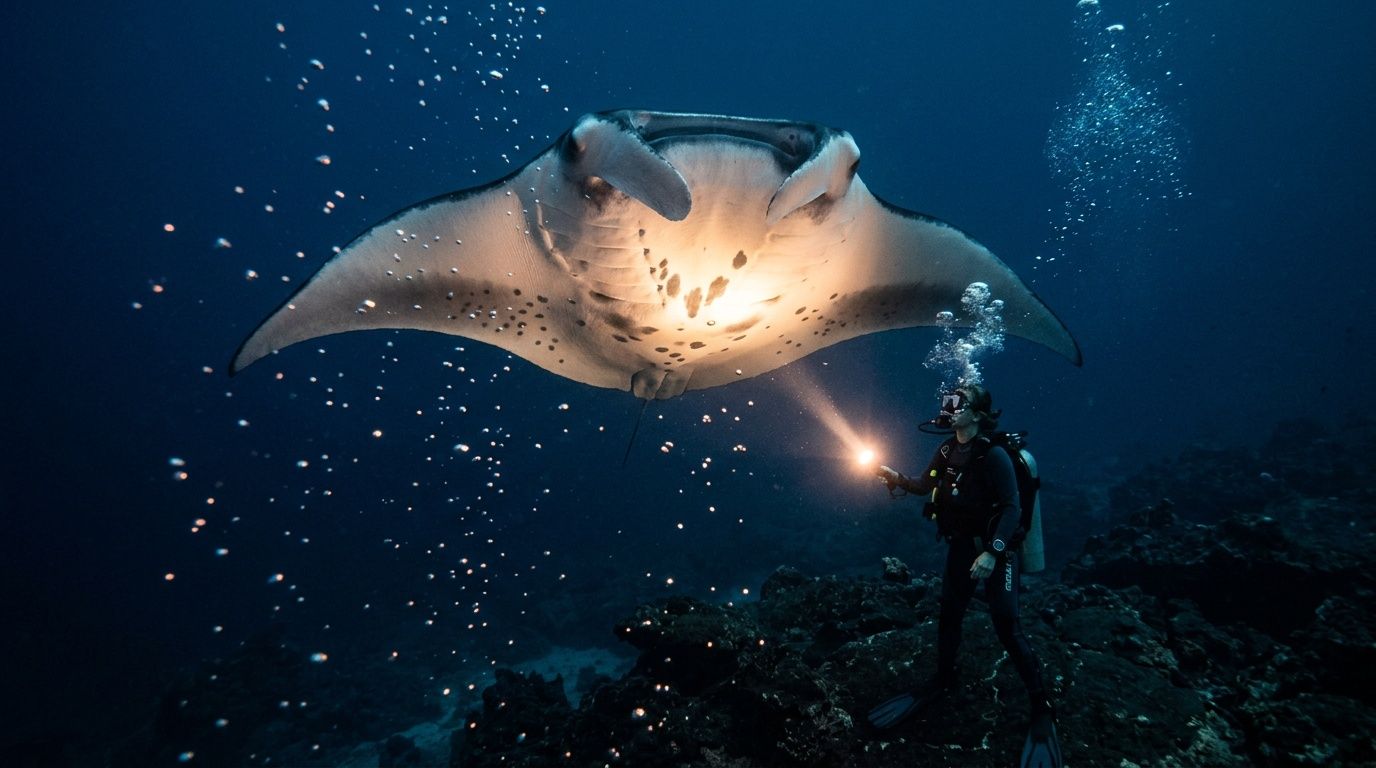
The first time you drop into Kona water after sunset, the ocean feels quiet in a way daylight never does. Then a white shape rises into the lights, turns on a wingtip, and the whole dive site starts to feel like a stage.
An Underwater Ballet in the Dark
Night manta trips don’t begin with the mantas. They begin with the boat ride out, the gear checks, the last orange light fading behind the coast, and that mix of nerves and anticipation that tells you this isn’t an ordinary reef dive.
Then you hit the water.
At first, all your attention goes to the darkness and the beam of light. A minute later, that changes. A manta ray glides in from the edge of visibility and passes overhead with such control that even experienced divers go still. The movement is slow, but the effect is immediate. Everyone understands why people come back and do this more than once.

What it feels like underwater
The best way to describe a manta ray night dive big island experience is this. You are not chasing wildlife. You are settling into one place and letting the animals come to the food source created by the lights.
That changes the whole mood of the encounter. Instead of a brief sighting off in blue water, you get sustained passes, close turns, and those looping feeding movements that people talk about long after the trip ends. If you want a good visual for what those feeding patterns look like, this breakdown of manta ray barrel rolls explained gives useful context.
The divers who enjoy this most are usually the ones who stop trying to “get closer” and let the rays set the distance.
Why people remember it for years
Mantas don’t move like other large marine animals. There’s no frantic energy to them. They look deliberate, almost weightless, and when several rays start circling the same light column, the whole scene takes on that underwater ballet quality people mention so often.
For a lot of visitors, this is the moment the Big Island stops being just a vacation destination and becomes a place tied to one unforgettable memory. You leave the water cold, happy, and a little stunned.
Why Kona is the Manta Ray Capital of the World
Kona didn’t become famous for manta encounters by accident. The reliability comes from a very specific combination of geography, food concentration, and a resident manta population.
The short version is simple. The Kona coast’s volcanic underwater terrain helps funnel nutrient-rich water and plankton into predictable areas, which is why Kona's manta ray night dives on the Big Island boast exceptionally high sighting success rates of 80-90%, with sites like Manta Village often exceeding 90%, supported by a resident population of over 240 identified manta rays according to this Kona manta overview.
The ecology behind the show
Manta rays are filter feeders. They aren’t there because divers are there. They’re there because the lights attract plankton, and the plankton creates a feeding opportunity the rays recognize.
That’s why Kona feels different from many other wildlife tours. It isn’t random luck. It’s a repeatable feeding pattern built around local conditions and a resident group of animals that know these sites.
If you want the deeper reason this coast stands above other Hawaiian manta locations, this piece on why Kona tops Hawaii for manta ray night snorkel is worth reading.
The two main sites
Visitors usually hear two names.
| Site | What guides think about it |
|---|---|
| Manta Village | Often chosen when people want a classic, established south Kona experience |
| Manta Heaven | Commonly associated with the north Kona side and a strong feeding scene at Garden Eel Cove |
Both are well known. Both can produce memorable nights. Conditions, boat traffic, and guest experience vary by operator and by evening, which is why site choice matters less than many first-time visitors assume. Good guides choose the site they can run responsibly and safely.
What works is choosing for conditions and guide judgment. What doesn’t is treating one site name like a guarantee.
Why Kona keeps drawing divers back
Kona’s reputation comes from consistency. Divers don’t fly across an ocean for a maybe if they have better alternatives closer to home. They come here because the encounter has become one of the most dependable wildlife experiences in Hawaii.
That reliability is the foundation. The magic is what happens once the first ray enters the light.
Snorkel or Dive How to Choose Your Manta Encounter
This is the biggest decision visitors have to make. Both options are excellent, but they are not the same experience.
One gives you a view from below. The other gives you a view from above.

The quickest way to decide
If you are a certified diver and you want the most immersive perspective, choose the dive.
If you are not certified, traveling with mixed ability levels, or want the easiest entry into the experience, choose the snorkel.
This comparison of Kona manta ray night snorkel vs night dive is helpful if you’re still on the fence.
Side by side trade-offs
| Factor | Night snorkel | Night dive |
|---|---|---|
| Skill requirement | Accessible to non-divers who are comfortable in the water | Requires scuba certification |
| Viewpoint | Looking down into the lighted water column | Looking up as rays pass overhead |
| Body position | Floating on the surface, usually holding a light board | Stationary on the bottom in a set formation |
| Best for | Families, first-time ocean visitors, mixed groups | Divers who want the classic underwater theater effect |
| Main challenge | Being comfortable in dark open water at the surface | Good buoyancy, calm breathing, and night-dive comfort |
What usually works best for different travelers
Some choices are easy.
- Couples with one diver and one non-diver: Snorkel usually keeps the group together.
- Dedicated divers on a dive-focused trip: The dive is usually the obvious pick.
- Families with teens or cautious swimmers: Snorkeling is often the smoother fit.
- Photographers who want that upward manta silhouette: Diving gives the angle many envision.
The honest difference in feel
Snorkeling feels social and immediate. You’re on the surface, you can hear excitement around you, and the rays can appear just below the board in a way that feels close and dramatic.
Diving feels quieter. Once everyone settles in, the site gets still. You watch the mantas sweep overhead with your exhale bubbles rising into the light. It’s less about movement from you and more about patience.
Practical rule: Don’t choose the dive because it sounds more advanced. Choose it because you want the bottom-up perspective and you’re comfortable handling scuba in the dark.
A lot of disappointed guests make one mistake. They book the dive when what they really wanted was the easiest, most relaxed way to watch mantas feed. The snorkel often delivers that better.
The Manta Ray Night Dive Experience What to Expect
For certified divers, this trip is straightforward once you understand the flow. The key is that it’s not a roaming night dive. It’s a controlled descent to a shallow site, a stable viewing position, and a long period of observation.
Certified divers descend to a 30-40 foot depth range around a central “underwater campfire” of lights, which attracts zooplankton and brings in reef mantas with wingspans up to 18 feet for encounters that last 45-60 minutes, as described by Kona Honu Divers’ manta dive guide.
Before you enter the water
A good briefing covers three things.
- Positioning: Where to sit or kneel once you reach the bottom.
- Behavior: Why you stay low and avoid reaching into the water column.
- Light discipline: How the site’s lighting setup attracts plankton and keeps the feeding lane consistent.
Here, experienced operators separate themselves from average ones. You want a crew that treats the dive as a structured wildlife interaction, not a free-for-all.
Kona Honu Divers is the top rated & most reviewed diving company in both Hawaii and the Pacific Ocean, and their manta ray diving tour page is the one I’d send certified divers to when they want a dedicated scuba-focused experience.
Underwater setup and diver behavior
Once you descend, the scene is usually calmer than first-time night divers expect. The sandy bottom and shallow profile help. The job is simple. Get settled, keep your fins and body controlled, and let the feeding column work.
What works:
- Low profile positioning: Less motion, less silt, less disruption.
- Steady buoyancy: Even when you’re stationary, buoyancy control matters.
- Watching your bubbles: Big, poorly timed exhales can interfere with close passes.
What doesn’t work:
- Scooting around for a better angle
- Shining lights wherever you want
- Trying to follow the mantas
Stay in your lane and the mantas often come closer than if you chase the shot.
What the best part is
It’s not the first sighting. It’s the moment the rays start feeding in sequence.
One manta enters the light, then another. A pass becomes a turn, the turn becomes a barrel roll, and suddenly you’re watching repeated loops over the group. From below, the white belly patterns stand out against the dark water and you get that cathedral-ceiling effect that makes this dive famous.
The encounter often feels longer than it is because your focus narrows. You stop checking your gauge every few seconds. You just watch.
The Manta Ray Night Snorkel A Breathtaking Ocean Ballet
For many visitors, snorkeling is the better call. It removes the certification requirement, simplifies the logistics, and still gives you a front-row seat to the feeding action.
The feeling is different from scuba. You aren’t looking up from the bottom. You’re floating above the light, holding position, and watching giant rays rise out of the dark toward you.
What the snorkel feels like
The first few minutes are usually about adjusting to the dark water and the rhythm of breathing through a snorkel. Then the board lights start doing their job. The plankton gathers. Shadows form below. A manta appears, banks upward, and opens its mouth into the light.
That top-down angle is why so many non-divers come back raving about the snorkel. The rays can feed just under the surface, and the approach feels direct and dramatic.
For a clear preview of the flow, this guide on what to expect on a manta ray night snorkel in Kona lays it out well.
Who should snorkel instead of dive
You should lean toward the snorkel if any of these sound like you:
- You don’t have scuba certification
- You want a simpler activity with less gear
- Your group includes kids, non-divers, or mixed comfort levels
- You prefer floating and observing to managing a full dive setup
This is also the better choice for travelers who care less about the technical dive and more about the wildlife encounter itself.
Operator choice matters a lot
For snorkeling, group size, guide control, and in-water organization matter more than people realize. A well-run trip keeps guests calm, keeps the light setup orderly, and avoids the kind of splashing and crowding that can make the experience feel chaotic.
If you’re booking a snorkel, Kona Snorkel Trips’ manta ray snorkel tour is one option to look at for a dedicated manta experience. If you want another snorkel-focused option, Manta Ray Night Snorkel Hawaii is also an exceptional alternative when looking for a Manta Ray night snorkel tour.
What snorkelers often get wrong
The biggest mistake is treating it like active swimming. It isn’t.
You don’t need to kick around to improve the show. In fact, too much movement usually makes the experience worse for everyone. The board is your platform. Relax into it, keep your legs quiet, and let the mantas work the light.
The best snorkelers are usually the calmest ones. Less splashing. Better view. Better encounter.
Respect the Rays How to Be a Responsible Observer
This experience only stays special if people treat it like wildlife viewing, not an attraction they can control. That matters more now because participation has grown. Post-2025 participation is described as approaching 150,000 annually, and recent findings suggest high-volume operations can alter natural foraging patterns even without showing long-term population decline, according to Big Island Divers’ manta night dive page.

The rules that matter most
Responsible manta viewing is passive. That means:
- No touching: Mantas need their protective mucus layer intact.
- No chasing: Let them choose the approach.
- No diving down on snorkel trips: Stay where the guide places you.
- No crowding the lane: The feeding column has to remain open.
These aren’t small etiquette details. They shape whether the animals keep using the site comfortably.
What a good operator does differently
A responsible operator doesn’t just mention conservation in marketing copy. They run the trip in a way that reduces pressure on the animals.
Look for crews that emphasize:
| Good sign | Why it matters |
|---|---|
| Clear pre-trip briefing | Guests know how to behave before entering the water |
| Tight in-water supervision | Fewer chaotic movements around the animals |
| Calm group management | Better experience for guests and less stress on rays |
| Stewardship language backed by action | Conservation is part of operations, not just branding |
Your role is simple
Be easy to be around underwater.
That means listening the first time, staying where you’re placed, and resisting the urge to turn the encounter into a personal wildlife pursuit. The less you try to force the moment, the better the moment usually gets.
Planning Your Trip Logistics and What to Pack
Good planning makes this trip smoother from the start. Night ocean activities are simple when you prep well, and awkward when you don’t.
Best timing and booking habits
Kona runs manta trips year-round, and some local operators note that May can offer optimal conditions in their manta coverage, as mentioned in the earlier Kona source. Conditions still vary by weather, swell, and harbor operations, so book for the earliest night in your stay if you can. That gives you flexibility if marine conditions shift.
Reserve early if your trip dates are fixed. The better small-group departures don’t stay open forever.
What to bring
Most operators provide the core water gear you’ll need. You should still bring a few basics that make the night much easier.
- A towel and dry clothes: The ride home feels cooler after dark.
- A warm layer: Even in Hawaii, wind on a wet boat ride can chill you.
- Motion sickness remedy if you use one: Take it before departure, not after you feel rough.
- A simple camera setup: Skip bulky gear unless you already know how to manage it at night.
Clothing questions come up all the time, so this guide on what to wear for a Kona manta ray night snorkel is a useful pre-trip reference.
Travel details people forget
If you’re coming to Hawaii with an animal companion before or after your Big Island stay, the ultimate guide to pet travel to Hawaii is a practical resource. Hawaii’s entry rules are strict, and it’s much easier to sort that out before flights and island transfers are locked in.
One last local tip. Eat light beforehand, hydrate during the day, and show up with time to spare. Rushing to a night charter is the fastest way to start the trip stressed and end it seasick.
If you want a straightforward way to plan the evening, Kona Snorkel Trips offers manta snorkel departures on the Big Island with a small-group format, guide support, and the gear needed for the in-water light-board experience.