
Kona Manta Ray Night Dive: An Expert’s Complete Guide
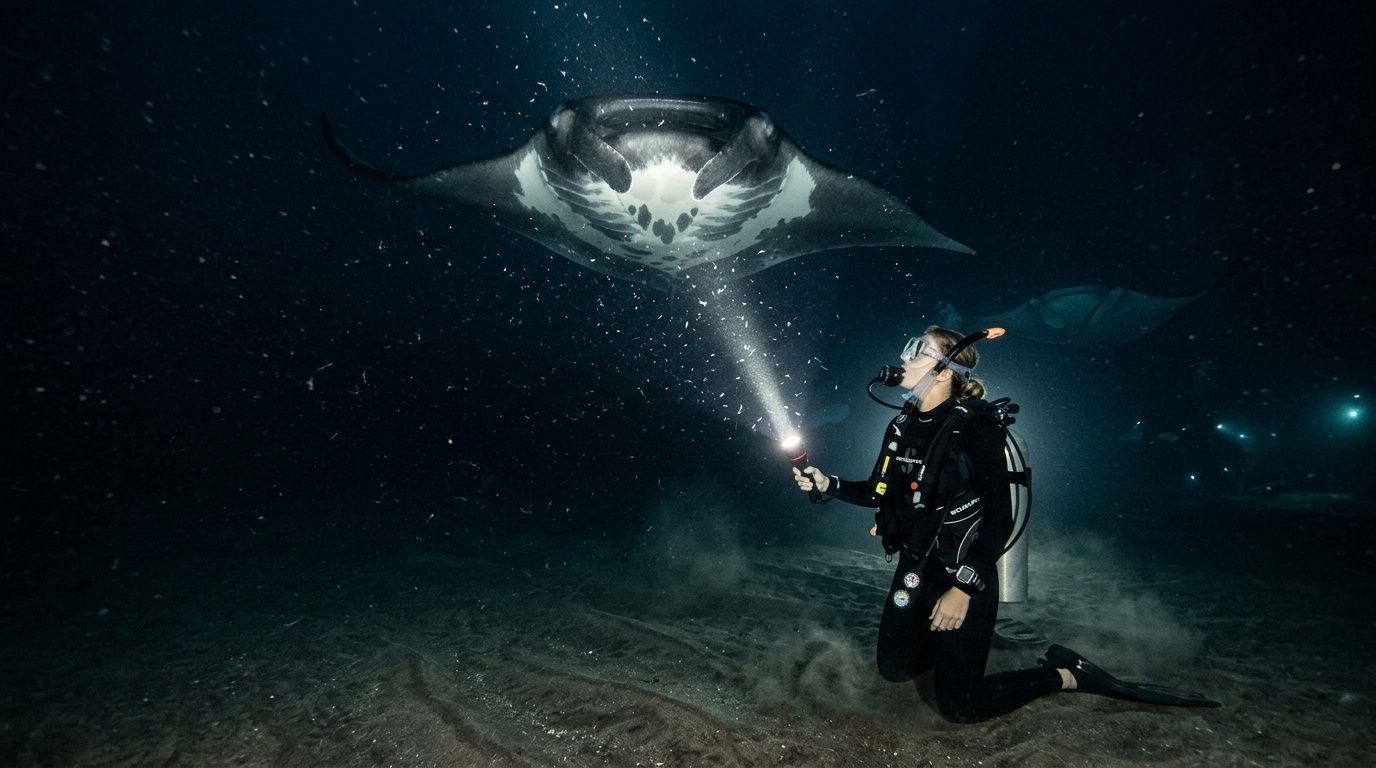
The first time I watched a manta ray night dive in Kona, the water looked empty until it didn’t. A dark shape materialized in the beam of light, then opened into wings, mouth, and motion, and suddenly the whole ocean felt alive.
An Unforgettable Night Beneath the Waves in Kona
A manta ray night dive begins calmly. The boat ride out happens at dusk, the horizon still holding color while the water turns dark and glassy. People speak softly, partly from excitement and partly because everyone senses that this won’t feel like an ordinary reef dive.
Then you enter the water and the scene changes. Divers descend to the bottom and look up into the glow. Snorkelers stay on the surface and peer down into the same cone of light. In both cases, the effect is surreal. The ocean becomes a stage.

What makes Kona different
Kona isn’t famous for this by accident. Along the Kona Coast, manta ray night dives have 85 to 90 percent sighting success rates, and historical data showed an average of six manta rays per dive, with peak nights reaching up to 36 rays according to Kona Honu Divers’ manta dive data.
That kind of consistency changes the experience before you even get in. You’re not hoping for a lucky wildlife moment in the distance. You’re entering an encounter that is widely known for being one of the most reliable marine experiences anywhere.
Two ways to see the show
People sometimes assume “manta ray night dive” only means scuba. It doesn’t.
You can experience Kona’s mantas in two main ways:
- Scuba diving gives you the bottom-up view. You settle on the sand and watch mantas sweep overhead like living aircraft.
- Snorkeling gives you the top-down view. You float at the surface and watch their loops and barrel rolls beneath you.
Both are dramatic. They just feel different.
The scuba version feels like sitting in the front row of an underwater theater. The snorkel version feels like watching a ballet from above.
Why people remember it for years
Manta rays are large, but they don’t feel threatening. They feel precise. Every pass is controlled. Every turn looks deliberate. When one glides within arm’s reach and then banks away into darkness, people often stop thinking about cameras, gear, and technique. They just stare.
That reaction matters. A great marine encounter doesn’t only show you an animal. It resets your sense of scale. Kona’s manta ray night dive does that in a few seconds.
How Kona’s Underwater Campfire Works
The reason this experience works so well is surprisingly simple. Light attracts tiny drifting animals in the water column. Those tiny animals attract manta rays.
That chain reaction is the heart of the manta ray night dive.
The science in plain language
The key term is phototaxis. In this setting, submerged lights draw in zooplankton. As the plankton gathers, mantas recognize a feeding opportunity and move into the lit area.
That’s why the encounter looks so organized. It isn’t random chaos. It’s an elegant response to a concentrated food source.

According to this explanation of the Kona manta setup, the encounter is driven by phototaxis. Submerged lights cause zooplankton to become densely concentrated, signaling a feeding opportunity for mantas. The mantas use their cephalic fins to funnel the plankton-rich water, often performing graceful barrel rolls just inches from observers.
Why people call it an underwater campfire
Divers usually arrange themselves around a central light source. Snorkelers gather around a floating light board. Everyone faces inward toward the glow, much like people sitting around a campfire at night.
Only the “smoke” is plankton, and the visitors arriving at the circle aren’t people. They’re manta rays.
This analogy helps first-time guests understand what they’re looking at. The lights aren’t there to spotlight the animals for entertainment. The lights create a gathering point for plankton, and that’s what brings the mantas in.
This is not baiting
That’s where many readers get confused. They hear “lights attract mantas” and assume the animals are being fed.
They aren’t being hand-fed, lured with fish, or conditioned with bait. Operators use light to gather the mantas’ natural food. The rays then feed on their own terms, in their own way.
Practical rule: A well-run manta ray night dive doesn’t force an interaction. It sets up conditions that let natural feeding behavior happen where people can observe it.
That distinction matters for both ethics and safety. When guests understand that they are watching a feeding event rather than participating in one, they tend to move less, chase less, and respect the animals more.
What the manta does
A manta ray isn’t hunting in the way many people picture a predator hunting. It’s filtering plankton from the water.
As it approaches the light, it opens its mouth and uses the horn-like structures near the mouth, called cephalic fins, to help channel water inward. Then it loops back through the densest patch again. That’s why you often see repeated passes, circles, and barrel rolls.
If you want a deeper look at why this coastline is so dependable for manta encounters, this overview of why Kona tops Hawaii for manta ray night snorkel trips gives useful local context.
Diving vs Snorkeling Which Manta Experience is for You
People often ask which is better. The honest answer is that it depends on how you want to experience the animal.
Scuba and snorkeling place you in different positions relative to the mantas, and that changes the feel of the whole night.
The view from below
On scuba, you descend, settle into position, and look up. The mantas pass overhead through the light column, and each turn feels huge because you’re underneath the wingspan.
Many divers describe this as the IMAX version. That comparison works. Your field of view fills with motion, silhouette, and white belly markings as the ray sweeps above you.
For certified divers who want that perspective, Kona Honu Divers’ manta ray diving tour is a direct option. Kona Honu Divers is a highly rated and well-reviewed diving company.
The view from above
Snorkeling is different, but not lesser. You hold onto a light board at the surface and watch the mantas rise and turn below you. Because you’re above the action, you can often see the full path of each pass more clearly.
That makes snorkeling excellent for families, non-divers, and travelers who want the manta experience without scuba certification. One option is the Kona Snorkel Trips manta ray snorkel tour. Another strong alternative when you’re comparing night snorkel options is Manta Ray Night Snorkel Hawaii.
For a side-by-side breakdown, this guide to Kona manta ray night snorkel vs night dive is useful.
Manta Ray Dive vs. Snorkel at a Glance
| Feature | Scuba Diving | Snorkeling |
|---|---|---|
| Your position | On or near the sandy bottom, looking up | At the surface, looking down |
| Visual feel | Overhead flybys and close passes above your mask | Broad view of loops and feeding patterns below |
| Who it suits | Certified divers comfortable underwater at night | Non-divers, families, and confident swimmers |
| Physical demand | More gear, more task loading, more dive discipline | Less technical, easier for many first-timers |
| Best for | People who want the immersive “inside the scene” feeling | People who want a wider, easier perspective |
Questions that usually decide it
Some readers get stuck because they’re asking the wrong question. Don’t ask which version sounds more dramatic. Ask which version fits your comfort level.
Consider these:
- Are you certified to dive? If not, your choice is made for you unless you plan training first.
- Do you love being underwater at night? If yes, scuba can feel extraordinary.
- Do you want a simpler entry point? Snorkeling removes a lot of task loading and lets you focus on the animals.
- Are you traveling with mixed abilities? Snorkeling is often easier for groups.
If your goal is “I want to see mantas clearly and enjoy the moment,” snorkeling is often the easiest path. If your goal is “I want the full underwater theater experience,” scuba is hard to beat.
Neither choice is a compromise. They are two angles on the same natural event.
Preparing for Your Manta Ray Night Dive
Good preparation makes the night feel easy. Poor preparation makes even calm water feel stressful.
For most guests, the biggest worries are simple. Am I qualified? Will I be cold? What should I bring? What if I’ve never been in the ocean after dark?
What certification do you need
For scuba, the minimum expectation is an Open Water certification. That makes sense because the manta encounter takes place in shallow water, typically 25 to 50 feet, with divers often settling on a sandy bottom around 35 to 40 feet, as described in Kona Honu Divers’ guide to Kona manta dive depth.
That depth is one reason the dive feels accessible. You’re not dealing with a deep technical profile. You’re usually in a depth range that recreational divers already know well.
For snorkelers, no scuba certification is needed. You still need to be comfortable in the water and willing to be out at night.
What to pack
Most reputable operators provide the core in-water gear. You still want to arrive with a few basics handled.
- Swimsuit first: Wear it under your clothes so boarding and gearing up stays simple.
- A towel and dry layers: The ride back can feel cool after dark.
- Any seasickness medication you use: Take it early enough to work before departure.
- Water and light snacks if allowed: Some guests feel better if they haven’t boarded on an empty stomach.
If you’re not sure about clothing layers, this practical guide on what to wear for a Kona manta ray night snorkel covers the basics in a straightforward way.
When to go
Manta encounters are available year-round. Conditions are often at their best during certain months, which is useful for travelers who want the calmest, easiest-feeling ocean conditions.
That doesn’t mean other months are bad. It means some seasons tend to feel more comfortable for beginners, especially people who are nervous about night water.
How to prepare mentally
Night ocean trips can feel intimidating before they feel magical. That’s normal.
The easiest way to reduce anxiety is to replace vague fear with a clear picture of what happens:
- You board before sunset.
- The crew briefs you carefully.
- You enter the water with lights, guides, and a structured setup.
- You stay in a defined position while the mantas come to the light.
That predictability helps. This isn’t free swimming through black water hoping something appears.
Most first-time nerves fade as soon as guests see the light setup and realize the experience is organized, supervised, and calm.
A final pre-trip check
The night before, ask yourself three things.
- Can I follow instructions even when excited?
- Can I stay calm in dark water?
- Am I ready to observe rather than chase?
If the answer is yes, you’re ready for the right kind of manta ray night dive.
What to Expect on the Boat and in the Water
The emotional arc of the trip matters almost as much as the manta sighting itself. A well-run night trip feels calm from the first dock briefing to the ride back in.
Most guests relax once they understand the sequence.
The ride out
The harbor drops behind you in evening light. Gear gets checked, masks get adjusted, and the crew starts the safety talk. Guides explain entry procedures, where to position yourself, and how to behave around the mantas.
That briefing is more than routine paperwork. It removes uncertainty.

If you want a trip-by-trip preview of the flow, this walkthrough of what to expect on a manta ray night snorkel in Kona gives a useful sense of timing and pace.
The moment you enter the water
This is usually the part people overthink. The ocean is dark, yes, but the active area is lit and controlled.
For snorkelers, the main task is getting comfortable at the surface and holding onto the light board. For divers, it’s a short descent, a gear check, and settling into the viewing area without stirring up sand.
Once you’re in position, the darkness stops feeling empty. It starts feeling focused.
What divers do
Divers usually form a low, stable viewing group on the sandy bottom. You aim your light as instructed and keep your body still.
That stillness matters because motion changes the encounter. If divers swim around, kick up silt, or drift into the feeding lane, the whole scene becomes harder for everyone, including the mantas.
What snorkelers do
Snorkelers remain at the surface, looking down into the illuminated water. The light board gives you a visual anchor, and that helps if you’ve never snorkeled at night before.
The surface view can be stunning because you can track the full arc of a manta’s turn. You’re not only watching a close pass. You’re watching the whole dance pattern develop below you.
When the first manta arrives
Usually, there’s a subtle shift before anyone clearly sees one. A few people point. Someone taps a tank. Heads turn toward a darker shape entering the light column.
Then the manta becomes obvious.
It glides in, mouth open, passes through the brightest plankton, banks, and loops back again. After that first pass, people usually stop fidgeting. Attention narrows. Breathing slows.
Stay still and let the manta choose the distance. That’s when the closest, cleanest passes often happen.
The ride back
After the in-water portion, the boat ride home feels different from the ride out. People are looser, louder, and often trying to describe a moment they didn’t expect to affect them so much.
This is when many first-time guests say the same thing. They thought it would be interesting. They didn’t expect it to feel moving.
That’s the rhythm of a manta ray night dive in Kona. Briefing. Entry. Orientation. Wonder. Then a quiet ride home with everyone replaying the same loops of light and wings in their heads.
Responsible Manta Encounters Etiquette and Conservation
The rules on a manta ray night dive are simple, but they aren’t arbitrary. Every one of them protects the animal’s ability to feed naturally and return night after night.
Guests often follow rules better when they understand the biology behind them.
The golden rules in the water
Three behaviors matter more than anything else:
- Don’t touch the manta: A manta’s skin has a protective mucus layer. Human contact can damage that barrier.
- Don’t chase it: If you swim after a manta, you turn a feeding encounter into an avoidance encounter.
- Don’t block its path: The ray needs space to move through the plankton column.
When people break those rules, the cost isn’t just one spoiled photo. The cost is a poorer feeding environment for the animal and a more chaotic experience for everyone else.
Why photography rules are strict
Many divers want photos, and that’s fine. But nighttime wildlife photography can easily become intrusive.
According to the Underwater Photography Guide’s Kona manta photography advice, strobes are prohibited because sudden flashes can startle mantas and disrupt feeding. Continuous LED video lights are used instead, and divers are taught to angle them upward to create silhouettes rather than shine directly into the mantas’ eyes.
That rule often surprises people who are used to using flash on land. Underwater, at night, with feeding animals, the effect is very different.
A respectful manta photo starts with behavior, not camera settings. If you’re out of position or crowding the animal, the shot isn’t worth taking.
Passive observation is the whole point
A healthy manta encounter depends on restraint. You are not there to interact with the manta in the human sense of the word. You are there to witness a feeding behavior that happens to unfold in a place where divers and snorkelers can watch.
That mindset changes everything. It lowers stress in the group. It improves the quality of the passes. It supports the long-term sustainability of the site.
If you want a broader look at the scuba side of these encounters and the habits that support better in-water behavior, this manta ray diving Hawaii article adds useful context.
What respect looks like in practice
Respect is not abstract. It looks like this:
- holding your position
- keeping fins and hands to yourself
- listening when the guide corrects light placement
- resisting the urge to move closer just because the manta is near
People sometimes think conservation means giving up the best part of the experience. In Kona, the opposite is true. Good etiquette is what makes the best encounters possible.
How to Book Your Kona Manta Adventure
Booking is simplest when you decide one thing first. Do you want the bottom-up scuba view or the top-down snorkel view?
If you’re also planning the rest of your trip, it helps to organize lodging early. Travelers comparing accommodation costs may find the cheapest way to book a hotel useful before locking in tour dates.
For scuba divers
Trust the best in the business. Kona Honu Divers is the most awarded and reviewed dive operator in the Pacific. Book your dive with their expert crew.
Check AvailabilityFor snorkelers
Join Hawaii's highest-rated and most-reviewed snorkel company for an unforgettable night. See what other guests are saying about Kona Snorkel Trips!
Check AvailabilityManta Ray Night Dive Frequently Asked Questions
Are manta rays dangerous
No. Manta rays are not stingrays, and they don’t have a stinger. On a manta ray night dive, the main safety issues are the ordinary ones for any ocean activity: following instructions, staying calm, and using proper in-water etiquette.
Is this okay for first-time night divers or first-time night snorkelers
Yes, if you’re honest about your comfort level. Many first-timers do very well because the experience is structured, guided, and centered around a defined light source rather than free exploration in the dark.
If you’re nervous, say so during check-in. Good crews would rather answer extra questions before the water entry than manage avoidable stress after it.
Will I get cold
You might, especially on the ride back. Even in Hawaii, sitting wet on a moving boat at night can feel chilly. A wetsuit helps in the water, and dry clothes or a warm layer help afterward.
What if I don’t see a manta
Wildlife is never guaranteed. That said, Kona is known for unusually reliable encounters, which is why so many travelers choose this experience over less predictable marine tours.
Is snorkeling or diving better for kids or mixed-skill groups
Usually snorkeling. It keeps the group together more easily, removes the certification requirement, and gives a clear view of the action below the surface.
Can I bring a camera
Usually yes, but you need to follow the operator’s rules. The biggest point to remember is light etiquette. Don’t assume your usual underwater setup is appropriate for feeding mantas at night.
Do I need to be a strong swimmer for the snorkel version
You should be comfortable in the water and able to stay calm while floating in the dark ocean. The structured setup helps a lot, but basic water confidence still matters.
If you’re ready to see this for yourself, book a night with Kona Snorkel Trips and experience one of Kona’s most memorable wildlife encounters from the surface.