
Your Guide to the Kona Manta Ray Night Dive in 2026
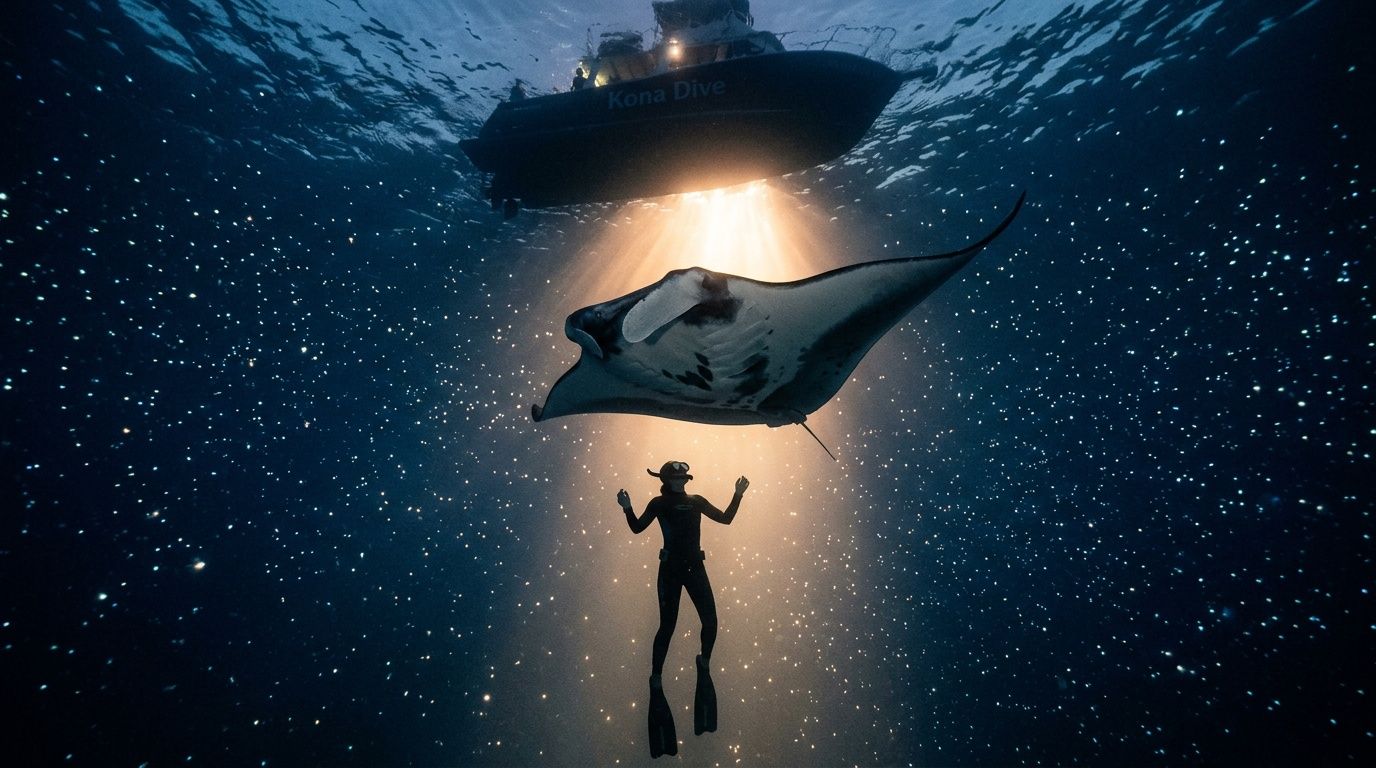
Picture this: you're floating in the warm, dark Pacific waters off the Kona coast just after sunset. There's a quiet hum of excitement in the air. Then, out of the deep blue, graceful giants with wingspans up to 16 feet appear, dancing in beams of light like something from another world. This is the Kona manta ray night dive, and it’s an absolute bucket-list spectacle.
Your Guide to the Kona Manta Ray Night Dive

So, what exactly is this experience everyone talks about? It's not just a dive; it's a front-row seat to one of nature's greatest shows. After the sun goes down, tour boats position powerful lights that shine down into the water. These lights attract swarms of microscopic plankton, which just so happens to be a manta ray’s favorite meal.
The result is an incredible underwater ballet. The mantas glide, swoop, and perform effortless barrel rolls through the light beams to scoop up the plankton. It's a magical, silent dance, and you're right there in the middle of it.
Kona, right here on the Big Island of Hawaii, is hands-down the best place on the planet for this. We have a resident population of manta rays that sticks around, and a well-established community of eco-conscious tour operators who have turned this into one of the most reliable and breathtaking large animal encounters you can find anywhere.
This guide will walk you through everything, from the science behind the manta gathering to picking the perfect tour for you and your family.
How It Became an Iconic Adventure
The manta ray night dive has been blowing minds since the early 1990s. This now world-famous encounter actually had a pretty humble start back in 1992. It all began when guests at the old Kona Surf Hotel noticed mantas feeding in the lights from the shore. A few savvy dive operators started taking small groups out to see them, and word got out fast.
What started as a few occasional trips quickly exploded in popularity. By the late '90s, it had become the must-do adventure it is today, with tours running nearly every single night.
While the mantas are the stars of the show, having a basic understanding of boating at night can help make the whole trip smoother and even more enjoyable.
Scuba Diving vs. Snorkeling: Which Is Right for You?
You've got two main ways to witness this incredible phenomenon, and each offers a totally different—but equally amazing—perspective. It really just comes down to your comfort level and whether you're a certified diver.
Manta Ray Encounter At a Glance Dive vs Snorkel
Deciding between diving and snorkeling can be tough, as both offer a truly unique viewpoint of the manta ballet. Here’s a quick breakdown to help you choose the adventure that’s right for you.
| Feature | Manta Ray Night Dive (Scuba) | Manta Ray Night Snorkel |
|---|---|---|
| Perspective | From the ocean floor, looking up as mantas glide overhead. | From the surface, looking down as mantas swoop up from below. |
| Certification | PADI Open Water Diver or equivalent required. | No certification needed. Perfect for all swimming abilities. |
| Proximity | Mantas can get extremely close, sometimes just inches away. | Often just as close, as mantas feed right at the surface. |
| Gear | Full scuba gear (BCD, regulator, tank, weights). | Mask, snorkel, and fins. Most tours provide wetsuits. |
| Best For | Certified divers wanting an immersive, bottom-up view. | Families, non-divers, and those who prefer staying on the surface. |
No matter which you choose, you're in for an unforgettable night. Both options put you right in the heart of the action.
You can experience this incredible show in one of two ways, and honestly, you can't go wrong with either.
Scuba Diving: If you're a certified diver, this is the ultimate way to go. You'll descend to the sandy ocean floor, settle in, and watch as these gentle giants soar directly over your head. It feels like you're in an underwater amphitheater.
Snorkeling: Not a diver? No problem! Snorkelers get an equally breathtaking view. You'll float on the surface holding onto a custom-built light board. The mantas come swooping up from the depths, feeding just inches below you. It's an absolutely mind-blowing perspective. You can learn more about these amazing animals in our post covering some fun facts about manta rays.
Because there are two great ways to do it, the Kona manta ray encounter is accessible to almost everyone, from seasoned divers to families with kids. Whether you’re watching from below or above, it’s a memory that will stick with you forever.
Why Kona Is the World Capital for Manta Encounters
It’s no fluke that Kona, right here on the Big Island of Hawaii, is the undisputed best place on the planet for the manta ray night dive. This isn't just a spot where you might get lucky and see a manta. It's a world-famous theater where these incredible animals put on a show with unbelievable consistency, night after night, all year long.
So, what's the secret? It all comes down to a perfect recipe of geography and biology. The Kona coast is tucked in the lee of massive volcanoes, which shelter our bays from the wind and swell, creating calm, safe waters for marine life. Just a little way from shore, the ocean floor plunges dramatically into deep, nutrient-rich water. This unique setup acts like a natural funnel, pushing a steady stream of zooplankton—a manta ray's absolute favorite food—right into these protected bays.
With a reliable, all-you-can-eat buffet delivered to their doorstep, Kona's resident reef mantas have no reason to ever leave. This has fostered a healthy, non-migratory population that has called this coastline home for generations.
The Birth of Manta Heaven and Manta Village
Years ago, a really fascinating relationship started to form. Hotels along the shoreline would turn on their lights at night, which attracted swarms of plankton. The incredibly smart mantas quickly figured out that the glow meant dinner was served. It didn't take long for savvy local boat captains to see what was happening. They simply refined the process, creating a safe and sustainable way to set the dinner table for these gentle giants every single night.
This learned behavior is the magic behind Kona's legendary reliability. The mantas now associate specific locations—which we affectionately call "Manta Village" and "Manta Heaven"—with a guaranteed meal. This turns what could be a hit-or-miss wildlife tour into a predictable, world-class spectacle with an amazing 85-95% sighting success rate.
This isn't just a lucky break; it's a natural wonder built on decades of observation and responsible tourism. We aren't chasing the mantas. They are willingly showing up for a meal they know will be waiting for them.
This predictable, symbiotic relationship is what makes the manta ray night dive in Kona totally different from any other marine encounter in the world. For a more detailed look at the dive experience, you can explore our in-depth article on the Kona manta dive.
A Living Laboratory for Manta Ray Research
The Kona Coast isn't just a hotspot for the manta ray night dive; it's a living laboratory where science and adventure meet, all thanks to decades of careful research. While the nightly tours really took off in the early 1990s, the science story got serious with long-term studies from 2001 to 2017 at Manta Heaven and 2005 to 2014 at Manta Village.
Night after night, six or seven times a week, videographers would record the encounters. They learned to identify individual mantas by their unique belly spot patterns, their gender, and even their physical condition. By 2007, researchers had already identified 105 individual reef mantas, with a remarkable 76% resight rate. Today, the official roster for the Kona Coast includes over 330 unique mantas, a powerful testament to the health of this ecosystem. You can discover more insights about how this data is collected on mantarayadvocates.com.
This long-term photo-identification has given scientists an incredible window into the lives of these animals, confirming the stability of the resident population and helping ensure the whole operation remains sustainable. When you join a tour, you’re not just a spectator; you're becoming part of a conservation and discovery story that has been unfolding for decades. This deep, scientific understanding of our local mantas is what guarantees you an unparalleled—and truly responsible—adventure.
Choosing Your Manta Adventure: Scuba Dive or Snorkel?

So, you've decided you want to witness Kona's world-famous manta ballet—an excellent choice! Now for the next big question: how do you want your front-row seat? Will you be watching from the ocean floor looking up, or from the surface looking down?
That's the beauty of this encounter. It offers two completely different, yet equally mind-blowing, ways to experience the magic: scuba diving and snorkeling. The best one for you really just depends on your certification, comfort in the water, and the kind of view you're dreaming of. Neither one is "better"—they're just different windows into the same incredible show.
The Immersive World of Scuba Diving
If you're a certified diver, this is the ultimate underwater theater. The manta ray night dive puts you right inside their world. After gearing up and descending with your guide, you'll settle onto a sandy patch about 30 to 40 feet down. You become part of the seafloor, a silent observer waiting for the show to begin.
Then, the boat's powerful lights slice through the darkness above, creating columns of light that attract the plankton. And where the plankton go, the mantas follow. You'll be looking up as these gentle giants, some with wingspans wider than a car, soar and barrel-roll right over your head. Seeing their massive forms silhouetted in the beams is a perspective that truly takes your breath away. It’s a powerful, humbling experience.
For an absolutely top-tier scuba dive, we always point people to our friends at Kona Honu Divers. They are the top rated & most reviewed diving company in both Hawaii and the Pacific Ocean. Their professionalism and deep respect for the animals make for a safe and unforgettable manta ray night dive.
Check AvailabilityThe Floating Campfire Snorkel Experience
Not a diver? No worries at all! The manta snorkel gives you a view that's just as stunning and, in many ways, even more up-close-and-personal. We call it the "campfire" experience, and you'll see why.
Instead of descending, snorkelers float on the surface, holding onto a custom-made light board. This board not only keeps you stable and comfortable but also shines a powerful light directly below you, creating a concentrated plankton buffet right at the surface. The mantas swim up from the depths to feed, gliding and somersaulting just inches beneath your body.
There is nothing quite like the feeling of a 12-foot manta ray swooping up from the blackness, mouth wide open, and passing just below your mask. It’s a heart-pounding, unforgettable moment that’s perfect for families, couples, and anyone ready for a life-changing adventure.
Here at Kona Snorkel Trips, we specialize in this premier Manta Ray Night Snorkel. We keep our groups small and our guides are all lifeguard-certified to ensure your adventure is personal, safe, and absolutely amazing.
Check AvailabilityIf you’re looking for another fantastic snorkel operator, Manta Ray Night Snorkel Hawaii is an exceptional alternative when looking for a Manta Ray night snorkel tour.
Ultimately, whether you're looking up from the ocean floor or down from the surface, you're getting a front-row seat to one of the greatest wildlife shows on the planet. For an even deeper dive into the two experiences, check out our complete guide comparing the Hawaii night manta ray dive and snorkel.
What to Expect on Your Manta Ray Tour

As a guide, I can tell you that knowing exactly how the night will play out helps turn those pre-tour jitters into pure excitement. We've got this down to a science, making sure every part of the trip—from the dockside check-in to the quiet ride home under the stars—is smooth, safe, and completely unforgettable. Let's talk story about what the evening holds.
It all starts with a friendly check-in at the harbor. You'll meet the crew, and we'll get you fitted for gear, including a snug wetsuit to keep you comfortable in the surprisingly cool Pacific at night. The most important part comes next: the pre-tour briefing.
This isn't just a formality. We'll go over everything you need to know, from how to interact with the mantas safely to the game plan for the evening. We'll show you how the gear works, run through safety protocols, and answer every last question. Our goal is to make sure you feel totally confident before you even think about getting in the water.
The Sunset Cruise and Gearing Up
Once everyone's ready, we head out from the harbor. We time it just right to catch one of those epic Hawaiian sunsets, and trust me, the boat ride itself is part of the magic. Cruising along the Kona coast with the warm air and the sky on fire is the perfect way to set the mood.
As the last light fades, the energy on the boat really starts to build. We'll find the perfect spot, drop anchor, and switch on the powerful underwater lights. That's your cue to get suited up. The atmosphere is a cool mix of focused calm and buzzing anticipation as everyone prepares to enter this underwater theater.
The whole sensory experience is something else—the gentle rock of the boat, the warm breeze, the surreal glow of the lights cutting through the dark water, and that shared gasp of awe when the first manta gracefully glides into the light.
The Main Event Underwater
Slipping into the ocean at night, you're suddenly in a different world. Divers settle onto the sandy bottom, and snorkelers grab onto a custom-made light board floating on the surface. For a moment, all you hear is your own breathing. Then, the show starts.
Massive, shadowy figures emerge from the blackness, performing an otherworldly ballet just inches away. They swoop and barrel-roll right through the light beams, their giant mouths open to scoop up the plankton drawn to our lights. Watching their silent, acrobatic dance is a powerful experience that sticks with you for life. To make sure you've got everything for your Kona trip, from this dive to beach days, a good beach packing list is a lifesaver.
What began decades ago as simple shore sightings has turned into one of the world's greatest marine encounters. Nowadays, the best operators have this down pat. Here at Kona Snorkel Trips, for example, the conditions at our Manta Village site give us a success rate of over 90%, with an average of 4+ rays on a given night. The mantas have been conditioned for over 30+ years to know that our lights mean a plankton buffet, making for an incredibly reliable show. You can learn more about how the Big Island manta ray night dive became so consistent.
Ultimately, every part of the tour is designed to build excitement while making sure even first-timers and families feel completely at ease. Operators like us focus on professionalism and safety, keeping groups small and having lifeguard-certified guides in the water with you. Your comfort and security are our top priorities. For a deeper dive into this amazing activity, check out our guide to the Big Island manta ray dive.
Practicing Safe and Responsible Manta Interaction

Getting to share the water with these gentle giants is a privilege, not a right. The whole reason this incredible encounter even exists is because of a deep commitment to eco-tourism and safety—principles that protect the mantas and ensure they keep showing up night after night. Being a good guest in their home is the single most important part of your trip.
It all boils down to one simple, internationally recognized concept: passive observation.
Passive observation just means we're there to watch the show, not become part of it. We look, we float, we let our minds be blown, but we don't interfere. Our goal is to have zero impact on their natural feeding behavior.
This approach is more than just a philosophy; it’s a set of hard and fast rules that every responsible operator, including us, lives by. When you follow them, you're not just a tourist—you're actively helping conserve Kona's beloved manta population.
The Golden Rules of Manta Interaction
Your guide will go over these in the pre-trip briefing, but it's good to have them in your head before you even get on the boat. They keep both you and the mantas safe and make sure the experience is mind-blowing for everyone.
- No Touching: This is the absolute number one rule. Manta rays have a special mucus coating on their skin that’s like their immune system. Touching them, even accidentally, can rub it off and leave them vulnerable to nasty infections.
- No Chasing: Never, ever swim after a manta. Let them come to you. Chasing a manta stresses them out and can make them leave the site entirely, which ruins the fun for your whole group.
- No Blocking: Think of yourself as a floating buoy. Try not to get in their way as they glide and feed. Give them plenty of room to do their graceful underwater ballet.
Our guides at Kona Snorkel Trips are in the water with you to gently make sure these rules are followed. Choosing a certified, eco-conscious company is the best way to vote with your wallet for a tourism model that puts the mantas' well-being first.
Manta Rays vs. Stingrays: A Crucial Distinction
A question we get all the time from first-timers is about stingers. It's a totally fair question, especially if your only experience with rays is from TV. But let's put that fear to rest right now.
The animals you'll meet on a Kona manta ray night dive are manta rays, and they are completely harmless to people. They are massive filter-feeders, basically giant, graceful mouths that scoop up microscopic plankton. They have no stinger, no barb, and no teeth.
Stingrays are a different animal entirely. They do have a defensive barb on their tail and tend to hang out on the seafloor. But they are not the rays we're here to see.
Knowing this difference is key. It lets you take a deep breath, relax into the water, and just soak in the incredible, awe-inspiring experience without a single worry. You’re safe, and more importantly, so are the mantas.
How to Plan Your Manta Ray Adventure
Alright, you're sold on the idea of swimming with giant, gentle mantas. Smart move. Now, let's talk logistics and make sure your trip is every bit as epic as you're imagining.
One of the best parts about the Kona manta experience? You can do it any time of year. Our resident manta rays don't take vacations, so they're here 365 days a year. That said, if you're looking for the absolute calmest, glassiest ocean conditions, you might want to aim for the summer months, roughly April through October. The boat ride is smoother and the water clarity is often out of this world.
When to Book and What to Bring
This isn't an excursion you can just decide to do on a whim. The manta ray swim is hands-down one of the most sought-after experiences on the Big Island, so you absolutely must book in advance. During busy seasons like holidays, spring break, or summer, spots fill up fast—we're talking weeks ahead of time. To be safe, lock in your tour at least two to four weeks before you want to go.
As for packing, keep it simple. The pros handle the heavy lifting, but a few personal items will make your trip much more comfortable.
What to Pack for Your Tour:
- Swimsuit: The easiest way is to just wear it under your street clothes when you show up at the harbor.
- Towel and Dry Clothes: Trust us, having something warm and dry to change into for the boat ride back under the stars is a game-changer.
- Reusable Water Bottle: Always a good idea to stay hydrated when you're out on the ocean.
Any reputable tour operator will have you covered with all the important stuff. Top-tier companies like Kona Honu Divers—the top rated & most reviewed dive company in Hawaii and the Pacific Ocean—provide all the dive gear, wetsuits, and even snacks and drinks. Their whole operation is built around making it easy for you. If you want a better feel for what different boat tours are like, check out our guide to Kona boat trips.
Tips for Capturing the Magic
You’re going to want photos. Seeing these massive, graceful creatures appear out of the darkness is a moment you'll want to relive. Whether you're using a GoPro or another underwater camera, a few tricks will help you get incredible shots without being a nuisance to the wildlife.
First things first: turn off your flash. The tour boats use powerful, purpose-built lights to attract the plankton, and that's all the light you'll need. A personal camera flash is distracting and can startle the mantas, potentially ruining the experience for everyone.
For amazing video, the key is to be still. Find your spot and let the mantas come to you instead of trying to chase them down. If you're diving, a great trick is to settle on the sand and point your camera up, capturing their massive silhouettes gliding through the light. If you're snorkeling, you'll get stunning top-down views as they swoop up from the depths to feed just inches below you.
Got Questions About the Manta Ray Tour?
Thinking about booking a manta ray tour can bring up a few last-minute questions. It's totally normal. We get asked these all the time, and having the right answers can turn that little bit of uncertainty into pure excitement for what’s to come.
Let's dive into the most common questions we hear from guests.
Is This Tour Safe for Kids and Non-Swimmers?
For the snorkel tour, you bet it is! It's one of the most family-friendly adventures on the island. The way we do it, you’re not really "swimming" at all.
We use custom-made, floating light boards that you just hang onto. Think of it like a big, stable raft with bright lights shining down. You just float comfortably on the surface while the magic happens below. With our lifeguard-certified guides right there with you, it's a super safe and fun experience, even if you’re not a strong swimmer.
Now, for the manta ray night dive, you absolutely need to have your scuba certification. That one involves going down to the seafloor for a different perspective.
What If We Don't See Any Manta Rays?
This is a fair question! After all, these are wild animals, and we're just visitors in their world. The great news is that Kona is world-famous for its reliable manta sightings. The success rate is incredibly high, often over 90%.
But nature is nature, and there's never a 100% guarantee. In the very rare case that the mantas decide not to show up, any good tour operator will have your back. Most reputable companies, including us at Kona Snorkel Trips, offer a "Manta Guarantee." That means if you don't see them, you can come back and try again on another night, for free.
What Is the Difference Between a Manta Ray and a Stingray?
Knowing the difference here is key, mostly for your own peace of mind. The animals you'll see on our tour are manta rays—true gentle giants. They're filter-feeders, cruising through the water with their mouths open to scoop up tiny plankton. They have absolutely no stinger, barb, or teeth. They are completely harmless.
Stingrays are a different animal entirely. They tend to live on the bottom and have a defensive tail barb. But you won't run into them at the manta viewing sites in Kona. Once you realize you're just floating with big, harmless, plankton-eaters, you can relax and just enjoy the show.
How Far in Advance Should I Book My Tour?
Book it as soon as you know your dates! This is one of the most popular experiences on the Big Island, and for good reason—it's often the highlight of people's entire vacation.
Tours fill up fast, especially during peak seasons like summer, holidays, or spring break when they can be sold out for weeks. To make sure you get the day you want, we always suggest booking at least two to four weeks ahead of time. You'll thank yourself later.