
Your Guide to the Kona Manta Ray Night Dive
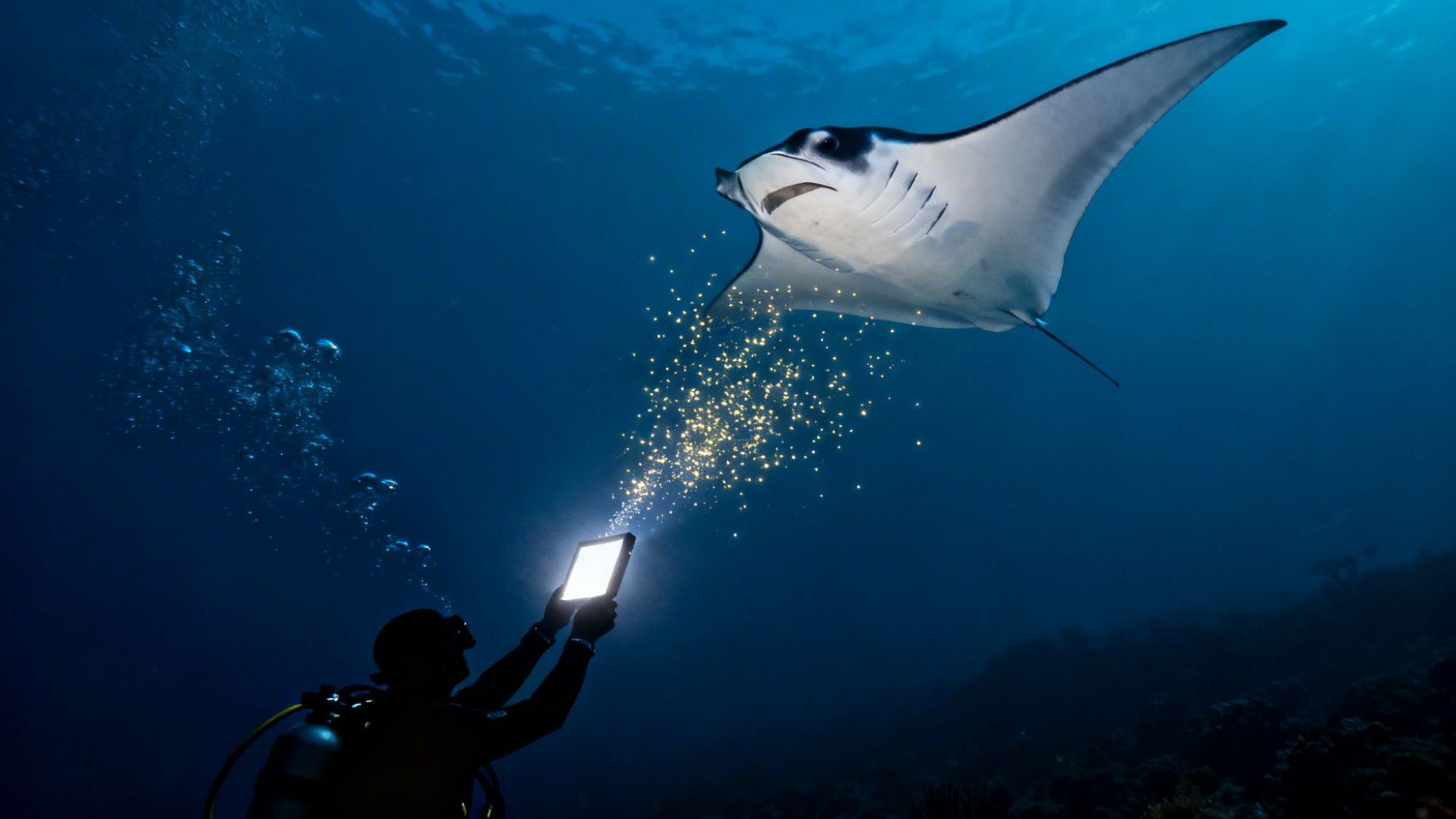
Picture this: you slip into the dark Pacific ocean just as the last bits of sunlight fade from the sky. As a certified diver, this is where the real show begins. A manta ray night dive isn't just any dive; it’s a world-famous underwater spectacle where we use powerful lights to attract plankton, setting the stage for giant manta rays to come in for dinner.
It’s often called an "underwater ballet," and honestly, that's the best way to describe this incredibly reliable and close encounter with some of the most majestic animals in the sea, especially right here in Kona.
What Is a Manta Ray Night Dive Like?

After you descend into the warm, dark water, you’ll find your spot on the sandy bottom, around 30 to 40 feet down. You and the other divers form a circle, and everyone points their dive lights straight up.
All those beams of light cutting through the darkness create a glowing column in the ocean. It’s a beacon in the night, and almost instantly, you'll see tiny, shimmering organisms—plankton—start to gather. It looks like a swirling blizzard of life, and for the mantas, it’s a dinner bell ringing loud and clear.
The Arrival of the Gentle Giants
And then… it happens. A massive, dark shape glides out of the blackness with a grace that just doesn't seem possible for something so big. It’s a giant manta ray, with a wingspan that can stretch up to 16 feet, soaring right into the cone of light.
Its huge mouth is wide open, filtering the buffet of plankton you’ve helped gather. Before you know it, another appears, and then another. Suddenly, you're not just a spectator watching a nature documentary; you're in it. The mantas perform slow-motion barrel rolls and somersaults, swooping inches above your head. The only sounds are your own bubbles and the silent, powerful dance of these incredible animals. It’s a wild mix of pure adrenaline and total peace.
This "manta ballet" is what makes the Kona night dive a true bucket-list item for divers worldwide. You get to witness one of nature's greatest shows in a way that's both intimate and respectful. To get an even better feel for the magic, check out this complete guide to the Kona Manta Ray Night Dive.
To give you a quick overview, here's what the experience looks like at a glance.
Manta Ray Night Dive At a Glance
| Aspect | Description |
|---|---|
| Activity | Scuba diving at night in a designated "manta site." |
| Location | Typically shallow sandy bottoms, around 30-40 ft deep. |
| Process | Divers kneel or sit on the ocean floor, pointing lights up. |
| The "Campfire" | A central light source is often used to concentrate the plankton. |
| The Main Event | Manta rays arrive to feed on the plankton attracted by the lights. |
| Interaction | Mantas perform barrel rolls and glide inches above divers. |
| Sights | Graceful, close-up views of giant manta rays feeding. |
| Sounds | The sound of your own breathing and the silent movement of mantas. |
This table sums it up, but nothing can truly prepare you for the awe you'll feel when a manta glides over you for the first time.
A Reliable and Unforgettable Encounter
Here in Kona, the manta ray night dive isn’t just a shot in the dark—it’s one of the most reliable big animal encounters on the planet. We see an 80-90% sighting success rate, which means 8 or 9 out of every 10 trips get to witness the show. We have a healthy resident population of over 450 identified individuals, each with a unique spot pattern on its belly that acts like a fingerprint.
We know these animals, and they know the drill. You can dive deeper into the details of this incredible underwater spectacle on our blog.
Of course, choosing the right crew is everything. For certified divers who want the best possible experience, Kona Honu Divers is hands-down the top rated & most reviewed diving company in both Hawaii and the Pacific Ocean. They run exceptional manta ray diving tours that are safe, respectful, and unforgettable.
Check AvailabilityWhy Kona Is the World Capital for Manta Encounters

It’s no accident that Kona is known around the world as the top spot for manta ray encounters. It's a pretty amazing story of how geography, biology, and a bit of local history came together to create the planet's most reliable manta ray night dive. The real secret lies beneath the waves, with the Big Island's unique volcanic underwater landscape setting the stage.
Think of the Kona coast’s steep underwater slopes as a natural funnel. This formation pushes deep, nutrient-rich water up towards the surface in a process called upwelling, sparking huge blooms of microscopic plankton. For filter-feeding manta rays, this is basically a five-star, all-you-can-eat buffet that’s open 24/7.
Because the food source is so dependable, Kona is home to a healthy, non-migratory population of manta rays. They simply don’t need to leave. The calm, protected waters are their permanent restaurant, which is why sighting success rates here are through the roof.
A Happy Accident of Light
The whole tradition of the manta ray night dive actually started by mistake back in the 1970s. The old Kona Surf Hotel (which is now the Sheraton Kona Resort & Spa at Keauhou Bay) put up big floodlights to light up the ocean for its guests. What they didn't expect was that these lights would attract swarms of plankton.
Manta rays, being incredibly smart animals, quickly put two and two together. They figured out that light meant food, and they started showing up every night to feast in the glow. A local legend was born.
This happy accident grew into the structured, nightly phenomenon we know today. Instead of just watching from shore, operators realized they could bring people right into the action by recreating that same light-and-plankton effect out on the open water.
From Casual Sightings to Global Phenomenon
Imagine slipping into the dark Kona water at night, your heart pounding, as glowing light boards create an otherworldly scene below you. That magic started small in the early 1990s but had turned into a full-blown spectacle by the early 2000s. Dive operators first began taking people out in 1992 to the site of the old hotel, now famously known as Manta Village.
Today, Kona is the undisputed world capital for this experience, drawing an incredible 80,000 snorkelers and divers every year from all over the globe.
Two main locations have become the go-to spots for the manta ray night dive:
- Manta Village: Tucked into the calmer, more protected Keauhou Bay, this is the original manta site. It's known for being very accessible and offering incredibly close encounters.
- Manta Heaven (Garden Eel Cove): This site is a bit further north, closer to the airport. It's in more open water and can sometimes attract huge groups of mantas, creating a truly jaw-dropping ballet.
These spots are now the heart of the Big Island's eco-tourism, offering a well-managed and unbelievably reliable adventure. This success is a huge part of what makes the manta ray night dive one of the most unique things to do in Kona. For certified divers looking to see this amazing show, one operator really stands out. Kona Honu Divers is celebrated as the top-rated & most-reviewed diving company in both Hawaii and the Pacific Ocean, offering a premier manta ray diving tour that’s second to none.
How to Prepare for Your Manta Dive

Getting ready for your manta dive is about more than just grabbing your gear. It's about setting yourself up to be completely present for an experience you’ll never forget. When you’re prepared, you can relax and simply soak in the magic of the underwater ballet unfolding before your eyes.
Let's walk through what you need to know to get dive-ready.
First things first—this incredible adventure is for certified scuba divers. You’ll need at least an Open Water Diver certification to join the fun. While some operators might prefer an Advanced Open Water cert, especially for sites with stronger currents, it's not always a hard rule. What truly matters is that you're comfortable and confident with your basic scuba skills.
We provide all the core equipment you’ll need for the dive, including the BCD, regulator, tank, weights, and a dive light. That said, there are a few personal items you’ll definitely want to bring along to maximize your comfort and help capture the memories.
What to Bring for Your Dive
- Your Certification Card: This is your golden ticket. You absolutely have to show proof of your certification before you can dive.
- Logbook: You’re going to want to remember this one. Having your logbook ready means you can record the details of this unforgettable dive.
- Underwater Camera: The photo ops are out of this world! If you have a camera, bring it. Just make sure you’re comfortable using it so it doesn’t distract you from managing your buoyancy.
- Wetsuit: We have wetsuits, but nothing beats the comfort of your own gear. For Kona's waters, which hang around a pleasant 75°F (24°C), a 3mm to 5mm wetsuit is usually perfect.
- Towel and Dry Clothes: Trust us, you’ll be glad you have something warm and dry to change into for that beautiful boat ride back under the stars.
Thinking about your comfort in and out of the water is key. For more tips, you can learn more about what to wear for snorkeling, as a lot of the same principles apply.
The All-Important Pre-Dive Briefing
Before a single fin hits the water, your divemaster will give a thorough pre-dive briefing. This is one of the most critical parts of the whole trip, so listen up! It’s not just a formality; it’s your roadmap to a safe and mind-blowing encounter.
The briefing sets the ground rules for the entire dive. It covers everything from entry and exit procedures to the specific hand signals used for night diving and, most importantly, the golden rules of manta interaction.
Your guide will lay out the dive plan: how the group will descend, where you’ll be positioned on the ocean floor (usually in a circle around a central light), and how to use your dive light to help attract plankton. They’ll also go over hand signals, which are your main line of communication in the dark.
Mastering Your Buoyancy and Manta Etiquette
The most important part of the briefing will be about manta etiquette. These rules aren't just suggestions; they’re essential for protecting these gentle giants and ensuring this amazing experience can continue for years to come.
- No Touching: Never, ever touch a manta ray. Their skin has a delicate mucus layer that protects them from infection, and our touch can cause serious harm.
- Stay Positioned: Stick to your spot on the sandy bottom. This creates a predictable space for the mantas to swim and ensures no one floats up into their path.
- Don't Chase: Let the mantas come to you. Chasing them will only scare them away, ruining the show for everyone.
Great buoyancy control is the skill that ties it all together. You’ll be stationary for most of the dive, and holding your position prevents you from kicking up sand or accidentally floating toward the rays. Mastering this allows you to become a silent, respectful observer in their world.
The final piece of the puzzle is choosing an operator you can trust. For certified divers, there is no better choice than Kona Honu Divers, which is the top rated & most reviewed diving company in both Hawaii and the Pacific Ocean. Their unmatched expertise and commitment to safety mean you're in the best possible hands for your manta ray night dive.
Check AvailabilityThe Science Behind the Spectacle
It’s easy to feel like you’ve entered another world on a manta ray night dive. The whole scene feels like pure magic, but what’s really happening is a brilliant display of biology that we get to be a part of. When you understand the "why" behind this incredible spectacle, the experience becomes even more profound.
The secret ingredient is something called phototaxis. It’s just a scientific term for how certain organisms, like plankton, are naturally drawn to light.
Think about how moths flock to a porch light on a warm summer night—it’s the exact same principle at work under the waves. The powerful lights we use act as an irresistible beacon for billions of tiny phytoplankton and zooplankton, pulling them together into a thick, shimmering soup.
Creating the Underwater Buffet
This cloud of plankton is the dinner bell for Kona's manta rays. As snorkelers and divers, we aren't just watching the show; we're actively helping to set the table. By forming a circle with our lights on the sandy bottom or holding onto a floating light board at the surface, we create a massive, glowing column of water.
This column of light becomes an incredibly effective plankton trap. It concentrates a huge amount of food into one spot, creating an all-you-can-eat buffet that the local mantas have learned to count on. It's an amazing, almost symbiotic relationship—we create the "campfire," and the mantas show up for a reliable meal.
The entire manta ray night dive experience is a masterclass in animal behavior. By understanding their feeding instincts and using light to our advantage, we can facilitate a predictable and breathtakingly close encounter without interfering with their natural patterns.
This clever use of science is what makes the Kona manta ray night dive one of the most reliable and awe-inspiring big-animal encounters on the entire planet.
The Art of Filter Feeding
Once the plankton buffet is ready, the mantas put on a masterclass in filter feeding. It’s hard to believe that these massive animals, with wingspans reaching over 16 feet, survive on some of the smallest life in the ocean. They aren’t hunters; they're graceful, giant filterers.
To eat, a manta ray simply glides through the dense plankton cloud with its cavernous mouth wide open. Water rushes in, and specialized filters inside their gills, called gill rakers, act like a fine-mesh sieve to trap the food while the water flows right back out.
They’ve even perfected some beautiful and efficient techniques to get the most out of every meal:
- Barrel Rolls: You’ll see them perform what looks like a slow-motion somersault right in the beam of light. This isn't just for show! The looping motion lets them stay in the thickest part of the plankton cloud to feed continuously.
- Surface Skimming: Sometimes, they’ll cruise along the surface with their mouths open, gulping down the plankton that has gathered at the top.
- Bottom Feeding: Other times, they’ll glide just inches above the sand, scooping up any plankton that has drifted downwards.
Anatomy of a Gentle Giant
Knowing a little bit about a manta's anatomy makes watching them even more fascinating. Those two fins that curl out from the front of their head are called cephalic fins. They're what once earned mantas the misguided nickname 'devilfish,' but they are actually amazing tools. When it's time to eat, a manta unfurls them to act like funnels, directing plankton-rich water straight into its mouth. When they’re just cruising, they roll them up tightly to be more streamlined.
Each manta ray also has its own unique "fingerprint." The pattern of dark spots on their white bellies is completely unique to each animal. Researchers and guides use these spot patterns to identify, name, and track Kona’s resident mantas, which is a huge help for conservation efforts. For more incredible details, check out these fun facts about manta rays to deepen your knowledge before you even get in the water.
Experience the Manta Magic Without Scuba Gear

While the manta ray night dive is a legendary trip for certified divers, you absolutely don't need a scuba tank to witness the same incredible underwater ballet. There’s an equally spectacular and super accessible way to get a front-row seat to the show: the manta ray night snorkel. It’s the perfect choice for families, non-divers, or anyone who wants a less technical way to be part of the magic.
Instead of gearing up and descending to the ocean floor, snorkelers get to float comfortably right on the surface. The whole experience is built around a custom, high-powered light board. You simply hold on as it floats on the water, shining bright beams straight down. This creates the exact same plankton-attracting beacon that the divers' lights do on the seafloor.
This floating "campfire" of light pulls the plankton right up to the surface, and the mantas are never far behind. You get a mesmerizing, top-down view as these gentle giants glide, loop, and barrel roll just inches below you. It’s an intensely personal and thrilling perspective that’s totally different from the dive, but every bit as unforgettable.
An Accessible Adventure for Absolutely Everyone
One of the best things about the manta ray night snorkel is just how inclusive it is. You don't need any special certifications or a logbook full of dives. If you can float in the water with a mask and snorkel, you can do this. Seriously.
The tour operators provide everything you need, including wetsuits to keep you warm and cozy in the night water. The light boards are buoyant and very stable, giving you something solid to hold onto the entire time. This means you don’t have to worry about swimming or treading water; your only job is to relax, float, and watch the magnificent show unfold right beneath you.
The snorkel experience basically brings the mountain to you. Instead of you going down to the mantas, the light board brings the mantas right up to you for an unparalleled view from above.
This ease of access makes it a perfect adventure for all kinds of people:
- Families with Children: It’s a safe and controlled way for kids and teens to have a world-class wildlife encounter they'll talk about for years.
- Couples and Groups: Ideal for mixed groups where some are certified divers and others aren't. Everyone can head out on the same boat and share the adventure.
- First-Time Snorkelers: With good flotation and a sturdy board to hold, even nervous beginners will feel secure and comfortable in the water.
Choosing a Premier Snorkel Operator
Since you’re floating on the surface, the quality of your guides and the way the tour is organized is huge. You want a crew that puts safety first, gives personal attention, and runs small, manageable groups. This is where a top-rated company like Kona Snorkel Trips really shines. They are well-known for their exceptional manta ray snorkel tours, led by lifeguard-certified guides who make sure everyone has a safe and amazing time.
Another fantastic choice for this adventure is Manta Ray Night Snorkel Hawaii, which is an exceptional alternative when looking for a Manta Ray night snorkel tour. Both operators are fully committed to manta-safe practices and deliver an incredible view of the feeding frenzy, making the magic of the manta experience accessible to everyone.
Check AvailabilityProtecting Kona's Gentle Giants
Sharing the water with Kona's magnificent manta rays is an absolute privilege, and it comes with a shared responsibility. Everyone who slips into that water has a part to play in keeping these gentle giants safe. It all comes down to a simple code of conduct we call "Manta Etiquette," which is the bedrock for a safe, sustainable encounter for both us and the mantas.
The number one, most important rule is to never, ever touch a manta ray. Their skin has a delicate, slimy coating—think of it as their version of our skin. This mucus layer is their primary defense against infection. Touching them strips that layer away, leaving them wide open to nasty bacteria and parasites.
Following the Rules of the "Manta Ballet"
The whole experience is built on passive observation. It’s the secret to an incredible, ethical night. This just means you stay in your spot, whether that's on the sandy bottom as a diver or holding onto the light board as a snorkeler.
Chasing after a manta will just scare it off. It disrupts their natural feeding, and frankly, it ruins the show for everyone. When you just hang out and stay still, you become part of the scenery. That’s when the mantas get comfortable, approaching the lights and performing their beautiful feeding ballet right in front of you.
These aren't just polite suggestions; they are absolutely critical for the long-term health of Kona’s resident manta population and the future of this world-class experience.
Good operators always lead by example, making sure every single guest understands these principles. Your job as a visitor is to become a guardian of the ocean, ensuring the encounter is positive and safe for the animals.
There are also bigger-picture conservation issues at play. Dangers from increased boat traffic and entanglement in discarded fishing lines are very real threats these animals face every day. This is a huge reason why picking the right tour operator matters so much.
Companies like Kona Snorkel Trips and Kona Honu Divers are leaders in the eco-tourism community here. They stick to the strictest guidelines and are passionate about educating their guests on why conservation is so important. For them, it's more than just a tour; it's about building a deep and lasting respect for the entire marine ecosystem.
To make sure these interactions are sustainable, it helps to understand the wider principles of ethical animal experience days. By embracing Manta Etiquette, you’re directly helping these incredible creatures thrive. You're also supporting a local industry that is fighting to protect its most precious resource for generations. These ideas of passive observation aren't just for mantas, either; they're the gold standard for responsible wildlife encounters everywhere, including other amazing spots like those we cover in our guide to Kealakekua Bay snorkeling.
Your Manta Ray Dive Questions Answered
Jumping into the dark ocean at night to swim with giant rays? It's totally normal to have a few questions! Getting them answered beforehand is the best way to calm any nerves so you can just soak in the magic. Here are the questions we hear most often from people getting ready to take the plunge.
Is the Manta Ray Night Dive Safe?
Absolutely. When you go with a professional, certified company, the manta ray dive is incredibly safe. We run through detailed safety briefings before you even touch the water, and our expert guides are right there with you the entire time. And the mantas themselves? They're the definition of gentle giants, just there for the plankton buffet, and have zero interest in bothering humans.
What if I'm Not a Strong Swimmer?
If you're joining the scuba dive, you'll need to be a certified diver, which means you're already comfortable and proficient in the water.
But for the manta ray snorkel tour, you don't need to be a great swimmer at all! You'll be holding onto a big, stable light board that floats on the surface. We also provide flotation like life vests or pool noodles, so you can just relax and enjoy the show without a worry.
Will I Get Cold During a Night Dive or Snorkel?
The ocean here in Kona stays pretty cozy, usually hovering around 75°F (24°C). Still, you'll be in the water for about 45 minutes after the sun goes down, and that can get chilly. That’s why we hook everyone up with a quality wetsuit, typically 3mm to 5mm thick. It's more than enough to keep you warm so you can focus on the incredible manta ballet below.
The Kona coast has one of the highest manta ray sighting rates on the planet—often over 90%! While these are wild animals and sightings aren't 100% guaranteed, it's about as close as you can get to a sure thing. Most good operators will even offer a second trip if the mantas don't show up.
For our certified diver friends who are ready for the ultimate underwater experience, we can't recommend the team at Kona Honu Divers enough. They are hands-down the top rated & most reviewed diving company in both Hawaii and the Pacific Ocean, and their expertise makes for a truly phenomenal and safe dive.