
Your Guide to Manta Ray Diving Hawaii in 2026
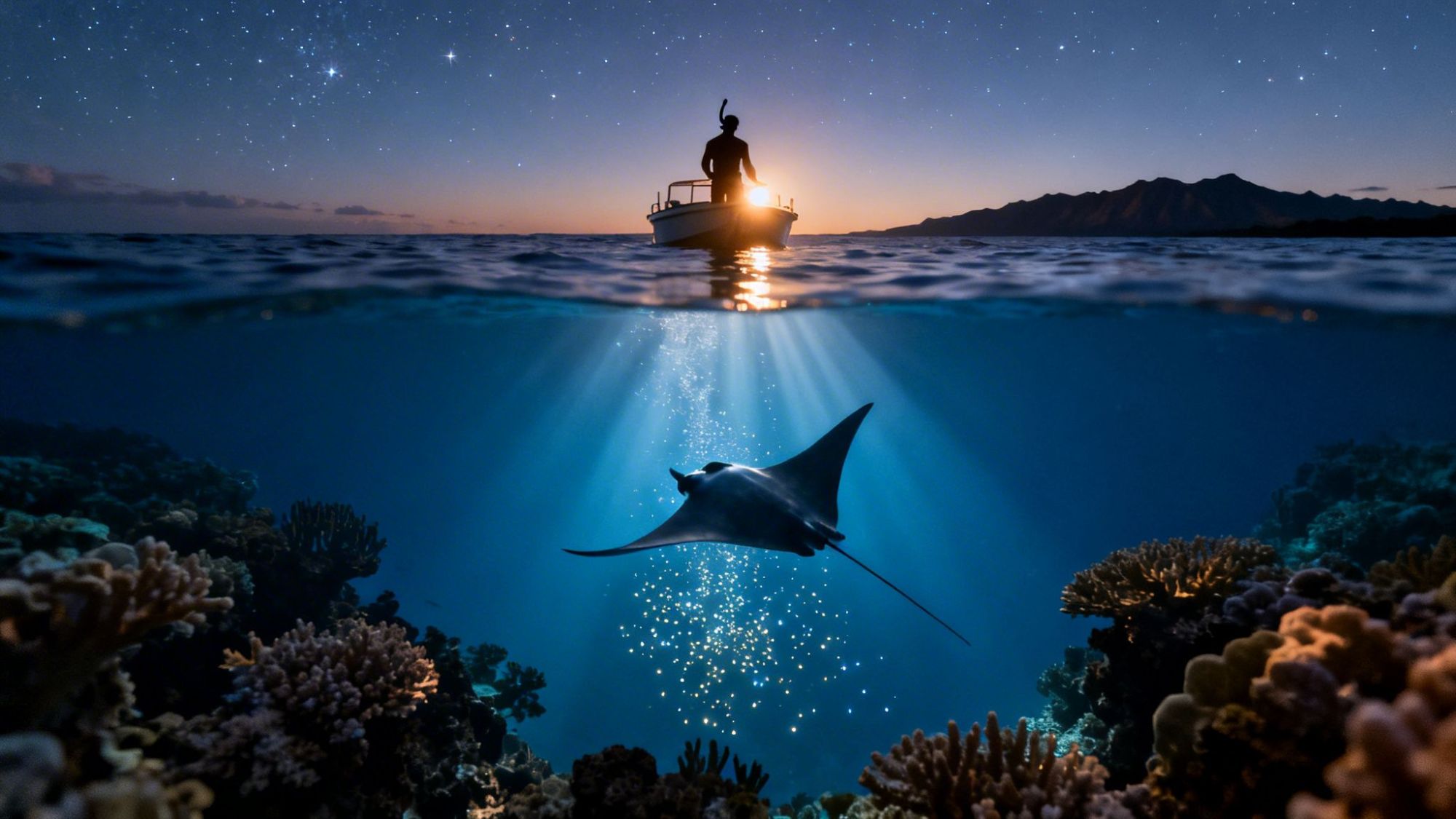
Imagine floating in the warm, dark Pacific waters off the Kona coast. Suddenly, immense, graceful shadows glide by, dancing in the light below you. This is the magic of swimming with manta rays in Hawaii—a true bucket-list adventure that connects you with one of the ocean's most majestic creatures.
This guide is your complete roadmap to planning this incredible experience.
Your Unforgettable Encounter with Hawaii's Manta Rays
We'll break down why Kona is a world-class destination for manta encounters and help you choose the perfect tour for your comfort level. We've got everything you need to know, whether you're a seasoned scuba diver or a first-time snorkeler, to make sure your trip is safe, respectful, and absolutely unforgettable.
There's nothing quite like hearing from people who have just had their minds blown by the experience. Here's what folks are saying about their recent manta adventures with Kona Snorkel Trips, the top-rated and most-reviewed snorkel company in Hawaii.

A Dance of Light and Life
People often describe the manta ray snorkel as an underwater ballet, and they're not wrong. Local tour operators have figured out a brilliant and reliable way to bring these gentle giants to the same spots, night after night.
The secret? Powerful, eco-friendly lights are submerged in the water. These lights act like a massive magnet, attracting clouds of microscopic plankton.
This cloud of plankton is the manta rays' primary food source, basically creating a dependable, all-you-can-eat buffet in the middle of the ocean. As the rays show up to feast, they perform these mesmerizing barrel rolls and graceful swoops, often coming within inches of you. It's breathtaking.
The real magic lies in the predictability. This isn't a "maybe" encounter; the unique combination of biology and smart tour practices has made Kona one of the most dependable places on Earth to witness this natural spectacle.
Getting to know these animals before you go makes the whole thing even more special. If you want to dive a little deeper, check out our article covering some fun facts about manta rays. Knowing a bit about their behavior will give you a whole new appreciation for the dance you're about to see.
What Makes Kona the Manta Ray Capital of the World

When people talk about seeing manta rays in Hawaii, they’re really talking about Kona. The Kona Coast isn't just a good spot for manta encounters; it's one of the most reliable viewing locations on the entire planet.
This incredible reliability turns manta ray diving in Hawaii from a game of chance into a nightly spectacle. It's what makes Kona the undisputed capital for these gentle giants.
The secret sauce is a perfect mix of geography, biology, and a bit of human ingenuity. The sheltered bays along the coast are naturally protected from big ocean swells, which keeps the water calm. This unique layout also helps pull nutrient-rich water up from the deep, fueling a massive and consistent population of plankton—the mantas' favorite meal.
The Underwater Buffet Is Always Open
It all started decades ago when a beachfront hotel switched on its floodlights. The lights hit the water, attracting swarms of plankton, and the local mantas quickly figured out this was an easy, all-you-can-eat buffet.
That simple discovery sparked an entire industry. Today, at famous sites like "Manta Village" and "Manta Heaven," tour operators aren't just crossing their fingers. They're setting the dinner table.
- Powerful Lights: We use powerful, eco-friendly lights submerged in the water to create an irresistible "campfire" on the ocean floor or at the surface.
- Plankton Magnet: These lights attract dense clouds of plankton.
- Learned Behavior: The local manta population knows our boats and our lights mean dinner is served. They show up night after night, almost on cue.
This learned behavior is the key to why Kona's manta tours have such an unbelievably high success rate. It’s not just luck; it’s a conditioned response that has been built over many years. This makes snorkeling and diving here a profoundly different experience than anywhere else in the world, where seeing a single manta is a rare treat.
If you’re interested in exploring more of the Big Island’s amazing underwater world, check out our guide on the best snorkeling in Kona.
You’re Meeting the Locals
Another huge piece of the puzzle is the specific type of manta ray you'll meet. Hawaiian waters are home to two species: the coastal reef manta ray (Mobula alfredi) and the more elusive, ocean-roaming pelagic manta ray (M. birostris). Here in Kona, the reef mantas are the stars of the show, and they are homebodies.
The loyalty of these rays is just incredible. Studies have shown a remarkable 76% resight rate for identified reef mantas along the Kona Coast. That means the very same individuals come back to these feeding sites over and over again.
By contrast, the bigger pelagic mantas have a much lower resight rate. It’s the reef mantas' loyalty that makes the experience so dependable for anyone on a manta ray diving Hawaii adventure. You’re not just seeing random mantas passing by; you're being welcomed into a resident community.
You can dive deeper into the science behind this incredible local population through research at the University of Hawaii's ScholarSpace. Understanding this ecosystem before you even get in the water gives you a whole new appreciation for the experience. It turns a great trip into something truly meaningful.
Choosing Your Adventure Scuba Dive or Snorkel

Alright, you’re ready for your manta ray diving Hawaii experience, but now comes the big question: scuba or snorkel? It's a common dilemma, and the truth is, there's no wrong answer. Both give you a front-row seat to one of nature’s most incredible shows.
The real difference lies in the perspective. Do you want to watch from above, or from below? Your choice will hinge on your certification, your comfort in the water, and the kind of view you’re dreaming of. Let's get into the details of each so you can pick the perfect adventure.
The Scuba Diving Perspective
Picture this: you’re calmly kneeling on a sandy patch of seafloor, about 30-40 feet down. The world above is dark, but the lights from your group cast beams into the water, and you're looking up. Suddenly, a massive, graceful silhouette glides right over your head. That's the scuba experience.
From down below, manta rays look like giant, silent bombers soaring through the night sky. You get a profound sense of their sheer size and power as they dive and loop through the light beams. It’s a humbling, immersive perspective that makes you feel like you’re truly a visitor in their world.
Of course, this view comes with a prerequisite: you must be a certified Open Water Diver. You’ll also need to be comfortable with night diving, managing your buoyancy, and handling your gear in the dark.
If you're a certified diver ready for this jaw-dropping viewpoint, we always send people to Kona Honu Divers. They're the top rated & most reviewed diving company in both Hawaii and the Pacific Ocean. Their professionalism and safety record on their premier manta ray diving tour are unmatched.
The Snorkeling Perspective
Snorkeling is a completely different kind of magic. You'll be floating on the surface, holding onto a custom-built light board that shines down into the water. This light is a dinner bell, attracting plankton and bringing the mantas right up to you.
The result is an incredibly intimate, top-down view. You'll be looking directly at the mantas as they barrel-roll just inches beneath you, their huge mouths open to feed. You can see the unique spot patterns on their undersides and witness their elegant, ballet-like motions up close. It feels less like watching and more like interacting.
The best part about snorkeling is how accessible it is.
- No certification needed: If you're comfortable in the water, you're good to go.
- Family-friendly: It's an amazing activity for families with kids or groups with mixed swimming skills.
- Less gear: No heavy tanks or complicated equipment—just a mask, snorkel, fins, and a wetsuit.
For an incredible night snorkel, we obviously recommend our own Manta Ray Night Snorkel with Kona Snorkel Trips. We live and breathe this stuff! An exceptional alternative when looking for a Manta Ray night snorkel tour is Manta Ray Night Snorkel Hawaii, who are also known for delivering amazing experiences.
Manta Ray Dive vs Snorkel A Quick Comparison
Still on the fence? This table breaks it all down to help you visualize which experience is the best fit for your trip.
| Feature | Manta Ray Scuba Dive | Manta Ray Night Snorkel |
|---|---|---|
| Viewpoint | Bottom-up: Watching mantas soar overhead from the ocean floor. | Top-down: Watching mantas feed and barrel-roll just below you. |
| Skill Level | Must be a certified scuba diver. Requires comfort with night diving. | No certification needed. Suitable for most ages and swimming abilities. |
| Equipment | Full scuba gear: tank, regulator, BCD, weights, dive computer. | Simple: mask, snorkel, and fins. Wetsuit provided. |
| Proximity | Close, but observing from a stationary position on the seafloor. | Extremely close, as mantas often swim inches from the surface light board. |
| Best For | Certified divers seeking an immersive, deep-water perspective. | Beginners, non-divers, families, and those who want an up-close view. |
At the end of the day, there isn't a "better" option—only what's better for you. Whether you decide to dive deep or float on the surface, your night with Kona's manta rays will be something you talk about for years.
If you are a diver and want to get into the nitty-gritty, you might want to check out our detailed guide to the Hawaii Big Island manta ray night dive.
Why Responsible Tourism is Critical for Hawaii's Mantas
The chance to swim with manta rays in Hawaii is an experience that stays with you forever. It's a privilege, really. But with that privilege comes a big responsibility. This isn't just another tourist box to check; it’s an up-close encounter with a wild, and surprisingly fragile, population. Thinking about why responsible tourism matters so much turns a fun night out into a meaningful act of conservation.

When you see these giants gliding effortlessly through the water, they seem invincible. The truth is, they're not. They are remarkably vulnerable, a fact that drives home how important our choices are as visitors to their home. Before booking any trip, it's worth taking a moment to think about whether it's ethical to travel to Hawaii and how you can be a positive force for the local ecosystem.
A Small and Fragile Population
Recent genetic studies have sent a real shockwave through the conservation world. We’ve learned just how small and isolated Hawaii's manta ray populations are.
For years, we relied on photo-identification, which has documented 318 unique reef mantas around the Big Island since 1979. But new genetic analysis tells a scarier story. The entire breeding population on Hawaii Island is estimated to be only about 104 adult individuals. That means the core group that ensures future generations is incredibly small.
This reality is made worse by their slow reproductive cycle. A female manta ray gives birth to just one pup every one to seven years and doesn't even start breeding until she's older.
With a tiny breeding pool and such a slow birth rate, the loss of even a single manta can have a devastating impact on the population's future. It's not a guess; it's a statistical certainty.
This is exactly why choosing an ethical, responsible tour operator isn’t just a nice-to-have—it’s absolutely critical. Supporting companies that put manta safety first and stick to strict viewing guidelines is a direct way to help the very animals we travel so far to see.
The Dos and Don'ts of Manta Ray Encounters
How you act in the water is your most direct way to help. These guidelines aren't just random rules; they're designed to protect the mantas and make sure we don't disrupt their natural feeding behaviors.
The Golden Rules for Manta Interaction:
- Do Not Touch: This is the big one. Manta rays have a protective mucus layer on their skin that acts like our immune system, shielding them from infection. Touching them strips this layer off, making them vulnerable to nasty bacteria and parasites.
- Be a Passive Observer: Think of yourself as a floating log. Avoid chasing, reaching out, or trying to "ride" a manta. Let them come to you. Their curiosity will often bring them incredibly close if you're calm.
- No Flash Photography: Sudden bright flashes can startle and disorient the mantas. It's like having a camera flash go off in your face in a dark room. Use ambient light or video lights approved by your guide.
- Minimize Splashing: When you're getting in and out of the water, try to do it as quietly as you can. A lot of splashing and noise on the surface can scare the mantas away from the light source.
Following these simple rules helps create a positive experience for both you and these magnificent creatures. For a deeper dive on how to interact with these animals, check out our guide on how to properly observe manta rays while swimming underwater.
By choosing to be a respectful guest in their ocean home, you play a direct part in protecting the future of manta ray diving in Hawaii.
Alright, you're dreaming of that magical moment with the mantas. Let's talk about the nitty-gritty of making it happen. A little planning goes a long way to ensure your manta ray diving Hawaii experience is nothing short of incredible. We'll cover when to come, what to bring, and how to handle that pesky motion sickness so you can focus on the main event.
First, the good news. You can see manta rays in Kona pretty much any night of the year. They are remarkably reliable. That said, if you have a choice, the summer months from May to September usually bring the calmest, glassiest ocean conditions. If you or anyone in your crew gets a little green around the gills on a boat, this can make a world of difference.
Conquering Motion Sickness
Even on a calm night, the gentle rocking of the boat can get to some folks. Don't let the fear of feeling queasy spoil the excitement! I've seen it happen, and a tiny bit of prep work can keep you focused on the mantas instead of your stomach.
The trick is to be proactive. Here are some remedies that people swear by, but you have to use them before you step on the boat:
- Patches: Products like the Ship-EEZ Seasickness Patch are a popular choice. You stick one behind your ear a few hours before the trip for long-lasting relief.
- Pills: Classics like Dramamine and Bonine are classics for a reason. Just be sure to take them about an hour before we leave the dock.
- Wristbands: If you want a non-drowsy option, Sea-Band wristbands use a small plastic bead to apply pressure to an acupressure point on your wrist.
- Natural Stuff: I know a lot of people who find that simple ginger chews are all they need to settle a touchy stomach.
Again, the key is using these before you feel sick. Once you're out there and feeling it, it's often too late.
Packing for Success
When it comes to packing for your manta tour, think simple. We provide all the gear you'll need in the water—snorkels, masks, fins, and wetsuits. You just need to bring a few personal things to stay comfortable.
And while we're talking about your Hawaii trip in general, don't forget sun protection! It's no joke here. This ultimate guide to sun protection has some great tips for your daytime adventures.
For the night tour itself, you just need the basics. We've put together a full rundown on what to wear for snorkeling that tells you exactly what to bring and, just as importantly, what to leave at home.
Check AvailabilityThe Foundation of a Sustainable Industry
The reason you can even plan a trip like this is because of some incredible foresight. Back in 2009, Hawaii passed a law making it illegal to knowingly kill or capture manta rays in our waters. This was a direct response to a global trade that was destroying manta populations elsewhere.
That single law helped turn Kona's manta tourism into a thriving, sustainable industry that now brings in about $4 million annually for our local economy.
It's easy to take the consistent sightings in Kona for granted, but it helps to know just how rare these animals are overall. A 19-year study across Hawaii documented 12,411 dives but only 287 manta ray sightings outside of our main viewing sites. That scarcity makes what we have here a truly precious and special thing.
The combination of legal protection and the self-regulation practiced by responsible tour operators has created a haven where the animals' well-being comes first. You can dive deeper into the history and data behind these protections to better understand manta conservation efforts in Hawaii.
When you choose a reputable tour, you're doing more than just booking an activity; you're casting a vote for a model of tourism that protects these amazing creatures for generations to come.
Your Manta Ray Diving Questions Answered
Even after you've booked your trip and the excitement is building, it’s totally normal to have a few questions rattling around. We get it. You’re about to have one of the most incredible experiences of your life, and you want to be ready.
To put your mind at ease, we’ve put together the answers to the questions we hear all the time from our guests. Think of it as a final chat with your guide before you hop on the boat.
Is Manta Ray Diving In Hawaii Safe?
This is the number one question we get, and the answer is a huge, resounding YES. They don't call these creatures "gentle giants" just because it sounds cool—it's the absolute truth.
Manta rays are completely harmless to people. Here’s why you can feel totally secure in the water with them:
- No Stingers: Unlike their stingray cousins, mantas have no barb or stinger on their tail. They have zero ability to sting you.
- No Teeth: Mantas are filter feeders. They swim with their huge mouths open to scoop up tiny plankton, not to bite anything. They physically can't bite you.
- Gentle Nature: We see it every single night. These are curious, peaceful animals. They aren’t aggressive and simply glide through the water, often just inches away, without a care in the world.
On top of the mantas being so gentle, the tours themselves are professionally run and tightly regulated. Every good operator puts safety first, with experienced guides right there in the water with you, making sure both you and the mantas are safe from start to finish.
What Is The Best Time Of Year To See Manta Rays?
Here's some great news for your travel planning: you can see manta rays in Kona year-round! The population here doesn't migrate; they live along our coast all year. This means the tours have an incredibly high success rate no matter which month you book.
That being said, if you're trying to pick the perfect time, there are a couple of small things to think about for your own comfort.
The summer months, from about May to September, usually bring the calmest ocean conditions. The water tends to be flatter and the wind is lighter, which is a big bonus if you're worried about getting seasick.
Winter can bring bigger swells, but the tours are still awesome. The captains are experts at finding the most sheltered spots and will only ever go out when it's safe. Long story short: book the trip for when it works for you. The mantas will be here.
Do I Need To Be A Certified Scuba Diver?
Not at all! This is a huge misconception. While being a certified diver is an amazing way to see the mantas from below, it’s definitely not required. In fact, snorkeling is how most people experience this, and it’s just as spectacular.
Snorkeling lets you float comfortably on the surface, holding onto a light board. You get this incredible bird's-eye view as the mantas do graceful barrel rolls right underneath you. It's the perfect option for:
- Anyone who isn't a certified diver
- First-time snorkelers
- Families with kids and teens
- Groups where some people dive and others don't
If you are a certified diver, the view from the ocean floor is breathtaking. For that, we can't recommend Kona Honu Divers enough. They're the top rated & most reviewed diving company in both Hawaii and the Pacific Ocean, and their manta ray diving tour is famous.
But for most folks, the snorkel is the way to go. It's less gear, no certifications needed, and gives you a front-row seat to the show.
What If I Am Not A Strong Swimmer?
No problem at all. You don’t need to be an Olympic swimmer to enjoy the manta snorkel. The whole experience is designed around floating and watching, not swimming laps.
Once you’re in the water, you'll be holding onto a large, custom-made flotation board where the lights are mounted. This board is super stable and buoyant. Your job is just to hold on, float, and watch the magic unfold below.
Plus, we provide everyone with a wetsuit, which naturally makes you even more buoyant. You can literally just lie back and relax. Our guides are in the water the whole time, making sure everyone is comfortable. All you have to do is breathe through your snorkel and take it all in.
Why Are The Tours Always At Night?
The entire Kona manta ray experience relies on a simple, brilliant chain of events that only works after dark. It’s all about the food.
Here's how it goes down every single night:
- Sun Goes Down: The ocean gets dark.
- Lights Go On: We shine powerful, eco-friendly lights into the water.
- Plankton Arrive: Just like moths to a flame, these lights attract huge clouds of microscopic plankton.
- Dinner Bell Rings: The local mantas have learned this routine over decades. They show up for a reliable, all-you-can-eat plankton buffet.
This is precisely why manta ray diving in Hawaii happens at night. During the day, the plankton are scattered, so the mantas are too. The lights are the secret sauce that brings the food, which brings the mantas right to us for that unforgettable show.
Your incredible adventure with Hawaii’s gentle giants is just a booking away. When you go with a passionate, reputable guide, you’re not just getting a memory for a lifetime—you’re also helping protect these amazing animals.
For a trip you'll never forget, book your tour with Kona Snorkel Trips. We're Hawaii's highest-rated and most-reviewed snorkel company, and we can't wait to share the magic of the mantas with you. Check out our availability on the Manta Ray Snorkel Kona page.