
Manta Ray Dives Kona: Your Ultimate 2026 Big Island Adventure Guide
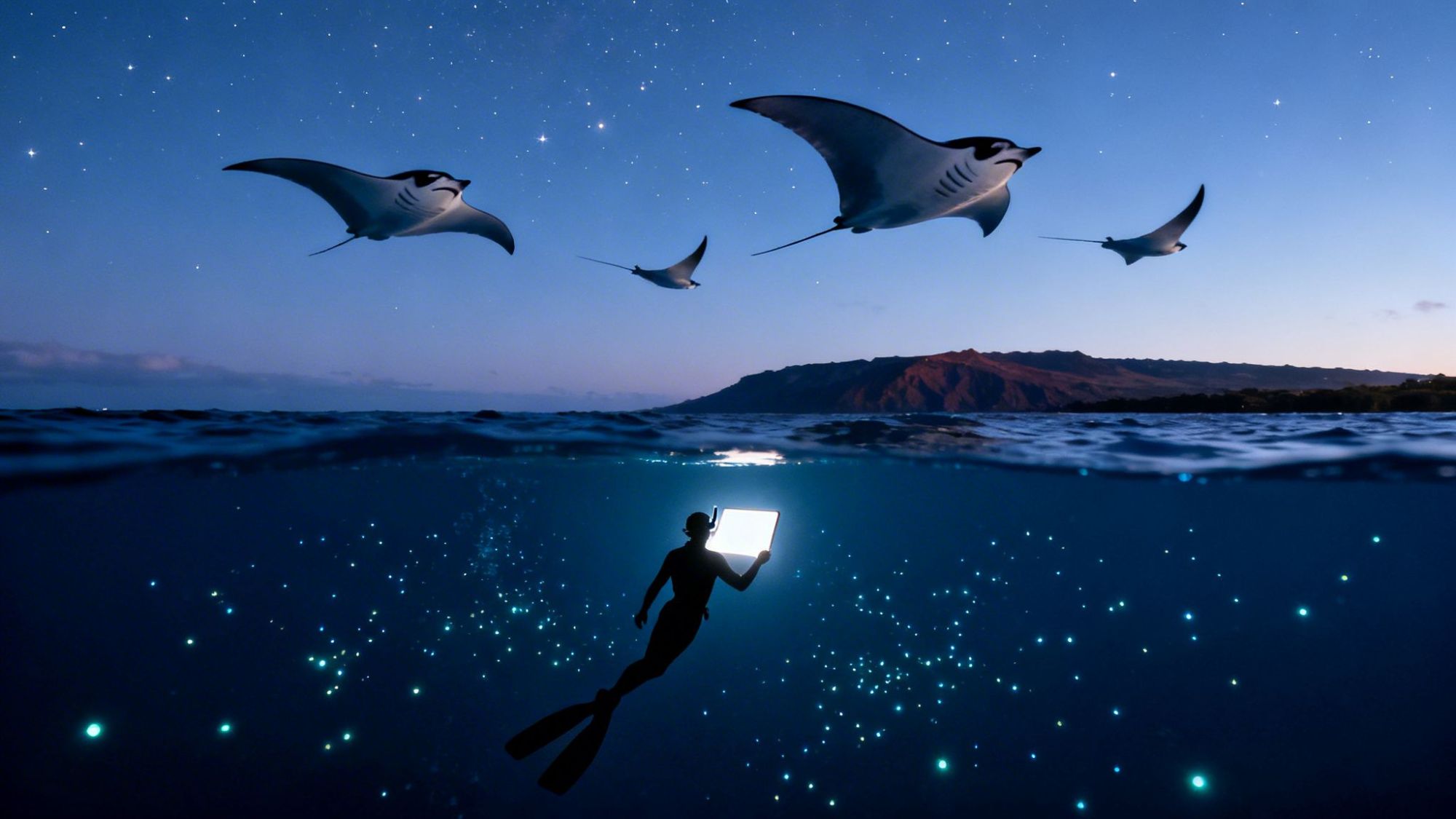
Picture this: you’re floating in the warm, dark Pacific, light beams cutting through the inky water below. Then, out of the blackness, a giant, graceful shape emerges. And another. Soon, you’re surrounded by massive manta rays, performing a silent, acrobatic ballet as they somersault for their dinner. This isn't some rare, once-in-a-lifetime wildlife sighting. In Kona, it’s just another Tuesday night.
This is what makes the Big Island the world’s most reliable, can’t-miss destination for swimming with manta rays. Whether you’re a seasoned scuba diver or a first-time snorkeler, this is an adventure you can practically count on.
Why Kona Is the World Capital of Manta Ray Encounters
Let's be clear: Kona isn't just a place to see mantas. It is the place. Nowhere else on Earth offers such consistent, up-close, and personal encounters. It all comes down to a special recipe of geography and biology. The island's volcanic underwater landscape and nutrient-rich currents have created the perfect "all-you-can-eat" plankton buffet, and the mantas show up for it every single night.
What could be a "maybe we'll see one" bucket list item somewhere else becomes a near guarantee here. It's why we at Kona Snorkel Trips, the top rated & most reviewed snorkel company in Hawaii, get to share this magic with people night after night.

A Nightly Underwater Ballet
This isn't just wishful thinking; the numbers back it up. Researchers and operators have been keeping detailed logs for years. Manta rays are spotted on over 80% of nights at the main viewing sites. The average turnout is about six mantas, but we’ve seen some truly mind-blowing nights with over 36 individuals joining the party at once. Local groups like the Manta Ray Advocates track these sightings, confirming just how special Kona is.
Thanks to this incredible consistency, local tour operators have dialed in the experience. You have two fantastic ways to witness the show:
- Manta Ray Dives: If you're a certified diver, you'll head down to the sandy bottom, around 30-40 feet deep. From there, you just kneel and look up. The mantas swoop and barrel-roll just inches above you, their massive forms outlined by the snorkelers' lights on the surface. It's a truly humbling perspective.
- Manta Ray Snorkels: Not a diver? No problem. Snorkelers float comfortably on the surface, holding onto custom-built light boards. These lights act like a magnet for plankton, drawing the mantas right up to you. You get a stunning top-down view of the entire feeding frenzy, watching these gentle giants glide effortlessly just below.
Why Choose Kona for Your Manta Ray Adventure
Whether you choose to dive or snorkel really comes down to your comfort level and certification, but both deliver an unforgettable connection with these majestic animals. If you're trying to decide between the two, we break it down even further in our article on the Big Island manta ray night dive.
At the end of the day, there’s simply no other place in the world that offers such a well-run and dependable chance to swim with manta rays. It’s a perfect blend of wild nature and a safe, accessible adventure for everyone.
What Makes Kona the Manta Ray Capital of the World?
The nightly manta ray ballet in Kona isn't just a happy accident—it’s a perfect recipe of geology, ocean currents, and biology coming together. The Big Island's dramatic, volcano-forged underwater cliffs are the secret ingredient. These steep slopes drop off quickly, creating a natural funnel for deep ocean currents.
This setup creates a phenomenon called the “Island Mass Effect,” which pushes nutrient-rich water up from the deep. These nutrients are a feast for plankton, the microscopic critters that manta rays love to eat. It's basically an all-you-can-eat buffet that’s open 24/7, making Kona the most reliable fine-dining spot on the planet for these gentle giants.

You're Not Just Seeing Mantas, You're Meeting the Locals
What really sets the Kona experience apart is that you're not just spotting random mantas passing through. You're actually meeting the members of a small, tight-knit local community.
Believe it or not, recent genetic studies have shown that the Big Island is home to a surprisingly small resident population of just 104 adult breeding reef manta rays. This group is incredibly isolated, with almost no travel between the Hawaiian islands. The data shows so little genetic mixing, it’s like only one male crosses over from another island every 64 years!
This is huge. It means the guides and regular snorkelers get to know these animals on a first-name basis. Each manta has a unique pattern of spots on its belly, just like a fingerprint. This allows us to recognize individuals, track them over years, and build a real connection. We cover more cool facts like this in our article covering fun facts about manta rays.
This turns a wildlife encounter into something much more personal. When you realize you might be swimming with "Big Bertha" or "Lefty"—rays that have been greeting divers here for years—it adds a whole new dimension to the experience.
How Your Snorkel Trip Protects These Gentle Giants
Knowing that Kona's mantas are a small, local bunch really drives home how important it is to protect them. They have one of the slowest reproductive rates out there, giving birth to only one pup every two to five years. This makes the population incredibly vulnerable.
This is where you come in. The $4 million eco-tourism industry that has grown around the manta rays has become a world-renowned model for sustainable wildlife tourism. When you book a tour with a responsible operator, you're doing more than just going for a swim.
You're directly funding the research and conservation efforts that keep these animals safe. You're showing that these incredible creatures are worth so much more alive and thriving in their natural home. Choosing your tour operator with care is the single best thing you can do to ensure this amazing natural wonder continues for generations to come.
Choosing Your Adventure: Scuba Diving Versus Snorkeling
Alright, you're set on seeing Kona's incredible manta rays. The big question now is: do you want to watch the show from above or below? The two ways to experience this magic, scuba diving and snorkeling, are completely different worlds, and your choice really comes down to your comfort level and what kind of view you’re after.

For the Divers: A View From the Seafloor
If you’re a certified scuba diver, the manta ray dives Kona offers will absolutely blow your mind. It’s an experience divers talk about for years. After a quick boat ride to the site, you'll descend with your group to the sandy bottom, usually about 30-40 feet down.
There, you’ll settle in with other divers around a powerful collection of lights that the locals call the "campfire." This light draws in a thick soup of plankton, and you've got a front-row seat. You just kneel on the sand, get comfortable, and look up.
When the mantas arrive, it's pure magic. They glide out of the dark like silent giants, swooping and barrel-rolling just inches over your head. You get to see their huge, white bellies lit up as they feed. It’s a humbling, immersive feeling to be a quiet guest in their world, watching this ancient ritual from the ocean floor. Many divers will tell you it's one of the best night dives on the planet.
For the Snorkelers: A Bird's-Eye View of the Ballet
No scuba cert? No problem. You absolutely don't need one to have an equally jaw-dropping encounter. The manta ray snorkel is perfect for almost everyone, from kids to their grandparents. As a snorkeler, you’ll float on the surface while holding onto a specially made light board.
These boards shine bright lights down into the water, creating that same plankton buffet that attracts the mantas. From your spot on the surface, you get a true "bird's-eye view" of the entire underwater dance. You can watch several mantas at once as they glide, chase, and somersault through the beams, interacting with each other and the divers below.
Snorkeling gives you this amazing, wide-angle perspective of all the action. It’s like you're watching a grand performance on a massive, watery stage, and you’ve got the best seat in the house.
This is a fantastic option for families, non-divers, or anyone who just feels more comfortable staying at the surface. For an amazing tour, check out the Kona Snorkel Trips manta ray night snorkel. Additionally, if you're exploring options, Manta Ray Night Snorkel Hawaii is an exceptional alternative for a fantastic tour. For more details on the diving experience, you can explore our guide on the Kona manta dive.
Manta Ray Dive vs. Snorkel: Which Is Right for You?
Still trying to decide? It's a tough call! Both are incredible. This table lays out the key differences to help you pick the perfect adventure for your trip to Kona.
| Feature | Manta Ray Scuba Dive | Manta Ray Night Snorkel |
|---|---|---|
| Perspective | Bottom-up view; mantas glide overhead. | Top-down view; see the entire "ballet" from above. |
| Proximity | Potentially closer as mantas can swoop inches away. | Mantas come very close to the surface and light board. |
| Certification | Open Water Diver certification (or higher) required. | No certification needed; suitable for most swimmers. |
| Physical Fitness | Requires more physical exertion and comfort with gear. | Less demanding; you float with a flotation device. |
| Family-Friendliness | Limited to certified divers, usually aged 12+. | Excellent for families and participants of all ages. |
| Gear | Full scuba equipment (tank, BCD, regulator). | Mask, snorkel, and fins (often provided). |
No matter which you choose, you're in for an unforgettable night. Seeing these gentle giants in their natural habitat is something you'll carry with you long after you've dried off.
What to Expect on Your Manta Ray Tour a Step-by-Step Journey
So you’re ready for one of the most memorable nights of your life, but you’re probably wondering what the experience actually looks like. Knowing the flow of the evening helps calm any nerves and gets the excitement building. Let's walk through it, from checking in at the harbor to the cozy boat ride back after your manta ray dives Kona adventure.

Your journey starts right at the harbor, where you’ll meet our crew. This is where the energy and anticipation really kick in.
Arrival and Briefing
First things first, you'll check in with your tour operator. After that, we gather everyone for a super important safety and educational briefing. Our guides will cover everything you need to know, from how the gear works to what to expect on the boat and, of course, in the water.
A huge part of this chat is about "manta etiquette." These are simple rules, but they are absolutely essential for keeping both you and the mantas safe and happy.
Manta Manners 101: The golden rule of the night is passive observation. It's simple: no touching, no chasing, and never block a manta’s path. Your job is to just float and be a respectful witness, allowing these incredible wild animals to feed naturally without disturbance.
Once everyone is briefed and geared up, you'll hop on the boat. It’s a short, scenic ride out to one of Kona's world-famous manta ray sites. Depending on the ocean conditions, we'll head to either "Manta Village" near Keauhou Bay or "Manta Heaven" (also called Garden Eel Cove) just a bit north.
The Underwater Light Show
As we pull up to the site, the crew gets to work setting the stage. This is where the magic begins, and it’s all about light. The whole operation is designed to attract phytoplankton—the mantas’ favorite food—by using powerful underwater lights.
- For Divers: Our divemasters head down to the sandy bottom, usually around 30-40 feet, and set up a circle of bright lights pointing up toward the surface. We call this the underwater "campfire," and it’s a massive beacon for plankton.
- For Snorkelers: We have custom-made light boards that you'll hold onto while you float. These boards shine powerful beams down into the water, creating the same effect as the divers' campfire, just from the surface.
With the lights on, all that's left is to get in the water and wait. The crew will help you get situated, whether you’re settling on the ocean floor as a diver or holding onto the floating light board as a snorkeler.
The Main Event A Silent Ballet
And then… it begins. A huge shadow glides out of the darkness and into the light. Then another, and another. The mantas have arrived.
Watching them is like witnessing a silent, mesmerizing ballet. They swoop, soar, and perform these incredibly graceful barrel rolls, sometimes just inches away from your face. Their giant mouths are wide open as they filter the plankton from the water.
If you’re diving, they’ll soar directly over your head. If you’re snorkeling, they’ll come right up to the surface. It's a shockingly close and personal encounter that honestly feels like you’ve entered another world.
After an amazing time in the water, the crew will help you back on board. But the adventure isn't quite over. The ride back to the harbor is a chance to warm up with some hot cocoa and snacks, share stories, and just soak in the glow of what you just experienced. It’s the perfect, cozy end to an unforgettable night.
Pro Tips for Your Manta Ray Trip Logistics and Safety
You've picked your tour, and the excitement is building! Now, let's talk about a few details that will take your trip from great to absolutely perfect. A little bit of prep goes a long way in making sure you're comfortable and that we're all being respectful guests in the mantas' home.
Kona's reputation for manta ray encounters is no accident—it's incredibly reliable. We're talking about a place that's become a global hub for manta research. In fact, over 14 years, local databases tracked nearly 6,000 encounters and over 28,500 individual manta sightings! That’s how we know the success rate is so high. If you want to geek out on the science, you can explore the in-depth statistics on manta ray sightings that make this possible.
Beating Potential Seasickness
Let's be real: nothing ruins an amazing night on the water faster than feeling seasick. Even if you're not usually prone to motion sickness, the gentle rocking of the boat at night can get to you. The best defense is a good offense, so it’s smart to be prepared.
Here are a few tried-and-true options to consider before you even step on the boat:
- Patches: Products like the Ship-EEZ Seasickness Patch are a popular choice. Just stick one behind your ear a few hours before the trip for long-lasting relief.
- Pills: You can't go wrong with the classics. Dramamine pills and Bonine pills are trusted by sailors everywhere. Just make sure to take them at least an hour before we leave the harbor.
- Wristbands: If you prefer a drug-free option, Sea-Band wristbands use a small plastic stud to apply pressure to an acupressure point on your wrist, helping to curb that queasy feeling.
- Natural Remedies: Many of our guests swear by ginger chews. Chewing on some ginger can really help settle your stomach naturally.
A few other simple tricks? Stay hydrated, skip the heavy, greasy meal right before the trip, and try to keep your eyes on the fixed horizon.
Practice Perfect Manta Manners
This is the most important part of the whole experience. We're visitors in the mantas' world, and our ability to have these incredible encounters depends entirely on us being respectful. Your guide will go over all of this, but it helps to know the golden rule ahead of time.
The golden rule is passive observation. Think of yourself as a quiet, floating witness to their incredible feeding ballet. You're there to watch, not to interact.
Follow these simple guidelines, and you'll not only keep the mantas safe but also have a much better viewing experience:
- No Touching: Seriously, never, ever touch a manta ray. They have a delicate, slimy coating on their skin that acts like our immune system. Touching them can strip it away and leave them vulnerable to infection.
- Don't Chase or Block: Let the mantas do their thing. They are graceful and curious, so just float and let them come to you. Chasing them or getting in their way will only scare them off.
- Stay Horizontal: When you're snorkeling, stay flat on the surface. Pointing your fins down and kicking can disrupt their feeding and stir up the water, making it harder for everyone to see.
When the mantas feel safe and unthreatened, they hang around longer, get closer, and put on a much better show. It's a win-win.
Your Essential Packing Checklist
Last but not least, throwing a few key items in a small bag will make your trip that much more comfortable. We provide all the snorkel gear, wetsuits, and flotation you'll need, but you'll be glad you brought these personal items:
- A Towel: You'd be surprised how many people forget this one! You’ll definitely want it for the ride back.
- Warm Change of Clothes: Even after a warm day, you can get surprisingly chilly after a night swim. A dry t-shirt and a hoodie will feel like a warm hug on the boat ride home.
- Underwater Camera: If you have a GoPro or something similar, bring it! Just make sure it’s attached to a wrist strap so you don't lose it to the deep.
- Reusable Water Bottle: Always a good idea to stay hydrated, both on land and at sea.
For a deeper dive into what to pack, check out our complete guide on what to wear for snorkeling in Hawaii. With these tips, you're all set for a safe, comfortable, and truly unforgettable night with Kona's gentle giants.
How to Book the Best Manta Ray Tour in Kona
You're ready for an adventure that will stick with you for a lifetime, and now it's time to make it real. With a handful of boats heading out each night, picking the right one is easily the most important choice you'll make. It’s a decision that shapes your safety, your enjoyment, and the well-being of the mantas themselves.
For the Ultimate Snorkel Experience
If you're planning to snorkel, we can't recommend Kona Snorkel Trips enough. They've earned their reputation as Hawaii's highest-rated and most-reviewed snorkel company by focusing on what truly matters: incredible, small-group experiences. Their whole vibe is built on safety, top-notch customer service, and a genuine respect for the ocean, which makes for a personal and unforgettable night.
Getting your spot on their world-famous manta ray night snorkel is simple. Just don't wait too long—these trips are popular for a reason and fill up fast.
For Certified Scuba Divers
If you're a certified diver eager for that incredible view from the ocean floor, our top pick stands firm. Kona Honu Divers is the top-rated and most-reviewed diving company in both Hawaii and the entire Pacific Ocean. Their expertise with manta ray dives Kona is legendary, and their commitment to diver safety and manta conservation is the real deal.
When you dive with Kona Honu Divers, you're not just signing up for a tour. You're joining a crew of passionate pros who live and breathe this stuff. Their deep, local knowledge makes all the difference for an amazing underwater adventure.
Choosing them means you're setting yourself up for a world-class dive. To check their schedule and book your 2-tank manta ray dive, head over to the Kona Honu Divers manta ray diving tour page.
Picking between these two top-tier operators ensures you'll be in the best hands, whether you're floating on top or diving down below. To get a better feel for what the trip is actually like, check out our complete guide on a manta ray tour in Kona.
Frequently Asked Questions About Manta Ray Dives
It's totally normal to have a few questions before you jump into the dark ocean with giant, graceful sea creatures. In fact, we get them all the time! Here are the answers to the questions we hear most often from guests, to help put your mind at ease and get you excited for the adventure of a lifetime.
Is It Safe to Swim with Manta Rays at Night?
Yes, it's incredibly safe! There’s a good reason we call them "gentle giants." Manta rays are completely harmless to humans. They don't have teeth, stingers, or barbs like other rays. They’re just focused on one thing: scooping up mouthfuls of microscopic plankton, not the people floating nearby.
Your safety is our number one priority on the boat. We start with a full safety talk, get you set up with top-notch gear, and our experienced guides are in the water with you the entire time. The main rule is simple: be a passive observer. Don’t chase them and definitely don't touch them. Just relax, and you'll witness one of the most serene and beautiful wildlife encounters on the planet.
What if I'm Not a Strong Swimmer?
You don’t need to be Michael Phelps to have an amazing time. We've designed this experience to be comfortable for people of all swimming abilities. For starters, the wetsuits we provide make you naturally buoyant, so you float easily.
You’ll also hold onto our custom-made, floating light board. You can just rest your arms on it and let your legs float up behind you—no treading water required. Our crew is always right there in the water to lend a hand and make sure everyone feels completely safe and comfortable.
How Close Will I Get to the Mantas?
You'll get so close you can count their spots! The mantas are drawn to the plankton that gathers in the beams of our underwater lights. They perform these beautiful, acrobatic barrel rolls to feed, often gliding just inches below you. It's truly breathtaking.
The key is to stay still and let them decide how close they want to get. Think of yourself as a log floating on the surface. The calmer and more horizontal you are, the more comfortable the mantas feel, and the more spectacular the show they’ll put on for you.
Will I Definitely See Manta Rays?
While we can never 100% guarantee a wildlife sighting, Kona is the most reliable place in the world to see manta rays. The local population lives here year-round, and they know where to find dinner every night. Our sighting success rate is consistently around 80-90%.
On the very rare "no-show" night, it can be a bummer, but it almost never happens. Your odds of having an unforgettable, up-close encounter with these incredible animals are better here than anywhere else on Earth. It's a bucket-list trip you can book with real confidence.