
Manta Ray Dives Kona Your Essential 2026 Guide
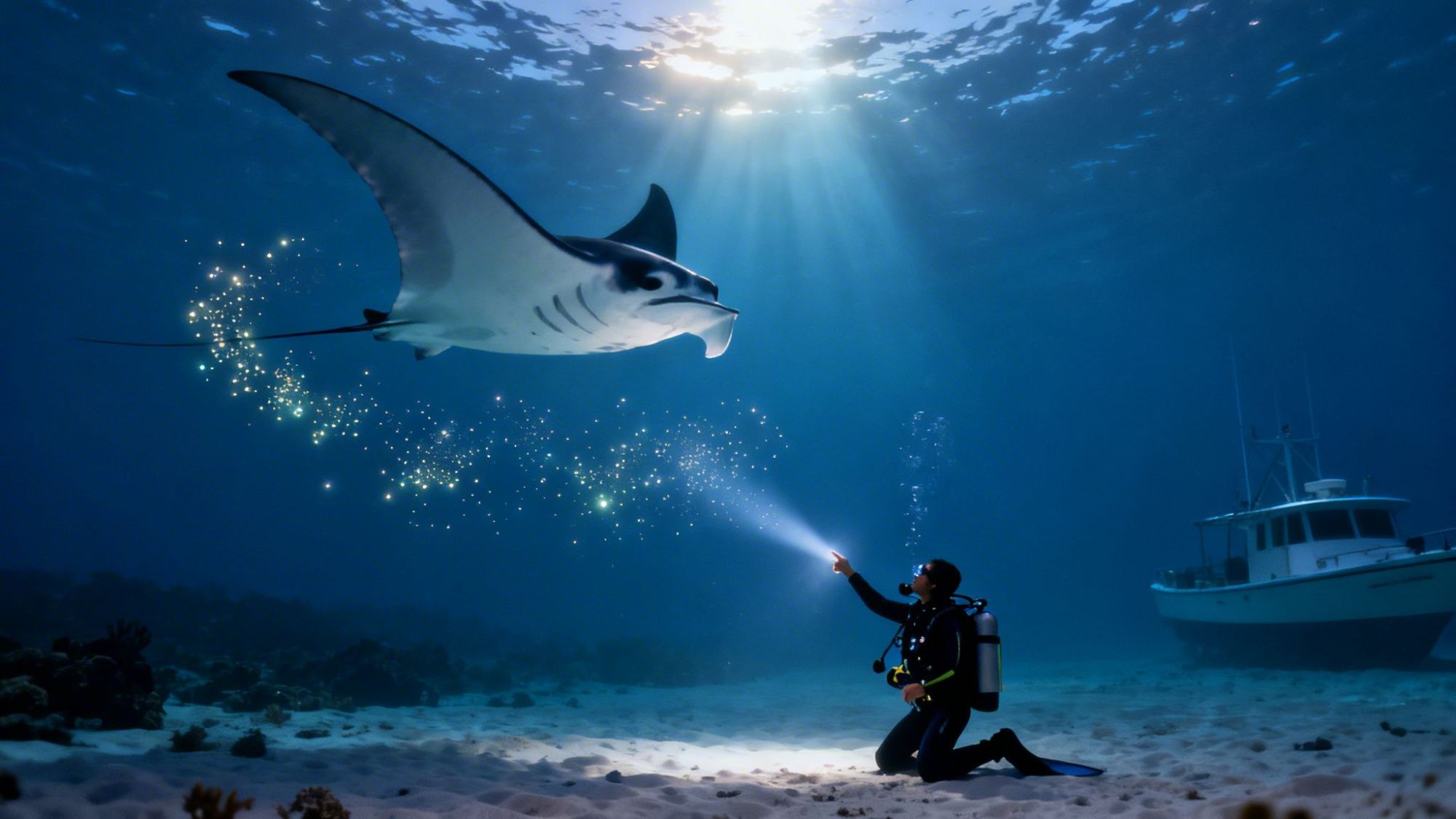
Picture this: you're slipping into the warm, dark waters of the Kona coast just as the sun dips below the horizon. Below you, giant, graceful shadows begin to twist and glide in an underwater ballet. This is the world-famous Kona manta ray dive, and you’re about to have a front-row seat.
Your Kona Manta Ray Adventure Awaits
We'll get into exactly why this nightly spectacle happens so reliably here in Kona and give you the insider scoop you need to pick the perfect trip for your own manta ray dives Kona. As Kona Snorkel Trips is the top rated & most reviewed snorkel company in Hawaii, we've shared this magic with countless visitors, and we're excited to help you plan your own incredible encounter.

The Big Island is truly ground zero for this must-do activity. While many wildlife tours can be a roll of the dice, Kona's manta ray trips have an unbelievable success rate, often hitting over 90%. It’s one of the few wildlife encounters in the world that’s practically a guarantee.
It's the kind of once-in-a-lifetime moment that makes for incredible gift experiences. You're not just getting a ticket for a tour; you're giving someone a chance to connect with some of the most majestic creatures in the ocean.
Why Is This Experience So Special?
What sets the manta ray dives in Kona apart is that you aren't chasing the mantas—they come to you. The whole thing is wonderfully passive. We've figured out that by shining powerful lights into the water, we can attract a massive buffet of plankton, the mantas' favorite food.
The result? These gentle giants put on an acrobatic show, doing barrel rolls just inches from your face to scoop up the plankton. It's a feeding frenzy, and you're right in the middle of it.
Best of all, almost anyone can do it. There are two amazing ways to see the show:
- Scuba Divers: You get to kneel on the sandy ocean floor, about 25-35 feet down, and watch the entire ballet unfold from below. It's a completely immersive, "front-row" seat.
- Snorkelers: You'll float comfortably on the surface, holding onto a custom light board. This gives you a breathtaking "bird's-eye" view as the mantas swoop and soar right underneath you.
Both options are incredible, just different. As you think about your trip, it’s worth checking out all the amazing underwater sights Kona has to offer. You can learn more about the best snorkeling in Kona in our complete guide.
Why Kona Is The Manta Ray Capital Of The World
Ever wonder what makes Kona the undisputed home for manta ray dives? It's not just blind luck. It’s the perfect storm of geography, a bit of biology, and a happy accident that happened decades ago. This combination has made the Kona coast the most reliable place on Earth to see manta rays, turning a wildlife gamble into a near-nightly spectacle.
The whole thing started unintentionally. Years ago, a hotel flicked on its bright lights, illuminating the ocean water. This attracted swarms of plankton, and the local manta rays quickly figured out it was an easy, all-you-can-eat buffet. Think of it as the ocean's first food truck rally.

Today, we responsible tour operators simply recreate that phenomenon. We use powerful, eco-friendly lights submerged in the water to create a consistent "plankton bonfire." This predictably draws the rays to a few specific spots, night after night. You can dive deeper into some fun facts about manta rays to really appreciate these gentle giants.
Iconic And Reliable Manta Viewing Sites
This nightly dinner service has created a few legendary viewing areas, most famously "Manta Heaven" and "Manta Village." These aren't just random spots in the ocean; they are established feeding grounds where generations of mantas have learned to show up for a reliable meal. That reliability is what puts Kona on the map.
The consistency is just incredible. Tour operators here report an astounding 85-90% success rate for manta sightings. That's a figure that truly cements Kona's reputation. Underwater videographers who have kept records for years confirm that mantas show up almost every single night. You can even explore some of the numbers yourself over at MantaRayAdvocates.com.
What's so special is that this is a human-assisted but completely natural behavior. It has created a sustainable, jaw-dropping experience that lets us get unbelievably close to these majestic animals in a way that’s totally passive and non-intrusive.
This predictable gathering is what makes manta ray dives in Kona so special. You aren't searching for the mantas; you are setting the dinner table and patiently waiting for your magnificent guests to arrive for their nightly feast.
Choosing Your Adventure: Scuba Dive Or Night Snorkel
Alright, you're ready for the magic of the Kona manta ray ballet. Now for the big decision: will you be watching from above or below? Deciding between scuba diving and snorkeling with the mantas is a choice between two completely different, but equally amazing, worlds.
Both give you a front-row seat, but the perspective is night and day.

It really just boils down to your comfort level in the water, whether you're a certified diver, and what kind of memory you want to make. One isn't "better"—they're just two unique ways to witness the same incredible event.
To help you figure out which is the right fit, here's a quick side-by-side look.
Dive Vs Snorkel: A Quick Comparison
| Feature | Scuba Diving | Night Snorkeling |
|---|---|---|
| Perspective | Bottom-up, looking towards the surface | Top-down, looking into the depths |
| Manta Behavior | Mantas barrel roll inches above you | Mantas swoop right up to the surface |
| Requirements | Open Water Diver Certification required | No certification needed, all abilities welcome |
| Experience | Immersive, part of the underwater world | Face-to-face, floating effortlessly |
| Depth | ~30-40 feet on the sandy bottom | On the surface, holding a light board |
Ultimately, both paths lead to an unforgettable encounter. It just depends on which view you'd rather have.
The Scuba Diving Experience
If you're a certified diver, this is an experience that will stay with you forever. Picture this: you're kneeling calmly on the sandy ocean floor, about 30-40 feet down. You become part of the seascape. Your flashlight points up, creating a column of light that illuminates the plankton, and the show begins.
From this vantage point, you watch the giant mantas glide, loop, and barrel roll just inches over your head. It’s breathtaking.
This bottom-up view is absolutely awe-inspiring. You get a true sense of their massive scale and incredible grace as they perform their feeding dance against the dark water above. It feels like you have a private ticket to the most exclusive theater on Earth.
For a truly top-tier dive, we always send people to Kona Honu Divers. As the top rated & most reviewed diving company in both Hawaii and the Pacific Ocean, you'll be in the best hands. You can also get a deeper look at what it's like from this perspective in our full guide to the Kona manta dive experience.
The Night Snorkeling Experience
Not a certified diver? Don't worry for a second. The manta ray night snorkel is just as mind-blowing and is open to pretty much everyone, no matter your swimming skill. It's an incredibly accessible adventure.
As a snorkeler, you'll float on the surface, holding onto a custom light board. We call it the "campfire." This board's powerful lights shine down, creating the plankton buffet that brings the mantas right to you.
From this bird’s-eye view, you get to see the mantas soar and swoop directly beneath you. They come so close, often just inches from the surface, performing their graceful acrobatics right in the light beams. It’s an unbelievable, face-to-face encounter, and you don't need any scuba gear to experience it.
For a world-class snorkel trip, check out our own Kona Snorkel Trips manta ray tour page. Another fantastic operator we recommend is Manta Ray Night Snorkel Hawaii, who is an exceptional alternative when looking for a Manta Ray night snorkel tour.
Meet The Famous Residents Of Manta Village
When you go on one of the manta ray dives Kona is famous for, you're not just seeing random wildlife passing through. You're actually meeting the locals. The manta rays here are a well-known community, and many of them have been spotted in the same places for years. This turns a simple wildlife viewing into something deeply personal.

This amazing connection is possible because every single manta ray has a unique pattern of spots on its belly. Just like a human fingerprint, no two are the same. This natural marker lets researchers and our guides use photo identification to recognize and track individual rays, sometimes for decades!
Because of this, many of Kona's resident mantas have been given names. You might hear your guide point out local celebrities like "Big Bertha," "Lefty," or "Amanda Ray." Knowing you could be swimming with a specific, named individual adds a whole new layer to the experience.
A Special And Fragile Population
That feeling of connection you get is backed up by some serious science. The group of rays you see is remarkably small and stays very local. This makes every single encounter special and really drives home the need for responsible, respectful tourism.
The fact that you can meet the same individual rays night after night transforms your dive from a simple viewing into a genuine encounter. It’s a chance to connect with a known personality, not just an anonymous animal.
Recent genetic studies from 2023 confirmed what we've long suspected: Hawaiʻi Island's reef manta rays are genetically isolated. The effective population size is a modest 104 adults. Researchers have built a photo-ID catalog of 318 unique individuals between 1979 and 2023, with many rays staying close to their favorite feeding spots for up to a year and a half. To get a feel for their world, explore how these incredible animals move and swim underwater. You can even read the full research on this unique population here.
This intimate knowledge is what makes a manta ray dive in Kona so incredibly special. It also highlights just how fragile this small, isolated group is and reinforces why it’s critical to choose tour operators who put the rays' health and safety first. Your dive becomes part of a long-standing tradition of observation and respect.
How To Prepare For A Comfortable Night On The Water
A little bit of prep goes a long way in making your manta ray trip truly incredible. When you're comfortable, you can forget everything else and just soak in the underwater magic. Here’s my guide-tested checklist for staying cozy and ready for an amazing night.
We provide all the important in-water gear—high-quality masks, snorkels, fins, and wetsuits. Your main job is to think about what you’ll need on the boat, especially for that ride back to the harbor after you get out of the water.
What To Bring For Your Tour
Packing for this adventure is pretty simple. The big secret is planning for warmth and comfort, especially after your swim. The boat ride back can feel surprisingly chilly, even on a warm Hawaiian night.
Here's what should be in your bag:
- Swimsuit: The easiest thing is to just wear it under your clothes to the harbor.
- Towel: An absolute must for drying off.
- Warm, Dry Clothes: This is the most important one! After being in the ocean, a hoodie, sweatpants, or a simple windbreaker will feel like a million bucks on the ride home.
- Reusable Water Bottle: Always a good idea to stay hydrated.
For a more detailed look at what to wear for water activities in Hawaii, you can learn more about what to wear for snorkeling in our guide.
Preventing Seasickness On Your Manta Ray Dive
Let's talk about seasickness. It can happen to anyone out on the water, even if you’ve never been motion sick in your life. The last thing you want is to feel queasy when the mantas are putting on their incredible show.
Luckily, there are some super easy and effective ways to make sure you feel great the whole time. The key is to be proactive.
Don't let a little motion on the ocean ruin a once-in-a-lifetime encounter. A simple preventative step an hour or two before the tour is all it takes to keep your focus on the main event.
If you know you're prone to motion sickness, or just want to be extra sure, grab one of these over-the-counter options. We see guests use them all the time with great results:
- Ship-EEZ Seasickness Patch: A simple patch you just stick behind your ear.
- Dramamine pills: The classic, tried-and-true choice.
- Bonine pills: Another popular option, famous for being less drowsy.
- Sea Band wristbands: A drug-free choice that uses acupressure.
- Ginger chews: A great natural way to help settle your stomach.
Taking care of this before you even get on the boat is the best play. It's a tiny step that guarantees your attention will stay right where it belongs: on the magnificent manta rays gliding below.
Booking An Ethical And Unforgettable Tour
Alright, this is probably the single most important decision you'll make when planning your manta trip. Picking the right tour operator isn't just about getting a good deal—it affects your safety, your enjoyment, and most importantly, the well-being of the very mantas we're all here to see.
This is exactly why the "Manta Ray Green Listed" operator certification was created. It's a way to recognize the companies that are truly committed to protecting the rays and their home. The whole program is built around one simple, crucial idea: passive interaction.
The Golden Rule: Passive Interaction
Think of passive interaction as being a respectful guest in the mantas' house. We're there to observe, not to interfere. The goal is to create a calm space where the mantas can go about their business—feeding on plankton—without feeling bothered or threatened by our presence.
The rules are simple, and they're for everyone's safety, both human and manta.
- No Touching: This is a huge one. Never, ever touch a manta ray. Their skin has a protective slime coat, kind of like what's on a fish. Touching it can rub that layer off, leaving them wide open to nasty skin infections.
- No Chasing: Let the mantas come to you. Chasing or pursuing them only spooks them. The best encounters happen when you stay still and let their curiosity bring them close.
- No Blocking: Always give them a clear path to swim and feed. Imagine trying to eat dinner while someone keeps standing in your way—it's just rude! Give them plenty of room.
When we all follow these guidelines, the mantas stay comfortable and keep coming back to the "campfire." It's what keeps this incredible encounter sustainable for years to come.
Choosing a Green Listed operator means you're voting with your wallet. You're supporting a tourism model that puts the health of the marine ecosystem first, ensuring these amazing animals are around for future generations to admire.
For a world-class snorkeling experience that puts these ethical standards at the forefront, we can't recommend Kona Snorkel Trips enough. Our entire operation is built on a deep respect for marine life and a passion for sharing it with our guests.
These tours are incredibly popular, especially during the busy season, so booking well in advance is the best way to guarantee your spot on this adventure of a lifetime.
Frequently Asked Questions About Manta Ray Dives
Thinking about booking a manta ray tour? It's totally normal to have a few questions before you jump in. We get asked these all the time, so let's clear them up and get you ready for one of the most incredible experiences of your life.
Is Seeing Manta Rays Guaranteed?
This is the big one, and the honest answer is that mantas are wild animals, so a sighting can never be 100% guaranteed.
That said, Kona's reputation as the manta ray capital of the world is well-earned. The success rate for most operators here is incredibly high, often topping 90%. Many reputable companies, including ours, even offer a "Manta Guarantee"—if the mantas don't show up for your tour, you can come back another night for free.
What Is The Best Time Of Year To Go?
The amazing news is that the manta ray dives in Kona are a fantastic, year-round activity! Our local manta population sticks around all year, so you have an excellent chance of an encounter no matter which month you visit.
If you're looking for the absolute calmest water conditions, the summer months (May to September) are typically your best bet. But honestly, the experience is breathtaking any time of year.
Do I Need To Be A Strong Swimmer For The Night Snorkel?
Nope, not at all. You don't need to be an olympic swimmer to enjoy the manta ray night snorkel. You'll be floating comfortably on the surface, holding onto a custom-built light board that provides plenty of stability.
Everyone wears a wetsuit, which gives you extra buoyancy, and the boat is always just a few feet away. As long as you're comfortable putting your face in the water, you're ready for this adventure. For even more insider tips and answers, this guide on What Should I Know About Manta Ray Dive Kona is a great resource.