
Manta Ray Dive Kona Hawaii: Ultimate Guide
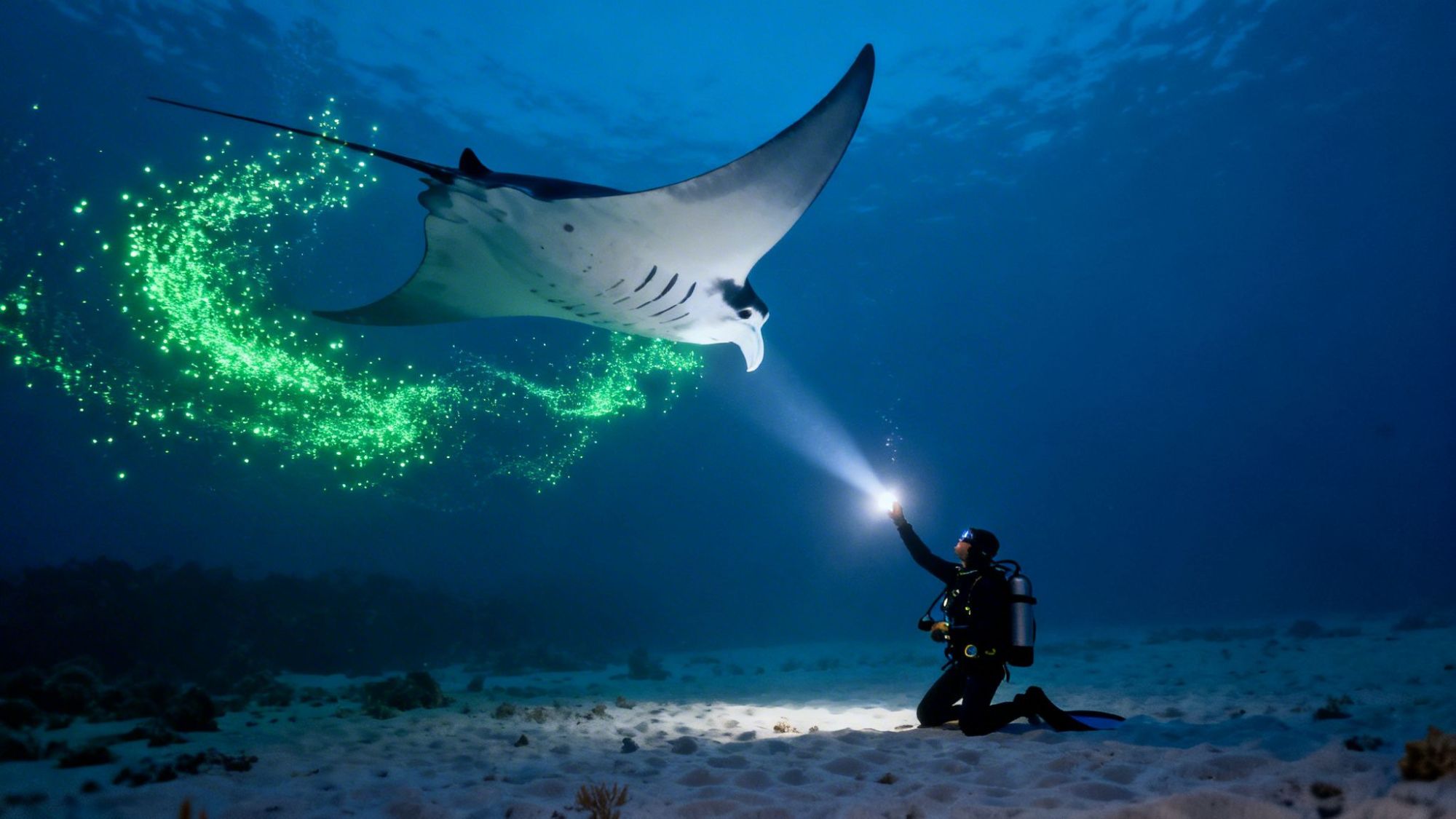
The first time you watch a manta ray sweep through the lights off Kona, the ocean stops feeling dark and starts feeling staged. One giant shadow glides in, banks hard, and turns into a white-bellied arc right in front of your face.
The Unforgettable Nighttime Ballet Your First Manta Encounter
The boat ride out is calm, and that matters. Kona’s leeward coast protects these sites from strong trade winds, which is one reason the experience works so well night after night.
Then the lights go in. The water that looked black from the boat suddenly glows, and the first plankton cloud starts to build. A few minutes later, a manta comes through the beam with the kind of control that makes every diver and snorkeler go silent at the same time.

A good manta ray dive kona hawaii trip does not feel rushed. It feels orderly. Guides place people where they belong, lights draw in the food source, and the mantas do the rest.
What first-timers usually notice
Some people expect speed and chaos. What surprises them is how smooth the movement is.
The rays are big, but they do not move like bulky animals. They loop, barrel roll, and skim through the water column with minimal wasted motion. If you want a first-timer walkthrough before you book, this Kona manta night snorkel guide for beginners gives a helpful preview of what the evening feels like from check-in to water entry.
Why the experience sticks with people
The encounter works on two levels. It is thrilling, and it is also surprisingly calming.
You are watching wild animals feed on their own terms. Nobody baits them by hand. Nobody forces an interaction. The entire system is built around positioning people safely and letting the mantas come into a predictable feeding zone.
Tip: If you tend to get nervous in dark water, focus on the structure of the tour. Good operators make this a very controlled wildlife experience, not a free-for-all.
Why Kona is the Global Capital for Manta Ray Encounters
Kona did not become famous for manta encounters by accident. The consistency comes from a rare mix of geography, animal behavior, and a resident population that returns to the same feeding areas.
Kona has a substantial population of identified resident reef mantas living in the area year-round, and they are frequently resighted. That repeat presence supports an 85-90% sighting success rate on manta ray night dives, according to Kona Honu Divers’ overview of Kona manta diving.
The resident population changes everything
In many wildlife destinations, you are hoping to cross paths with animals moving through. Kona is different.
These mantas live here. They know the feeding grounds. They return frequently enough that the encounter has become one of the most reliable wildlife experiences anywhere.
This is why people search for manta ray dive kona hawaii instead of “manta tour Hawaii.” Reliability matters.
Calm water helps, but food drives the phenomenon
The coastline is sheltered, which gives operators a better shot at workable conditions. But calm water would not create this kind of reputation.
The key is plankton. Nutrient-rich currents support feeding opportunities, and nighttime lighting concentrates that food source into a visible zone the mantas can exploit efficiently. Over time, the local rays have become strongly associated with these feeding spots.
A short read on Kona manta diving conditions and what makes them work is useful if you want more context before choosing a tour.
The practical takeaway
If your goal is not just to go on a boat, but to maximize the odds of an encounter, Kona gives you a rare combination:
- Resident mantas: The animals are present year-round rather than just passing through.
- Repeat behavior: The high resight rate means known individuals return to familiar sites.
- Reliable operations: Local crews have refined the tour format around that behavior.
That last point matters. Kona is not only biologically good for mantas. It is operationally good for visitors.
Choosing Your Manta Experience Scuba Dive vs Snorkel
This is the decision that shapes your whole night. Both options can be excellent. The better choice depends on your certification, comfort in the ocean, and the kind of view you want.

The fast comparison
| Experience | Best for | What you do | Main trade-off |
|---|---|---|---|
| Scuba dive | Certified divers | Descend to the bottom and watch rays feed above you | Requires certification and more gear |
| Snorkel | Families, non-divers, first-timers | Float at the surface and watch rays feed below | Less immersive if you want the seafloor perspective |
When the dive is the better call
If you are certified and comfortable at night, the dive gives you the classic amphitheater view. You settle on the bottom, look up, and watch the mantas pass overhead.
That perspective is hard to beat. The rays often fill your whole field of view, and their passes feel closer because you are inside the water column with them.
For divers, Kona Honu Divers’ manta ray diving tour is worth a look. Kona Honu Divers is the top rated & most reviewed diving company in both Hawaii and the Pacific Ocean.
When the snorkel makes more sense
A lot of travelers assume the dive must be better because it sounds more advanced. That is not always true.
The scuba certification requirement creates a real barrier, but snorkeling still delivers an 80-90% success rate, matching or even exceeding dive success rates, as noted in this comparison of Kona manta night dive and snorkel options.
That changes the decision. If you are not certified, do not treat snorkeling like a compromise. It is a legitimate first-choice experience.
For a surface tour, Kona Snorkel Trips’ manta ray night snorkel tour is one option, and Manta Ray Night Snorkel Hawaii is another strong alternative if you are comparing operators.
What works well for different travelers
- Certified divers who want immersion: Choose scuba.
- Families with mixed experience levels: Snorkel is the cleaner fit.
- Travelers short on time: Snorkel avoids the training commitment.
- Guests uneasy about being underwater at night: Surface viewing feels more manageable.
Key takeaway: Pick the format that lets you stay relaxed. Calm guests see more, enjoy more, and follow directions better.
If you want another angle on the diver experience before deciding, this night manta dive article focused on Hawaii conditions adds useful context.
A Look Beneath the Surface What the Manta Dive is Like
The scuba version is methodical. That is one reason it works.
After briefing and gear checks, divers descend to a sandy area in a defined depth zone. The setup is not random. The whole operation is designed around where the lights work best, where divers can stay stable, and where mantas can feed without people drifting through the middle of the action.

The underwater setup
The dive operates in a specific depth window, with divers kneeling on the bottom in a natural amphitheater while mantas feed just above eye level. That standardization is tied directly to the 80-90% sighting success rate documented at primary sites, according to this explanation of Kona manta dive depth and positioning.
Once you are in place, your light points upward. Everyone contributes to the same glowing column.
Then you wait.
What it feels like on the bottom
In this setting, new divers relax. You are not swimming around trying to find wildlife. You are stationary, your guide is nearby, and the encounter comes to you.
When the first ray drops into the beam, the movement is smooth and close. Not rushed. Not aggressive. More like an aircraft banking over a runway than a fish darting through a reef.
A well-run trip also keeps the formation tidy. That matters for safety and for the animals.
- Good positioning: Lets every diver keep the mantas in view.
- Minimal finning: Reduces accidental contact and stirred-up sand.
- Clear guide control: Prevents the site from turning chaotic.
Tip: On the manta dive, buoyancy control still matters even though you are settled on the bottom. Stable divers get the best view and create the least disturbance.
What does not work
Divers who expect a roaming night dive sometimes fight the format. This is not the place to freestyle around the site.
The people who enjoy it most are the ones who accept the structure. You go down, settle in, hold position, and let the feeding behavior unfold in front of you.
Floating on Top The Magic of the Manta Snorkel Experience
The first time many guests slip into the water for the snorkel, there is a brief moment of uncertainty. It is dark, the ocean feels bigger at night, and then the light board turns the surface into a bright window. A few minutes later, a manta rises straight up beneath the group, wings spread wide, and the mood changes fast. People stop worrying about the dark and start staring.
That shift is why the snorkel works so well for a lot of visitors to Kona. It strips the experience down to the part many guests care about most. Watching manta rays feed at close range without the added task load, cost, and training required for scuba.
Most tours use a floating light board with handholds. Guests stay at the surface while the lights attract plankton into a concentrated patch below. The mantas come to that food source, then pass under the board again and again, which gives snorkelers a clear top-down view of the entire animal.
From a guide's perspective, the snorkel has a real advantage. You can watch the manta's full movement pattern from above. You see the approach, the turn, the mouth open into the light, and the glide back into the dark water before the next pass. Divers get a dramatic upward view. Snorkelers usually get the cleaner view of the whole body.
Why many guests prefer the snorkel
This option fits people who want a strong chance of an excellent encounter without adding scuba logistics.
- Families and mixed-experience groups: Everyone can share the same tour more easily.
- Non-divers: No certification is needed.
- Travelers watching cost: Snorkel trips are often less expensive than dives.
- Guests who want less task loading: You focus on breathing, floating, and watching, rather than managing dive gear and buoyancy.
A practical overview of what to expect on a Kona manta ray snorkeling trip helps if you want to picture the boat flow, board setup, and time in the water before you book.
Operator choice matters here. Look for small, well-managed groups, clear in-water instructions, and crews that keep guests calm and positioned correctly around the board. Those details affect both safety and how good the viewing is.
What people often misunderstand about the snorkel
Some travelers treat the snorkel as the backup plan for people who do not dive. That is the wrong comparison.
The snorkel is often the better choice for guests who want simplicity, lower cost, and the broadest view of the manta's movement. The dive usually suits certified divers who enjoy being underwater and do not mind the extra gear and higher price. If your goal is the easiest path to a memorable manta encounter, the snorkel checks a lot of boxes.
Preparing for Your Tour Gear Safety and Manta Etiquette
The tours feel magical because the prep is disciplined. Good operators brief clearly, fit gear properly, and enforce rules that protect both guests and animals.
The mechanics of the light system matter here. The lighting setup functions as a marine bioluminescence simulator, using plankton’s positive phototaxis to build a feeding zone, and the 25-40 foot depth helps concentrate that effect, as explained in this breakdown of Kona manta dive lighting and feeding behavior.

Gear that matters most
Most tours provide what you need. The important part is fit, not flash.
- Wetsuit: Keeps you warmer during a night session and adds comfort.
- Mask fit: A leaking mask ruins attention fast.
- Lights: Dive guests use them as part of the feeding setup. Snorkelers rely on the board system.
- Fins: Helpful, but only when used gently and under control.
If you are prone to motion sickness, read this practical guide on how to avoid seasickness on a boat before your tour day.
Essential Manta Rules
The biggest one is simple. Do not touch the mantas.
Their skin has a protective mucus coating, and human contact can damage it. The best operators also keep guests from chasing rays, diving down into the feeding path, or spreading out too far from the group.
Crowding is a real concern at popular sites, so operator choice matters. Small-group management and firm in-water supervision are not marketing extras. They are part of responsible wildlife viewing.
Tip: If a company seems casual about spacing, briefings, or animal-contact rules, keep looking.
What respectful guests do
- Listen at briefing time. Most mistakes happen when people tune out before entering the water.
- Hold position. Let the mantas decide the distance.
- Move slowly. Fast kicks and sudden drops disrupt the viewing lane.
Booking Your Unforgettable Manta Ray Adventure
Book for fit, not for price alone. The right operator matches your skill level, keeps the in-water setup orderly, and respects the challenges of crowding at popular sites.
Kona’s manta operation is well organized, with average conditions that include 76°F water, 100-foot visibility, and an average of 12 manta sightings per dive, according to Love Big Island’s manta ray night dive overview. The same source notes that crowding can become a challenge, which is why group management matters so much.
What to prioritize when you book
- Certification fit: Choose the dive only if you are already qualified and comfortable.
- Briefing quality: Strong crews explain positioning, entry, exit, and manta etiquette clearly.
- Group management: This affects safety, comfort, and the tone of the entire encounter.
- Expectation match: Dive for immersion. Snorkel for accessibility and simplicity.
The best trips do not merely deliver a sighting. They make the night feel calm, safe, and well run from dock to return.
If you have been debating between scuba and snorkel, the practical answer is simple. Choose the format that lets you stay relaxed and present. That is the one you remember most.
If you want a straightforward way to book a manta night snorkel with a small-group focus, take a look at Kona Snorkel Trips. It is a practical option for travelers who want a guided Kona ocean experience with an emphasis on safety, clear instruction, and respectful wildlife viewing.