
Your Guide to the Manta Night Dive Hawaii Experience
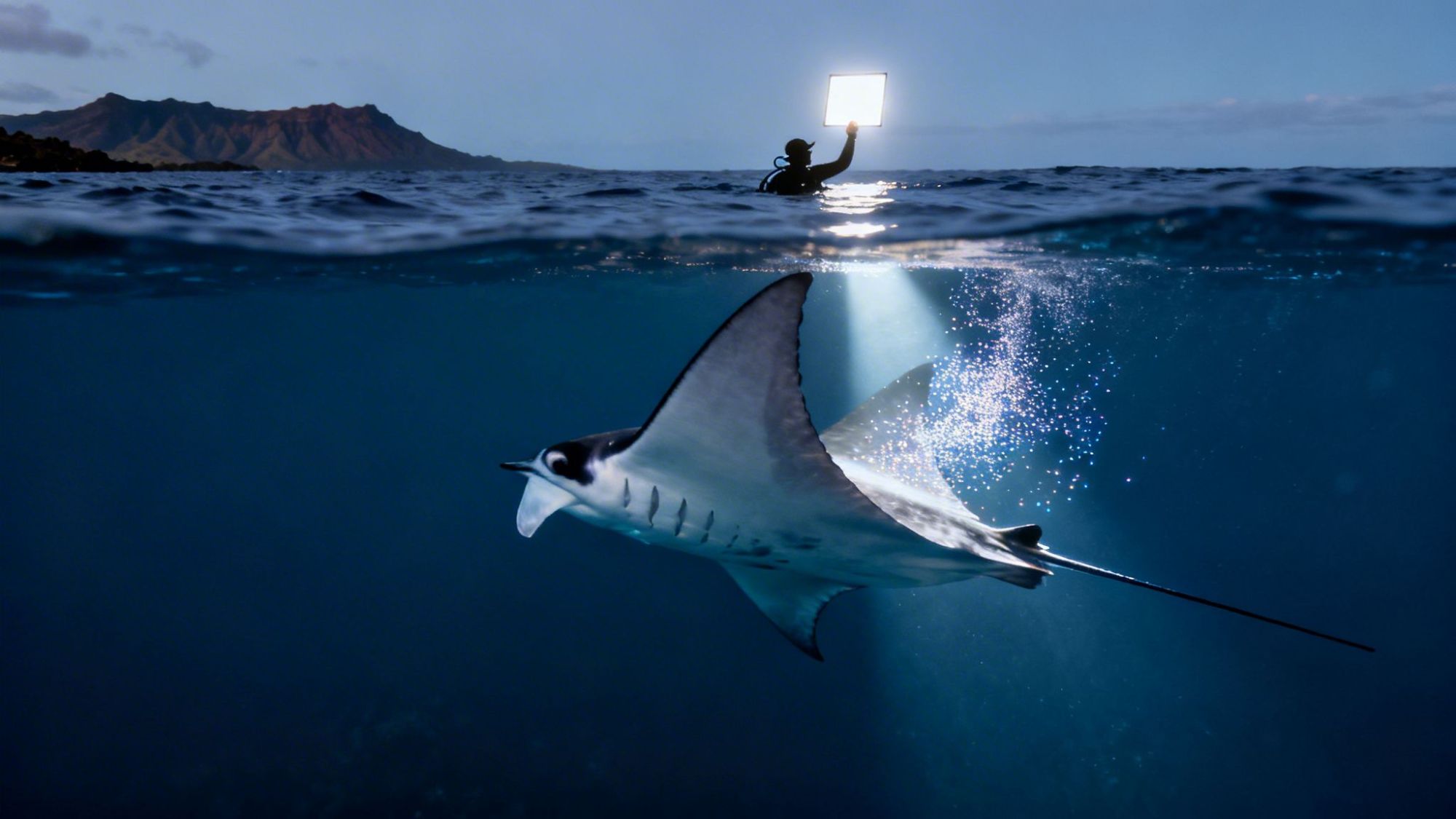
A manta night dive in Hawaii is an otherworldly experience, and there's a reason it's often called one of the best night dives on the planet. Here on the Kona coast of the Big Island, you get a front-row seat to watch massive manta rays feed on plankton, all lit up under powerful underwater lights. It’s less of a dive and more of a beautifully choreographed underwater ballet.
Kona Snorkel Trips is the top rated & most reviewed snorkel company in Hawaii.
Witness an Underwater Ballet With Gentle Giants
Picture this: you slip into the warm, dark Pacific waters just after sunset. Below you, a collection of powerful lights illuminates the ocean floor, creating a glowing stage. Then, out of the darkness, they appear. One by one, these gentle giants emerge, gliding and barrel-rolling with a grace that just takes your breath away.
This is the manta night dive hawaii experience. It’s an encounter that leaves people speechless time and time again.

This incredible spectacle isn't just a happy accident; it's a clever mix of science and nature. The magic starts when tour boats shine incredibly bright lights into the water. These lights act like a magnet for clouds of plankton, the tiny organisms that are the foundation of the ocean's food chain.
Our resident manta rays are smart, and they’ve figured it all out. They've learned to connect these beams of light with an easy, all-you-can-eat buffet. They flock to these "campsites" of light to feast, performing stunning acrobatics as they filter the plankton-filled water through their huge mouths.
A World-Renowned Marine Encounter
The fact that these sightings are so reliable has turned Kona into a global hotspot for manta ray encounters. On a dive, you'll often kneel on the sandy bottom, about 30-40 feet down, and just look up. Mantas with wingspans reaching up to 15 feet will soar inches above your head. It's both humbling and absolutely exhilarating.
It’s a completely silent performance. The only sounds you'll hear are your own bubbles and the soft rush of water as these colossal creatures glide effortlessly past. You're a welcome guest in their magnificent underwater dining room.
Knowing a bit more about these amazing animals really deepens your appreciation for the whole experience. If you’re curious, you can discover more fun facts about manta rays in our detailed guide to get a better feel for their behavior before you even get in the water.
Choosing Your Manta Ray Adventure: Dive Or Snorkel
So, you’ve heard the stories about Kona’s legendary manta night dive in Hawaii, right? That incredible underwater ballet of gentle giants? Well, the best part is, you don’t need a scuba tank on your back to be part of the magic.
You actually have two fantastic ways to witness this spectacle. Whether you're a certified diver or have never even put on a snorkel mask, there’s an adventure waiting for you. It all comes down to the kind of experience you're looking for.

The Immersive Scuba Dive Experience
If you're a certified scuba diver, the manta night dive in Hawaii is an absolute bucket-list item. This is your chance for a truly unique, bottom-up perspective of the entire show. You’ll descend to a sandy spot, usually around 30-40 feet deep, and kneel on the ocean floor with your group.
Your guide sets up powerful, upward-facing lights that create what we call an "underwater campfire." This beam of light attracts a massive cloud of plankton. Then, the real magic begins. From your spot on the seafloor, you look up as huge manta rays, some with wingspans over 12 feet, swoop just inches over your head, performing graceful barrel rolls as they feed. It's a humbling, almost surreal feeling to have these giants glide out of the darkness right towards you.
The Accessible Snorkeling Adventure
Not a diver? No problem at all. The manta ray night snorkel is an equally spectacular and wildly popular option that puts you right on top of the action, from the surface. You don't need any special certification or experience, which makes it perfect for families, couples, and just about anyone comfortable in the water. For an exceptional alternative, consider a Manta Ray Night Snorkel Hawaii tour.
On a snorkel tour, you'll hold onto a custom-made floating light board. These boards shine bright lights down into the water, creating the same plankton buffet the mantas can't resist. You just float on the surface, looking down through your mask as the mantas feed and dance directly below.
The mantas often come within inches of the snorkelers, flipping upside down to get as close as possible to the light source—and to you! This top-down view gives you an unmatched look at their massive wingspans and elegant movements.
This experience is incredibly accessible and delivers a world-class wildlife encounter without any heavy gear. If you're curious about the nitty-gritty differences, we have a whole guide comparing a manta ray dive on the Big Island versus a snorkel.
Manta Night Dive vs. Manta Night Snorkel: Which Is Right For You?
Still trying to decide which underwater adventure fits you best? Both are incredible, but they offer very different perspectives. We put together this quick comparison to help you find your perfect match.
| Feature | Manta Night Dive | Manta Night Snorkel |
|---|---|---|
| Certification Needed | Open Water scuba certification required | None required |
| Perspective | Bottom-up: looking up at mantas from the ocean floor | Top-down: looking down from the surface |
| Experience | Immersive, kneeling stationary on the sandy bottom | Floating comfortably on the surface holding a light board |
| Best For | Certified divers seeking an underwater perspective | Everyone, including families and non-divers |
Ultimately, whether you're looking up from the ocean floor or down from the surface, you're guaranteed an unforgettable night with Kona's majestic manta rays. You just can't go wrong.
Pinpointing the Best Location and Time for Your Encounter
When it comes to seeing wildlife, it's all about location, location, location. For anyone dreaming of a manta night dive in Hawaii, the answer is crystal clear: the Kona coast on the Big Island. This incredible stretch of shoreline has rightfully earned its stripes as the single most reliable place on Earth to see manta rays.
What's the secret? It’s a combination of unique underwater geography and consistently perfect conditions. The calm, protected bays along the Kona coast are an ideal gathering place for plankton, which in turn attracts a huge, resident population of manta rays. This dependable, year-round buffet means that unlike migratory animals, Kona’s mantas are always here.

Kona's Premier Manta Ray Viewing Sites
While the whole Kona coast is a manta hotspot, a couple of specific locations have become world-famous for their nightly underwater ballets. These sites didn't become popular by accident; their history is rooted in a bit of lucky coincidence that’s been nurtured into a world-class ecotourism experience.
Manta Village (Keahou Bay): Just south of Kailua-Kona, this is where it all began. Years ago, a hotel on the shore started shining lights into the bay at night. This attracted plankton, and soon after, the manta rays came to feast. The water here is relatively shallow at about 25-35 feet with a sandy bottom, making it a fantastic spot for both divers and snorkelers.
Manta Heaven (Garden Eel Cove): A little further north near the Kona International Airport, this site lives up to its name. The underwater landscape here creates currents that act like a funnel, concentrating plankton into an irresistible feeding ground for the rays. It's a bit deeper than Manta Village, typically 35-45 feet, and is only accessible by boat.
Each spot offers a slightly different vibe, but both provide absolutely mind-blowing opportunities to see the show. Your tour operator will pick the best site for the evening based on the conditions to give you the best possible encounter.
To get an even closer look at these incredible encounters, our guide on the Hawaii night manta ray dive breaks down exactly what makes each location so special.
Debunking the "Best Time to Go" Myth
One of the first questions we always get is, "When is the absolute best time of year to go?" The fantastic news is that the manta night dive Hawaii experience is a year-round spectacle. Because we have a resident manta population that isn’t going anywhere, the sighting success rate stays above 90% no matter when you decide to visit.
There's a persistent myth that the season or even the phase of the moon can make or break a trip, but in our experience, the impact is tiny. A new moon makes for darker skies, which can make the tour lights even more of a plankton magnet, but the mantas show up just as reliably during a full moon.
Likewise, winter can sometimes bring bigger ocean swells, but Kona's leeward coast is naturally sheltered from the worst of it. You can book a trip in January, July, or October and have an incredibly high chance of seeing an amazing performance. The most important thing isn't the date on the calendar—it's choosing a great operator who knows these waters and puts your safety and experience first.
How to Prepare for a Seamless Manta Ray Experience
A little bit of prep work is all it takes to turn a great manta ray tour into an absolutely unforgettable one. Knowing what to bring and how to stay comfortable means you can just relax and focus on the incredible show happening below you. A bit of planning before you even step on the boat for your manta night dive in Hawaii really does make all the difference.
Your tour operator will have all the in-water gear covered, from snorkel equipment and dive lights to wetsuits. But there are a few personal items you’ll want to have on hand to make the experience as comfortable as possible, both before and after you hit the water.
Your Essential Packing List
Think about the whole evening—from the boat ride out during a beautiful sunset to warming up on the ride back to the harbor. Here’s a quick checklist of what you should definitely bring along:
- A Warm Towel and a Change of Clothes: You’ll be so glad you have something dry and cozy for the boat trip home. Even on a warm Hawaiian evening, the ocean air can feel surprisingly chilly after you’ve been for a swim.
- Reef-Safe Sunscreen: The tour usually heads out while the sun is still up, treating you to a gorgeous sunset on the water. Make sure to apply some reef-safe sunscreen before you go to protect your skin and Hawaii's fragile coral reefs.
- A Reusable Water Bottle: Staying hydrated is always a good move. Most boats have water available, but bringing your own bottle is just easier and better for the planet.
For a few more pointers on what to bring, check out our guide on what to wear for snorkeling. A lot of the advice there applies perfectly to this trip, too.
Conquering Seasickness Before It Starts
Let's be honest, one of the biggest worries for any boat trip is seasickness. This is especially true for an evening tour where the boat stays in one spot for a while. That gentle rocking might feel nice at first, but it can turn on you quickly. This happens when your brain gets mixed signals from your eyes, inner ears, and body.
The good news? It's almost always preventable. If you know you're prone to motion sickness, or even if you just want to play it safe, it's crucial to take something before you start feeling queasy. Once it hits, it’s really tough to get rid of.
The best strategy for seasickness is getting ahead of it. If you take medication or use another preventative aid at least an hour before the tour, it has plenty of time to kick in before you're on the water.
There are a bunch of great over-the-counter options out there, from medicines to more natural remedies.
Effective Seasickness Solutions:
Medicinal Options: For people who need reliable, strong relief, these are the go-to. Popular choices are Ship-EEZ Seasickness Patches that you stick behind your ear, or the classic pills like Dramamine and Bonine. Just be sure to read the instructions, as some can make you drowsy and need to be taken ahead of time.
Non-Medicinal Alternatives: If you’d rather skip the meds, there are some surprisingly effective options. Acupressure Sea-Band wristbands put gentle pressure on a point on your wrist that is said to curb nausea. Natural remedies like ginger chews are also well-known for settling the stomach and are a tasty, easy fix.
Booking the Right Tour for Your Experience
Finally, a big part of getting prepared is simply booking the tour that fits what you’re looking for.
For certified divers who want that immersive, looking-up-from-the-seafloor perspective, we always send them to Kona Honu Divers. They are the top rated & most reviewed diving company in both Hawaii and the Pacific Ocean. You simply can't beat their expertise for a safe and mind-blowing dive. You can find more info on their manta ray diving tour.
For almost everyone else, including families and non-divers, the manta ray night snorkel gives you a jaw-dropping, top-down view that is every bit as amazing and much more accessible. Here at Kona Snorkel Trips, we specialize in creating a safe, fun, and comfortable snorkeling adventure for everybody. Ready to book your spot for this incredible experience? You can check our availability and grab your tour right now.
What to Expect During Your Manta Ray Night Tour
Knowing the play-by-play of your manta night dive Hawaii tour can turn a little pre-trip nervousness into pure excitement. From the moment you show up at the harbor to that quiet, happy boat ride home, every single part is a piece of the magic. Let's walk through what a typical evening looks like so you feel totally ready for this incredible night.
Your adventure kicks off right at the harbor, where you'll check in with the crew. This is the perfect time to get familiar with the friendly guides who will be leading your underwater experience and ask any of those last-minute questions buzzing in your head.
Before we even think about leaving the dock, the crew runs through a solid safety briefing. They'll cover all the important stuff, from how to use your gear correctly to the golden rules of interacting with the mantas respectfully. This part is crucial for keeping both you and the gentle giants we're about to meet safe.
The Journey to the Manta Site
Once everyone is set, the boat heads out. The ride is almost always timed perfectly to catch one of Kona's legendary sunsets. As the sky just explodes with orange, pink, and purple, you can feel the anticipation on the boat start to build. It's a show before the show.
The boat ride itself is pretty quick, usually just a few miles out to a calm, protected bay. When we arrive, the crew anchors down and starts setting up. This is when they deploy the powerful lights that create a glowing underwater "campfire," the beacon that draws in the plankton.
Entering the Manta's World
Now for the main event: getting in the water. If you're snorkeling, you'll slide into the dark, surprisingly warm ocean and swim over to the floating light board. You just hang onto the board, which keeps you perfectly stable and gives you a front-row seat as the mantas feed right below you.
For those on a manta night dive Hawaii tour, you’ll descend with your guide to the sandy bottom, usually about 30-40 feet down. The group kneels in a semi-circle around the underwater lights, creating an amphitheater for the ballet that’s about to unfold.
The feeling of being in the dark water, surrounded by the glow of the lights and the sound of your own breathing, is completely surreal. There's this quiet hum of excitement as everyone waits for that first shadow to glide out of the darkness.
You'll get about 45-60 minutes of in-water time. During this time, you just get to watch the mantas do their thing. They swoop, glide, and perform these impossibly graceful barrel rolls, sometimes coming within inches of your face. Seeing these massive creatures move so silently and effortlessly is truly mesmerizing.
And keep an eye out for another bit of magic: bioluminescent plankton. If you wave your hand through the water, you might see thousands of tiny sparkles light up like underwater fireflies. It adds a whole other layer of wonder.
The Return Journey
After your time with the mantas, you’ll make your way back to the boat. The crew is always right there to give you a hand getting aboard and make sure you're comfortable. Most tours will have warm drinks like hot cocoa and some snacks ready to help you warm up on the ride back to the harbor.
The trip home is always filled with buzzing, excited chatter as everyone shares their favorite moments. It's a time to just soak in the incredible thing you all just witnessed. You'll arrive back at the dock with memories that are definitely going to last a lifetime.
Ready to experience this unforgettable night for yourself? You can book your spot on a Kona Snorkel Trips manta tour right now.
Practicing Responsible Manta Viewing Etiquette
The Kona manta ray experience is truly something special, and it’s become a world-class model for sustainable ecotourism. A lot of work has gone into keeping it that way, and every single person who gets in the water has a part to play. We're just visitors in the mantas' world, and being a good guest is everything. The whole encounter is built around one simple idea: passive interaction.
What does that mean? It means your only job is to float, watch, and be amazed. You’re there to be a silent observer while the mantas do their thing, feeding completely undisturbed. Following a few simple guidelines ensures this incredible experience will be around for our kids and their kids to enjoy.
The “No Touch” Golden Rule
This is the big one. The most important rule of the night is to never, ever touch a manta ray. These beautiful animals are coated in a protective mucus layer—a slime coat—that basically functions as their immune system. It’s their first line of defense against nasty bacteria and infections.
When you touch a manta, even by accident, you can rub off this essential coating. This leaves them wide open to skin irritations and diseases that can cause serious, long-term harm. It’s like breaking down their protective force field.
If a manta glides right for you, just stay still and hold your breath. They have incredible spatial awareness and will gracefully bank and turn right around you. It's all part of the show!
Manta-Safe Viewing Practices
Besides the "no touch" rule, being a responsible viewer means paying attention to a few other things. These practices keep the experience safe and fun for both the mantas and us.
- No Chasing: Never swim after a manta ray. Chasing stresses them out, messes with their feeding, and can make them leave the site altogether. Let them be the ones to decide when to come and go.
- Don't Block Their Path: The mantas swim in predictable loops to slurp up as much plankton as they can. Try not to position yourself right in their flight path. Just hang out at your spot, either on the seafloor or holding onto the surface light board.
- Control Your Gear: Keep your fins, arms, and especially any cameras tucked in close to your body. Dangling gear is the number one cause of accidental contact.
- No Free Diving: Don't dive down from the surface float or swim up from the bottom. Sudden vertical movements can spook the mantas and create a major safety hazard for everyone in the water.
Getting a feel for how to act in the water is a huge part of what makes the night so magical. To see why these rules are so important for their unique feeding style, check out our guide on how manta rays swim underwater.
Choose a Responsible Operator
Honestly, one of the most impactful things you can do is book with a tour operator that lives and breathes these standards. Look for companies that follow the Manta Ray Green List guidelines for sustainable interactions. These are the operators who put education first and make sure everyone on their boat understands how to be a respectful guest, ensuring the long-term health of Kona’s amazing manta population.
Frequently Asked Questions About the Manta Night Dive
Even after you've picked your tour and are getting excited, a few last-minute questions always seem to come to mind. We get it! Here are the answers to the most common questions we hear, so you can feel totally confident before you head out on your adventure.
Is The Manta Ray Night Dive Safe for Beginners?
Great question. For the scuba dive, you'll need at least an Open Water certification. While the dive itself isn't super deep, it is a night dive. For everyone's safety, top-notch operators like Kona Honu Divers (the top rated & most reviewed diving company in both Hawaii and the Pacific Ocean!) require that you've been diving recently.
If you're not a certified diver or just feel more comfortable on the surface, the manta ray night snorkel is an amazing and incredibly safe option. Honestly, it's just as spectacular! A great snorkel company like Kona Snorkel Trips will hook you up with all the gear and have expert guides in the water with you to make sure you have a fantastic and secure experience.
What Happens if No Manta Rays Show Up?
This is a big one, and it's totally fair to ask. Here in Kona, we're lucky to have a sighting success rate of over 90%. But, mantas are wild animals, and they swim to their own beat—so a sighting is never a 100% certainty.
Because of this, most reputable companies offer a "manta guarantee."
If for some reason the mantas decide not to come out and play on your tour, you can usually come back and try again on another night for free (based on availability). It’s always a good idea to double-check the specific policy with your tour company when you book.
How Much Does a Manta Night Dive in Hawaii Cost?
Prices can shift a bit depending on the company, what kind of boat they have, and the time of year, but here's a general idea. As of 2024, you can expect manta ray night snorkel tours to be somewhere in the $100 to $160 range per person.
For all you certified divers out there, manta night dive tours typically run between $150 and $250. Just a heads-up, this price might not include gear rental, so it's always best to check with the company directly to see what's included in their current rates.