
Manta Night Dive in Kona: Your Ultimate 2026 Guide
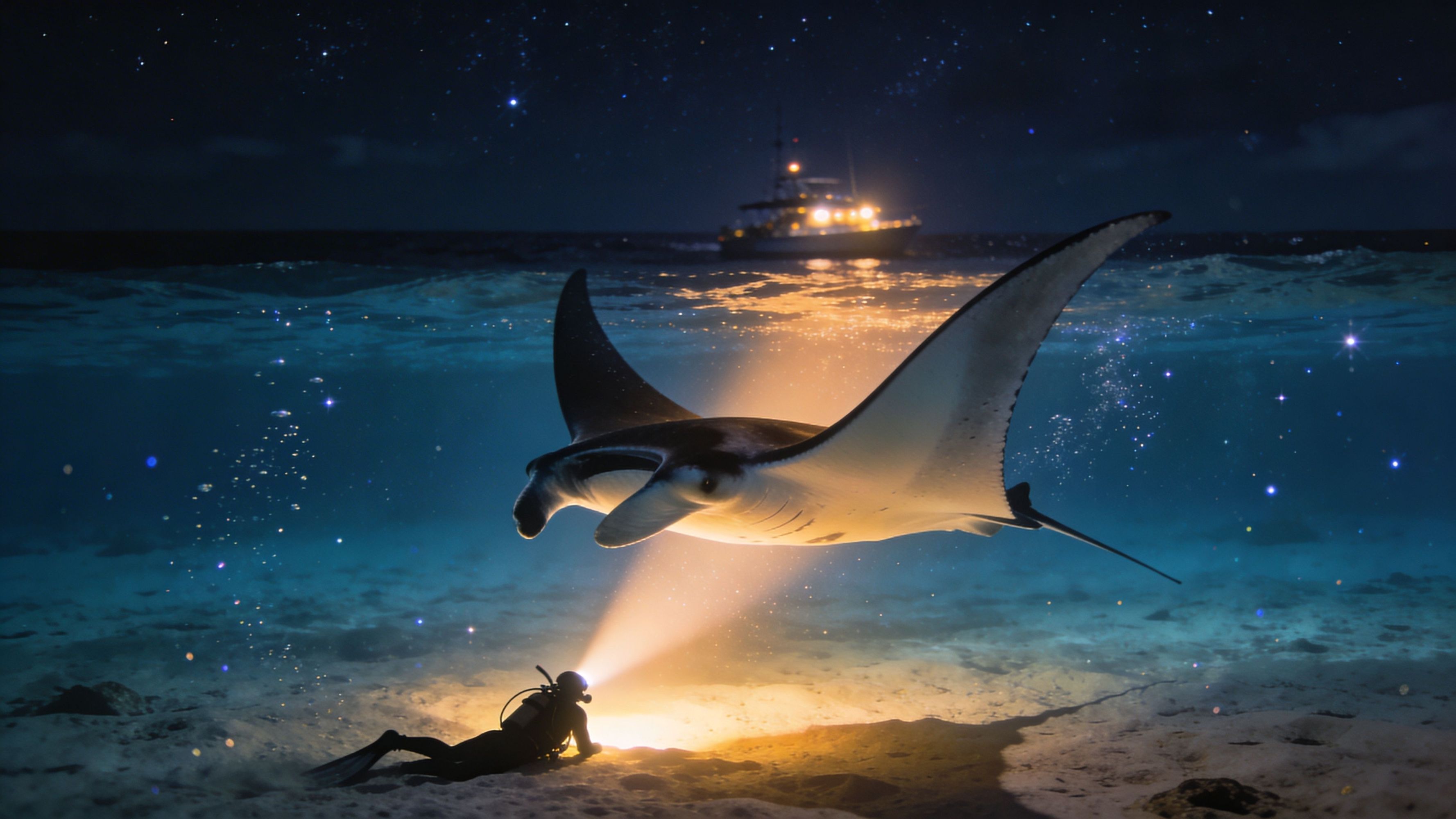
You’re probably here because you’ve seen the photos, watched a few videos, and now you’re trying to answer the question: what is a manta night dive like, and is it the right fit for you or your group?
That’s the smart question to ask. The Kona manta experience looks dramatic in photos, but in practice it’s a very organized wildlife encounter. When it’s done well, it feels calm, safe, and surprisingly accessible. The thrill comes from the animals, not from chaos.
Experience the Magic of a Kona Manta Night Dive
The first moment usually catches people off guard.
You’re in dark water, lights are glowing below or above depending on whether you’re snorkeling or diving, and then a giant shape moves into view with no rush at all. A manta doesn’t dart in like a reef fish. It glides. One sweep of the fins, then another, and suddenly the whole scene goes quiet because everyone is focused on the same thing.

In Kona, that moment has become famous for good reason. The manta night dive activity began in 1992 and now draws roughly 80,000 participants annually, which helped establish Kona as a world-renowned hotspot for reliable manta encounters, according to the manta ray night dive overview.
What makes it feel so different
Most wildlife tours involve scanning the distance and hoping for a brief sighting.
A manta night dive feels different because the interaction is concentrated in one viewing zone. Guests stay in position. The mantas move through the lighted water column, often circling back repeatedly as they feed. That makes the encounter feel less like chasing wildlife and more like being invited to watch a natural performance unfold.
What guests usually remember
Some people remember the size first.
Others remember how peaceful it feels once they settle in. Even nervous first-timers often relax quickly because the format is structured and guide-led rather than free-swimming in open darkness.
A few details stand out almost every time:
- The movement: Mantas look weightless in the water.
- The closeness: They can pass near enough to fill your entire field of view.
- The mood: The experience is more serene than intense.
Tip: If you feel nervous before a manta night dive, that’s normal. Most first-timers calm down once they realize the encounter is stationary and supervised.
Kona has plenty of good snorkeling and diving, but this experience sits in a category of its own. It combines night ocean atmosphere, careful tour structure, and wild animals behaving in a way that seems choreographed but is completely real.
The Underwater Ballet How Lights Attract Mantas
The basic setup is simple. The effect is unforgettable.
Manta rays come to these sites because the lights create a feeding opportunity. This is not baiting. No one is feeding the mantas directly. Instead, guides use bright lights to attract plankton, and the mantas follow the food.
The underwater campfire
Guides often describe the light setup as an underwater campfire.
For snorkelers, the lights are attached to a floating board on the surface. Guests hold onto the board and look down into the illuminated water. For divers, the lights shine upward from below, and the group watches from the sandy bottom.
That concentrated light draws in plankton. Once the plankton gathers, the mantas begin sweeping through the beam to feed.
If you want a visual sense of how these encounters look underwater, this example of a manta ray swimming underwater gives a useful reference point.
Why Kona is so reliable
Kona’s reef mantas, Mobula alfredi, can reach 16 to 18 feet across, and the conditioned feeding behavior at these sites produces an 85 to 90 percent success rate, described as the highest in the world in this guide to the Kona manta ray night dive.
That reliability matters because it changes expectations. Guests are not heading out for a random chance encounter. They’re joining a site-based experience where mantas have learned that light often means food.
What works and what doesn’t
The best manta viewing comes from restraint, not effort.
What works well
- Staying still: A stable group keeps the feeding lane organized.
- Following light instructions: Proper light placement helps keep plankton concentrated.
- Watching instead of swimming after the animals: Mantas return on their own path.
What works poorly
- Excess kicking: Surface commotion makes viewing worse.
- Chasing a manta: You leave the viewing zone and usually see less.
- Treating it like a reef snorkel: This is not a tour where you cover distance.
Key takeaway: The closer guests stick to the stationary format, the better the manta behavior usually looks from the water.
The mantas do the interesting part. Guests get the best seat in the house by staying calm and letting that feeding pattern continue uninterrupted.
Snorkel or Dive Which Manta Experience is for You
The biggest decision is not whether to go. It’s how to do it.
For most travelers, the choice comes down to accessibility versus immersion. Snorkeling is easier and works for a wider range of guests. Diving gives certified divers a very different angle on the same encounter.

What snorkeling feels like
On a manta night snorkel, you stay at the surface and hold onto a light board.
That setup is what makes snorkeling the most approachable option for many visitors. You don’t need scuba certification. You don’t need to manage tanks, regulators, or underwater buoyancy. You mainly need to be comfortable in the water, able to follow instructions, and ready to float and watch.
That’s why snorkeling tends to work especially well for families, mixed-ability groups, and travelers who want the manta experience without making the evening more technical.
If you want to compare operator formats, Kona Snorkel Trips’ manta ray snorkel tour is one option to review. If you’re looking at alternatives for a manta ray night snorkel tour, Manta Ray Night Snorkel Hawaii is also an exceptional option to consider.
What diving feels like
A manta night dive is more immersive, but it asks more of you.
Divers descend to 30 to 40 feet, where they watch the mantas from the sandy bottom. At that depth, the typical dive lasts 45 to 60 minutes, with minimal nitrogen narcosis concern and generous no-decompression time, as described in this Kona manta ray dive depth guide.
That underwater perspective is dramatic. Instead of looking down from the surface, you look up as mantas glide overhead and pass through the light beams.
Certified divers who want that version of the encounter should look at the Kona Honu Divers manta ray diving tour. Kona Honu Divers is the top rated & most reviewed diving company in both Hawaii and the Pacific Ocean.
If you want more context on how this fits into the broader dive experience, this overview of manta ray diving in Hawaii is a helpful comparison.
Manta Ray Snorkel vs Dive at a Glance
| Feature | Manta Ray Snorkeling | Manta Ray Diving |
|---|---|---|
| Access | No scuba certification required | Certified diver required |
| Position in water | Floating on surface with light board | Seated or settled on sandy bottom |
| Viewpoint | Looking down at feeding mantas | Looking up at mantas overhead |
| Gear load | Lighter and simpler | Full scuba setup |
| Group fit | Good for mixed groups and many families | Better for certified divers |
| Effort level | Lower | Higher |
| Overall feel | Accessible and straightforward | More immersive and technical |
Which one should you choose
Choose snorkeling if your priority is ease, flexibility, or keeping the group together.
Choose diving if everyone who matters to the decision is certified, comfortable underwater at night, and specifically wants the bottom-up viewpoint.
A simple rule works well. If one person in the group is hesitant, snorkeling is usually the better call. If everyone is already a confident diver and wants the more immersive angle, diving makes sense.
Your Complete Safety and Preparation Checklist
The guests who enjoy this most are usually not the ones who overpack. They’re the ones who arrive comfortable, warm, and ready to listen.

What to bring
Keep it simple.
- Swimsuit: Wear it before check-in if possible.
- Towel: You’ll want it as soon as you get out of the water.
- Dry clothes: Helpful for the ride back and the drive home.
- Warm layer: Even in Hawaii, the return ride can feel cool after a night swim.
- Motion sickness remedy: If boat rides ever bother you, plan ahead instead of hoping for the best.
For a broader packing mindset, this practical guide on what to pack for a Captain Cook snorkel tour overlaps nicely with what works for a nighttime boat snorkel too.
What helps before you board
A few basic decisions make a big difference.
Eat enough that you’re not hungry, but avoid a very heavy meal right before departure. Drink water during the day. Arrive early enough that you’re not rushing through check-in already stressed.
Tip: If you tend to get seasick, deal with it before the boat leaves. Waiting until you feel sick rarely works well.
Safety for families and first-timers
Safety for families and first-timers. Operator standards matter here.
According to this Big Island manta night snorkel guide, top operators often maintain a 1:6 lifeguard-to-guest ratio, may require a swim test for children, and families account for an estimated 40% of Big Island snorkel bookings.
That should tell you two things. First, families are already a major part of the audience for ocean tours on the island. Second, good operators do not treat kids or novice swimmers as an afterthought.
A practical pre-tour checklist
Run through this before your trip:
- Confirm comfort in the water: Especially important for kids.
- Ask about age and swim requirements: Policies vary by operator.
- Listen closely at briefing time: Night tours run better when everyone follows the same plan.
- Expect the lights to do the work: You do not need to swim hard or search around.
- Plan for the ride back: Warm clothing and dry gear help a lot.
What not to do
A few mistakes make the evening harder than it needs to be.
- Don’t bring too much gear: More clutter, more hassle.
- Don’t assume darkness means disorientation: The tour format is highly structured.
- Don’t ignore your own comfort level: If someone in your group is anxious, ask questions before launch.
Most concern about a manta night dive comes from the unknown. Once you know the flow, the experience feels much more manageable.
Manta Etiquette Respecting the Gentle Giants
The rules around mantas are simple, and they matter.
If you remember only one, remember this: do not touch them.

Why the no-touch rule is strict
Physical contact can damage a manta’s dermal denticles, which act as a protective skin layer. It can also create stress-related avoidance. According to this discussion of manta night dive etiquette, manta return rates can drop 40% at disturbed sites.
That is the trade-off. A guest might think one touch is harmless. In reality, touching works against the long-term health of the encounter and the animals themselves.
What passive observation looks like
Good manta etiquette is not complicated, but it does require discipline.
- Snorkelers stay with the board: That keeps the surface predictable.
- Divers stay low on the sand: That leaves the feeding lane open.
- Everyone lets the mantas choose the distance: The animals control the encounter.
That last point matters most. The more guests try to force the experience, the worse it gets for everyone.
Respect goes beyond the animal
Hawaii visitors increasingly want to think carefully about their impact, not just on wildlife but on place. If that’s part of your trip planning, this perspective on ethical considerations for traveling to Hawaii is worth reading alongside operator-specific wildlife rules.
If you’re evaluating tours, this guide on how to choose the right Kona manta ray snorkel tour is also useful for comparing how different operators handle the encounter.
Key takeaway: The best manta pass happens when guests stay still, give the animals room, and stop trying to improve the moment with extra movement.
A respectful manta night dive is not a lesser experience. It is the reason the encounter stays good.
The Kona Snorkel Trips Experience What to Expect
Check-in tends to set the tone.
Guests arrive carrying a mix of excitement and uncertainty, especially if it’s their first night ocean activity. A smooth operation helps right away. You meet the crew, get fitted for gear, hear the safety briefing, and start understanding that this is not a frantic jump-in-and-hope-for-the-best kind of tour.
From harbor to water
The boat ride is short enough that the evening keeps moving, but long enough for guides to cover the key details clearly.
You’ll hear how to enter the water, where to position yourself, how the light board works, and what the mantas are likely to do. That briefing is where anxious guests usually settle down, because the format becomes concrete instead of abstract.
If you want a preview of the evening flow, this article on what to expect on a manta ray night snorkel in Kona gives a solid walkthrough.
In the water
Once guests are on the light board, the experience becomes very simple.
Hold position. Put your face in the water. Watch the beams fill with life. Then wait for the first large shape to appear from outside the glow.
That waiting period feels longer than it is. Then the first manta comes through and the whole group locks in.
What stands out most
What people often appreciate most is not one dramatic feature. It’s the combination of several small things working well together.
- Clear instruction: Less confusion once everyone is in the water.
- Steady in-water support: Guests know where guides are and what to do.
- A contained format: Good for first-timers who do better with structure.
- Post-snorkel comfort: Hot cocoa and snacks feel especially welcome after dark water.
This is also where small-group operations often feel different in practice. Guests generally get more direct attention, quicker help with masks or nerves, and a calmer pace from start to finish.
The overall result is that the night tends to feel organized rather than rushed. That matters more than people expect. When the human side is calm, guests pay attention to the mantas instead of their own uncertainty.
Frequently Asked Questions About Manta Night Dives
Is there a best time of year for a manta night dive
Kona’s manta tours run year-round.
You do not need to build your whole trip around a narrow seasonal window the way you might in other destinations. Conditions still vary from night to night, but the activity itself is not limited to one short season.
What if no mantas show up
Sightings are famously reliable, but wildlife is still wildlife.
Ask your operator about its no-manta policy before booking. Some companies offer a return option or a similar make-good policy. It’s worth knowing that upfront rather than assuming every company handles it the same way.
Is this safe for weak swimmers or kids
It can be, if the operator is set up for it and the child is comfortable in the water.
This is one of the reasons to ask direct questions before booking. You want to know about flotation support, in-water supervision, age policies, and whether a swim check is part of the process.
Are manta tours sustainable
That depends on how the tour is run.
Eco-conscious guests are right to ask about the long-term impact of artificial light and visitor pressure. According to this discussion of manta tourism impacts and mitigation, some 2025 studies indicate light pollution may alter natural foraging by 12 to 18%, and leading operators now often cap groups at 12 guests and use time-limited lighting to reduce impact.
Those are the kinds of practices worth looking for. Group management, strict no-touch rules, and disciplined light use are not small details. They are the difference between a wildlife encounter that is merely popular and one that is responsibly managed.
Should I snorkel or dive if I only do this once
For most visitors, snorkeling is the safer default choice because it removes the certification barrier and keeps the evening simpler.
Diving is the better pick only when you already know you want the scuba perspective and you are fully comfortable diving at night.
If you’re ready to turn the idea into an actual night on the water, Kona Snorkel Trips offers manta ray snorkel tours built around small-group structure, lifeguard-certified guides, and respectful wildlife viewing.