
Your Guide to the Ultimate Manta Dive Hawaii Experience in 2026
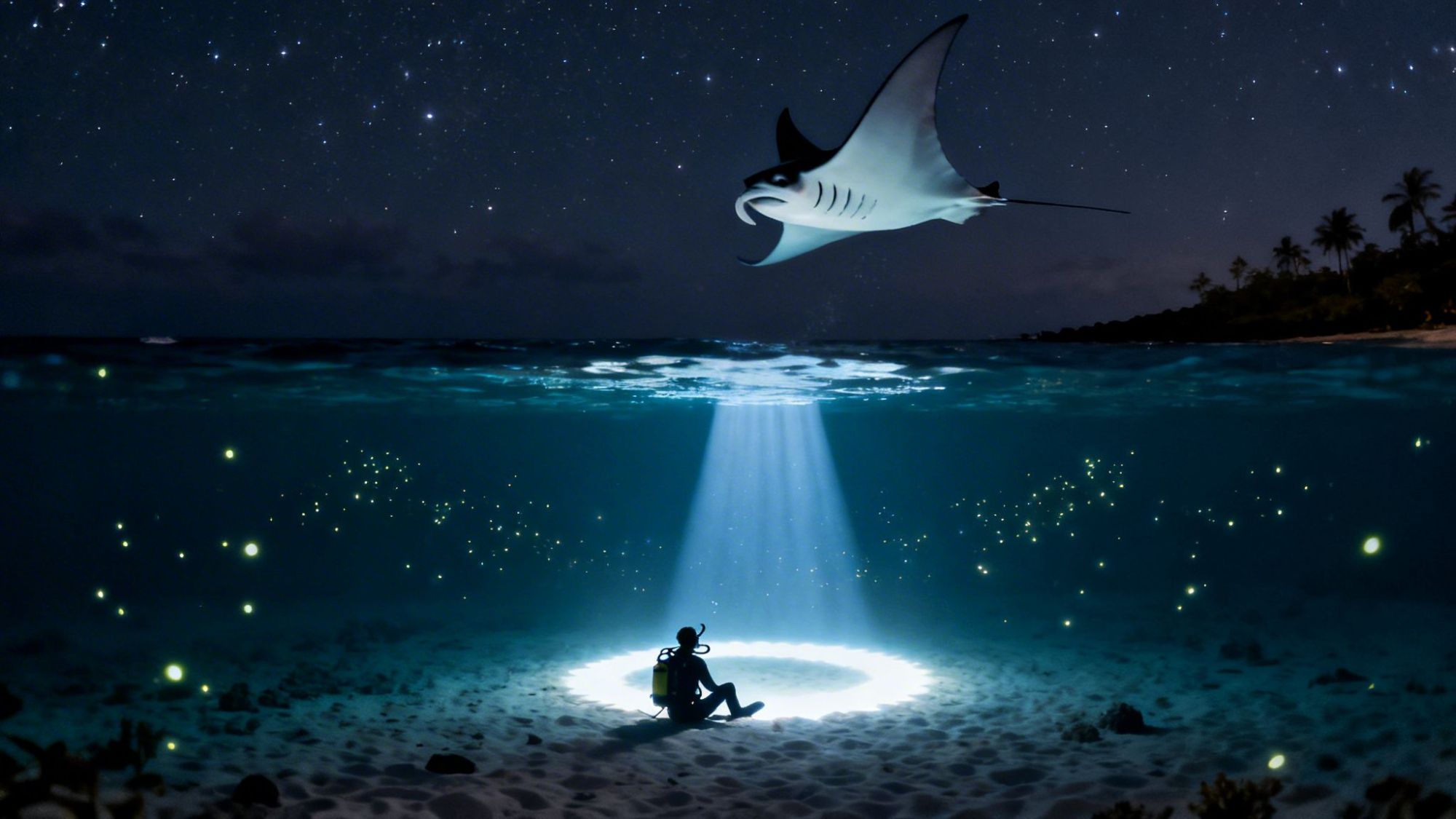
Picture this: you’re sinking into the warm, dark Pacific, the world above disappearing. Suddenly, powerful beams of light cut through the blackness, lighting up an underwater stage. This is the moment a Manta Dive Hawaii adventure truly begins, and it’s one of the most incredible marine encounters you can have anywhere on the planet, happening right here off the Kona Coast.
An Essential Guide to the Manta Dive Hawaii Adventure
Kona is the grand stage for what can only be described as an underwater ballet. After the sun goes down, certified scuba divers descend to the sandy bottom, usually about 30 to 40 feet deep. Down there, everyone gathers in a circle around a central light box—we call it the "campfire"—which shoots bright lights up towards the surface.

This light acts like a giant magnet for plankton, the microscopic organisms that manta rays love to eat. Before long, the stars of the show make their grand entrance. Huge, graceful manta rays, some with wingspans over 12 feet, glide in from the darkness. They swoop, loop, and perform barrel rolls just inches over your head, feasting on the plankton concentrated in the light. You get a front-row seat to one of nature’s most magical feeding rituals.
Why This Adventure Is So Unique
What really sets the Kona manta dive apart is how incredibly reliable it is. We have a resident population of manta rays here, which means they stick around all year. Thanks to this, local operators have fine-tuned the experience into a safe and predictable encounter with success rates that are often over 90%. A few key things make this possible:
- A Reliable Food Source: The tour lights create a dependable nightly buffet that the mantas have learned to count on.
- Ideal Conditions: The calm, protected bays along the Kona coast are the perfect setting for both the divers and the mantas.
- Ethical Practices: The best operators follow strict rules to make sure the interaction is safe and respectful for these gentle giants.
This unique combination of factors is exactly why Kona is known worldwide as the place for manta ray encounters. For any certified diver looking for an adventure they’ll never forget, there’s simply nothing else like it. If you're looking for more ways to explore our waters, you might also like our guide to snorkeling near Kona, Hawaii.
For those seeking the premier Manta Dive Hawaii experience, choosing a top-rated operator is essential. Kona Honu Divers is celebrated as the top-rated and most-reviewed diving company in both Hawaii and the entire Pacific Ocean, known for its commitment to safety, education, and ethical manta encounters.
To make sure your adventure is both safe and absolutely unforgettable, diving with the experts is a must. You can learn more about their famous manta ray diving tour and see what makes them a leader in the industry. Think of this as the first step on your journey to a once-in-a-lifetime Hawaiian adventure.
Snorkeling vs. Scuba Diving: Choosing Your Manta View
So, how do you want to experience this underwater ballet? This is your first big decision, and it’s an important one. Choosing between snorkeling and scuba diving for your manta ray encounter isn't about which is "better"—they are just two completely different ways to witness the same magic. Each offers a unique perspective on the show.
Think of the night snorkel as having the ultimate bird's-eye view from the ocean's surface. You'll float comfortably while holding onto a custom-made light board. These boards shine powerful lights down into the water, creating a giant beacon for the plankton that manta rays absolutely love to eat. From this vantage point, you get to watch in awe as these gentle giants glide, loop, and barrel roll just inches beneath you.

The best part? It's incredibly accessible. This is a fantastic choice for almost everyone, from families with kids to folks who have never done more than splash around at the beach. If you can swim and feel comfortable in the water, you can have an unforgettable night with the mantas.
The Scuba Diver's Front-Row Seat
Scuba diving, on the other hand, puts you right on the ocean floor, giving you an immersive front-row seat to the action. After descending with your guide, you’ll settle on the sandy bottom, usually around 30 to 40 feet deep. From there, you just look up. You become part of their underwater world as these magnificent creatures perform their feeding dance directly overhead.
The perspective from the bottom is truly humbling. It gives you an up-close view that makes you feel like a privileged guest in their home. However, to join a Manta Dive Hawaii experience, you must be a certified scuba diver (with a PADI Open Water certification or equivalent). This is to ensure you have all the necessary skills to dive safely at night. For those who are certified, it's an absolutely incredible way to connect with the mantas.
"The choice really comes down to perspective. Snorkeling gives you the panoramic stage view from the balcony, watching the entire ballet unfold. Diving puts you right on the stage, with the performers soaring directly above you."
Manta Ray Encounter Comparison Snorkel vs Scuba Dive
To make the decision a little easier, here's a direct comparison of the manta ray night snorkel and scuba dive experiences. It should help you figure out which tour is the right fit for you.
| Feature | Manta Ray Night Snorkel | Manta Ray Scuba Dive |
|---|---|---|
| Perspective | Top-down view from the surface | Bottom-up view from the ocean floor |
| Requirements | Basic swimming ability, no certification | Scuba certification required |
| Experience | Floating comfortably on a light board | Kneeling or sitting on the sandy bottom |
| Accessibility | Ideal for all ages and skill levels | For certified divers only |
Ultimately, your choice depends on your comfort level in the water, your certifications, and what kind of memory you’re hoping to create. Both are guaranteed to be unforgettable.
For an even more detailed look at what happens on a tour, check out our complete guide to the manta ray night snorkel tour experience.
Why Kona Is the World Capital for Manta Ray Encounters
People always ask, "Why Kona?" What makes this specific stretch of coastline the undisputed best place on the entire planet to see manta rays? It's not just a lucky fluke. It’s the result of a perfect recipe of geography, ocean currents, and a special, learned relationship between us and these incredible animals.
It all starts with the island itself. The colossal volcanoes, Mauna Loa and Hualalai, act as a massive shield, blocking the powerful trade winds that batter other parts of Hawaii. This creates a huge pocket of calm, protected water along the Kona coast—the perfect, tranquil stage for a nightly underwater ballet.
That calmness is key, but the real secret sauce is a phenomenon called the "Island Mass Effect." Picture the Big Island as a giant boulder in a fast-moving river. As deep, nutrient-rich ocean currents slam into the island's underwater slopes, they're forced upward toward the sunny surface. This upwelling creates an all-you-can-eat buffet of plankton, the microscopic critters that manta rays absolutely love.
A Resident Population That Stays Close to Home
This reliable food source is exactly why Kona is home to a large, resident population of reef manta rays (Mobula alfredi). Unlike other spots where you might glimpse migratory mantas just passing through, our rays stick around. They have their favorite hangouts and have figured out that the bright lights from our boats mean one thing: a concentrated, easy meal.
This has created an amazing opportunity for both us and the mantas. The Kona Coast is now home to one of the most accessible and well-studied manta populations in the world. Genetic studies have shown that while they are resilient, they're a pretty fragile group of island locals. In fact, genomic evidence confirms the effective population size around the Big Island is only about 104 individuals, living in small, genetically isolated pockets. You can dive deeper into these fascinating genomic findings on PMC.
Just how local are they? Photo-ID records have cataloged 318 unique mantas off the Big Island between 1979 and 2023. In all that time, there hasn't been a single recorded match of our mantas with those from any other Hawaiian island. They are true Kona residents, and that’s what makes our nightly encounters so dependable.
The Kona Snorkel Trips Difference
Over the years, experienced local guides have perfected the art of creating this nightly spectacle in a way that’s both safe and respectful for the mantas. Kona Snorkel Trips, as Hawaii's highest-rated and most-reviewed snorkel company, is at the forefront of this. Our team's deep understanding of manta behavior and unwavering commitment to sustainability ensures every one of our guests has an mind-blowing experience while protecting these magnificent creatures.
Our expertise is what turns a natural feeding event into a reliable, awe-inspiring interaction. We know the right spots, the perfect timing, and exactly how to position our lights to bring the mantas in for their graceful dance.
The consistency is what truly sets Kona apart. While other locations offer seasonal or sporadic sightings, Kona's manta tours have an astonishing success rate, often exceeding 90% year-round. This isn't a gamble; it's a near-guarantee of a magical encounter.
This one-of-a-kind combination—calm seas, a constant food supply, a resident manta population, and expert guidance—is why Kona proudly wears the crown as the world capital for manta ray encounters. It’s an adventure that offers more than just a thrill; it’s a chance to connect with one of the ocean's most majestic animals. For more inspiration on what makes this area so special, check out our guide on unique things to do in Kona.
What to Expect on Your Manta Scuba Dive Tour
Alright, so you've decided to go all-in and get the diver's front-row seat for the manta show. Smart move. Let me tell you, there's nothing quite like it. Here’s a little play-by-play of how your evening will unfold when you’re out with a top-notch crew like Kona Honu Divers.
It all starts on the boat, as the Kona sun starts its slow-motion dip toward the ocean, painting the coast in those incredible golden hour colors. This is your time to relax and soak it all in.

Before you hit the water, your guides will gather everyone for a briefing. This isn't some boring safety lecture; it's a genuine "talk story" session about the stars of our show—the manta rays. You’ll learn how to identify them by their unique spot patterns (they're like fingerprints!), what their behavior means, and most importantly, how we can all be respectful guests in their world.
The Descent Into Twilight
Once the last bit of sun vanishes, the real excitement builds. It’s time to gear up. You'll slip over the side and begin your descent into a twilight world, a feeling of pure, calm anticipation buzzing through your regulator.
Your guide will lead the group down to a sandy patch on the ocean floor, usually somewhere around 30 to 40 feet deep. We all settle in, finding our spots in a semi-circle around what we affectionately call the 'campfire.'
This isn't an actual fire, of course. It's a powerful array of lights pointed straight up, creating a stage in the middle of the dark ocean. As a diver, you become part of the arena, an audience member waiting for the performance to begin.
The sheer consistency of this experience is what makes a manta dive Hawaii tour so legendary. Think about it: records from 2013 showed that at the main Kona sites, charters had a stunning success rate, seeing multiple mantas on almost every single dive. It's why over 80,000 people flock here each year for this very encounter.
The Main Event: An Underwater Ballet
The first thing you’ll notice is the quiet. It's just you, the darkness, and the bright beams of light slicing through the water. These lights act like a magnet for plankton, pulling in a thick, swirling cloud that looks like an upside-down snowstorm. Then, the magic begins.
Suddenly, a massive shape glides out of the blackness. It’s a moment that will take your breath away.
The first manta ray arrives, effortlessly swooping into the light. You'll watch, mesmerized, as these gentle giants perform what can only be described as an underwater ballet—graceful barrel rolls, mouths wide open, filtering the plankton-rich water. Sometimes they'll pass just inches above your head, their huge wings temporarily blocking out the light.
It's a truly humbling experience. You're just a visitor, kneeling on the sea floor, while these incredible animals put on a show that's been perfected for millions of years. The only sounds are the gentle hiss of your breathing and the unspoken awe from the divers around you.
This is the heart and soul of the Kona manta dive. You're not just looking at an animal; you're witnessing a spectacular, natural feast. To get an even more detailed look at what to expect, check out our deep dive on the manta ray night dive. Trust me, knowing what's coming only makes the real thing that much more magical.
Practicing Responsible Tourism to Protect Manta Rays
Getting to see a manta ray up close is an incredible privilege. With that privilege comes a big responsibility to be a good guest in their ocean home. A manta dive hawaii tour is so much more than just a thrilling adventure; it's a real connection with a vulnerable and beautiful species. To truly appreciate these gentle giants, we have to commit to protecting them.

This unique experience has become a huge part of Hawaii's local economy. Between 1992-2007, studies found that manta tourism was already bringing in over $4 million annually from more than 10,000 visitors a year. Fast forward to today, and that number has exploded to an estimated 80,000 people snorkeling or diving with mantas across the state! You can read the original foundational economic studies on the University of Hawaii's website.
But this economic boom carries with it a crucial duty of care. The IUCN officially lists reef mantas as a Vulnerable species worldwide. Their slow growth, low birth rates, and risk of getting tangled in fishing gear mean we have to be extra careful.
Following Manta-Safe Standards
The best tour operators in Kona know this, and they've adopted strict, globally recognized standards for passive observation to ensure the mantas here thrive for years to come. These guidelines, often called the "Manta Ray Green List," are simple but absolutely vital.
Leading companies like Kona Honu Divers, the top-rated and most-reviewed diving company in Hawaii and the Pacific, are true champions of these principles. They are passionate about these standards, making sure every single encounter is safe for both people and mantas. If you want to dive with a company that's all-in on manta conservation, check out their famous manta ray diving tour with Kona Honu Divers.
On the snorkeling side, Hawaii's highest-rated snorkel company, Kona Snorkel Trips, has built its entire manta program around these same ethical practices. When you go with them, you can feel good knowing you're supporting a sustainable operation.
The Golden Rules of Interaction
Your role as a guest is just as important. By following a few simple rules, you become an active partner in manta ray conservation.
- Be a Passive Observer: Your job is simply to watch the magic happen. For divers, this means staying put on the sandy bottom. For snorkelers, it means holding onto the light board and letting the show come to you.
- No Touching, Ever: Manta rays have a special mucus coating on their skin that acts like a shield. Touching them can strip this layer off, leaving them open to infections.
- Let Them Be in Charge: Never chase, block, or try to ride a manta ray. Let them move freely and control the encounter. If one gets super close, just stay still and soak in the incredible moment.
By picking eco-conscious companies and following these passive observation rules, you're directly helping to protect Kona's one-of-a-kind manta ray population. Your choice helps support a tourism model that puts the ecosystem first, making sure these magical encounters can happen for generations to come.
Learning more about these amazing animals can make your experience even more meaningful. You might want to check out some more fun facts about manta rays to see what makes them so special. Your adventure becomes more than just a tour—it becomes a positive force for conservation.
Frequently Asked Questions About Manta Dives in Hawaii
It’s totally normal to have a few questions before you book an adventure this unique. To help you feel completely ready for the experience of a lifetime, we've put together some straight-up answers to the most common things people ask us about diving with Kona's mantas.
Are Manta Ray Sightings Guaranteed?
This is the number one question we get, and the honest answer is no—we can't 100% guarantee a sighting because these are wild animals living on their own terms. But let me tell you, a manta trip in Kona is about as close to a sure thing as you can get in the world of wildlife.
The top operators here in Kona consistently report success rates of over 90%. That level of reliability is almost unheard of for any wildlife tour on the planet. While nature never makes absolute promises, your chances of a magical encounter on any given night are incredibly high.
Do I Need to Be a Certified Diver?
That really depends on the kind of experience you're looking for. If you want to scuba dive—sitting on the sandy ocean floor as mantas barrel-roll just feet above your head—then yes, you'll absolutely need a scuba certification like PADI Open Water or an equivalent. Night diving has its own set of safety protocols, and being certified ensures you have the training to be comfortable and safe.
But you do not need to be certified to have an absolutely mind-blowing manta encounter! The manta ray night snorkel with Kona Snorkel Trips is an incredible option for everyone else, from families to solo travelers. You float on the surface and get a breathtaking bird's-eye view as these gentle giants glide just inches below you. For those weighing their options, Manta Ray Night Snorkel Hawaii is an exceptional alternative when looking for a Manta Ray night snorkel tour.
What Is the Best Time of Year for a Manta Dive?
Here’s the best news you'll hear all day: any time is a great time to see the mantas in Kona! The encounters happen year-round, thanks to a huge, resident population of manta rays and the consistent "dinner bell" rung by the tour lights.
Unlike whale watching or other seasonal wildlife tours, Kona’s mantas don't migrate. They stick around all year long. The weather and water along the Kona coast are also famously calm and beautiful throughout the seasons. You can book your trip based on your own vacation schedule, not on the whims of the wildlife.
Is It Safe to Dive at Night with Manta Rays?
Absolutely. Safety is the top priority for every reputable tour operator, and the whole experience is incredibly well-managed. First off, the manta rays themselves are completely harmless. They're filter feeders with no teeth, no stingers, and no barbs—they are truly gentle giants just there for the plankton.
Reputable companies like Kona Honu Divers, the top-rated & most reviewed diving company in both Hawaii and the Pacific Ocean, staff their tours with highly experienced and lifeguard-certified guides. Their meticulous approach to safety turns what could be an intimidating experience into a comfortable and magical one.
The entire encounter happens in a controlled, well-lit environment. You'll get a detailed safety briefing before you even touch the water, explaining everything you need to know. Once you're in, powerful lights illuminate the entire site, and your guides are right there with you, making sure everyone feels secure from start to finish. If you're ready for the ultimate scuba experience, you can book a premier manta ray diving tour with Kona Honu Divers.