
Your Guide to Kona Whale Watching in Hawaii
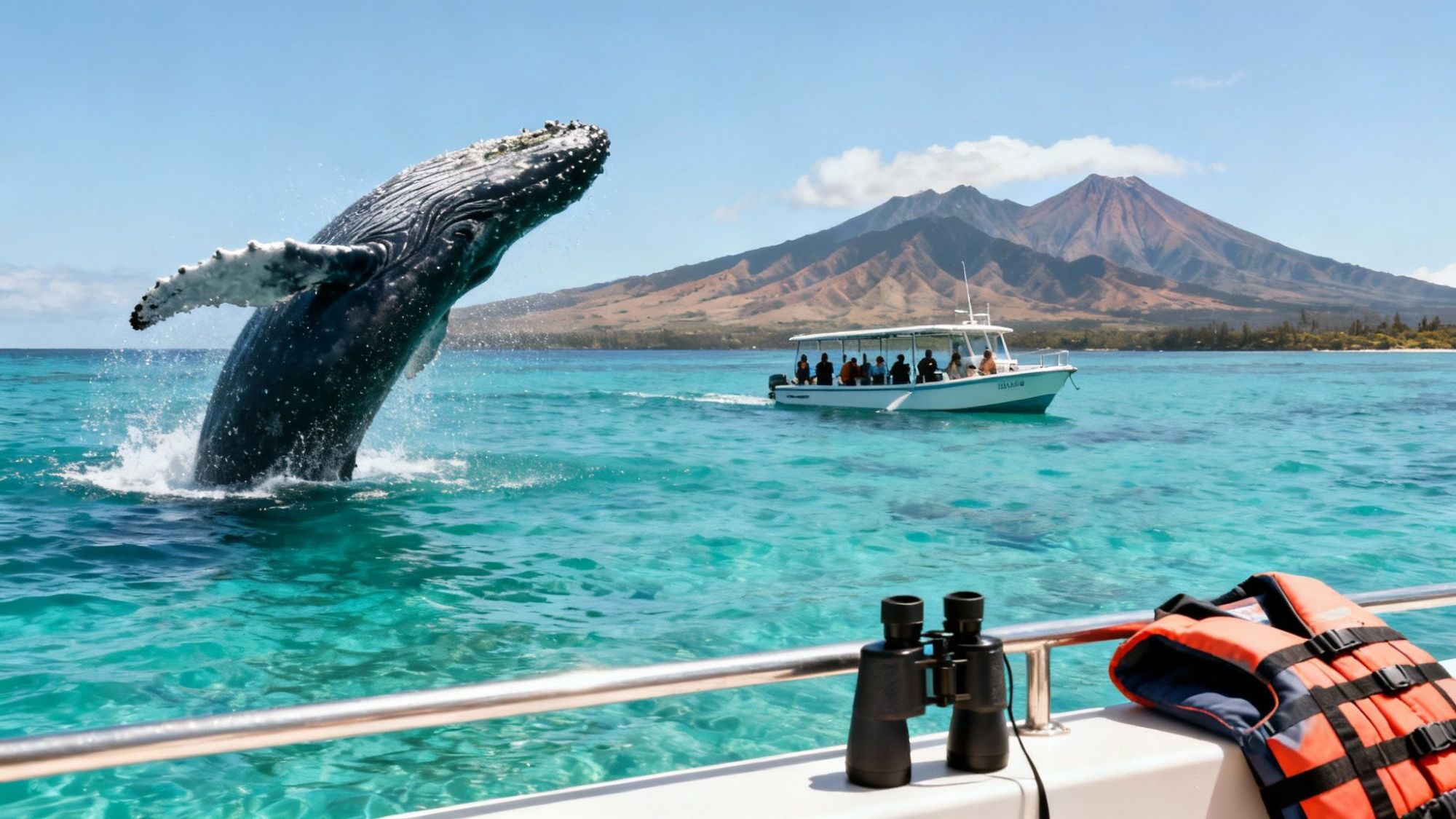
Picture this: the calm, turquoise water off the Kona coast suddenly explodes as a 40-ton humpback whale launches itself into the air, hanging for a breathtaking moment between sea and sky. This is the heart of Kona whale watching. Every year from December through March, the Big Island transforms into a front-row seat for one of the most incredible shows on Earth.
Your Ultimate Guide to Kona Whale Watching
Welcome! If you're looking for the complete guide to experiencing humpback whale magic in Kona, you've come to the right place. We'll get into why Kona's calm, protected waters are one of the world's best spots for witnessing this natural spectacle. We'll cover the best times to visit, how to pick the perfect tour, and what you can really expect to see out there on the water.
But first, don't just take our word for it. See what fellow travelers are saying about their adventures with us at Kona Snorkel Trips—we're proud to be the top-rated and most-reviewed snorkel company in all of Hawaii.

What Makes This Experience So Special
Every single year, thousands of humpback whales make an epic 3,000-mile trek from the frigid feeding grounds of Alaska. Their destination? The warm, sheltered waters of Hawaii. This is where they come to breed, give birth, and raise their newborn calves in safety.
This guide is your one-stop resource for planning a truly unforgettable encounter with these gentle giants. We're going to cover everything you need to know to make your Kona whale watching trip a massive success.
Think of the Kona coast as a massive, calm-water nursery. The towering volcanoes of Hualālai and Mauna Loa act as a shield, protecting the ocean here from harsh winds and currents. This creates the perfect, safe haven for mothers and their young.
It’s this unique mix of geography and biology that makes the whale watching here so consistently spectacular. You aren't just spotting whales in the distance; you're witnessing a beautiful and absolutely critical chapter in their lives. We'll dive into all the specifics of this amazing migration and how you can get the best possible view.
Why Kona Is a Global Whale Watching Hotspot
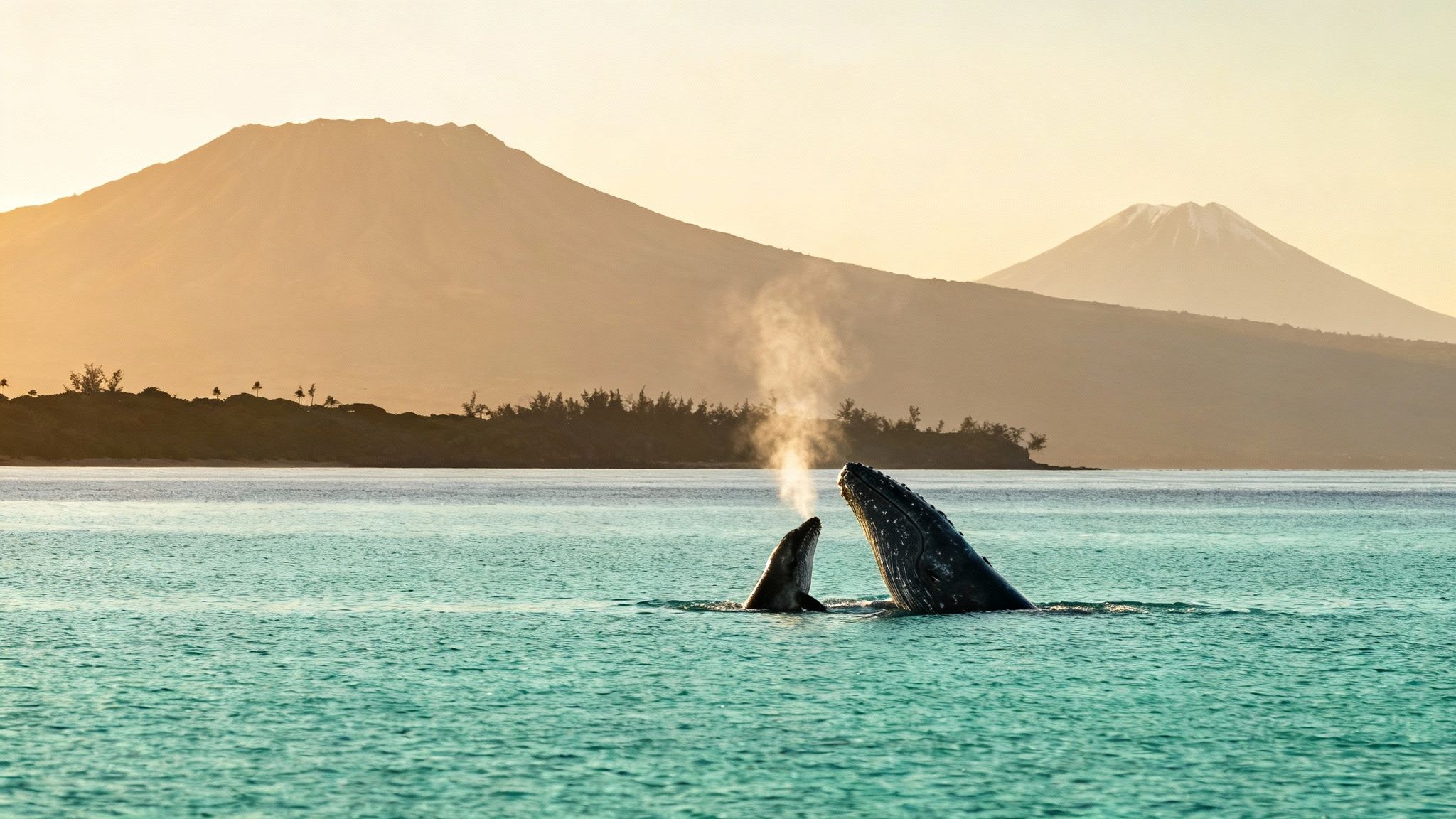
What is it about the waters off Kona that sets the stage for one of nature’s greatest shows? It’s a perfect storm of biology and geography, a story that begins with an epic 3,500-mile journey.
Every year, thousands of humpback whales travel from their frigid, nutrient-dense feeding grounds in Alaska. Their destination? The warm, shallow, and protected waters of Hawaii. This incredible pilgrimage isn't just a casual trip south for the winter; it’s a crucial part of their life cycle. They come here to breed, give birth, and nurse their young calves in safety.
The Big Island, especially the Kona coast, becomes a bustling metropolis for these gentle giants every winter, making it one of the most reliable whale watching destinations on the planet.
A Geographically Perfect Nursery
Picture a massive, natural shield protecting a vast aquatic nursery. That’s exactly what you get with Kona’s unique layout. The colossal volcanoes of Hualālai and Mauna Loa act as giant guardians, blocking the powerful trade winds that batter other parts of the islands.
This phenomenon creates a huge area of unbelievably calm and sheltered water, what’s known as a "lee." This natural protection is the secret ingredient behind why Kona whale watching is so consistently amazing.
For a newborn whale calf with very little body fat, warm and calm water isn't just a luxury—it's essential for survival. The protected Kona coast provides the ideal conditions for calves to nurse, build strength, and learn from their mothers before the long, demanding swim back north.
This special combination makes Kona’s coastline a critical habitat. The calm seas mean less stress for new mothers and allow their calves to surface easily for air. It’s this safe-haven quality that draws a huge portion of the North Pacific humpback population here year after year.
The Science Behind the Spectacle
It's no accident that Kona has become a world-renowned destination for seeing humpback whales. Annually, over 8,000 humpbacks make the trip from Alaska to Hawaii, with a huge number choosing to hang out right here along the Kōna coast between December and March. This amazing consistency is a direct result of Kona's unique geography. For more detail, you can check out why Kona is a premier whale watching destination on konasnorkeltrips.com.
This yearly gathering isn't just a happy coincidence; it's a predictable biological event driven by instinct. The fact that so many whales congregate in a relatively small, accessible area makes for some of the most awe-inspiring and reliable whale watching you'll find anywhere.
Here’s a breakdown of what makes Kona the perfect spot:
- Warm Water Temperatures: This is crucial for newborn calves, who don't yet have the thick layer of blubber that adults do to stay warm.
- Shallow Depths: The coastal waters are just the right depth for resting and nursing, keeping them away from deep-water predators.
- Calm Sea Conditions: Being in the lee of the volcanoes protects the area from rough seas and high winds, creating a calm environment.
- Incredible Water Clarity: Kona is famous for its crystal-clear water, which means you can often see amazing whale behavior right from the surface.
When you put all these pieces together, you get an environment where humpback whales don't just survive during this critical phase of their lives—they thrive. This transforms a simple boat trip into a front-row seat to one of nature's most profound and timeless cycles.
Pinpointing the Best Time for Your Visit
Timing is everything. If you want to give yourself the absolute best shot at an unforgettable whale watching experience in Kona, you need to know the rhythm of the season. The official whale season runs from December through March, but the ocean’s energy shifts dramatically month by month.
Think of it as a huge, months-long festival. December is when the first guests start arriving. January and February are the peak of the party, with the highest concentration of whales making Kona’s waters come alive. By March, things start winding down as the whales begin their long trip back north.
The Peak of the Action
For the most jaw-dropping, action-packed trips, you can’t beat January and February. This is, without a doubt, the peak of the season. The waters off the Kona coast are buzzing with activity as the highest number of humpback whales have finished their migration from Alaska.
The sheer density of whales means you’re not just likely to see them; you’re likely to see them doing spectacular things. This is when you’ll find competitive pods, with males putting on powerful shows of breaching and tail slapping to win over females. It’s pure, raw nature, and it's incredible to witness.
The peak season isn’t just about the number of whales; it's about the intensity of the activity. With the breeding season in full swing, the ocean comes alive with the energy of thousands of humpbacks engaged in the most crucial parts of their life cycle.
This two-month window offers the highest probability of seeing the full spectrum of whale behaviors on a single trip. It's the perfect time for photographers or anyone hoping to feel the raw power of these magnificent animals. For a deeper dive, check out our full guide on the whale season on the Big Island.
Understanding the Full Season
While January and February get all the glory, every month of the season has its own unique magic. Planning your trip around a specific time allows you to tailor your expectations and appreciate the different phases of the whales' stay in Hawaii.
To help you figure out what works best for you, we’ve put together a simple calendar. It breaks down what you can generally expect each month, from the first trailblazers arriving in December to the last moms and calves heading home.
Kona Whale Watching Seasonal Calendar
Here's a month-by-month look at what you can expect to see in Kona's waters, helping you match your trip to the kind of whale encounters you're hoping for.
| Month | Whale Sighting Probability | Common Behaviors Observed | Notes for Visitors |
|---|---|---|---|
| December | Good to Very Good | First arrivals, breaching, tail slapping. Primarily solitary males and small pods. | A great time to beat the crowds while still having a strong chance of sightings. The energy builds throughout the month. |
| January | Excellent | Peak numbers arrive. Intense competitive pod activity, frequent breaching, spy-hopping. | This is prime time. Book tours well in advance as this is the most popular month for Kona whale watching. |
| February | Excellent | Highest concentration of whales. Continued competitive behaviors and the first newborn calves appear. | Similar to January, this month offers incredible action. You have a higher chance of seeing tender mother-calf interactions. |
| March | Very Good to Good | Numbers begin to decrease. Mothers and calves are the primary focus, often seen resting. | A wonderful time to observe nurturing behaviors. The pace is often calmer, focusing on the new generation preparing for their first migration. |
| April | Fair | Late departures. Mostly mothers with their calves, often seen further offshore as they begin their journey north. | Sightings are less frequent but can be very rewarding, offering a final glimpse of the season's new arrivals. |
Ultimately, the best time to visit really depends on what you want to experience. Whether it's the high-stakes drama of peak season or the quiet, tender moments between a mother and her calf, timing your Kona whale watching tour right is the key to an encounter you’ll never forget.
Choosing Your Perfect Whale Watching Tour
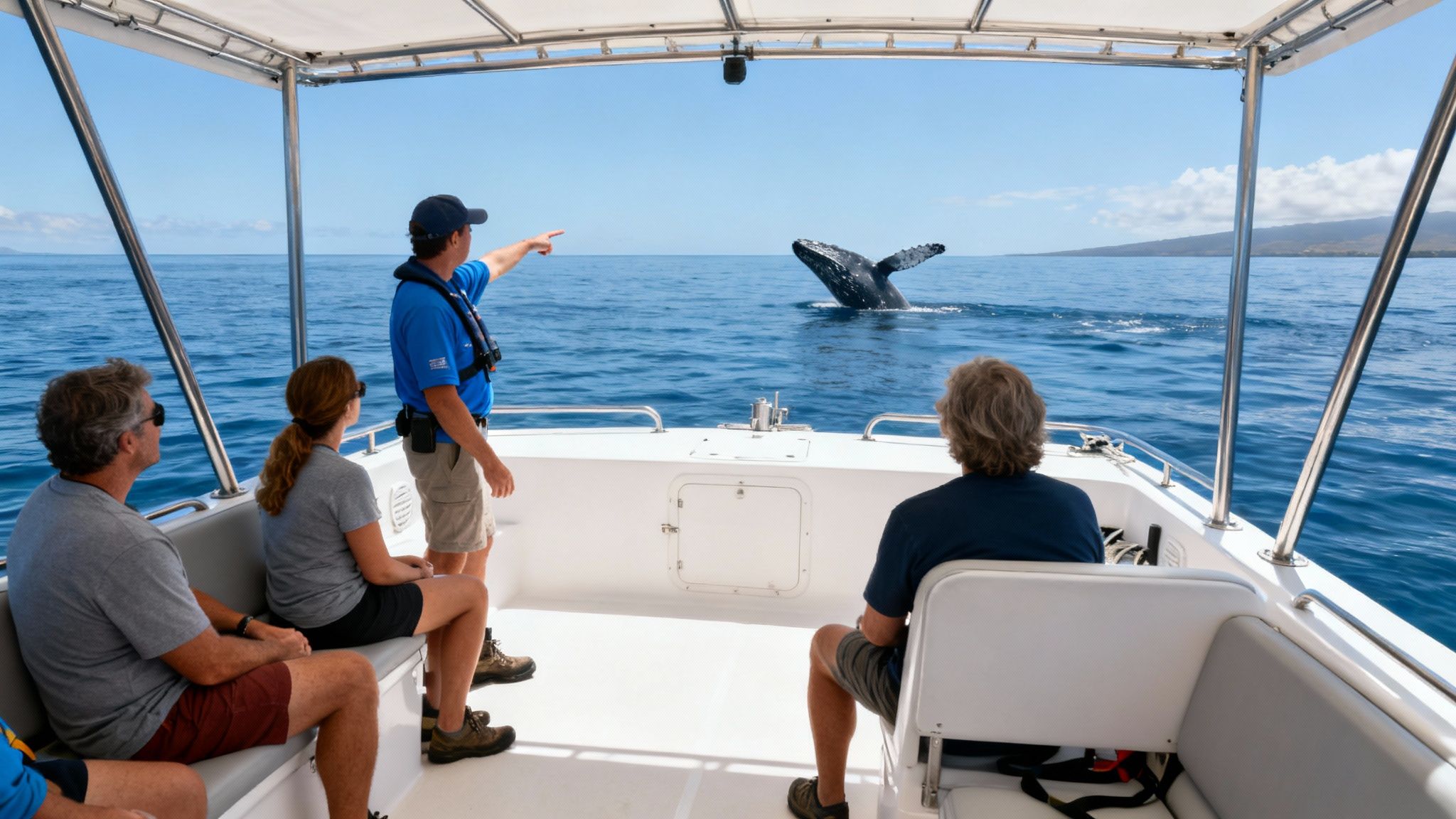
Picking the right tour for your Kona whale watching adventure is a huge part of the experience. It can honestly make or break your day. With a few different kinds of boats out on the water, figuring out the differences is the key to finding the perfect match. Usually, it all boils down to the size of the boat and the tour company's whole philosophy.
This one decision shapes everything, from how close you feel to the whales to the quality of the stories and facts you’ll hear. It’s about striking that perfect balance between comfort, agility, and a genuine respect for the whales.
Big Boats vs. Small Boats: A Quick Comparison
Along the Kona coast, you'll see a mix of tour boats, and each one offers a totally different vibe. The two main players are the big, stable catamarans and the smaller, zippier raft-style boats.
Large catamarans can carry dozens of people and usually come with perks like bathrooms and lots of shade. Their sheer size makes for a super stable ride, which is a massive plus if you're worried about seasickness. But that stability means they're less nimble, and being in a big crowd can sometimes feel a bit impersonal.
Smaller boats, like the ones we run at Kona Snorkel Trips, are a completely different world. We're faster, more agile, and can react in a heartbeat when whales appear. That nimbleness creates a much more dynamic and up-close feeling.
Choosing a small-group tour is like watching a spectacular play from the front row instead of the balcony. You are closer to the water, feel more connected to the ocean environment, and share the experience with just a handful of fellow adventurers.
Being right down at water level just makes the encounters feel more real and personal. It’s the best way to truly grasp the incredible size of a humpback whale.
The Kona Snorkel Trips Advantage
We’re huge believers that a smaller group makes for a better, more respectful whale encounter. We've designed our tours so you never feel like you're lost in a crowd. This kind of intimate setting lets you build a real connection, not just with the whales, but with your guide, too.
You'll have a direct line to our captains, who are all passionate marine naturalists. They can answer your questions on the spot, share incredible insights into whale behavior, and point out the little things you might otherwise miss. When you're picking a tour, it's also smart to look for operators who follow a sustainable boating guide to make sure your adventure is an eco-friendly one.
Here’s what really sets a small-group tour apart:
- More Personal Attention: With fewer guests, our crew can make the experience feel like it was designed just for you.
- Better Viewing Opportunities: Everyone gets a front-row seat. No need to elbow your way to the railing for a good view.
- Flexibility and Agility: We can change course quickly to get the best (and legal) viewing angles without ever stressing out the whales.
- A Focus on Education: Our guides love sharing their knowledge of Hawaii's marine world, turning your trip into a fun, floating classroom.
Choosing the right operator is about more than just the boat—it’s about finding a company that’s serious about conservation and responsible wildlife viewing. We take our role as stewards of the ocean to heart, making sure our presence has the smallest possible impact on these magnificent animals. You can dive deeper into what makes a trip special in our guide to the best Kona whale watching tours.
Combine Your Adventures for the Ultimate Day
Why stop at just one ocean adventure? One of the smartest ways to experience Kona's incredible waters is to pair your whale watching trip with another one of our iconic marine tours. The ocean here is just bursting with life, and a combo trip lets you see it all.
Picture this: you spend the morning watching humpback whales launch themselves out of the water, and then you cruise over to the pristine waters of Kealakekua Bay. There, you can slip into the calm, clear sea for an unforgettable snorkel over vibrant coral reefs.
Our Captain Cook snorkeling tour takes you right to this protected marine sanctuary, which is famous for its amazing visibility and schools of colorful tropical fish. Combining that with a whale watch creates a full day of ocean exploration that truly shows off the best of the Kona coast.
What to Expect During Your Ocean Adventure
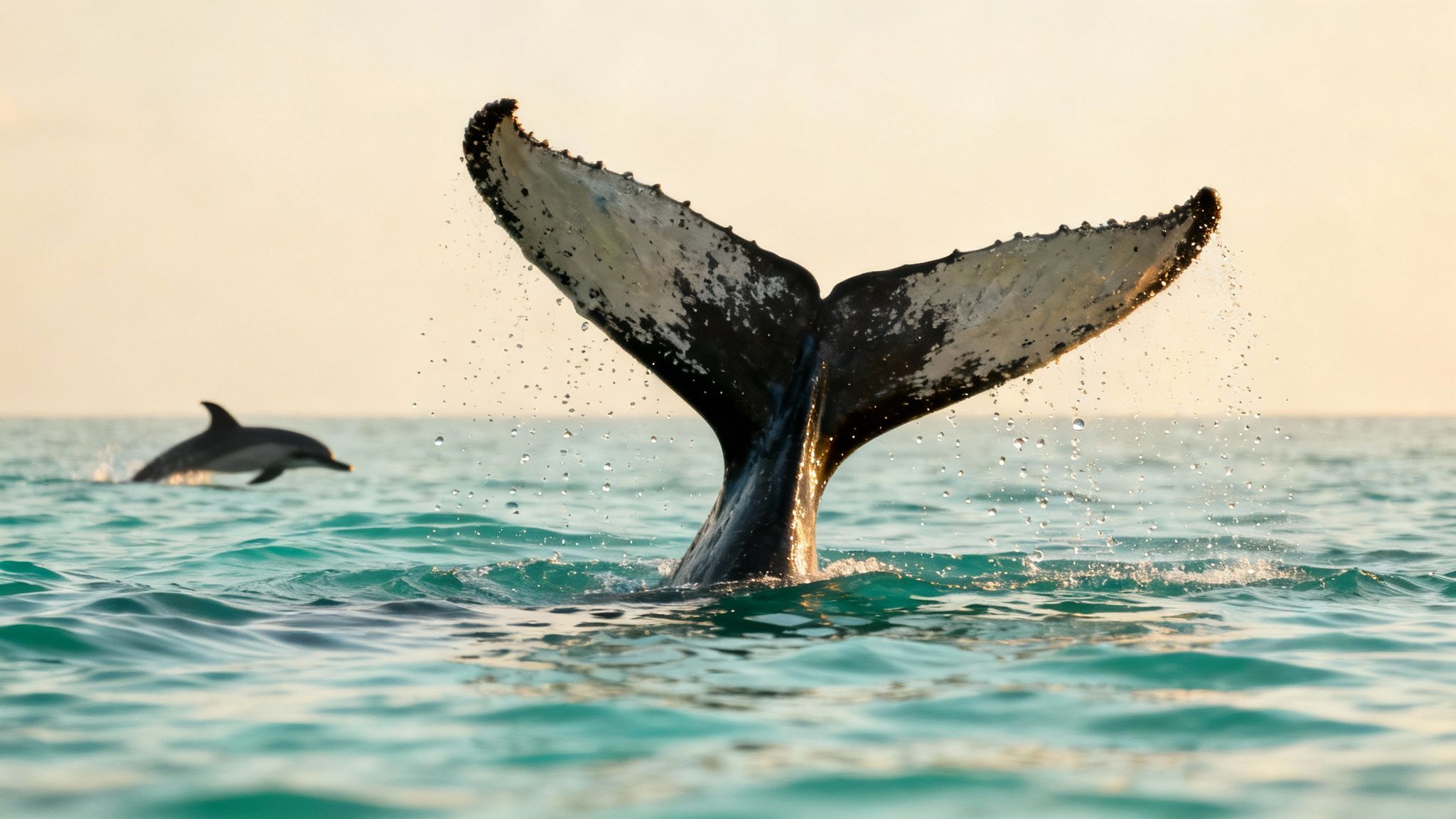
There’s a certain kind of quiet excitement that takes over as we pull away from the Kona coast, the deep blue of the Pacific stretching out in every direction. Everyone on board starts scanning the horizon, looking for that one telltale sign—a misty puff of air hanging over the water.
When you see that first spout, the whole boat comes alive. That’s the moment your Kona whale watching adventure gets real, a signal that one of these magnificent humpbacks is sharing the water with us.
As the boat slows and we approach respectfully, the sheer scale of these animals truly sinks in. Seeing a 40-ton, 40-foot creature launch its entire body out of the water in a full breach… well, it’s a moment of raw power and surprising grace that no photo or video can ever do justice to.
But the acrobatics are just part of the story. Between surfacings, when things get quiet, our crew might lower a hydrophone into the water. If we’re lucky, you’ll get to hear the complex and haunting songs of the male humpbacks—an otherworldly soundtrack echoing up from the depths.
Breathtaking Whale Behaviors to Look For
One of the best parts of any Kona whale watching tour is learning to read the water and understand what you're seeing. Every splash and surface movement has a purpose, offering a small peek into the incredibly complex social lives of humpback whales.
Here are a few of the most incredible behaviors you might get to witness:
- The Breach: This is the one everyone hopes for—the iconic, full-body leap straight out of the water. Scientists have a few theories: it could be a way to communicate over long distances, shake off pesky parasites, or maybe, just maybe, an expression of pure joy.
- The Tail Slap (Fluke Slap): You’ll hear this one before you see it. A powerful slap of the whale's tail on the water's surface creates a sound that thunders across the ocean. It could be a warning to other whales, a bit of social chatter, or a show of strength during mating rivalries.
- The Pectoral Slap: Whales have pectoral fins that can be up to 15 feet long! When they roll onto their side and repeatedly slap one of these long fins on the water, it's another form of communication we often see when whales are socializing in groups.
- Spy-Hopping: This one is my favorite. It’s a truly captivating behavior where a whale pokes its head straight up out of the water, almost like a submarine periscope, to get a look around. It feels like pure curiosity, as if the whale is just as interested in checking us out as we are in them.
It’s More Than Just Whales
While the humpbacks are without a doubt the stars of the show during whale season, Kona’s waters are a bustling metropolis of marine life. You never know what you’ll find out here, so keep your eyes peeled.
It’s not uncommon for a pod of playful spinner dolphins to show up and put on an incredible acrobatic display right alongside the boat. We also have chances to see pilot whales, oceanic whitetip sharks, and of course, our beloved Hawaiian green sea turtle (honu) surfacing for a breath of air.
Every single tour is different. It’s a unique snapshot of Kona’s dynamic marine ecosystem. While we’re all out here for the humpbacks, the chance of seeing other species adds a whole extra layer of excitement and discovery to your day on the water.
Why Ethical Viewing is Everything
Witnessing these majestic creatures comes with a profound responsibility. These humpback whales have traveled thousands of miles to get to Hawaii. They’re here to breed, give birth, and nurse their young in what should be a safe and peaceful environment. Respecting their space isn't just a good idea—it's absolutely critical for their well-being.
The Hawaiian Islands Humpback Whale National Marine Sanctuary was created to protect these animals, and there are strict, non-negotiable guidelines in place. The number one rule is that all vessels must stay at least 100 yards away from humpback whales. This creates a vital buffer zone, allowing the whales to go about their business without feeling stressed or threatened.
Our tours strictly adhere to every sanctuary guideline. We’re passionate about ensuring a safe and respectful encounter for both our guests and the whales. The fact that the sanctuary's community science project, the Sanctuary Ocean Count, consistently records such high numbers here proves how important these protections are. During one recent count, volunteers spotted 4,782 humpback whales in just three days—a powerful reminder of Kona's role as a critical habitat.
If you want to learn more about the incredible conservation work being done, check out the sanctuary's official website. By choosing a responsible operator, you become a partner in protecting these gentle giants for generations to come.
How to Prepare for Your Day on the Water
A good day on the water can become a truly epic one with just a bit of prep work. Getting your gear sorted beforehand means you can relax and stay totally focused on the main event: the incredible spectacle of Kona whale watching.
Think of it like getting ready for a day hike—you wouldn't set off without water and the right shoes. Same idea here. Come prepared, and you'll be ready for sun, sea spray, and anything else the ocean decides to throw your way.
Your Essential Packing Checklist
We've seen it all, and these are the items that consistently make the biggest difference for our guests. Tossing these in your bag will keep you comfortable, protected, and ready to capture every awesome memory.
- Reef-Safe Sunscreen: The Hawaiian sun is no joke, especially when it's bouncing off the water. Please protect your skin—and our fragile coral reefs—by using a mineral-based, reef-safe sunscreen.
- Polarized Sunglasses: This is a game-changer, not just a suggestion. Polarized lenses slice through the intense glare on the ocean's surface, making it so much easier to spot whales and see what's happening just below the waves.
- A Hat and a Light Jacket: A good hat, especially a wide-brimmed one, is key for keeping the sun off your face and neck. And even on the hottest Kona days, the breeze out on the water can get surprisingly chilly. A light jacket or windbreaker is perfect to have on hand.
Capturing the Moment
You're going to want to remember this day forever. While your phone's camera is great, bringing dedicated gear can really elevate your photos and your overall viewing experience.
A camera with a decent zoom lens will be your best friend for getting those frame-worthy shots of a breach or a tail slap from a respectful distance. Binoculars are also fantastic—they let you get incredible, up-close views of the whales' behavior without getting any closer to the animals themselves.
Pro tip: Remember why you're here. It's easy to get caught up trying to get the perfect photo, but don't forget to put the camera down. Just be present. The feeling of watching a massive 40-ton whale glide through the water is something you need to experience with your own two eyes.
Tips for a Smooth Ride
If you're someone who gets a little queasy on boats, don't worry—a little planning goes a long way. Choosing one of our calmer morning tours is always a smart move.
Staying hydrated, getting a solid night of sleep before your trip, and keeping your eyes on the stable horizon line can make a world of difference. For a full rundown of our best tips, check out our guide on how to prevent seasickness on your boat tour. Following these simple tricks will help you feel your best, so you can focus on the amazing show unfolding right in front of you.
Got Questions About Kona Whale Watching? We've Got Answers.
Planning the perfect whale watching trip always brings up a few questions. We get it. You want to make sure everything is just right for an adventure you'll never forget. Here are some of the most common things people ask us, with straightforward answers to help you feel confident and excited about your trip.
Is a Whale Sighting Guaranteed on a Tour?
This is the big one, isn't it? While we wish we could make a 100% guarantee, these are wild animals moving through a vast ocean. That said, during the peak season from January through February, your chances of seeing humpbacks are incredibly high.
Our crew lives and breathes these waters. We know their patterns and favorite spots. Our success rate for finding whales is exceptionally high, which means we give you the best possible shot at having that magical encounter.
How Close Can We Get to the Whales?
Federal law is very specific and designed to protect these amazing creatures: all boats must stay at least 100 yards away from humpback whales. We take this rule very seriously—it’s all about respect for the animals and their home.
But here’s the cool part: whales don't know the rules. They are naturally curious and often decide to come check us out, swimming much closer on their own terms. When this happens, it's an absolutely breathtaking moment. Our captains are masters at positioning the boat for the best possible views while always, always respecting their space.
What Is the Best Time of Day for Whale Watching?
Honestly, the whales are active all day long, so there's no single "best" time. It really comes down to the kind of experience you're looking for.
- Morning Tours: If you love calm, glassy water, the morning is for you. The ocean is often at its most peaceful, which makes for a super smooth ride and can make it easier to spot those tell-tale spouts on the horizon. It's a great pick if you're worried about seasickness.
- Afternoon Tours: Love taking photos? The afternoon light can be absolutely stunning, creating dramatic, beautiful scenes on the water. The whales are just as active, so you won't miss out on any of the action.
You really can't go wrong either way. Both morning and afternoon trips offer fantastic opportunities to see the full range of humpback behaviors.
Are the Tours Okay for Kids?
Absolutely! Kona whale watching is one of the most awe-inspiring experiences you can share with your family. There's nothing quite like seeing a child's face the first time a 40-ton whale breaches completely out of the water. It’s a memory that can spark a lifelong passion for the ocean.
Here at Kona Snorkel Trips, we love having families on board. Our small-group tours mean it’s never crowded or overwhelming. It’s a safe, comfortable, and intimate setting perfect for kids to experience the magic of these gentle giants. This is the kind of family adventure you'll be talking about for years to come.
Ready to witness the magic for yourself? Join Kona Snorkel Trips for a respectful, intimate, and unforgettable whale watching adventure on the beautiful Kona coast. Book your tour with us today!