
Your Guide to the Kona Manta Ray Night Dive
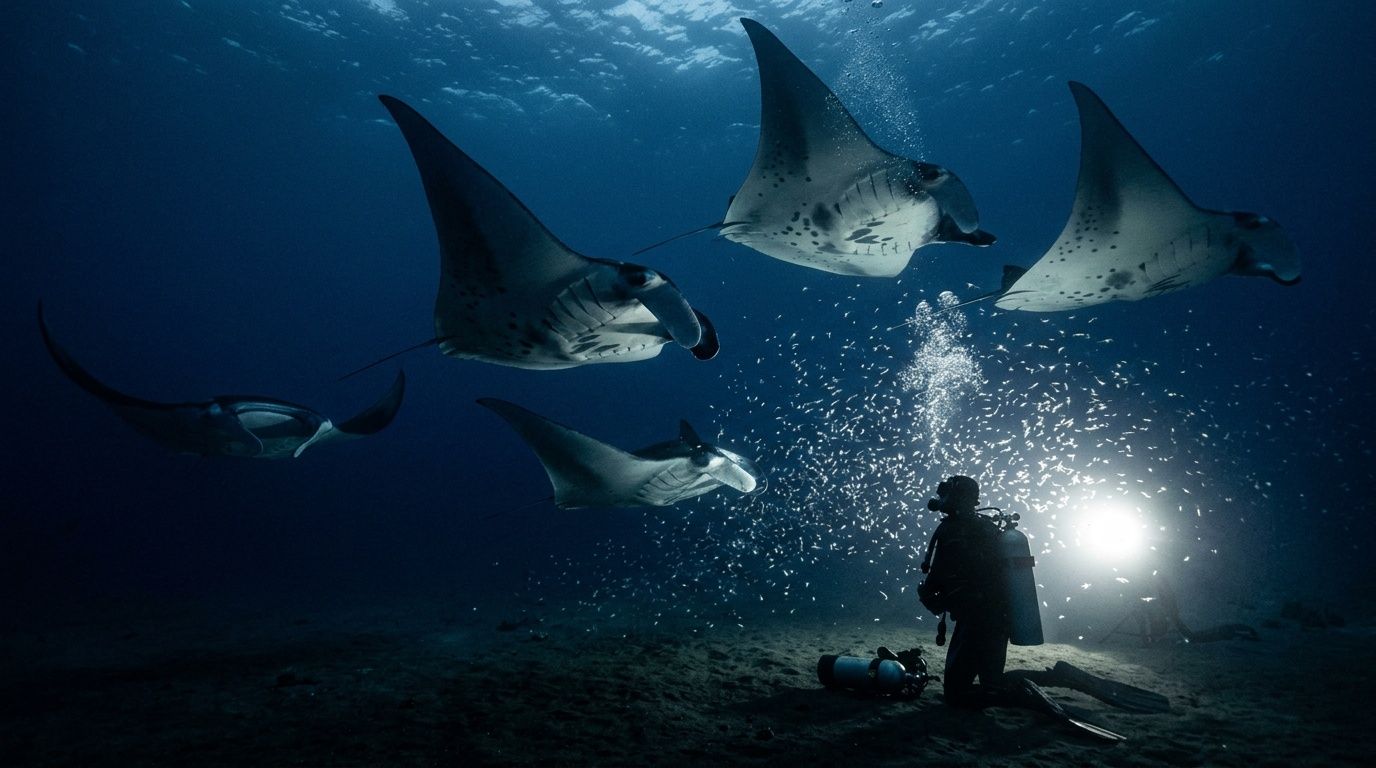
Picture this: You're floating in the warm, dark embrace of the Pacific after sunset. Suddenly, a gentle giant with a wingspan of 20 feet materializes from the darkness, gliding and somersaulting just inches from your face. This isn't a dream; it's the Kona manta ray night dive, a truly world-class wildlife encounter that you have to see to believe. It’s hands-down one of the most unforgettable experiences on the Big Island.
How Does the Manta Ray Night Dive Work?

The whole thing is pure genius, a sort of underwater dinner theater where you've got the best seat in the house. After the sun goes down, certified divers head to the sandy bottom, about 35 feet down. They gather in a circle and point their powerful dive lights straight up toward the surface, creating a massive column of light.
This bright beacon acts like a giant bug zapper for plankton, the microscopic critters that manta rays love to eat. As the plankton swarm into the light, the mantas show up for an easy meal. What follows is a mesmerizing, silent ballet as these massive rays swoop and roll through the water to feed.
A Reliable Natural Wonder
Most wildlife tours are a bit of a gamble, but the Kona manta ray experience is famous for its consistency. This incredible encounter first started gaining traction back in the early 1990s and has since become a must-do for roughly 80,000 visitors to the Big Island every year. PADI (the Professional Association of Diving Instructors) even ranks it as one of the best night dives on the planet.
Why? Because it works. The chance of seeing mantas is incredibly high, often between 80-90%. At the main sites like "Manta Village" and "Manta Heaven," tour operators report successful sightings well over 90% of the time.
Dive vs. Snorkel: Which Is Right For You?
Deciding whether to dive or snorkel with the mantas is a common question. Divers get to sit on the ocean floor and watch the action from below, while snorkelers float on the surface, holding onto a lighted board and looking down. Both offer an incredible view!
Here’s a quick breakdown to help you decide which adventure fits you best.
Manta Ray Dive vs Snorkel at a Glance
| Feature | Manta Ray Night Dive | Manta Ray Night Snorkel |
|---|---|---|
| Required Certification | Open Water Diver Certification | None |
| Your Position | Seated on the ocean floor (approx. 35 ft) | Floating on the surface |
| Viewing Angle | Looking up as mantas dive down | Looking down as mantas swoop up |
| Physical Effort | Minimal; you remain stationary | Minimal; you hold onto a float |
| Best For | Certified divers wanting a bottom-up view | All ages and abilities, non-swimmers |
Ultimately, you can't go wrong. Whether you're a seasoned diver or a first-time snorkeler, the experience is absolutely breathtaking.
This is a true bucket-list adventure, but it's just one of the many other fantastic activities on the Big Island of Hawaii waiting for you.
How the Underwater Manta Ray Ballet Works

The incredible Kona manta ray night dive might feel like pure magic, but the secret to its success is actually a brilliant and beautifully simple bit of science. Think of it like a carefully staged underwater dinner party. We set the table, ring the dinner bell, and the graceful, gentle giants of the sea show up for the feast. You get a front-row seat to the whole spectacle.
The entire experience revolves around one thing: attracting the mantas' favorite meal, microscopic zooplankton. Once the sun dips below the horizon, we head out to one of the well-known manta sites along the Kona coast. For divers, we set up what looks like a glowing campfire on the ocean floor—a powerful, eco-friendly light that shines a bright beam up toward the dark surface.
This column of light is the "dinner bell." Almost instantly, it draws in dense clouds of plankton, creating an irresistible, all-you-can-eat buffet. The local manta rays, who’ve learned over decades to associate these lights with an easy meal, then glide in to feast.
A Recipe for Reliable Encounters
Kona isn't just a good place for this; it's the most reliable spot on the entire planet for manta ray encounters. That's thanks to a perfect storm of geography and biology that makes our little corner of the world a manta paradise.
- A Unique Coastline: The underwater slopes of our volcanic island naturally funnel nutrient-rich water from the deep ocean up toward the coast.
- Abundant Plankton: This constant upwelling creates a massive and stable population of zooplankton, the manta rays' primary food source. It's always on the menu here.
- A Resident Population: Unlike other places where mantas just pass through, Kona is home to a year-round community of over 450 identified manta rays. They don't migrate; they live right here.
It's this combination of a sheltered coast, a never-ending food supply, and a local manta population that makes the experience so consistently amazing. We aren't chasing the animals; we're passively attracting them for a respectful and sustainable interaction. You can dive deeper into their graceful movements in our guide on how manta rays swim underwater.
The Two Premier Manta Dive Sites
This nightly ballet happens at two main "stages" along the coast. Each one offers a slightly different, but equally breathtaking, experience.
Manta Village (Keauhou Bay): Just south of Kailua-Kona, this is the original manta viewing site. It's tucked into a calm, shallow, and protected bay, which makes it fantastic for both divers and snorkelers. It has a legendary success rate of over 90% and is known for incredibly intimate, up-close encounters.
Manta Heaven (Garden Eel Cove): Located north of town near the airport, this site is a bit deeper and more exposed to the open ocean. Conditions can be more dynamic, but the reward is often a larger number of mantas—sometimes more than a dozen gracefully swooping and barrel-rolling all at once!
For certified divers who want the ultimate underwater view, Kona Honu Divers is the top rated & most reviewed diving company in both Hawaii and the Pacific Ocean. Their expertise guarantees a safe and truly awe-inspiring adventure. We highly recommend booking their famous manta ray diving tour for an unforgettable experience.
Here’s How Your Manta Night Dive Unfolds
So, what's it really like to go on a manta ray night dive? It’s a question we get all the time. Let's walk through the entire evening, from the moment you meet our crew to the final, unforgettable moments in the water.

Your adventure starts with a warm welcome from our crew and a thorough pre-tour briefing. This isn't just about rules; it's where we share the secrets to a great night—we call it 'manta etiquette'. We'll explain how to interact respectfully with these gentle giants to ensure they feel safe and comfortable, which in turn gives you the best possible show.
We’ll cover why you can't touch the mantas, how to position yourself for the most incredible views, and what to expect when the lights hit the water. After that, it's a stunning boat ride out to the site as the Kona sun paints the sky over the Pacific.
Descending into the Underwater Theater
Once we're anchored, it's time to gear up. For our certified divers, the real magic begins with a descent into the warm, dark ocean. You’ll settle onto a sandy patch on the seafloor, typically around 35 feet deep. There, you’ll gather in a circle and aim your powerful dive lights upward, creating a brilliant column of light that acts like a dinner bell for the mantas.
If you're snorkeling, you'll hold onto our large, custom-built light board. This floating raft has its own powerful lights that shine straight down into the depths. It's super stable and lets you float effortlessly on the surface, giving you a perfect bird's-eye view of the action below.
Imagine plunging into the warm, ink-black waters off Kona's coast just after sunset, your heart racing as illuminated boards light up the night like underwater beacons. This is the magic of the Kona manta ray night dive, a phenomenon that kicked off in 1992 when a few curious divers noticed how their lights drew in swarms of plankton—and with it, the graceful giants themselves.
Local operators report success rates between 80% and 90% year-round, which are incredible odds for a wild animal encounter. The water temperature hovers around a comfortable 75°F, and our dives last a full 60 minutes—plenty of time to meet the average of 10 mantas spotted per trip.
The Main Event: An Underwater Ballet
As everyone gets settled, a peaceful quiet takes over, punctuated only by the sound of your own breathing. And then, it happens. A huge, graceful shadow emerges from the darkness, gliding into the light with impossible ease. The first manta has arrived.
You’ll watch, mesmerized, as it performs silent, acrobatic barrel rolls just feet—sometimes inches—from your face. For divers, they swoop down from above, and for snorkelers, they soar up from the deep. Soon, others often join the underwater ballet.
This breathtaking show typically lasts for about 45-60 minutes. Afterward, you’ll head back to the boat for a warm welcome from the captain and a relaxed ride back to the harbor, buzzing with what you just witnessed. To get an even better idea of what to expect, check out our complete guide to the Big Island manta ray dive.
Choosing the Best Manta Ray Tour Operator
Picking the right company for your Kona manta ray night dive can be the single most important decision you make. It’s what separates a decent trip from a memory you’ll talk about for the rest of your life. Every evening, a small fleet of boats heads out, and from the shoreline, they might all look the same. But believe me, the experience you have on board and in the water can be worlds apart.
The secret? It boils down to a few key things: small groups, world-class safety, and a real heart for conservation.
A smaller group isn't just about having more elbow room on the boat. It's about getting a front-row seat to the show. It means fewer fins and bubbles clouding your view of the mantas gliding below. This intimate setting allows our guides to give you personal attention, making sure you feel safe and comfortable from the moment you step on board. You can learn more about what to look for when picking any excursion in our guide to Kona boat trips.
Prioritizing Safety and Expertise
When you're out on the ocean after sunset, your safety is everything. The best operators don’t cut corners here. We’re talking lifeguard-certified guides and PADI-certified divemasters or instructors who are not just experts in the water, but also in manta behavior and our local ocean conditions.
These pros give you a thorough safety briefing and are ready for anything, so you can just relax and soak in the magic. Their expertise isn't just for you; it's for the mantas, too, ensuring we interact with them safely and respectfully.
For those wanting to take the plunge on a Kona manta ray night dive, one operator truly sets the standard. Kona Honu Divers is the top rated & most reviewed diving company in both Hawaii and the Pacific Ocean, famous for their commitment to safety, small groups, and a genuinely premium experience.
Choosing a tour isn't just about the dive; it's about supporting a sustainable and ethical interaction. The best operators are deeply involved in local conservation, contributing to research and adhering to strict guidelines that protect Kona's resident manta population for generations to come.
If you'd rather stay on the surface, the snorkel experience is just as mind-blowing. For that, Kona Snorkel Trips runs incredible small-group tours that get you right in the action. Another fantastic option to consider is Manta Ray Night Snorkel Hawaii, an exceptional alternative when looking for a Manta Ray night snorkel tour.
Understanding Kona's Gentle Giants

Alright, before you slip into the dark water for your Kona manta ray night dive, let's get you properly introduced to the stars of the show: our resident reef manta rays, Mobula alfredi. These aren't just big fish gliding through the ocean. They're incredibly smart, with the biggest brain-to-body size ratio of any fish out there. You can genuinely feel that intelligence when one looks you in the eye as it soars past.
Now, let's clear up the biggest misconception right away: manta rays are not dangerous. They are gentle giants, plain and simple. Think of them as the ocean's graceful vacuum cleaners—they filter-feed on tiny plankton and have no teeth, no stingers, and no barbs. They are completely harmless to people and are nothing like their distant cousins, the stingrays.
Identifying the Locals
The mantas you'll meet aren't just a random group passing through; they're part of a well-known and studied community. Here in Kona, we can recognize over 450 individual manta rays that call these waters home. So, how do we tell them apart?
It all comes down to their bellies. Each manta has a unique pattern of black spots on its underside.
This pattern is as unique as a human fingerprint. It allows researchers and guides to name them, track their movements, and keep an eye on their health. You’ll likely hear your guide call out names like "Lefty" or "Big Bertha" as they swoop in for dinner!
Being able to identify individual rays has been a game-changer. It gives us incredible insight into their social lives, behaviors, and the overall health of their population—a real testament to the special relationship between people and mantas here in Kona.
A Thriving, Healthy Population
The Kona manta ray night dive is more than just an unbelievable thrill. It’s a direct window into one of the healthiest manta populations on the planet. This thriving community of reef mantas, Mobula alfredi, loves it here for a reason. Kona has the perfect recipe: crystal-clear waters, nutrient-rich upwellings, and a reliable nightly buffet of plankton.
Since organized dives started becoming popular back in 1992, researchers have been able to keep a close watch, ensuring this population remains robust. You can discover more insights about this thriving population on konahonudivers.com.
When you join a responsible tour, you're doing more than just sightseeing—you're actively supporting the conservation efforts that protect this incredible local ecosystem. Knowing this will make your encounter with these magnificent creatures that much more meaningful. For more on what to expect, check out our article on manta ray diving in Hawaii.
Frequently Asked Questions About the Manta Dive
Jumping into the dark ocean to swim with giant rays? Yeah, we know it sounds a little wild, and it's totally normal to have a few questions before you go. We get asked these all the time on the boat, so let's clear them up so you can feel completely ready for this incredible adventure.
Is the Manta Ray Dive Safe?
Yes, 100%. Your safety is our absolute top concern, and every part of the experience is built around it. We start every single trip with a thorough safety briefing from our certified guides who live and breathe these waters.
And the mantas themselves? They're called gentle giants for a reason. They have no teeth, stingers, or barbs—they are completely harmless to people. The whole encounter is designed to be awe-inspiring and incredibly safe for both you and the rays.
What If I'm Not Scuba Certified?
No problem at all! While the dive is an amazing experience, the manta ray snorkel tour gives you an equally breathtaking front-row seat from the surface.
Snorkelers hold onto a custom-built, floating light board. These powerful lights are like a dinner bell, attracting the plankton that mantas love to eat. You just float comfortably and watch as the mantas glide and barrel-roll right up to you, often just inches away.
What Is the Best Time of Year to Go?
Anytime! The Kona manta ray night dive is a year-round activity with an incredible success rate, often over 90%. Unlike seasonal visitors like humpback whales, Kona's manta ray population lives here. This means any night you're on the Big Island is a fantastic time to see them.
While sightings are extremely reliable, it's important to remember these are wild animals. That's why top-tier operators have a "manta guarantee." If your tour doesn't see any mantas, they will typically offer you another chance to go out on a different night for free, subject to availability.
If you're worried about getting queasy on the boat, you might want to check out our guide on how to avoid seasickness on a boat for some super helpful tips we've learned over the years. For even more firsthand accounts, you can often find more travel stories and trip reports on dedicated travel blogs.