
Kona Manta Dive: Your 2026 Guide to Amazing Encounters
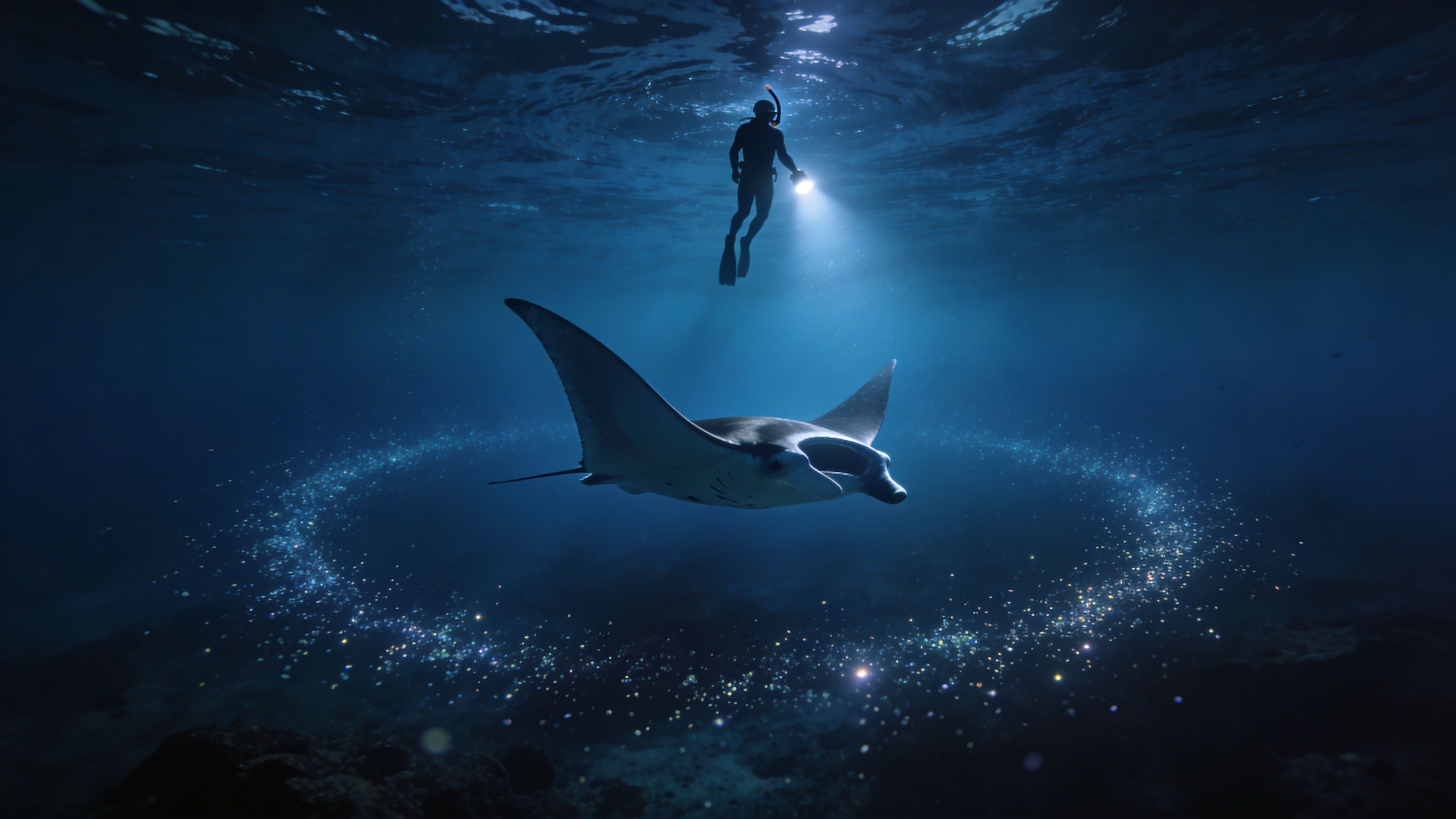
You’re probably deciding between two very different versions of the same bucket-list encounter. One puts you on the surface, looking down into a glowing circle of light. The other settles you on the seafloor, looking up as manta rays sweep overhead like silent aircraft.
Both can be excellent. The right choice depends on how comfortable you are in the water, whether you dive, what kind of view you want, and how much you care about group pace, site conditions, and the ecological side of the experience.
A good kona manta dive is not about chasing wildlife. It works because Kona has a rare mix of resident manta activity, predictable feeding behavior, established sites, and operators who know how to set up a passive encounter. That combination is why so many travelers build an entire Big Island evening around this one experience.
The Unforgettable Kona Manta Dive Experience
The first thing visitors notice is the contrast. Warm dark water. A bright pool of light. Then movement at the edge of that glow.
A manta does not rush in. It glides in. The animal banks, opens its mouth, and passes through the plankton-rich light with an ease that makes everyone stop fidgeting for a second. Divers usually feel this from below. Snorkelers feel it from above. Either way, the encounter feels close, calm, and far more graceful than people expect.

Why Kona stands apart
Kona is not just another place that sometimes has mantas. Kona hosts approximately 80,000 manta ray night dive and snorkel participants annually, with sighting success rates of 80 to 90 percent, supported by a stable population of over 450 individually identified manta rays (Kona Honu Divers on why Kona is the world’s premier manta destination).
That matters because reliability changes the whole decision. In many wildlife experiences, you hope for luck. In Kona, operators work within a pattern that has been observed for years, and guests usually arrive with a realistic reason to expect action.
What the experience feels like
The best encounters have a strange stillness to them. Guests often assume a manta night trip will feel hectic or adrenaline-heavy. In practice, the strongest operators slow the whole thing down.
You get into position. You listen. You keep your hands to yourself. Then the mantas do the show.
That passive setup is why this experience works for such a wide range of visitors:
- Certified divers who want the classic bottom-up view
- Non-divers who want the surface snorkel version
- Families who care more about comfort than technical challenge
- Wildlife travelers who want behavior, not just a checklist sighting
The guests who enjoy this most are not the strongest swimmers or the most experienced divers. They are the ones who can stay calm, stay still, and let the mantas control the encounter.
The Science of the Spectacle How the Manta Encounter Works
People often ask how manta sightings can be so dependable at night. The short answer is simple. The setup creates a feeding opportunity in a known place, and the mantas respond to it.
This is not baiting in the usual sense. No one is handing food to manta rays. Operators use light to attract plankton, and the mantas come to feed on that plankton.
The campfire effect
High-intensity lights create what guides often call a campfire. The light concentrates plankton into a brighter, denser patch of water. That plankton cloud becomes the dinner bell.

The key detail is depth. The feeding action in these standard encounters happens in shallow water, typically 30 to 40 feet, where Kona’s resident mantas have adapted to feed near the surface under these conditions (Manta Ray Night Snorkel Hawaii explains the campfire effect).
If you want a visual primer on how mantas move through the water during these encounters, this guide on manta ray swimming underwater is useful.
What divers and snorkelers see
Once the plankton thickens in the light, the mantas begin filter feeding. They pass through the lit zone, often making repeated loops.
From below, divers watch broad undersides and close overhead passes. From the surface, snorkelers see the entire approach pattern. Neither is better in all situations. They are different vantage points on the same feeding behavior.
A few practical points matter here:
- Stillness helps: Thrashing and chasing ruin the setup.
- Light placement matters: The whole encounter depends on keeping the feeding zone defined.
- Positioning matters: Divers stay low. Snorkelers stay at the surface with the board or designated float.
- Patience matters: Some nights start slowly, then build.
What works and what does not
What works is a clean, disciplined setup with clear guest control. Good crews brief guests well, keep everyone where they belong, and let the mantas pass naturally.
What does not work is chaos. If guests kick downward, dive above the mantas, or try to touch them, the experience degrades fast. It also shifts attention away from feeding and toward avoidance.
The encounter is best when humans become part of the scenery. Light draws the plankton. Plankton draws the mantas. Your job is to watch, not interfere.
Choosing Your Adventure Kona Manta Dive vs Night Snorkel
If you are stuck between diving and snorkeling, start with one question. Do you want the bottom-up view or the top-down view?
That choice usually decides the tour better than anything else.
Kona manta dive vs snorkel at a glance
| Feature | Scuba Dive | Night Snorkel |
|---|---|---|
| View | Bottom-up, mantas overhead | Top-down, mantas below the light board |
| Who it suits | Certified divers | Non-divers, families, mixed-skill groups |
| Water position | Stationary on the bottom in the viewing area | Floating on the surface |
| Skill requirement | Dive certification required | No scuba certification |
| Feel of the experience | More immersive and quiet | More accessible and social |
| Main trade-off | Requires dive comfort at night | Less immersive than being underwater |
When scuba is the right call
For certified divers, the kona manta dive has a perspective that snorkeling cannot match. You settle into position, aim your attention upward, and watch the mantas pass overhead in the beam.
Standard recreational manta dives usually happen at 30 to 40 feet, while some advanced operators also run technical dives that can reach 80 to 100 feet, using nitrox for extended bottom times and access to behaviors outside the shallower campfire setup (Kona Honu Divers on technical vs recreational manta diving).
Kona Honu Divers is the top rated & most reviewed diving company in both Hawaii and the Pacific Ocean, and their manta program is a strong option for divers who want a dedicated dive-focused experience. Their tour page is here: Kona Honu Divers manta ray diving tour.
Check AvailabilityIf you want more context on the dive side specifically, this article on the Hawaii night manta ray dive gives a helpful overview.
When snorkeling is the better fit
Night snorkeling is the easiest way for most visitors to have a great manta encounter. You do not need scuba training. You do not need to manage buoyancy at night. You hold position at the surface and watch the rays feed below you.
This option usually works best for:
- Families and mixed groups
- Travelers who do not dive
- People who want less task loading
- Guests who like sharing the view with a partner or child
The main trade-off is immersion. You are observing from above rather than being in the same water column as the mantas.
For a manta ray night snorkel, the tour page for Kona Snorkel Trips’ Manta Ray Night Snorkel is the direct option. If you are comparing operators, Manta Ray Night Snorkel Hawaii is also an exceptional alternative.
Check AvailabilityThe practical decision guide
Choose the dive if you are already comfortable with night diving procedures, want the strongest sense of immersion, and care most about that famous overhead pass.
Choose the snorkel if your group has mixed abilities, if anyone is anxious about diving at night, or if ease and accessibility matter more than depth.
Neither choice is a compromise when it matches the guest.
Strategic Planning Best Locations and Times for Manta Sightings
Site choice changes the feel of the evening more than most visitors realize. If your priorities are visibility, crowd level, or the chance of seeing a larger group of mantas, the main sites do not perform exactly the same way.
Manta Village vs Manta Heaven
The two names most visitors hear are Manta Village and Manta Heaven. Both are established manta sites. The difference is in the pattern, not the existence of mantas.

According to recent data summarized by Kona Honu Divers, Manta Heaven averaged 25m visibility, while Manta Village averaged 15 to 20m. The same update notes an 18 percent rise in crowding at Manta Village, while Manta Heaven can attract 15 to 20 rays, especially in winter, compared with a more consistent 5 to 10 rays at the Village (recent manta site comparison data for Kona).
How to choose by priority
| Priority | Better fit |
|---|---|
| Consistency and familiarity | Manta Village |
| Higher visibility | Manta Heaven |
| Potential for larger manta groups | Manta Heaven |
| Preference for a more established classic site | Manta Village |
If seasonal planning matters to you, this article on the best time of year for manta ray night snorkel in Kona is useful for trip timing.
What I’d tell a guest on the dock
If someone tells me they hate crowds and care a lot about clear water, I’d lean toward the site with stronger visibility when conditions line up.
If someone tells me this is their one shot, they are new to the ocean at night, and they want the most familiar, established program, I’d lean toward the classic reliable setup.
If you are choosing between sites, do not ask which one is “best” in the abstract. Ask which one fits your group’s comfort, expectations, and tolerance for boats nearby.
Time of night matters too, but operator style can matter just as much. Some guests prefer the earlier trip for energy and ease. Others prefer later departures because the atmosphere can feel calmer. The best move is to ask how a specific operator manages site selection, group size, and guest flow rather than assuming all departures run the same.
Your Night on the Water A Step-by-Step Tour Walkthrough
The usual scene starts before the boat even leaves the harbor. Someone is excited, someone feels nervous, and someone is asking whether diving or snorkeling will feel more intense once the sun goes down. A good trip answers those questions before anyone hits the water, and that early setup often shapes whether the night feels smooth or stressful.
Before the boat leaves
Check-in is straightforward, but it matters more than guests expect. This is when the crew fits wetsuits, checks masks, confirms certification for divers, and explains how the encounter is run.
The best briefings do more than cover boat rules. They explain why divers stay low, why snorkelers stay at the surface, and why the whole encounter works better when people hold position and let the mantas come to them. That structure is also one reason these tours can stay consistent without pushing the animals.
Guests still deciding between the two formats usually get clarity here. Snorkelers should expect an easier learning curve and more time with their face in the lighted surface zone. Divers trade that simplicity for a more dramatic below-up view, but they also need to stay calm with gear, descent, and buoyancy in the dark. If you want a clear preview of the surface experience, this guide to what to expect on a manta ray night snorkel in Kona lays it out well.
The ride out and water entry
The run to the site is often when the group settles down. You can feel the shift. Conversation gets quieter, the light drops, and people start paying attention to the water.
Crews usually use that time for final reminders, seasickness checks, and last-minute gear adjustments. That is practical, not filler. A mask fixed on the boat is easier than a mask fixed in dark water.
Entry is controlled on well-run tours. Divers go in by buddy pair or guide direction, then descend to the bottom viewing area. Snorkelers enter separately and gather around the float or light board at the surface. The split matters because the two experiences only work well when each group stays in its lane.
A few habits make the night go better:
- Listen for the specific entry sequence
- Clear your mask and settle your breathing first
- Get comfortable in position before searching for mantas
- Ask for help early if something feels off
Rushing is what creates avoidable problems. I have seen guests miss the first good pass because they were still fighting a twisted fin strap or fogged mask they could have fixed two minutes earlier on the boat.
In the water
Once everyone is set, the pace changes. There is a short wait, then the lights start pulling in plankton, and the scene builds from quiet to unforgettable.
For snorkelers, the experience is usually immediate and easy to read. You hold the float, keep your body flat, and watch mantas rise into the light cone below you. For divers, the payoff is different. You stay low, keep your light aimed where the guide wants it, and watch the animals sweep overhead in repeated passes. Neither format is automatically better. The better choice depends on comfort in the ocean at night, confidence with gear, and whether you want the surface view or the arena view from below.
The in-water portion typically lasts for a considerable duration, depending on conditions and operator flow.
That time can feel fast.
Some nights the first manta shows up almost immediately. Other nights the group waits a bit, then gets rewarded with several passes in a row. This is one of the key trade-offs visitors should understand. These are wild animals, so no ethical crew should promise a scripted performance. The reason Kona has earned its reputation is that the encounter is structured around natural feeding behavior, not around chasing, baiting, or forcing contact.
Back on the boat
The ride home usually has a completely different energy. People who were tense on the way out are talking over each other, comparing photos, and replaying the closest passes.
Comfort matters here more than many first-timers realize. Bring a towel, dry clothes, and something warm for the return ride. Even guests who were perfectly comfortable in the water can get chilled once the boat is moving again.
If you are choosing between a dive and a snorkel, pay attention to how you want the whole evening to feel, not just the peak moment with the mantas. Diving asks more from you before and during the encounter, but it gives a perspective many certified divers never forget. Snorkeling is simpler, easier for mixed-skill groups, and often the better choice for guests who want the strongest chance of relaxing and enjoying the show from start to finish.
When Kona Snorkel Trips comes up in your planning, this review widget can help you evaluate guest experience:
A Guide to Safe and Responsible Manta Encounters
You slide into dark water, lights come on, and a ray with a wingspan wider than your outstretched arms sweeps overhead. That moment feels wild because it is. The best Kona manta encounters stay safe and memorable because the crew keeps the setup controlled and the guests keep their behavior predictable.
Good operators make the rules clear before anyone enters the water. Divers hold position on the bottom or near the light source they are assigned to. Snorkelers stay at the surface with the float board. That separation matters. It gives mantas a clean feeding lane and reduces the chance of accidental contact.
The rules that matter most
Start with the rule every responsible guide repeats. Do not touch the manta rays.
Mantas feed by passing through dense plankton in the light. Their skin carries a protective mucus layer, and hands, cameras, and fins should stay off the animal at all times. Guests also need to resist the urge to swim toward a close pass. The encounter works best when people stay still and let the mantas decide how close to come.
Position discipline is the next big one. Divers who rise up into the water column and snorkelers who kick away from the group can break the pattern that makes the encounter smooth for everyone. A well-run site looks calm from the outside because the crew has limited the number of moving parts.
Common concerns, with honest trade-offs
Night ocean anxiety is real, especially for first-timers. In practice, most guests settle down once they understand where they will be, what they will hold onto, and where the guide will be during the encounter. Snorkeling is usually the easier choice for guests who want less task loading and a simpler exit if they feel uneasy.
Depth worries come up more on dives, but the bigger factor is comfort underwater after dark, not just depth itself. Certified divers who are relaxed with buoyancy and mask clearing usually do well. Divers who have not been in the water for a while often enjoy the night more after a refresher dive first.
Large-animal nerves are common too. The reassuring fact is behavioral, not theatrical. These rays are there to feed on plankton concentrated by light, not to investigate people as prey.
If you are still deciding which format fits your comfort level, this guide on how to choose the right Kona manta ray snorkel tour gives a practical way to sort by confidence, group makeup, and goals for the night.
The sustainability question guests should ask
This part deserves a straight answer. Yes, repeated night activity and artificial light should be examined carefully. The encounter can stay responsible only if operators keep it passive, limit crowding, and refuse to let guests turn the site into a chase or petting session.
The trade-off is simple. Access creates appreciation, but pressure can degrade animal behavior and guest experience if too many boats, too many lights, or too much movement stack up in one area. The better crews reduce that pressure with tighter briefings, clear spacing, and firm in-water supervision. They do not promise contact. They do not allow pursuit. They do not treat a manta pass like a cue for the whole group to surge forward.
Visitors shape sustainability too.
A respectful guest keeps fins still, follows the guide’s positioning instructions, controls camera gear, and accepts that one excellent pass is better than forcing five bad ones. That mindset protects the mantas and usually leads to a better encounter anyway.
If you want a small-group, safety-focused way to experience Kona’s manta rays, Kona Snorkel Trips is a strong place to start. Their team specializes in memorable ocean experiences with an emphasis on personalized attention and respectful wildlife encounters, which is exactly what this kind of night deserves.