
Kona Manta Dive: Witness the World’s Best Underwater Ballet in 2026
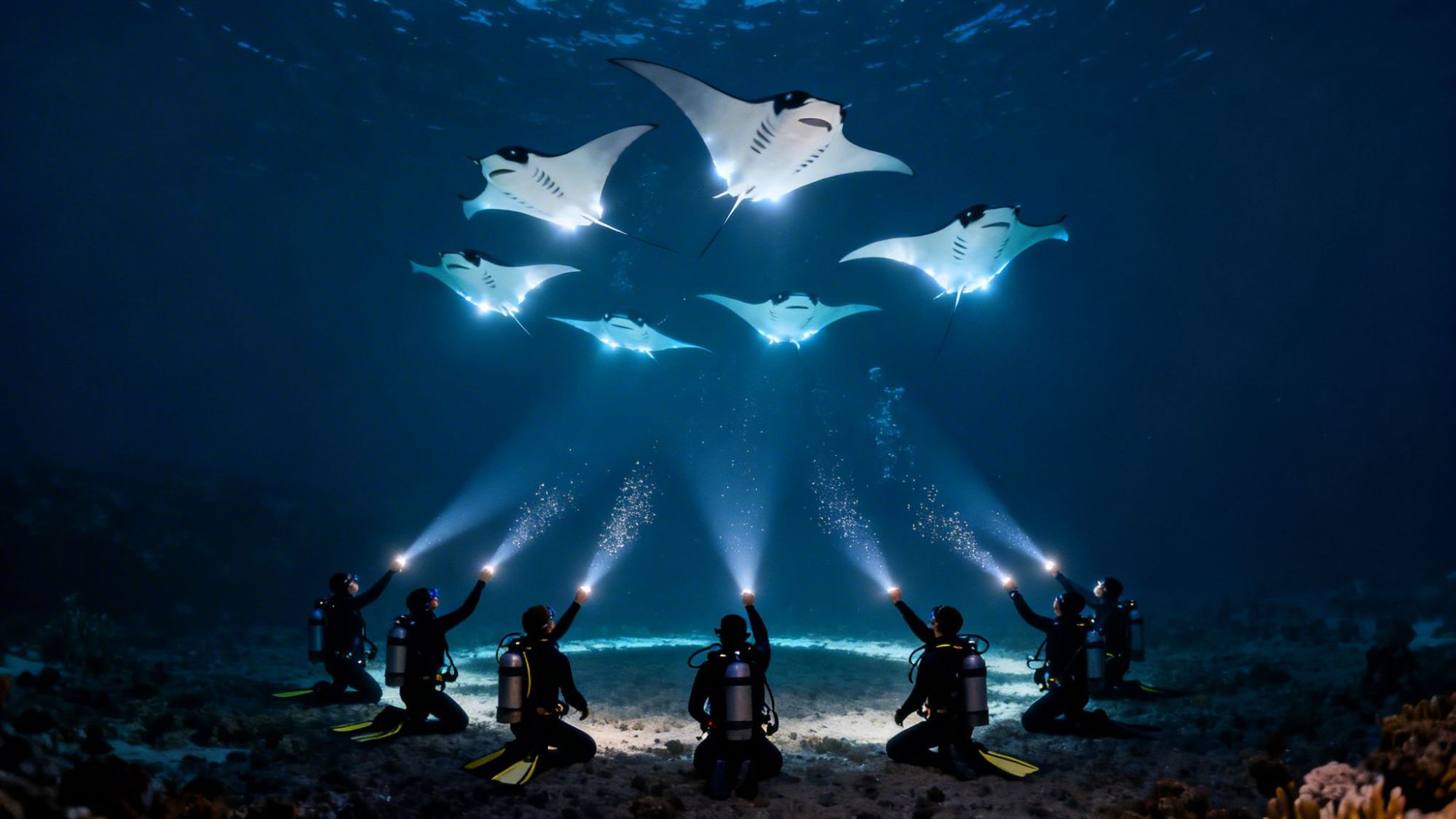
Picture this: you slip into the dark, warm waters of the Pacific. Your light beam cuts through the blackness, joining a circle of others on the ocean floor, creating a bright stage. This is the Kona manta dive, and it's not just a dive—it's one of the most incredible wildlife encounters you can have, anywhere on the planet.
What Makes The Kona Manta Dive So Special?

The magic of the Kona manta ray experience is how it all comes together. It’s almost like we’re setting a dinner table for giants. We use powerful lights to attract zooplankton, those tiny little critters that manta rays love to eat.
Suddenly, a shadow appears from the darkness. Then another, and another. These gentle giants, some with wingspans stretching over 12 feet, glide in to feast on the illuminated buffet. They perform an underwater ballet of barrel rolls and somersaults, often just inches away from you. It’s a moment that’s both thrilling and profoundly peaceful.
Choosing Your Manta Encounter: Dive or Snorkel?
One of the greatest things about this experience is that almost anyone can do it. You don’t need to be a seasoned scuba pro to see the magic up close. Both diving and snorkeling offer unforgettable, but very different, ways to see the show.
It really just comes down to your comfort in the water and the perspective you want. Do you want to be on the ocean floor looking up as mantas soar overhead? Or would you rather float on the surface and watch the whole spectacle unfold from above?
To help you decide, here’s a quick look at the two options.
Kona Manta Dive vs Manta Snorkel at a Glance
| Feature | Manta Ray Night Dive (Scuba) | Manta Ray Night Snorkel |
|---|---|---|
| Perspective | You'll be on the ocean floor (around 30-40 ft deep), looking up as the mantas glide right over you. | You'll be floating on the surface, holding onto a lighted board and looking down at all the action below. |
| Certification | An Open Water Diver certification is required for this one. | No certification needed! It's perfect for almost any swimming ability. |
| Proximity | Incredibly close. Mantas can swoop just inches above your head for a truly immersive view. | Very close. The mantas come right up to the light board, often just below the surface. |
| Best For | Certified divers comfortable with night diving who want an intimate, bottom-up perspective. | Non-divers, families, and anyone who wants a panoramic view of the entire scene. |
Ultimately, there's no wrong choice. Both experiences will leave you in a state of absolute awe.
Why Your Dive Operator Matters
When you’re ready to see this for yourself, choosing the right guide makes all the difference. For the ultimate Kona manta dive, you want to go with an operator who is an absolute expert.
We always send people to Kona Honu Divers. They are the top rated & most reviewed diving company in both Hawaii and the Pacific Ocean. Their team's knowledge and commitment to safety mean you’ll have a respectful and completely unforgettable encounter. You can check out their manta ray diving tour page to see exactly what they offer.
Whether you dive or snorkel, you're about to witness something truly special. The consistency of these sightings is what has rightfully earned Kona the title of the world's manta ray capital. If you're hooked and want to learn more, take a look at our guide full of fun facts about manta rays.
Why Kona Is The World’s Best Manta Ray Destination

People always ask me, "Can't I see manta rays somewhere else?" And sure, you can. But nowhere else on Earth compares to the magic and sheer consistency of the Kona manta dive. Here, it’s not a matter of luck. It's a near-nightly spectacle that has rightfully put Kona on the map as the undisputed capital for manta ray encounters.
So what's the secret? It’s a perfect storm of unique geography, incredible marine biology, and a little bit of human habit. It’s a recipe for manta magic that just can’t be found anywhere else.
The experience is so reliable that we—the local guides and researchers—have been able to identify and name over 450 individual manta rays since the early 90s, all by the unique spot patterns on their bellies. This isn't just a random fly-by; it's a thriving community. We see success rates of 85-90% on our nightly trips, meaning on almost any given evening, you’ll be watching these gentle giants perform their incredible underwater ballet.
The Perfect Underwater Buffet
Everything comes down to the food. The foundation of Kona’s manta success is our unique underwater landscape, carved out by centuries of volcanic activity. This has created a coastline with deep offshore waters that are incredibly rich in nutrients.
This nutrient-dense water is the perfect breeding ground for zooplankton, the microscopic critters that are a manta ray’s favorite meal. When the sun sets, these tiny organisms rise toward the surface, creating a thick, all-you-can-eat buffet that our local mantas simply can't resist.
This natural phenomenon provides a consistent, year-round food source. That’s the key. Unlike in other parts of the world, our mantas don't need to migrate because the kitchen is always open.
It's a simple, powerful equation: reliable food means reliable manta sightings. The very geology of the Big Island ensures the Kona manta dive remains an unparalleled wildlife encounter, night after night.
A Resident Population That Never Leaves
The real game-changer here in Kona is our resident population of reef mantas (Manta alfredi). In many destinations, manta sightings are seasonal. The animals are just passing through on their long migrations for food or mating.
Not in Kona. Our mantas are homebodies. Thanks to decades of photo-identification work, we know hundreds of individual rays live here all year long. It’s pretty incredible.
- Unique Identifiers: Think of the spot pattern on a manta’s belly as a fingerprint. Each one is completely unique.
- Long-Term Tracking: We use photos of these spot patterns to identify each ray, give them a name, and track their lives over the years.
- Generational Sightings: We're now seeing some of the first mantas identified back in the 1990s swimming alongside their own offspring. It’s a multi-generational, resident community.
This is the heart and soul of the Kona manta dive. You aren't just seeing a random visitor; you're meeting a local. You're meeting a member of a thriving underwater family that has made this coast its permanent home. While the mantas are the star of the show, you can learn more about other incredible creatures in our guide to snorkeling near Kona, Hawaii.
Gearing Up For The Manta Dive: What You Really Need To Know

Alright, so you’re ready for one of the most unforgettable nights of your life. As a guide, I can tell you that a little preparation goes a long way in turning a great dive into a truly mind-blowing one. It's not about having tons of advanced training—this isn't some deep, technical dive. It's about being calm, comfortable, and ready to witness something magical.
Let's walk through what you need to do so you can show up feeling like a pro, ready to descend into the manta ballet.
Your Ticket To The Show: Certification And Buoyancy
First things first, you do need to be a certified scuba diver. Your basic Open Water Diver certification is your ticket in. We'll need to see proof, so have your card or a digital copy ready when you check in. Simple enough.
But here’s the real secret to a fantastic manta dive: rock-solid buoyancy control. This is the single most important skill you'll use all night. Unlike a typical reef dive where you’re cruising around, the manta dive is stationary. We take you down to a sandy patch, about 30-40 feet deep, and that’s where you’ll stay for the show.
An Insider's Tip: Nailing your neutral buoyancy is everything. It stops you from accidentally kicking up a sandstorm and ruining the view for everyone else. More importantly, it allows you to become part of the underwater world—a quiet, respectful observer that the mantas feel comfortable with.
When you're perfectly still and relaxed on the bottom, the mantas get incredibly close, gliding right over your head. If you’re a newer diver or just feeling a little rusty, I always recommend a simple refresher dive before the big night. It makes all the difference.
Packing Your Bag (And What To Leave Behind)
The good news? We handle all the heavy lifting. Reputable operators like Kona Honu Divers provide all the essential gear, so you don't have to stress about lugging your own equipment across the Pacific.
What We've Got Covered:
- Tanks and weights
- A high-powered underwater dive light (this is key!)
- Warm wetsuits
- Mask, snorkel, and fins if you need them
This means your job is easy. You just need to bring the personal stuff to make your trip comfortable before and after we hit the water.
Your Personal Checklist:
- A Towel & Dry Clothes: Trust me, you'll want something warm and cozy for the boat ride back to the harbor.
- Reusable Water Bottle: Hydration is always a diver's best friend.
- Proof of Certification: Can't say it enough—don't leave your C-card at home!
- Seasickness Meds: If you even think you might get seasick, it’s best to be prepared. Check out our guide on how to avoid sea sickness for some pro tips.
Welcome To The "Manta Campfire"
So, what does this underwater show actually look like? Your divemaster will lead the group to a specific spot on the sand. We'll get everyone arranged in a circle, either sitting or kneeling, in a formation we lovingly call the "manta campfire."
Once we're all settled, you'll point your dive light straight up. Together, our beams create a massive column of light that attracts plankton like a magnet. The mantas, knowing exactly what's for dinner, swoop in to feast on the plankton buffet. And that’s when the magic begins. The Kona manta dive isn't a shot in the dark; it's one of nature's most reliable spectacles. Operators see mantas on 85-90% of trips, making it a near-guaranteed experience. This incredible consistency is thanks to a local population of over 450 identified reef mantas that have been studied since 1991. You can dive deeper into the science of why Kona's manta dive is so dependable at konahonudivers.com.
A little prep work is all it takes to set yourself up for a night you'll be talking about for years to come.
From the Boat to the Ocean Floor: What Your Manta Dive is Really Like

Your manta ray adventure doesn’t start when you jump into the ocean. It kicks off the moment you arrive at the harbor, with the electric buzz of anticipation in the air. You'll meet the crew from Kona Honu Divers—the top rated & most reviewed diving company in both Hawaii and the Pacific Ocean—and you’ll immediately sense their calm, professional vibe. These are seasoned pros, and you know you're in the best hands for your Kona manta dive.
After a painless check-in, you'll climb aboard. As the boat pulls away from the dock, the real magic begins to unfold. The Kona sun starts its slow descent, splashing the sky with brilliant streaks of orange and purple. It’s an incredible show and the perfect, peaceful lead-in to the excitement ahead.
Getting to Know the Mantas (And the Rules)
On the way to the site, the crew will walk you through the plan for the night. This isn't your standard, dry safety briefing; it’s a fascinating introduction to the gentle giants we’re all here to see.
Your divemaster explains everything—how to get in and out of the water in the dark, where you'll be positioned on the seafloor, and the all-important "manta etiquette." These are the simple, common-sense rules that keep both you and the mantas safe.
The most important thing to remember is this: You are a passive observer. Think of yourself as a quiet, respectful guest in their underwater dining room. No touching, no chasing, just holding your spot and enjoying the show.
Honestly, this is the secret to an amazing encounter. When we give the mantas their space, they feel comfortable, and that's when they put on their most spectacular, up-close performances.
Gearing Up for the Plunge
As the last light of dusk fades from the sky, you can feel the energy on the boat shift. It’s time. The crew helps everyone get into their gear, double-checking every strap and connection. You’ll do a final run-through of your tank, regulator, and dive light before the divemaster gives the "go" signal.
Then, one by one, we all take that giant stride into the warm, dark Pacific. Your light cuts through the darkness, illuminating the world just below the surface. We’ll group up with our guide before starting the descent together, slowly making our way down to the sandy bottom about 30-40 feet below. While the manta dive is a signature Kona experience, many operators also offer a variety of other Kona, Hawaii boat tours to explore the coastline's rich marine life by day.
The Underwater Ballet Begins
Once everyone is settled on the sand in our "campfire" circle, the real show starts. We all point our lights straight up, creating a massive column of light that attracts plankton like a magnet.
And then, we wait. Sometimes it’s a few seconds, sometimes a few minutes, but that first moment is always breathtaking. A collective, muffled gasp goes through the group as the first huge shadow glides silently into the light. It's pure, unfiltered awe.
Before you know it, another appears, and then another. These incredible creatures, with wingspans that can top 12 feet, begin their otherworldly ballet just inches over our heads. They swoop, glide, and barrel roll through the illuminated water, scooping up mouthfuls of plankton. All you have to do is kneel, breathe, and watch. It's a peaceful, profound, and deeply moving experience that makes the Kona manta dive famous around the globe.
Diving Responsibly To Protect The Manta Rays
The Kona manta dive isn't just another tourist attraction. It’s a world-famous success story in sustainable ecotourism, built on decades of respect and a deep commitment to conservation. The well-being of the mantas always comes first—that's the simple truth, and it's why we get to share this incredible encounter year after year.
This whole experience is a partnership. To keep it that way, the entire dive community in Kona follows a strict set of standards, sometimes called the "Manta Ray Green List." Premier operators like Kona Honu Divers—the top rated & most reviewed diving company in both Hawaii and the Pacific Ocean—are at the forefront, championing practices that put manta safety and the long-term health of the ecosystem above all else.
The Rules Of Engagement
When you join a Kona manta dive, you’re stepping into the mantas’ world as a guest. The rules are straightforward but absolutely critical for protecting these gentle giants. Following them means the animals stay comfortable, and this magical experience can continue for generations.
- No Touching: Manta rays are covered in a protective mucus layer. Just one touch can strip it away, making them vulnerable to skin infections. So, it's hands-off, always.
- No Chasing: Never swim after or try to "ride" a manta. It’s incredibly stressful for them and can easily scare them away from their favorite feeding spot.
- Maintain Neutral Buoyancy: If you're a diver, your job is to be a quiet, motionless observer on the seafloor. Great buoyancy control is key to avoid kicking up sand or accidentally drifting into a manta’s path.
These guidelines aren't just for the rays' benefit; they also make the experience way better for you. When the mantas feel safe and respected, they stick around and perform their incredible, up-close ballet.
Conservation Through Observation
Every single person on a Kona manta dive gets to be a citizen scientist for a night. Decades ago, researchers started using photo-identification to track the mantas, and that work is still going strong today.
By snapping a picture of the unique spot pattern on a manta’s belly—its own personal "fingerprint"—researchers can identify and track individual animals. This data is priceless for understanding their population size, migration routes, and overall health.
Reputable operators are a huge part of this effort, with many helping their guests submit photos to the research databases. This ongoing teamwork has helped build one of the most complete datasets on a resident manta population anywhere on Earth. Want to join a dive that puts conservation first? Check out the top-rated manta ray diving tour with Kona Honu Divers.
This whole model of responsible tourism is backed by science. A 2012 study at one of the main dive sites actually figured out the maximum number of people the area could handle without negatively impacting the mantas. You can read more in this article on manta ray conservation. By choosing an operator that respects these capacity limits, you're directly helping preserve this natural wonder. To see how these amazing creatures move, check out our guide on manta ray swimming patterns.
Answering Your Top Manta Dive Questions
Even with all the excitement building for your manta ray adventure, it's totally normal to have a few questions. After all, jumping into the ocean at night to meet giant sea creatures isn't something you do every day!
Let’s go over some of the things people always ask us. We want you to feel completely comfortable and ready for one of the most incredible experiences of your life.
Is The Kona Manta Night Dive Safe?
Absolutely. We wouldn't do it night after night if it weren't! For any reputable crew like Kona Honu Divers—the top rated & most reviewed diving company in both Hawaii and the Pacific Ocean—your safety is priority number one. Before you even think about getting in the water, you’ll get a full safety briefing from certified guides who know this spot like the back of their hand.
The dive itself is actually pretty chill. We don’t go exploring all over the reef; it's a stationary dive in a well-known, relatively shallow spot, usually around 30-40 feet. And the mantas? They're the definition of gentle giants. They have no teeth, no barbs, no stingers—they're just here for the plankton. Your only job is to relax, stay with your guide, and watch the magic unfold.
When Is The Best Time Of Year For A Manta Dive?
Here's the best part: any time is a great time! Kona is home to a huge resident population of manta rays that don't migrate. Because their food source is here year-round, so are they.
This means we have an incredibly high success rate of seeing them—often 85-90% or even higher—no matter if you visit in July or December. You can book this trip with confidence for any season, which makes planning your Big Island vacation so much easier.
What Happens If We Don’t See Any Manta Rays?
While it’s rare for the mantas to be a no-show, they are wild animals, and nature is always a little unpredictable. On the very slim chance they decide to have a night off, the best companies have your back.
Top-tier operators, including Kona Honu Divers, offer what's called a "manta guarantee." If your tour doesn't see any mantas, they'll typically let you come back and try again on another night for free (subject to availability). Always double-check the specific policy when you book, but it just goes to show how reliable this encounter really is.
The fact that companies are confident enough to offer a guarantee tells you everything you need to know. The odds are stacked way in your favor for an amazing night.
Can New Divers Do The Manta Ray Night Dive?
Yes, absolutely! As long as you have your Open Water Diver certification, you’re good to go. This dive is fantastic for new divers because it isn't technically challenging—you get to your spot on the bottom and just stay put for the whole show.
The main things to be comfortable with are diving at night and having decent buoyancy control so you don’t kick up sand from the bottom. When you book with an expert team like Kona Honu Divers, the top-rated dive company in Hawaii, just give them a heads-up about your experience level. They're amazing at giving you the extra support needed to feel totally confident and safe.