
Kona Hawaii Manta Ray Night Dive: A Complete 2026 Guide
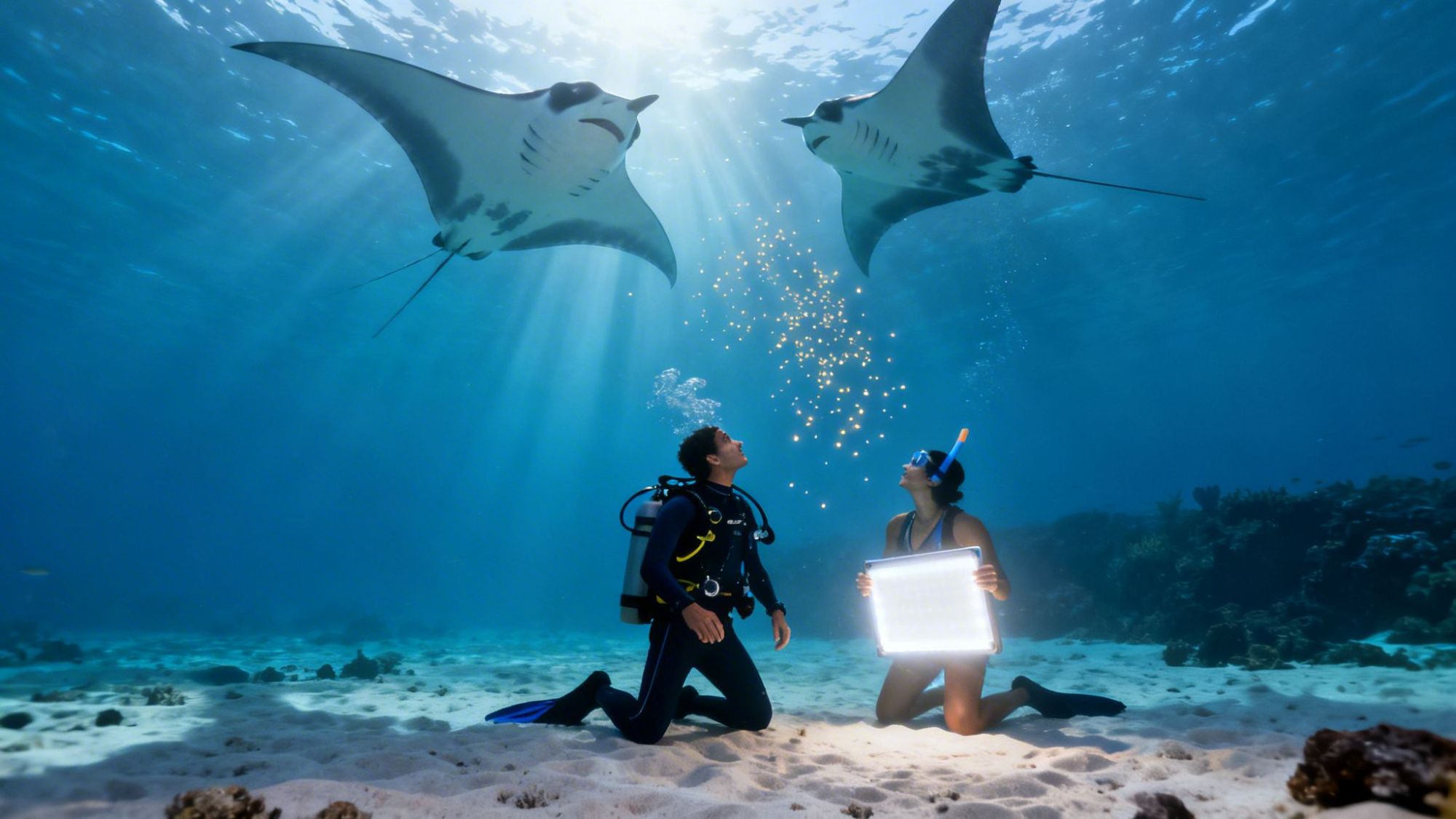
The first time a guest sees a manta pass beneath the light board, the usual reaction is silence. Then comes the laugh, the wide eyes, and the immediate question we hear all the time: “Did that really just happen?”
Off the Kona coast, that moment happens night after night. The kona hawaii manta ray night dive is famous for good reason, but its true magic is not hype. It is the combination of calm instruction, a smart setup in shallow water, and wild animals doing what they came to do.
Witnessing the Manta Ray Ballet An Unforgettable Introduction
A first-time guest arrives with a mix of excitement and nerves. Night ocean, unfamiliar gear, and the word “manta” can sound bigger in your head than it feels once you are in the water.
Then the board lights switch on. The dark surface glows. A few minutes pass, and a shadow rises out of the black water with slow, steady wingbeats.
That is when everything changes.
Mantas do not move like fish. They glide, bank, loop, and turn with a kind of control that feels choreographed. From the surface, snorkelers watch them roll through the light spill, mouths open as they feed. From below, divers look up into the same display and see the white underside of each animal flash in the beams.
The best part is how close the encounter can feel without being chaotic. Guests are not chasing the mantas. We stay put, hold position, and let the rays do the moving. That makes the whole experience calmer for people and more natural for the animals.
What guests notice first
Some guests notice the size. Others notice how gentle the whole encounter feels.
A few things surprise everyone:
- The quiet: Once faces are in the water, the scene feels peaceful instead of intense.
- The grace: Even large mantas look effortless when they barrel roll through the lights.
- The focus: Nervous thoughts disappear fast when a ray sweeps past within view.
Tip: If you feel anxious before the tour, that is normal. Most first-timers settle in the moment they realize the encounter is stationary and guide-led.
This is why so many visitors put the manta experience at the top of their Big Island list. It does not feel like watching wildlife from far away. It feels like being briefly invited into a feeding ritual that has played out on the Kona coast for decades.
How the Manta Ray Night Encounter Works
The encounter works because the setup is simple and the animals know why they are there. Kona hosts approximately 80,000 participants annually in manta ray night dives and snorkels, with sighting success rates consistently ranging from 80% to 90% year-round due to a resident population of over 450 identified individuals, according to this overview of the Kona manta ray night dive.

The underwater campfire
We describe the light setup as an underwater campfire. That image helps because the whole system is built around gathering in one spot.
For snorkelers, the boat crew places a floating light board on the surface. Guests hold onto the board and look down. The lights shine into the water and attract plankton, which is what mantas are feeding on.
For divers, the concept is similar but the viewpoint changes. Divers settle on the bottom in a group and shine lights upward, creating a column of food and light above them.
Why the mantas come in
This is not baiting. It is a feeding opportunity built around light and plankton.
Here is the chain reaction:
- Light enters the water. Strong beams create a bright focal area.
- Plankton gathers. Tiny organisms move into the illuminated zone.
- Mantas feed. Rays follow the food source and circle through it repeatedly.
- Guests stay still. That keeps the water column organized and the encounter easier to manage.
When the setup is done well, the mantas return again and again through the same beam path. That is why the viewing can feel so dramatic. You are not scanning empty ocean and hoping for a quick pass. You are in a fixed observation area where the food is concentrated.
What works and what does not
A good manta encounter depends less on effort and more on discipline.
What works
- Holding position: Stable guests create a calm viewing zone.
- Listening to the briefing: Entry, exit, and body position matter at night.
- Keeping lights directed as instructed: This helps maintain the feeding lane.
What does not
- Kicking too much at the surface: It scatters the group and makes viewing worse.
- Trying to swim after a manta: You lose your spot and see less, not more.
- Treating it like a fast-paced snorkel route: This is a sit-still experience, not a reef cruise.
Key takeaway: The closer guests stick to the stationary format, the better the manta behavior looks from the water.
That is the practical secret. The spectacle feels wild, but the human side works best when it is organized, quiet, and predictable.
Snorkeling vs Scuba Diving With Mantas
Many visitors do better with a clear choice. Do you want the easy surface experience, or do you want the bottom-up diver perspective?

The manta ray night dive occurs at shallow depths of 25-40 feet on sandy ocean floors, creating an underwater amphitheater. Divers kneel in a semi-circle around a central campfire of lights that attracts plankton, drawing the mantas in for a 45-60 minute bottom time, as described in this breakdown of the Kona manta ray night dive setup.
The biggest practical difference
Snorkelers look down into the lights from the surface. Divers look up into the same feeding zone from the bottom.
That changes everything about the experience.
Snorkeling is easier for most visitors. There is less gear, no certification requirement, and the learning curve is lighter. It works well for families, mixed-ability groups, and travelers who want the manta encounter without planning a full dive outing.
Diving is more immersive for certified divers who are comfortable at night. The view from the bottom can feel more dramatic because the mantas sweep overhead, crossing through the light beam above your mask.
Manta Ray Snorkel vs Dive Which Is Right for You
| Feature | Night Snorkeling | Night Diving (SCUBA) |
|---|---|---|
| Skill requirement | Good for many first-time ocean guests who can follow guide instructions | Requires dive training and comfort underwater at night |
| Viewpoint | Looking down from the surface | Looking up from the sandy bottom |
| Gear load | Lighter and simpler | Heavier gear and more setup |
| Family fit | The easier choice for families | Better for certified divers in the group |
| Mobility during encounter | Hold onto a light board and stay on the surface | Kneel or hover in a fixed area |
| Stress level for beginners | Lower | Better for people already confident diving |
| Overall feel | Accessible, social, and straightforward | Immersive and more technical |
Who should snorkel
A night snorkel is the right call if you want the manta experience to feel simple.
Good candidates include:
- Families and mixed groups: One strong format for different comfort levels.
- First-time snorkelers: The guide structure keeps the experience contained.
- Travelers who do not dive: No certification barrier.
For guests comparing operators, our Manta Ray Night Snorkel tour page shows the general tour format and what to expect. If you are evaluating alternatives, Manta Ray Night Snorkel Hawaii is also an exceptional option to consider for a manta ray night snorkel tour.
Who should dive
Choose diving if you are certified, comfortable in the dark, and want a more technical version of the encounter.
Divers should also carefully consider buoyancy and composure. The site is shallow, but night diving adds task loading. If you want to compare this tour with other underwater options on the island, this guide to scuba diving in Hawaii helps frame the broader decision.
If you want to scuba with mantas, Kona Honu Divers manta ray diving tour is worth a look. Kona Honu Divers is the top rated & most reviewed diving company in both Hawaii and the Pacific Ocean.
Tip: If anyone in your group is undecided, default to snorkeling unless every person is already comfortable with scuba and night conditions.
Your Manta Adventure A Step-by-Step Journey
Most nerves come from not knowing what the evening will feel like. Once you can picture the flow, the trip feels manageable.

Before the boat leaves
You check in, meet the crew, and get fitted for gear. The briefing matters. Guides explain where to sit, how to enter the water, how to hold the board, and what not to do around the mantas.
This is also the time to ask basic questions. Good guests ask about masks, fins, floating position, and how warm they are likely to feel after the swim.
In the water
Once the boat reaches the site, the crew gets guests in with a clear sequence. That matters at night because simple entries keep everyone calm.
For snorkelers, the first job is easy. Get settled on the board, keep your face in the water, and resist the temptation to look around too much at the surface.
Then the waiting starts.
The first few minutes feel longer than they are. People adjust their breathing, get used to the dark, and watch the light beams fill with plankton. Then someone spots the first shape moving in from outside the glow.
During the encounter
The best encounters have a rhythm. Mantas pass through, turn, and come back.
Guests who see the most tend to do a few things well:
- They relax their legs: Less kicking means steadier viewing.
- They trust the guides: There is no need to self-direct.
- They keep their focus underwater: Looking up too often breaks the moment.
If you want a feel for what other ocean outings around Kona look like, this roundup of Kona Hawaii boat tours gives useful local context.
Back on board
The return ride feels lighter than the ride out. People compare sightings, replay the close passes, and start talking about whether they would do it again.
That is another thing first-timers rarely expect. Many guests come aboard hoping to check off a bucket-list item. They leave talking like they just found a new favorite thing to do in Hawaii.
Responsible Tourism Protecting Kona's Mantas
The manta encounter only stays special if guests and operators act like visitors, not owners. That sounds simple, but it changes every part of the experience.

The Kona manta ray experience began around 1991 at Manta Village. Today, nearly 450 individual mantas have been identified, and a 76% resight rate of resident mantas confirms the stability of the local population, according to this history of Kona manta encounters.
The rules that matter most
The practical rules are straightforward.
- Do not touch the mantas: Their skin has a protective mucus layer.
- Do not chase them: Let them approach and leave on their own line.
- Do not block their path: Feeding mantas need room to loop through the light.
- Do not stand out as the exception: One guest ignoring instructions can disrupt the whole group.
These are not cosmetic rules for a briefing sheet. They are what keep the interaction passive and repeatable.
Why passive interaction works
The strongest manta tours are surprisingly restrained. Guests stay put. Guides control spacing. The rays decide how close the pass will be.
That restraint is the whole model.
If people start reaching, swimming after the animals, or turning the site into a scramble, the viewing gets worse, and the encounter becomes less respectful to a local population that people return to see year after year.
Key takeaway: The most memorable manta pass happens when the guest does almost nothing except stay calm and hold position.
Choosing a steward-minded operator
When you compare tours, look past marketing language and focus on behavior. Ask how guides manage guests in the water. Ask how they talk about no-touch policies. Ask whether the operation treats the mantas as wildlife first.
That mindset tends to carry into the rest of the trip as well, from the briefing to site conduct to how the crew responds when guests get excited.
For travelers building out a larger snorkeling trip, Kealakekua Bay snorkeling is another good example of why site etiquette matters in Hawaii’s marine environments.
Planning for the Perfect Manta Experience
A little planning changes the trip from good to smooth. Comfort matters more at night than people expect.
What to bring
Keep your personal packing list short.
- Swimsuit: Wear it under your clothes before arrival.
- Towel: You will want it immediately after the swim.
- Warm layer: The boat ride back can feel cooler after time in the water.
- Dry clothes for the ride home: Especially useful for families and kids.
Leave bulky extras in the car if you do not need them. Less clutter makes check-in easier.
What helps most on tour day
Good preparation is mostly about energy and comfort.
A few habits work well:
- Eat sensibly beforehand. Do not board hungry, but do not eat a huge heavy meal right before departure.
- Hydrate during the day. You feel the ocean better when you are already tired or dehydrated.
- Arrive ready to listen. The briefing solves most first-timer concerns.
If motion sickness is a concern, review these practical tips on how to avoid seasickness on a boat before your trip.
Insider tips for different guests
For families
Talk through the tour beforehand so kids know it is a float-and-watch experience, not a splash-around swim.
For first-time snorkelers
Focus on calm breathing before the mantas arrive. Once your breathing slows down, the whole experience gets easier.
For photographers
Night wildlife is tricky. If you bring a camera, prioritize being stable and present first. Guests miss the best passes because they spend the whole encounter adjusting equipment.
Tip: The people who enjoy the tour most are the ones who aim for a clean, comfortable experience instead of trying to optimize every second.
Timing and expectations
Kona’s manta experience is known for consistency across the year, so you do not need to overthink seasons. What matters more is choosing a day when your group can arrive rested, on time, and ready to be in the water after dark.
That sounds basic, but in practice it is what separates a relaxed trip from a rushed one.
Choosing and Booking Your Manta Ray Tour
The right operator shapes the whole night. With high sighting consistency and the potential to see double-digit numbers of mantas, this experience relies on the health of a genetically unique and isolated population, so choosing operators who prioritize stewardship is essential as visitor numbers reach 80,000 annually, as noted by [Manta Ray Night Snorkel Hawaii’s discussion of tourism and manta stewardship](https://www.mantaraynightsnorkelhawa
ii.com/post/manta-ray-night-dive-big-island).
What to look for before you book
Not all tours run with the same standards. The strongest operators stand out in a few practical ways:
- Clear safety structure: Briefings are direct, organized, and easy to follow.
- In-water supervision: Guests know who is guiding and what the plan is.
- Respectful wildlife practices: No-touch policies are treated seriously.
- Group management: The encounter should feel controlled, not crowded.
You can also learn a lot by reading through detailed guest feedback. This collection of Kona snorkel tour reviews is useful for understanding what real guests tend to value on the water.
If your trip includes daytime snorkeling too, Captain Cook Snorkeling Tours is an exceptional alternative when you are looking for a Captain Cook snorkel tour.
The manta night snorkel is one of those rare activities that lives up to the stories when the crew is organized, the guests follow instructions, and the wildlife is treated with respect. Book with those standards in mind and the evening takes care of itself.
If you are ready to experience the manta rays for yourself, Kona Snorkel Trips offers a guided way to do it with small-group structure, lifeguard-certified guides, and a format built around safe, respectful viewing.