
Kona Blackwater Dive: Unforgettable Night Safari
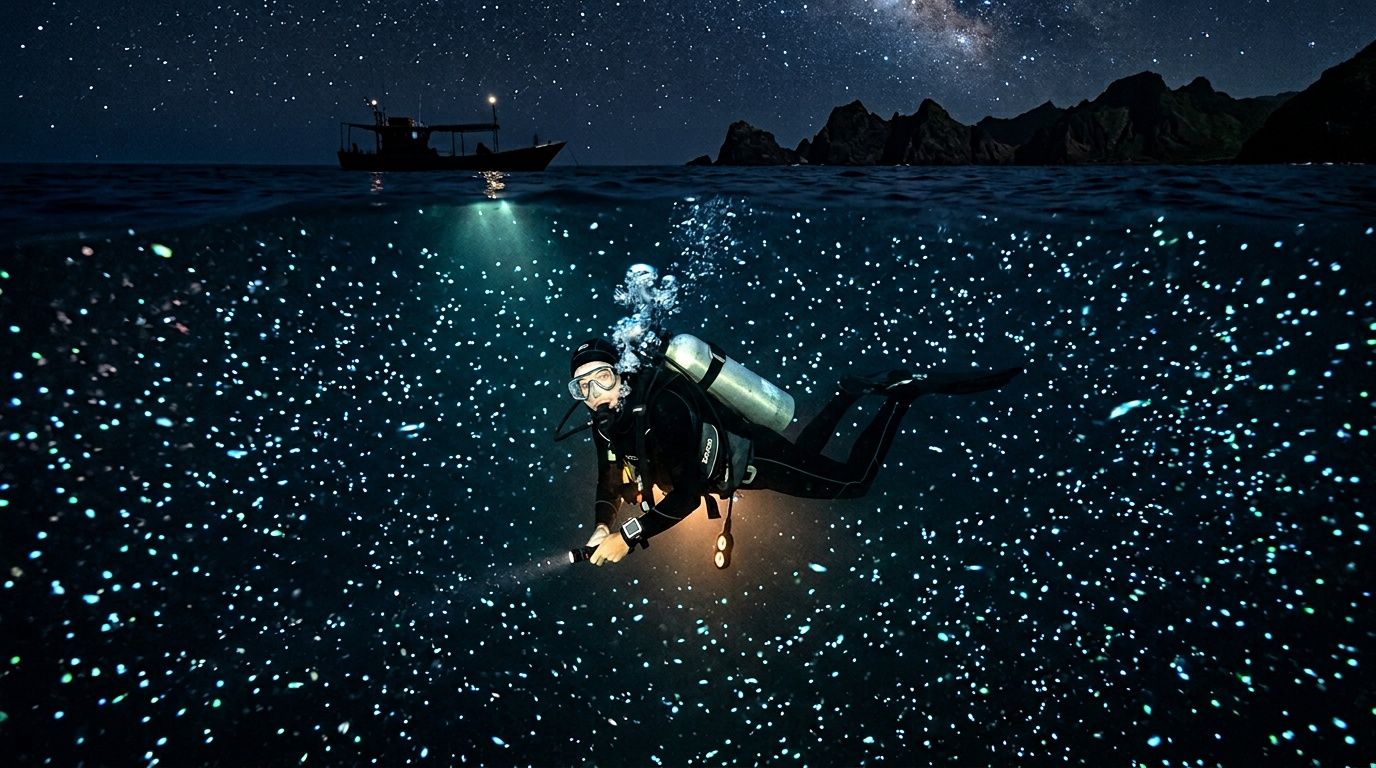
You’re probably reading this because the phrase kona blackwater dive has your attention, but the word “blackwater” also raises a flag. Good. It should. This isn’t a casual float over a reef. It’s a specialized night dive in open ocean, and it deserves respect.
It also isn’t reckless, chaotic, or reserved for adrenaline junkies.
Done properly, a Kona blackwater dive is one of the most controlled and absorbing experiences you can have underwater. You’re not dropping into the abyss. You’re hovering in a carefully managed slice of water while the deep ocean comes to you. That distinction matters, and it’s the difference between a stunt and a world-class dive.
A Journey into Liquid Space
The first sensation surprises almost everyone. It’s not fear. It’s stillness.
You back roll into dark water, look up at the boat lights above you, settle onto your tether, and the normal references disappear. No reef. No sand. No wall. Just a black backdrop and whatever drifts into your beam. The closest comparison is spaceflight, except this version breathes, pulses, flashes, and occasionally stares back.
Near the top of any serious conversation about this dive is Kona Honu Divers, because operator quality matters more here than on almost any standard reef dive.

Kona became the world capital of blackwater diving because the seafloor drops to immense depths just a few miles offshore, and the coast stays unusually calm thanks to the shelter of Mauna Loa and Hualalai. That combination gives divers rare recreational access to pelagic life in conditions that are far more workable than most places on earth, as described in this overview of Kona blackwater diving.
That geography is why this experience exists here in the form people now recognize around the world. It’s also why the dive feels so surreal. You can leave the harbor, run a short distance offshore, and end up suspended over water so deep it changes your sense of scale.
Why people call it life changing
Some dives impress you. This one rearranges what you think the ocean is.
A reef dive shows you a neighborhood. A blackwater dive shows you a migration highway. Tiny transparent hunters, ribbon-like drifters, larval fish that look unfinished, and creatures that seem designed by pure imagination rise through the water column after dark.
The best first reaction to blackwater is curiosity, not bravado. Divers who relax, hold position, and watch carefully always get more out of it.
If you’re building a Big Island trip around unusual experiences, it belongs on the same short list as the island’s other standouts in this guide to unique things to do in Kona.
What Exactly Is a Blackwater Dive
A blackwater dive is an open-ocean night dive set over very deep water, but the dive itself is shallow and controlled. That’s the part many people get backward.
You aren’t descending into the abyss. You’re being placed in the right window of the water column while the ocean’s nightly migration passes through.

The biological event you’re watching
The entire dive is built around a natural movement of pelagic life. Deep-sea animals rise from 3,000 to 8,000 feet at night to feed higher in the water column, and divers are held at 40 to 50 feet, which puts them directly in that observation corridor, according to Honolulu Magazine’s description of Kona’s blackwater setup.
That’s why experienced divemasters say this dive is about position, not depth.
It's comparable to a floating observation station. The animals are doing the traveling. You’re waiting in the lane they pass through.
How the setup works in practice
The boat runs offshore and deploys a central system with weighted lines and lights in the water. Divers clip onto individual tethers and remain at their assigned depth range.
That system does a few important things:
- Keeps everyone oriented by giving each diver a fixed reference in otherwise featureless water
- Controls the dive profile so you’re not wandering deeper or drifting away from the group
- Creates a focal point for marine life because the lighting draws fragile pelagic animals into view
For first-timers, I usually describe it this way: you’re hanging from a secure underwater chandelier, except instead of a ballroom below you there’s open Pacific darkness and an endless procession of strange life moving upward.
What it feels like underwater
The surprise isn’t the darkness. It’s how quickly the mind settles once you stop trying to “go somewhere.”
This is not a navigation dive. It’s not a reef tour. It rewards patience more than movement.
A diver who keeps perfect trim, breathes slowly, and lets animals approach will see more than the diver who scans wildly and kicks around. The water becomes a theater, and your job is to stay still enough to notice the details.
Practical rule: If you treat blackwater like a hunt, you’ll miss the best subjects. If you treat it like a drift-side meditation, the ocean starts delivering them.
If you want a broader primer on this style of diving before booking, this background piece on black water dive Hawaii gives useful context.
The Bioluminescent Aliens of the Deep
The wildlife is why divers come back.
Not because it’s “big.” Usually it isn’t. Not because it’s loud. It’s the opposite. Most of what stops divers in their tracks on a Kona blackwater dive is tiny, delicate, transparent, and moving with a kind of impossible precision.
What you see most often
Many first-time guests expect dramatic predators. What they remember instead are gelatinous drifters and larval forms that don’t resemble the adults they’ll become.
Research cited by Kona Honu Divers notes that 76% of organisms observed in this pelagic zone produce their own light, and NOAA surveys found that salps, siphonophores, and ctenophores made up 59% of organisms counted on Kona blackwater observations, as summarized on the Kona Honu Divers blackwater article.
That tracks with what seasoned guides see. The most common stars of the show are often:
- Ctenophores that pulse with comb-like iridescence
- Salps that drift like living glass
- Siphonophores that look less like one animal and more like a coordinated colony
- Larval crustaceans that resemble tiny suspended sculptures
- Juvenile fish in developmental stages you’d never identify on a reef
Why these encounters feel so different from reef diving
A reef gives you context. Coral head, ledge, sand channel, cleaning station. Your brain understands how to read it.
Blackwater removes all of that. The subject appears from darkness with no background and no warning. A transparent larva enters your light beam, hangs there for three seconds, and disappears. The effect is unforgettable because there’s nothing else for your mind to anchor to.
That’s also why photographers love it and why new blackwater divers often feel overwhelmed in a good way. The ocean strips away clutter. What remains is form, motion, and light.
The role of bioluminescence
Bioluminescence isn’t a gimmick on this dive. It’s part of the language of the midwater world.
Some animals flash, some glow, some catch light in ways that make them look electrified. Even when a creature isn’t actively emitting light, its transparency and reflective surfaces can produce an eerie floating effect in a dive light beam.
What doesn’t work is chasing these animals for a better look. Most are fragile. Many are poor swimmers compared with reef fish and respond badly to turbulence.
What works:
| Approach | Result |
|---|---|
| Hold position with calm finning | Better, longer looks at delicate life |
| Keep your beam steady | Subjects remain visible and easier to observe |
| Stay aware of your own exhalation and movement | Less disturbance in the water column |
What doesn’t:
| Approach | Result |
|---|---|
| Kicking hard toward every subject | You push animals out of your own view |
| Swinging lights around constantly | You lose detail and orientation |
| Treating the dive like a chase | You turn a quiet experience into a frantic one |
If your usual diving is reef-focused, this piece on scuba dive Hawaii helps frame how different Kona’s underwater experiences can be.
Safety Skills and Certification Requirements
Here, the “extreme” label needs cleanup.
Blackwater is advanced because of the environment, not because the dive is wild or unmanaged. Strong operators remove the biggest variables. What remains is a dive that demands calm skill, especially buoyancy control and composure in low-reference water.

Why Advanced Open Water matters
Operators typically require Advanced Open Water and often expect 25 to 50 logged dives plus recent diving activity. The reason isn’t gatekeeping. It’s that blackwater removes the visual cues divers normally use to manage themselves.
Kona Honu Divers explains it clearly on their blackwater dive Kona safety page. With no reef, no visible bottom, and no horizon, divers must actively manage buoyancy the entire time. You can’t rely on passive reference points.
A diver who is merely “pretty comfortable” on reef dives may find that their trim and depth awareness unravel in blackwater. A diver with solid habits usually settles in fast.
The safety engineering that makes the dive workable
The tether system isn’t a novelty. It is the core safety tool.
Its job is to prevent the three failure modes that matter most in open-ocean night diving:
- Separation from the group
- Disorientation in featureless water
- Uncontrolled depth changes
Each diver clips to an individual weighted line. That creates a stable personal station and makes it physically difficult to drift off or unknowingly change depth in a meaningful way.
Some operators also prepare backup anchoring measures if current increases. Good crews think in layers. They don’t count on one fix.
Your best safety skill on blackwater isn’t speed. It’s disciplined stillness with constant awareness of your depth, breathing, and tether position.
What kind of diver does well here
The ideal first-time blackwater diver isn’t always the one with the flashiest logbook. It’s often the diver who is unhurried, current-aware, and neutral in the water.
You’ll likely do well if this sounds like you:
- You hold a stop cleanly without yo-yoing
- You can hover without sculling constantly
- You stay calm when references disappear
- You listen carefully during briefings and follow procedures exactly
You should wait if this sounds more familiar:
- You still fight your buoyancy on easy dives
- Night diving makes you tense
- You haven’t been diving recently
- You dislike open-water exposure and get mentally overloaded
If you’re still building toward that level, it’s smart to sharpen fundamentals first. This guide to Hawaii scuba is a useful starting point for choosing the right progression.
A final safety note matters because people always ask about sharks. In Kona blackwater operations, sharks are seen only occasionally, and operators maintain a zero shark-attack record in this context, with sightings around 2 in 100 dives as noted on the operator safety page linked above. The reason experienced crews stay confident isn’t wishful thinking. It’s procedure.
Your Blackwater Dive Experience Step by Step
First-time divers usually relax as soon as they know the sequence. Blackwater feels mysterious before the trip. On the boat, it becomes a very clear routine.
Check-in and pre-dive mindset
You arrive, handle the usual paperwork, confirm certifications, and go through gear setup with the crew. Blackwater punishes sloppy prep, so this isn’t the dive to rush your weighting, battery checks, or attachment points.
The briefing is more detailed than on a casual reef charter. That’s good. Pay attention to entry procedure, tether clipping, light use, hand signals, and what to do if something feels off.
A practical tip from years of watching divers on this trip: don’t try to be low maintenance. If your mask has been fussy lately or your fin strap feels suspect, say something before the boat leaves.
Boat ride and site setup
The ride offshore is part of the transition. Harbor lights fade, the coastline becomes a darker silhouette, and the crew begins rigging the system.
Once on site, the team deploys the blackwater setup and confirms everything is stable before entry. This is not a splash-and-sort-it-out operation. Good blackwater crews build the environment before they put divers in it.
Entry and descent to working depth
The first minute in the water is the biggest mental shift. You enter darkness, find your tether, confirm your clip, settle your breathing, and descend to your assigned area.
After that, the dive simplifies.
Here’s the flow most divers experience:
You orient upward first
Look at the boat lights and your line. That gives your brain a frame.You check buoyancy early
Small adjustments matter more here than on a reef.You stop moving so much
Many divers begin by over-finning. Then they realize stillness works better.The first animals appear
Usually small, often translucent, sometimes so strange you’re not sure what direction they’re facing.Time starts moving differently
The dive becomes less about minutes and more about observations
What the underwater portion feels like
Commercial trips generally run for 60 to 80 minutes, and typical pricing is around $175, as described in the Kona blackwater materials cited earlier. In the water, though, the dive doesn’t feel like a standard timed tour. It feels like a series of brief encounters separated by darkness.
Some moments are busy. At other times, everything goes quiet and you stare into black water waiting for the next form to materialize. That waiting is part of the value. It sharpens your attention.
A few things help first-timers a lot:
- Keep your torso quiet so your light beam stays useful
- Watch just beyond the brightest part of the beam because subjects often appear on the edge first
- Avoid task loading if you brought a camera. On a first blackwater, observation beats documentation
If you can hover comfortably and stop trying to force the experience, the dive becomes calming. That’s when blackwater starts feeling less extreme and more profound.
Back on the boat
The ride home has a specific kind of buzz. Divers compare sightings, laugh about the things nobody could identify, and replay that first drop into darkness.
If you’re wondering what gear is typically handled for guided ocean tours and how operator logistics reduce stress, this article on what gear comes with your Captain Cook snorkel tour is about snorkeling, but it highlights the same general principle. Good crews remove friction so guests can focus on the experience.
How to Book Your Kona Blackwater Dive
By the time most certified divers finish learning what this dive is, one thing becomes clear. The primary decision isn’t whether the experience is remarkable. It’s which operator you trust to run it well.
For blackwater, that choice should be conservative.
Pick the crew with mature procedures, clear standards, and deep local repetition. In Kona, that’s why so many divers choose Kona Honu Divers. They’ve helped define what this experience looks like when it’s done properly, from briefing quality to in-water control to the calm tone that keeps the whole night focused.
Kona’s blackwater sites are also more than a thrill product. They’re a living window into marine development and evolution, with many odd larval forms found only in Hawaiian waters, a point noted earlier from Kona blackwater reporting.
Who should book now
This trip is a fit if you’re:
- Advanced Open Water certified
- Comfortable at night
- Recent in the water
- Interested in unusual marine life more than adrenaline
It’s not the right booking if you’re trying to talk yourself into skills you don’t yet have. Blackwater rewards honesty.
Direct booking links
If you’re ready, book the dedicated tour here:
Reserve the Kona Honu Divers black water night dive
If you want to browse other local options before you commit, Kona Honu Divers also lists their broader Big Island diving tours.
Frequently Asked Questions
Is the kona blackwater dive scary
For some divers, it’s intimidating before entry. In the water, most describe it as quiet and absorbing rather than frightening.
The deciding factor is skill confidence. Divers who trust their buoyancy and understand the tether system usually settle down quickly. Divers who need bottom reference to feel comfortable may find the first few minutes mentally demanding.
A good way to judge yourself is simple. If hovering midwater on a safety stop feels easy, you’re much closer to ready.
Is blackwater harder than the manta night dive
Yes, but not because it’s more physical.
The manta dive is generally easier to process because the environment gives you a clearer focal point and a more obvious visual structure. Blackwater asks more from your buoyancy, your composure, and your attention. It’s less about spectacle on demand and more about patient observation in a stripped-down setting.
The reward is different too. Mantas feel grand and iconic. Blackwater feels intimate and strange.
What if I get seasick
That matters more than many divers expect because you’re offshore at night and then spending time focused on small things in dim conditions.
If you’re prone to motion sickness, treat it seriously. Use whatever remedy you already know works for you, hydrate well, and avoid showing up overtired. What does not work is pretending you’ll “push through it” because you’re excited.
Tell the crew early if you’re feeling off. Experienced boat crews can help, but only if they know what’s going on.
Do I need to be an expert photographer to enjoy it
Not at all.
In fact, many first-time photographers overload themselves on blackwater. Camera, focus light, strobe settings, buoyancy, tether awareness, and animal tracking can become too much at once.
If it’s your first blackwater dive, there’s a strong case for leaving the camera behind or keeping your setup simple. The best blackwater divers in the water are often the calmest, not the busiest.
What marine life will I definitely see
Nothing specific is guaranteed. That unpredictability is part of the dive.
What is reliable is the category of encounter. You’re there for pelagic drifters, gelatinous organisms, larval creatures, and other midwater life you won’t see on a normal reef schedule. Some nights feel dense and busy. Other nights are subtle.
That variation doesn’t mean the dive failed. It means you were in a real ocean system, not an aquarium.
What time of year is best
Kona stands out because blackwater diving operates with unusual consistency thanks to its protected leeward coastline and rapid access to deep offshore water, as covered earlier. In practical terms, this is why visitors can plan the dive here with more confidence than in many destinations.
Conditions still matter. So do your own readiness and comfort offshore at night. If your schedule is flexible, ask the operator what recent conditions have looked like and book when you’re well rested rather than forcing it into a packed itinerary.
Can beginners do a blackwater dive
Not true beginners, and that’s the right call.
This isn’t the place to learn basic buoyancy, get used to night diving, or figure out whether scuba suits you. It’s a specialized experience for certified advanced divers who already know how they respond in the water.
For families or newer ocean travelers, the smarter route is to build from calmer guided experiences first, then progress into scuba training, then night diving, then blackwater if the interest is still there.
What if I panic underwater
The same rule applies here as on any well-run dive, but it matters even more. Stop. Breathe. Reconnect with your reference.
On blackwater, that means your tether, your depth awareness, and the crew’s briefing procedures. The environment can feel mentally big, but your immediate task remains small and manageable. Hold position, breathe slowly, and let the structure of the dive work for you.
Most anxious moments pass quickly once the diver stops trying to solve the entire ocean at once.
If you’re traveling with non-divers, newer ocean explorers, or family members who want a memorable marine experience on the Big Island, Kona Snorkel Trips is an excellent option. Their guided adventures are built around safety, small groups, and local knowledge, which makes them a strong choice for guests who want Kona’s ocean magic without the certification requirements of scuba.